The sound of armored bodies colliding was not a single crash but a long, rolling thunder. By the time the dust had settled over the field, the battle was no longer a contest of formations but a grinding, desperate scrum of men in steel, fighting for their lives in a space far too small for the number of bodies pushing and falling within it. This was the reality of late medieval combat, a world far removed from the romantic duels of legend. The men who fought in this world were not the gleaming knights of popular imagination.
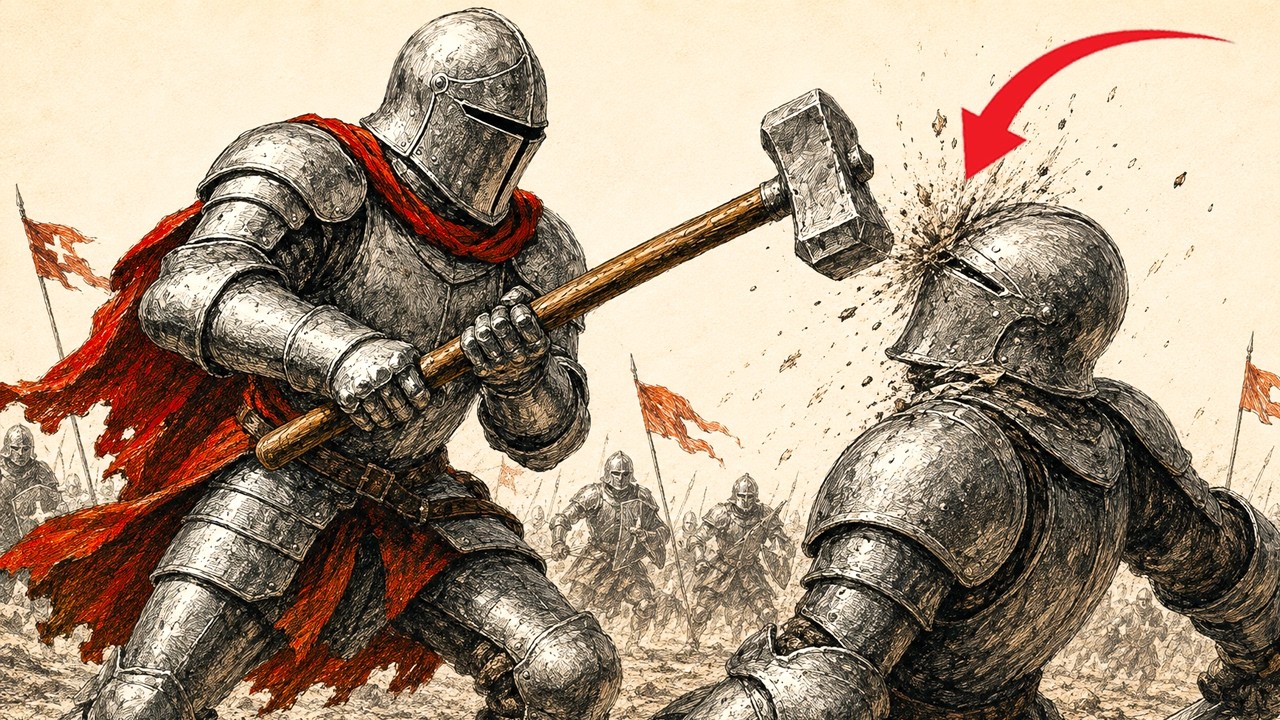
They were professionals, often nobles by birth but hardened by experience, who understood a brutal truth that the stories left out. A sword, that most noble and blessed of weapons, was nearly useless against a man encased in a full suit of plate armor. The curved, hardened steel of a breastplate or helmet was designed to deflect a blade’s edge, and the physics of a sword striking such a surface achieved little more than a scratch. The sword remained a symbol of status, a weapon for court and ceremony, but on the battlefield, it was a sidearm, effective only in the final desperate moments of a fight.
The men who survived understood that armor had defeated the sword, and so the weapons of war had evolved to meet the challenge. The battlefield was dominated not by elegant blades but by brutal, effective tools. The poleaxe, a five-foot haft of ash topped with an axe blade, a hammer face, and a spear point, was the most feared close-quarters weapon of the era. Alongside it were the war hammer and the bec de corbin, heavy, blunt instruments designed not to cut through steel but to transmit shock through it.
A powerful blow from a war hammer to a helmet did not need to break the metal; it only needed to move it, and the skull inside would move with it, causing concussion and disorientation. These were the weapons that won fights, and their ugliness was a testament to their purpose. A veteran of half a dozen campaigns knew that the fight against an armored opponent was not a matter of elegant parries and thrusts. It was about closing the distance, grappling, and finding the gaps.
It was about using a heavy implement to strike a joint, like the knee, where the armor had to be thinner to allow movement, and the shock of the blow would travel directly to the bone. A man unbalanced was a man defeated, for he could no longer generate power or control the distance. Once an opponent was reeling, the fight moved to the ground, where the victor would pin the fallen knight beneath him. With his enemy helpless, he would draw a rondel dagger, a stiff, narrow blade designed for one purpose only: to find the gaps in the armor—the visor slit, the armpit, the groin.
This was how armored men were killed, not by a cinematic thrust through the heart, but by a precise, brutal insertion of a blade into an eye slit or the exposed flesh beneath the helmet while the victim lay pinned and helpless in the dirt. The battle itself followed a predictable, savage trajectory. The initial cavalry charge was a single, shattering moment of impact, as lances of elm, each designed to be used once and then shatter, conveyed the full momentum of horse and rider into the enemy line. The primary target of any competent infantryman was not the armored man but the horse beneath him.
A dead or wounded horse would fall, trapping its rider underneath it. In an instant, an invincible knight became a man in an expensive metal coffin, struggling to find his bearings from his back. After the initial clash, the battle devolved into the press—a heaving, confused mass of men where visibility was reduced to a few feet by the thick, choking dust. Formations dissolved, banners disappeared, and friends and foes became indistinguishable.
In this environment, men often died from suffocation, crushed beneath the weight of their fallen, armored comrades, rather than from a deliberate wound. The sheer physical exertion of fighting in 60 pounds of plate armor was itself a killer. A knight could fight at full strength for only two or three minutes before exhaustion set in, turning him into an easy target. The real battle was a slow, grinding affair punctuated by moments of intense violence when a man managed to throw another to the ground.
The victor was rarely the better swordsman; he was the man who could wrestle his opponent into the dust and finish him there. The aftermath of the battle was a cold, economic reckoning that completely shattered any illusion of chivalry. The first men onto the field were not medics or priests but looters, stripping the dead of their valuable armor and weapons. A knight in full plate was worth a fortune even in death, and a wounded man who could not prove his worth as a prisoner was more valuable dead than alive.
He would be dispatched with a dagger by whoever found him. This was not personal; it was simple economics. For the survivors who were captured, a different drama unfolded. Ransom was the true economic engine of medieval warfare.
A captured nobleman was not a prisoner in the modern sense but a valuable asset. He was treated well, fed, and allowed to move freely while messengers rode to his family with the bill. These ransoms could be astronomical, bankrupting entire families for years. The most famous was that of King John II of France after the Battle of Poitiers in 1356, a sum equivalent to roughly double France’s annual royal revenue.
The logic applied at every level. For a professional like Robert, a single good day on the battlefield, capturing two men, could secure his income for over a year. This was why a weapon like the war hammer was so crucial; it could incapacitate an opponent without killing him, giving the victor the choice of whether a man was worth more alive or dead. The history that was written down was a lie, or at best, a highly sanitized version of events.
The chroniclers who recorded these battles were almost all clergymen or heralds, none of whom had ever fought. They had every reason to frame the story in terms of honor and noble deeds. The result was a two-tiered reality. In the practical records—the fighting manuals, the ransom ledgers, the letters home—the truth of the field was visible.
But in the chronicles that shaped Europe’s view of these wars for the next 500 years, a different story emerged, one of shiny swords and elegant duels. This was the version that reached the paintings, the novels, and eventually the movies. The men who actually fought knew the truth, but they did not write it down. By the time any of them wrote their memoirs, the myth had already taken root.
The image of the medieval knight that persists today is largely a 19th-century invention, created by romantic writers and artists who had never seen a real suit of armor or a real battle. The real knight was a professional worker in violence, wearing expensive, high-tech machinery. He carried a sword for status and a war hammer for work. He fought on foot as much as on horseback.
He killed with a nine-inch blade through a two-inch gap in another man’s helmet, kneeling on his chest in the dust. The medieval fighting manuals, which modern scholars have been studying intensely, reveal that about half of their content is devoted to wrestling, dagger fighting, and defeating a fully armored opponent by throwing him to the ground. The masters who trained knights spent as much time teaching them to grapple in steel as they did teaching them to wield a sword. The ugly weapons were effective, and the beautiful ones were not.
On a medieval battlefield, when your life depended on what was in your hand, you did not want a symbol; you wanted a tool that worked. Every professional warrior of the 15th century knew this in his bones, even as the culture around him insisted otherwise. The sword survived in the paintings because the paintings were made by people who had never been in a fight. The hammer survived on the ground, in the training manuals, in the ransom records, and in the silent knowledge of the men who had used it.
That is the true history of how knights actually fought.