For forty-six years, the family of a teenage girl murdered in Texas waited for justice. On Valentine’s Day 1974, seventeen-year-old Carla Walker returned from a school dance with her boyfriend. She was four-foot-eleven, weighed one hundred pounds, and was a cheerleader and tennis player from south Fort Worth. The parking lot behind the bowling alley was dark.
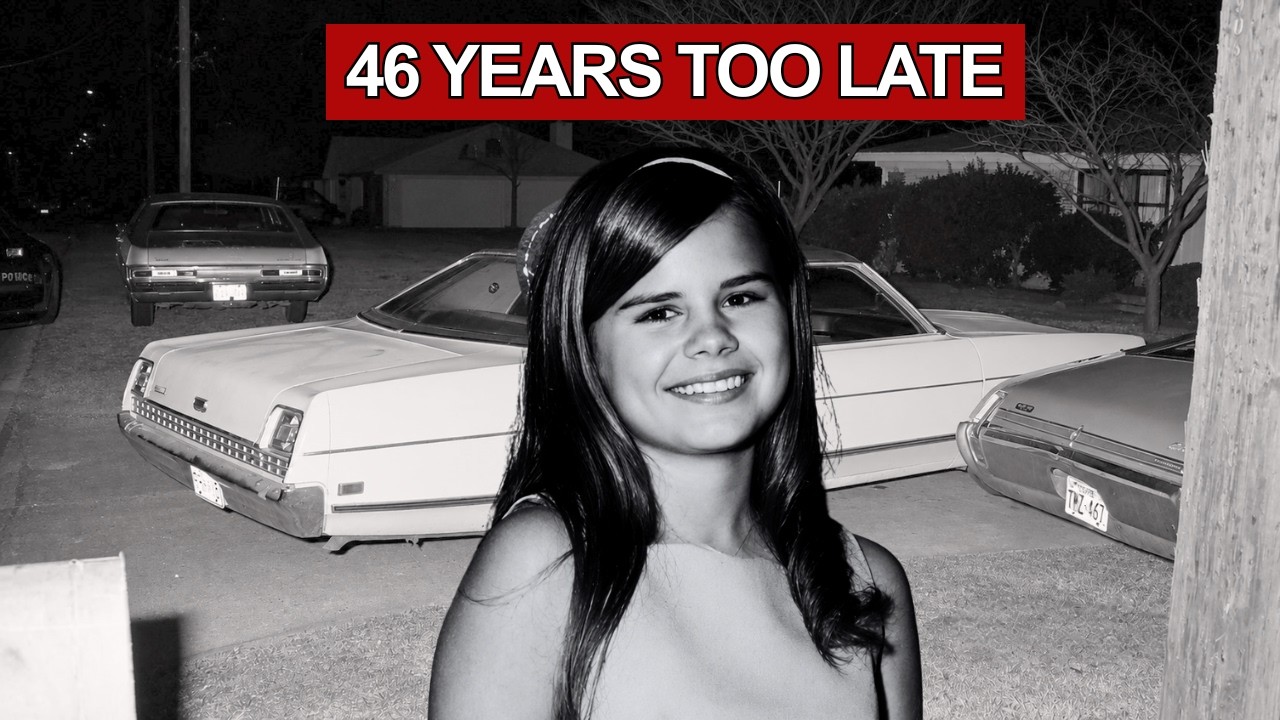
The car was quiet. Then a man wrenched open the passenger door and spoke four words Carla Walker would never live to forget. “You’re coming with me, aren’t you, sweetheart? ” Her boyfriend was beaten unconscious before he could do anything.
Her last words, spoken as he struggled to stay awake with blood filling his eyes, were: “Rodney, go get my dad. ” She believed her father could still reach her. Rodney never found her in time. The man who took her lived one mile away, passed a lie detector test, and remained free for forty-six years.
He kept the murder weapon hidden inside his home the entire time. This is the story of Carla Walker. Fort Worth in February 1974 felt less like one big city and more like a collection of connected neighborhoods. Working-class families in the south, tree-lined streets, Friday night football games.
It was the kind of place where teenagers knew each other’s names and parents recognized each other’s faces. Carla Jean Walker grew up in the heart of all that. A junior at Western Hills High School, she was small but full of spirit. Her sister Cindy later described her as vivacious, the type of person who brought energy to a room without trying.
She cheered. She played tennis. Her parents, Lobby and his wife, had built a life in the south side centered around their children. On the evening of February 16, 1974, a Thursday that coincided with Valentine’s Day, Carla went to a dance at Western Hills High School with her boyfriend, Rodney McCoy.
Afterward, Rodney drove to the Brunswick Ridglea Bowling Alley on South Holland Street. They needed to use the restrooms. He parked behind the building. Carla leaned back against the passenger door.
It was just past midnight in a dark lot, in the middle of what should have been a perfect Valentine’s night. Suddenly, the passenger door flew open. It had been pulled with force from the outside. Carla was knocked partway out of the car.
A white man stood outside, about five-foot-ten, someone neither of them had ever seen before. He held a gun. He brought the butt of the pistol down hard on Rodney McCoy’s head. Once, and possibly more.
McCoy later testified, “There was a very loud ringing. I was stunned. I couldn’t move. ” He heard Carla scream at the man to stop hitting him.
Even in that moment, with her boyfriend being beaten and an armed stranger present, her instinct was to protect Rodney. The man looked at her and said, “You’re coming with me, aren’t you, sweetheart? ” In the final seconds before McCoy lost consciousness, Carla Walker spoke the last words he would ever hear from her. “Rodney, go get my dad.
” She believed her father could still reach her. Then McCoy blacked out. When he came to, the lot was empty. Carla was gone.
The man was gone. On the ground nearby lay the magazine from a Ruger . 22 pistol. It had separated from the grip during the attack.
Carla’s purse was there. Nothing else. McCoy drove to the Walker home. It was around one in the morning.
Lobby Walker opened the door to find his daughter’s boyfriend on the doorstep, blood streaming down his face. McCoy looked at him and said, “Mr. Walker, they took her. They’re going to hurt her badly.
”
Three days later, on February 20, 1974, her body was discovered in a drainage ditch near Lake Benbrook, about thirty minutes south of Fort Worth. She had been beaten. She had been sexually assaulted. She had been tortured.
The autopsy documented wounds on her thighs and legs. She had been strangled. The instrument used was her own bra. Forensic examination indicated she had survived for roughly two days after being abducted from that parking lot.
Two days. Forty-eight hours between the moment McCoy lost consciousness and the moment she died. What happened to Carla Walker in those hours was known fully only to one person. He spent forty-six years making sure no one else knew it.
Fort Worth investigators worked the case hard from the start. The gun magazine was their most promising lead. It was matched to a specific type of weapon, a Ruger . 22 pistol.
Detectives matched regional gun purchase records and almost immediately came up with a name: Glen Samuel McCurley. He lived about a mile from the Brunswick Ridglea Bowling Alley. He had recently purchased a Ruger . 22, the same model as the magazine now in evidence.
He was interviewed. He told police the gun had been stolen from his truck. He agreed to take a lie detector test. He passed it.
By the criminal and procedural standards of 1974, passing a polygraph was enough to remove a person from the suspect list. McCurley left that interview and returned to his life in the south side of Fort Worth. The investigation moved on. Detectives pursued other angles.
In 1976, a bowling alley employee picked a different man, a convicted criminal named Will Hoy, out of a lineup, placing him at the bowling alley the night of Carla’s abduction. Investigators went to Huntsville prison for a polygraph. Hoy failed it. In the conversation that followed, he hinted he failed because the questions reminded him of another crime, an attack on a Texas Christian University student, that he felt he could not be prosecuted for.
That lead went nowhere in Carla’s case. But it produced one of the darkest sidelines of the case. A man named Kenneth Leslie Miller had been falsely convicted in the university student attack, had fled before sentencing, and had disappeared. One case tangled inside another.
Neither was clear. Neither was solved. Other leads surfaced over the years. False confessions, tips from psychics, anonymous letters.
Every thread was pulled. Every thread snapped. The Fort Worth Police Department never closed Carla Walker’s case. Detectives rotated through it over the decades, each inheriting a file that outlived the investigators who came before.
The Brunswick Ridglea Bowling Alley became a skating rink, then a wedding venue, then a mortgage company. The city moved on. The case did not. Lobby Walker spent the rest of his life without an answer.
The father who opened his door at one in the morning and absorbed what Rodney McCoy told him, who spent the following days, weeks, months, and years waiting to learn the perpetrator’s name, never got it. He died not knowing. Carla’s mother died not knowing either. Her parents went to their graves without knowing who took their daughter from that lot.
Carla’s sister Cindy kept pushing. Her brother Jim kept pushing too. They contacted law enforcement. They made sure Carla’s name stayed present in conversations where her memory could have faded.
Jim Walker would say years later, “I have never met a Fort Worth police officer who worked on my sister’s case who did not want to solve it. ” It was not false comfort. It was the truth of what a cold case looks like from a family’s perspective. Not indifference, not neglect, but a system doing what it could with what it had, with technology that had not yet caught up.
Biological evidence was preserved. Clothing, the bra, samples from the original examination. Standard DNA testing was attempted when the technology became available in the early 2000s. Results came back degraded.
There was not enough readable genetic material to produce a usable profile. In April 2020, Carla Walker’s case was featured in an episode of the Oxygen network series “The Genetic Detective with Paul Holes. ” Holes was one of the investigators who had worked the Golden State Killer case, which had proven two years earlier what investigative genetic genealogy could do for cold cases that traditional DNA tests could not solve. The production team agreed to fund DNA testing on the preserved evidence from Carla’s 1974 case.
The cost was fifteen thousand dollars. The evidence was sent to Othram, a forensic genomics laboratory in The Woodlands, Texas, specializing in limited and degraded DNA samples. Standard tests failed because the genetic material was too damaged for traditional methods. Different sequencing techniques had been built specifically for this problem.
Their team managed to extract a comprehensive DNA profile from material that had been in storage since 1974. Then they used forensic genetic genealogy, the same methodology that identified Joseph James DeAngelo as the Golden State Killer, to trace the genetic markers through public databases. The results pointed to a family in the Fort Worth area. Three brothers stood out as possible matches.
Further analysis narrowed the possibilities to one person. On the morning of July 4, 2020, Independence Day, detective Jeff Bennett was at home when his phone rang. The caller was David Mittelman, CEO of Othram. Bennett would later describe the call.
They told him they had developed a full profile, genetically, and that they had a family name. Mittelman told him the name was McCurley. Bennett said it was one of the most overwhelming moments he had experienced during forty-six years of waiting to hear exactly that. McCurley was seventy-seven years old, retired, living in the south side of Fort Worth.
The same city, the same side of town, the same community from which he had abducted a seventeen-year-old girl from a Valentine’s Day parking lot. Investigators did not approach him directly. On July 7, 2020, they quietly collected items he discarded in a trash container outside his home. Those items were sent for analysis.
The DNA matched the profile extracted from Carla’s clothing. A cheek swab was then taken directly from McCurley. That matched too. On September 21, 2020, forty-six years and seven months after Carla Walker was abducted from that lot, Glen Samuel McCurley was arrested and charged with murder.
He initially denied ever seeing her. He maintained his innocence. Not for long. When investigators searched Glen McCurley’s home, they found something that demanded a moment of deep reflection.
In 1974, McCurley had told police that his Ruger . 22, the weapon whose magazine had fallen in the bowling alley parking lot the night of Carla’s abduction, had been stolen from his truck. That was his explanation. That, along with the earlier polygraph, was why police moved on.
The gun was found inside McCurley’s home. He had kept it. For forty-six years, the weapon he used to strike Rodney McCoy and abduct Carla Walker remained inside his house. He had lived his lie for nearly half a century, and the evidence that could have exposed it was within his reach the entire time.
Glen Samuel McCurley’s trial for murder began on August 19, 2021, in Tarrant County district court before Judge Elizabeth Beach. McCurley was seventy-eight. Rodney McCoy, now sixty-five, took the witness stand on the first day of trial. He told the jury what he had lived with since 1974.
He described the moment the door opened, the gun striking his head, the blood covering his eyes. He said he remembered trying to get up, trying to fight off unconsciousness, trying to do something, but he could not. He told the court he felt he had failed Carla’s father by not protecting her. The recorded interview of McCurley with investigators was played for the jury.
In it, detectives asked him directly, “How did you kill her? ” The jury heard his answer. On the third day of trial, August 24, 2021, Judge Beach told the courtroom she had received a document in which McCurley confessed to the abduction and murder. She asked whether he understood his right to continue the trial before a jury and that by signing the agreement he was waiving that right.
McCurley changed his plea to guilty. He was immediately sentenced to life in prison. He had maintained his innocence for forty-six years. It took three days in a courtroom with the evidence, the DNA, the weapon, and Rodney McCoy on the stand to stop.
After sentencing, Carla’s family gave victim impact statements. Her brother Jim spoke first. He said he had found something he did not expect to find at this point in his life. Forgiveness.
Not for McCurley, but for himself. He said it was time to heal. “Funny to say after almost fifty years, right? We witnessed a lot of emotion in that courtroom, and now it’s time to move forward.
” Then Carla’s sister, Cindy Stone, stood. She looked at McCurley, the man who had shared the same city, who had lived a mile from where he abducted her sister, who passed a lie detector test and lived free for forty-six years. She said what she had been waiting to say. “I spent seventeen years in the same room with my sister.
I knew her well. She was four-foot-eleven and weighed one hundred pounds. You had choices. A lot of choices that night.
You went out to kill somebody. You had your gun. You had your whiskey. And you still won’t tell the truth about everything you did.
I want to know if you did this to anyone else. You need to say because those families need to know too. You have nothing to lose now. ” Cindy Stone spent seventeen years sleeping in the same room as her little sister.
Seventeen years of ordinary mornings, ordinary nights, ordinary arguments about nothing, which after everything now seemed like the most precious thing imaginable. Then on a Valentine’s Day, a man with a gun and a bottle of whiskey drove to a parking lot. Carla was there, and he made his choice. Her parents never knew his name.
They died holding a question that Cindy and Jim lived long enough to hear answered. Glen McCurley did not escape detection for forty-six years because he was clever. He did not construct a genius alibi or carefully dispose of evidence. He got away with it because of a series of gaps, each explainable on its own, but together forming a wall that took five decades to break through.
He passed a lie detector test in 1974, a test now known to have serious reliability problems and inadmissible in most modern courts. That result was enough by the investigative standards of the time to shift attention elsewhere. He kept the murder weapon in his home, not because he was careless, but because after the polygraph cleared him, no one came looking. He lived a mile from the bowling alley in the same city, the same side of town, for nearly five decades.
People walked past him. Detectives were close. He was there the whole time. The biological evidence on Carla’s clothing was real and intact.
It was preserved carefully, but the DNA technology available in the 1990s and early 2000s could not extract a usable profile from degraded material. The science that would have caught McCurley in 2005, had it existed in its current form, simply did not exist. He did nothing to destroy the evidence. The evidence just could not reach him yet.
Then a television production company paid fifteen thousand dollars to a private Texas laboratory, and that gap was closed. McCurley was arrested at seventy-seven. He pleaded guilty at seventy-eight. He died in prison in 2023 at the age of eighty.
He served less than two years of a life sentence. He lived forty-six years of an ordinary life that Carla Walker, four-foot-eleven and one hundred pounds, never got the chance to live on a Valentine’s night at seventeen. The Tarrant County prosecutor in the case said she could not rule out McCurley’s responsibility for other crimes. There are boxes of unsolved murder cases from the 1970s in Fort Worth that have never been DNA tested because funding is unavailable.
She said if he committed other crimes, or if some of those cases are connected, obtaining the money to test them might reveal the truth. That question was never answered. It may never be. Cindy Stone and Jim Walker committed to using Carla’s case to help other families fund DNA testing for old cases.
Jim put it simply: “Our hope is that this case helps spur more testing, especially this new DNA testing. Maybe we can solve some old cases and give some other families a sense of closure. ”
In the end, the case that began with a fifteen-thousand-dollar investment from a television network, less than the cost of a used car, became one of the first murder trials in American history to use investigative genetic genealogy. The science exists.
The funding is often missing. That gap is one of the most solvable problems standing between the families of cold cases and the answers they deserve. The parking lot at 3900 South Holland is no longer a bowling alley. The building that stood there on Valentine’s night 1974 became other things.
A skating rink, a wedding venue, a mortgage office. The city moved around it as cities always do. But the question Rodney McCoy carried from that night, when he woke up alone in his car and the lot was empty, found its answer. It took five decades.
A television network, a private laboratory, a phone call on a holiday morning, and an investigator who refused to close the file. Carla Walker was four-foot-eleven. She weighed one hundred pounds. She went to a Valentine’s dance with a boy she liked and asked him to stop hitting her boyfriend before she asked for anything for herself.
Her last words were for her father. She was seventeen years old.