By the time the Allies reached the German countryside in 1945, the wife of the Reichsmarschall had been reduced to a two-room cottage with no running water and no electricity. Emmy Göring, once the most visible woman in the Third Reich, the hostess of state dinners who had traded her stage career for ten years as the regime’s unofficial first lady, owned exactly two dresses. Three authorities had made predictions about her fate. Allied prosecutors at Nuremberg expected a full account, a public reckoning from the woman who had stood at the center of the regime’s social world.
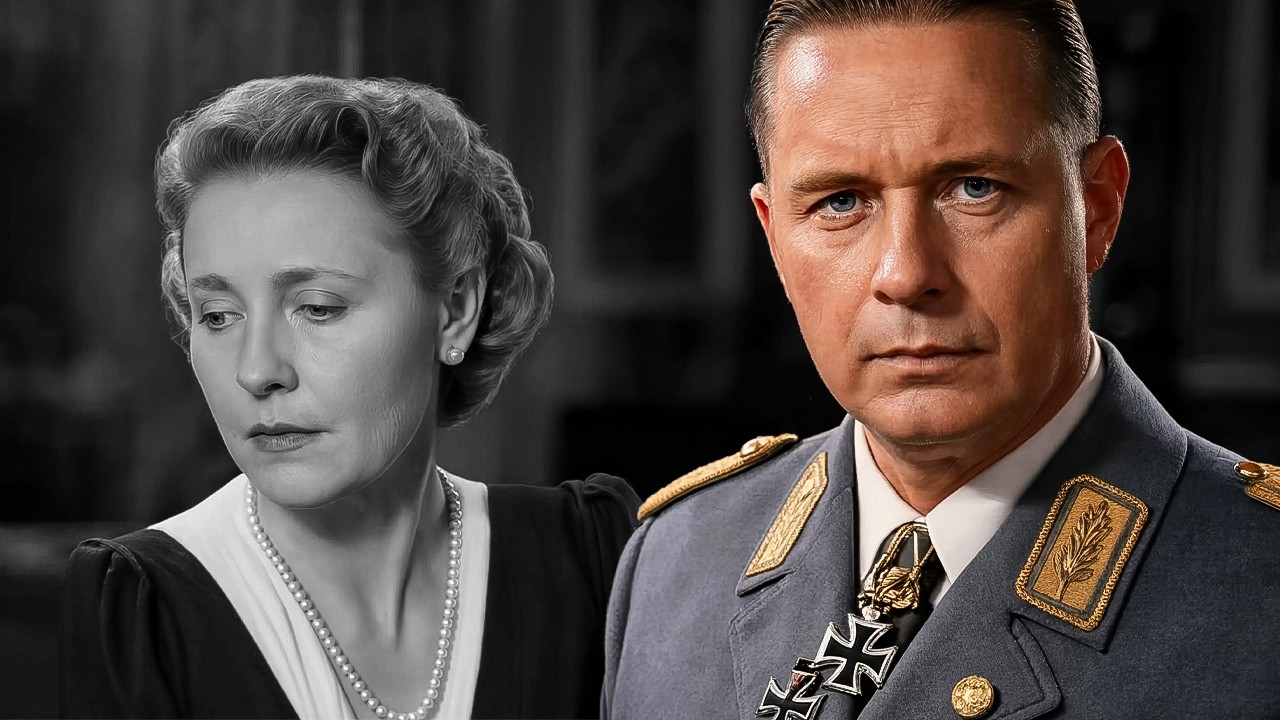
German denazification courts assumed the law would handle her as it handled everyone else who had circled the inner core: a questionnaire, a hearing, a classification. Emmy Göring calculated differently. In the foreword of a memoir she published in 1967, she stated that she owed no justification and no apology to anyone. She published the book.
She defended her husband. She lived in Munich until June 8, 1973. The memoir did not address a man named Albert. He carried the same surname and used it differently.
He died in West Germany in 1966 without a job, without recognition, without a biography. No company would hire anyone named Göring. His story surfaced only decades later. Hers was published while he was still alive.
Emmy Sonnemann was born in Hamburg on March 24, 1893, the daughter of a salesman from the city’s merchant class. She trained as an actress under Leopold Jessner beginning in 1910 and moved through the standard progression of German provincial theater: Hamburg, Munich, Vienna, Stuttgart, Weimar. She became an established stage actress at the National Theater in Weimar. She married a fellow actor, Karl Köstlin, in 1916; they divorced in 1926.
She met Hermann Göring in 1932. He had been widowed the year before when his first wife, Karin, died of tuberculosis, and he had named his enormous estate in the Schorfheide Forest after her. By then he was already among the most powerful men in Germany: Minister President of Prussia, founder of the Gestapo, rising toward command of the Luftwaffe. He advanced her career immediately.
In autumn 1934 he granted her the title of Prussian State Actress and secured her an engagement at the Berlin State Theater. She performed there until she married him and retired from the stage entirely. The wedding took place on April 10, 1935, at the Berlin Cathedral. Adolf Hitler stood as a witness, visible in the official photograph directly behind the couple.
Emmy was 41. She had spent 30 years in provincial theater. She would spend the next decade as the closest thing the Reich had to a first lady. Because Hitler was unmarried, Emmy filled the representational role his private life could not.
She hosted foreign heads of state at Carinhall. She appeared beside diplomats and allied leaders at state functions. She hosted the Duke and Duchess of Windsor when they toured Germany in 1937. Her gowns required multiple closets.
The estate had its own power station. She was also, by documented account, openly hostile to Eva Braun, snubbing her at official events until Hitler issued personal instructions to Göring demanding that Emmy treat her with respect. The consequence was direct: Emmy was disinvited from the Berghof. Their daughter Edda was born on June 2, 1938, when Emmy was 45.
The birth was orchestrated as a public propaganda occasion. She did not set policy. She was the visible domestic face of a regime run by men who believed that was exactly what a woman should be. What those men were deciding was documented at Nuremberg.
As Allied forces closed in during the spring of 1945, Göring attempted to negotiate his own surrender, sending a message suggesting he was prepared to lead Germany in Hitler’s place. The response was to declare him a traitor and place him under SS arrest. Emmy and seven-year-old Edda fled south toward Austria and were arrested by American forces. Hermann surrendered separately and was transported to Nuremberg.
The tribunal heard evidence of the Luftwaffe’s bombing campaigns, the establishment of the Gestapo, the administration of forced labor, and the signed order Göring had transmitted in July 1941 instructing the SS to make all necessary preparations for a complete solution of the Jewish question in Europe. He was convicted on all four counts: conspiracy, crimes against peace, war crimes, and crimes against humanity. He was sentenced to death. On October 15, 1946, the night before the execution was scheduled, Hermann Göring died in his cell at Nuremberg prison.
He was found dead before dawn. The execution did not take place. Emmy was not with him. The German denazification court reviewed her case in 1948 and convicted her of being a Nazi: one year in jail, 30 percent of her remaining property confiscated, and a five-year ban from the stage.
By the time of Hermann’s death, she and Edda had already been reduced to the two-room cottage in the countryside with no running water and no electricity. The woman who had required multiple closets for her gowns owned two dresses. This is documented in multiple biographical sources and confirmed by people who saw the conditions directly. She had hosted the Duke and Duchess of Windsor at Carinhall.
She had been disinvited from Hitler’s private mountain retreat for being rude to the wrong woman. She had lived inside the most gilded domestic environment the Third Reich constructed for anyone not in direct command. And then she lived in a cottage without running water and owned two dresses. Hermann Göring’s name appeared at the top of every document that helped build the machinery of the systematic persecution of European Jews.
That same name appeared on something else entirely: forged documents, camp release orders, and bribe payments used to save Jewish lives. The man writing those documents was Hermann’s brother. Albert Göring was born on March 9, 1895, two years after Hermann. They were physically and temperamentally different men.
Hermann was heavy, loud, and by the war years deeply addicted to morphine. Albert was tall, musically inclined, and four times married. He refused to join the Nazi Party. He refused to allow Heil Hitler to be spoken in his presence.
The Gestapo opened a file on him. When German forces annexed Austria in March 1938, Albert was in Vienna. In one documented incident, SS officers had organized a group of Jews to scrub the pavements on their hands and knees. Albert walked to the front of the crowd and knelt down beside them.
When the SS officer demanded identification and saw the name Göring, he ordered everyone to disperse. He was not going to be held responsible for humiliating a Göring. Albert understood exactly what his name could do, and he used it accordingly. He wrote letters on Göring stationery demanding the release of political prisoners from the camps.
On one documented occasion, a letter to the commandant at Dachau demanding the release of a doctor resulted in the accidental release of two men with the same surname. Albert had not specified which one, so both were freed. He provided false documents, exit permits, and financial transfers for Jewish families attempting to flee Germany, across multiple countries and multiple years of the regime. The Gestapo knew.
They confronted Hermann. By Albert’s own later account to Allied interrogators, Hermann intervened repeatedly to protect his brother from arrest. Albert told them, “As far as he could, Hermann helped me in those things. When it came to family, Hermann had a warm heart.
”
Allied interrogators at Nuremberg dismissed Albert’s account as suspicious. He was a Göring. An interrogation report described his testimony as “as clever a piece of rationalization and whitewash as we have ever seen. ” He was eventually cleared and released.
He had done nothing criminal. He had spent the war doing the opposite of criminal. No West German company would hire him. His name was Göring.
Albert Göring died on December 20, 1966 in Nuremberg, West Germany, at the age of 71. He died in poverty. He had refused to allow friends in the film and publishing industries to tell his story while he was alive, considering it too self-promotional. He was buried in the Göring family plot in Munich, without a biography, without recognition, without a job.
Emmy published her memoir in 1967, one year after Albert’s death. She wrote that she did not want to justify or apologize. She described life at Carinhall, the diplomats, the state dinners, the husband she defended until her death. The memoir was titled An Der Seite Meines Mannes, “At My Husband’s Side.
” An English translation appeared in 1972 as My Life with Göring. It covered the years 1932 through 1946: Carinhall, Mussolini, the Windsor visit, Eva Braun, Nuremberg, the forest cottage. In the foreword she said she owed no apology. Emmy Göring died June 8, 1973, in Munich at age 80 and was buried at the Munich Waldfriedhof.
Her daughter Edda outlived her. Edda has argued publicly throughout her life that her father’s role in the regime has been exaggerated. She pursued legal claims to artworks from the Carinhall collection, art assembled through the looting of occupied Europe, arguing it constitutes family inheritance. She has never publicly renounced her father.
In Israel, an ongoing campaign to recognize Albert Göring as Righteous Among the Nations, the highest honor Yad Vashem bestows on non-Jews who risked their lives to save Jewish lives, has been debated for years. Australian author William Hastings Burke wrote a biography of Albert, naming it 34 after the number of Jews he is documented to have saved. The formal recognition had not been awarded as of the most recent documented accounts. The historical record of the Göring name contains two stories it has never fully reconciled.
One story is in Emmy’s memoir. It is about a man who built the Gestapo, commanded the Luftwaffe, and signed the order that set the administrative machinery of the Holocaust in motion. Emmy’s story says he was also a husband, a father, a man with a warm heart toward his family. The other story is in a biography that took decades to appear.
It is about a man who used the same name, the name on every Gestapo document, the name on the Nuremberg indictment, to forge documents, free prisoners, and move Jewish families across borders. Albert Göring used the most feared name in the German security apparatus as a weapon against it. He died without recognition, without employment, without a memoir. His brother’s wife published hers one year after he died.
She said she did not want to apologize. The Göring name is still in living hands. Edda Göring is still defending the version of it the world already knows. The version that took decades to surface is in the Göring family burial plot in Munich.
Albert Göring, 1966. The same name, two completely different directions. The archive holds both of them now.