On November 30, 1939, the Red Army crossed the Finnish border without a declaration of war, and Soviet bombers appeared over Helsinki almost immediately, killing civilians and shattering windows across the capital. Stalin’s commanders had told their soldiers they would be welcomed as liberators, that the war would end quickly, and that Finland’s working class was waiting for them with flowers. Instead, the invaders met a Finnish army that knew every meter of the terrain and had prepared for this moment. Entire Soviet divisions were trapped in the forests and destroyed, and the attackers suffered staggering losses.
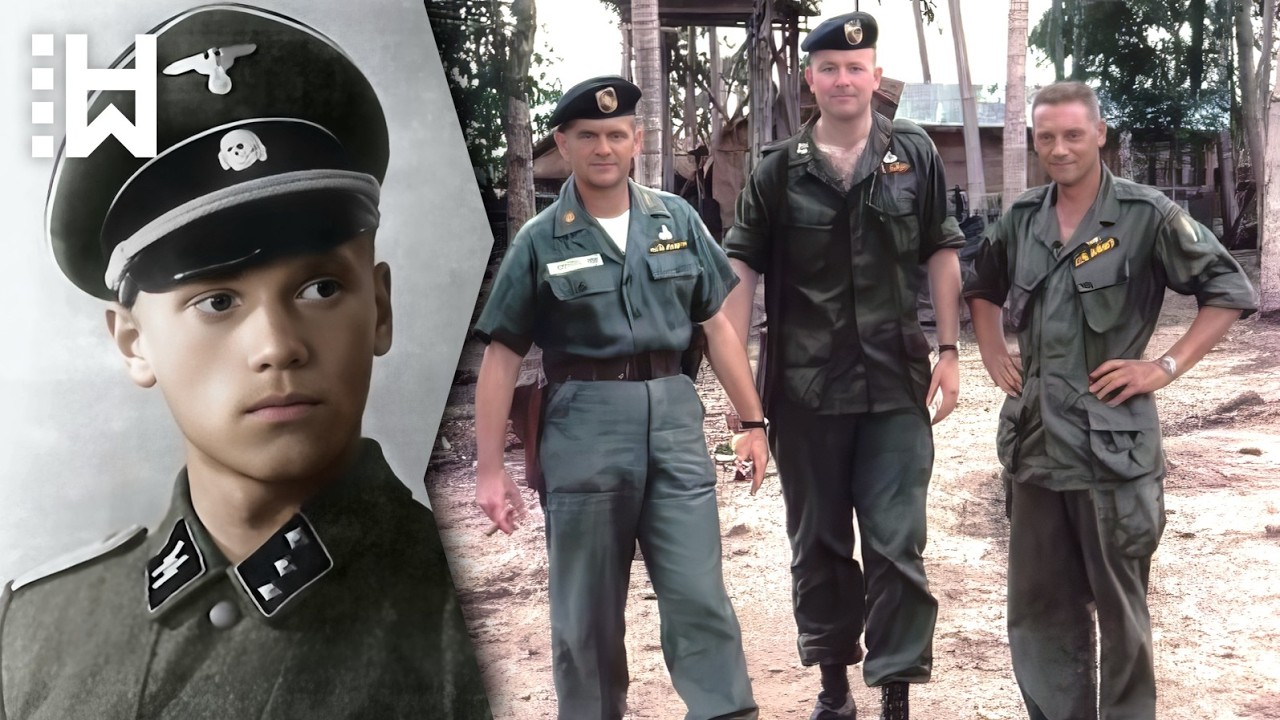
Out of this brutal, unequal conflict emerged soldiers whose names would define Finnish military culture for generations. One of them was a young man who would spend his life fighting communism, serving under the flags of Finland, Nazi Germany, and the United States. His name was Lauri Törni. Lauri Allan Törni was born on May 28, 1919, in the town of Viipuri, then part of independent Finland and today the Russian city of Vyborg.
His father, Hjalmur Törni, was a ship’s captain, while his mother, Rosa Maria Kosunen, ran the household. He had two younger sisters, Salme and Kaija. The family was stable and respected, and Törni grew up in an environment that valued physical achievement. He attended commercial school and excelled in sports, particularly skiing and boxing.
In his youth, he was a childhood friend of Sten Suvio, who would later win the gold medal in boxing at the 1936 Berlin Olympics. Törni served in the anti-communist semi-military Civil Guard, and in 1938 he entered military service, joining the 4th Jaeger Battalion stationed in the village of Kivennimi on the Karelian Isthmus. World War II began on September 1, 1939, when Nazi Germany invaded Poland. Three months later, when the Soviet Union attacked Finland and the Winter War started on November 30, 1939, Törni’s conscription period was extended, and his unit was moved to the front.
He held the rank of corporal and was responsible for supply logistics, a position that neither satisfied his energy nor his ambitions. One night, while temperatures dropped to 42 degrees below zero, he slipped out of his camp unnoticed by his guards, walked alone to a Soviet position, captured a soldier, and brought him back to the Finnish lines. Recognizing his potential, his commanders assigned him light infantry missions, and his unit fought around Lake Ladoga, including the encirclement and destruction of Soviet divisions at Lemetti, a battle that proved the Finnish forces’ ability to annihilate enemies who vastly outnumbered them. The Winter War ended with the Moscow Peace Treaty in March 1940, which forced Finland to cede territory including the Karelian Isthmus.
By then, Törni had been sent for officer training and was commissioned as a second lieutenant in the reserves. The peace lasted barely more than a year. In June 1941, following Germany’s invasion of the Soviet Union, Finland entered the war again in what became known in Finland as the Continuation War, or the Second Soviet-Finnish War, fighting alongside Nazi Germany with the stated goal of regaining the territories lost in 1940. Before the new conflict began, Törni had traveled to Vienna, Austria, for seven weeks of training with the Waffen-SS, the military wing of the Nazi paramilitary organization.
He returned to Finland in July 1941 holding the SS rank of Untersturmführer, equivalent to a second lieutenant in the U. S. Army, in addition to his Finnish rank. This training was part of a broader arrangement in which about 1,400 Finnish volunteers joined the Waffen-SS.
Marshal Carl Gustaf Emil Mannerheim, commander of Finnish forces, later requested their return to service in the Finnish army. During the Continuation War, Törni’s reputation grew far beyond what he had achieved in the Winter War. He returned to active duty in the Finnish armed forces and was seriously wounded in 1942 when he skied over a landmine and it exploded. The injury did not stop him.
In 1943, the Finnish high command created a dedicated unit under his command, an infantry detachment informally named after him that operated deep behind Soviet lines. Törni’s detachment was a light infantry force trained for reconnaissance, sabotage, and combat in the wooded Karelian terrain, a border region between Finland and the Soviet Union. The unit became feared by Soviet commanders and celebrated in Finnish military culture. One of the men who served under Törni during this period was a young reconnaissance soldier named Mauno Koivisto, who later became President of Finland, serving from 1982 to 1994.
The unit became so effective that the Soviet army placed a bounty of 3 million Finnish marks on Törni’s head. The last battle fought by Törni’s unit was the Battle of Ilomantsi in July and August 1944, the last major battle between Finland and the Soviet Union in the Continuation War, taking place in the forests of North Karelia. Finnish forces, operating in difficult terrain against a much larger Soviet army, succeeded in encircling and repelling two Soviet divisions. Earlier, on July 9, 1944, Törni had been awarded the Mannerheim Cross, Second Class, Finland’s highest military decoration.
Of nearly 600,000 Finns who served in the Continuation War, only 191 received this honor. The Moscow Armistice in September 1944 ended the Continuation War. Its terms required Finland to expel German forces from its territory, leading to the Lapland War, a conflict between former allies that lasted until 1945. This time, the Finns were fighting against Nazi Germany.
The armistice also required Finland to demobilize most of its military forces. Törni was discharged in November 1944, suddenly unemployed and unwilling to accept an outcome that left the Soviets controlling his family’s homeland. In January 1945, a German-aligned Finnish resistance network recruited him, and he left for Germany for training in potential sabotage operations in case the Soviets occupied Finland. When that training stopped in March 1945, with no way to return to Finland, Törni joined a Waffen-SS unit fighting Soviet forces near the city of Schwerin in northern Germany.
He surrendered to British forces in the final days of the war, and in June 1945 he escaped from a British prisoner-of-war camp in Lübeck, northern Germany, making his way back to Finland. What awaited him at home was not the reception he deserved. Finland, operating under the constraints of the Moscow Armistice and Soviet pressure, had no room to protect men who had continued fighting in German ranks after the armistice. When Törni arrived in Helsinki, Finland’s capital, he was arrested by Valpo, the Finnish state police.
Törni escaped, was re-arrested in April 1946, and was tried for treason for continuing to serve in the German army during the Lapland War. In January 1947, he was sentenced to six years in prison. He served part of this sentence in a provincial prison in Turku in southwestern Finland and escaped again in June 1947. He was recaptured and transferred to Riihimäki State Prison in southern Finland.
He remained there until December 1948, when President Juho Paasikivi granted him a pardon. After his release, unable to find a stable future in Finland, Törni left in 1949 with his wartime executive officer, Holger Pitkäinen. They crossed the border from the Finnish city of Tornio into the Swedish city of Haparanda and traveled to Stockholm, Sweden’s capital, where Törni stayed with a Swedish aristocratic family that had sheltered several Finnish officers after the war. In Stockholm, he met and became engaged to a Finnish-Swedish woman named Maria Kops.
To find work, he joined as a sailor under a false name aboard the merchant ship SS Bolivia, bound for Caracas, Venezuela. From Caracas, he made his way onto a Swedish cargo ship, MS Skagen, heading to the United States. In the Gulf of Mexico, he jumped overboard and swam to shore. He arrived in the United States as an illegal immigrant and a stateless man.
Törni traveled to New York City, where the Finnish-American community helped him. In 1954, he enlisted in the U. S. Army under the name Larry Thorne.
He was immediately drawn to the U. S. Army Special Forces, and between 1958 and 1962 he served with the 10th Special Forces Group in Bad Tölz, West Germany. During this period, he was second-in-command of a search-and-rescue operation in the Zagros Mountains of Iran, a mission in difficult mountain terrain that reinforced his reputation among Special Forces officers as a man who solved problems no one else could.
In November 1963, Thorne was deployed to South Vietnam, where he operated near the Cambodian border. His unit ran camps for Civilian Irregular Defense Groups, training and leading local fighters against the communist Viet Cong forces. During this time, he was wounded and received two Purple Hearts and a Bronze Star for valor. He had by then been fighting communists for a quarter century under the flags of three very different nations.
On October 18, 1965, Törni boarded a South Vietnamese Air Force CH-34 helicopter as part of Operation Shining Brass, the first covert mission tasked with locating Viet Cong supply points along the Ho Chi Minh trail in Laos and directing airstrikes against them. Two helicopters took off from the camp and met a U. S. Air Force forward air control aircraft amid deteriorating weather over a mountainous area in Phước Sơn District, Quảng Nam Province, central Vietnam.
While one helicopter flew through a gap in the clouds to drop off the six-man team, Törni’s helicopter and the small observation aircraft remained nearby. When the first helicopter climbed back above the clouds, both other aircraft had disappeared. Search teams found nothing, and the crash site was never located. Shortly after his disappearance in the helicopter crash, Törni was posthumously promoted to major and awarded the Legion of Merit and the Distinguished Flying Cross.
He remained listed as missing in action for 34 years. In 1999, a joint Finnish-American team recovered the remains of those aboard the downed helicopter. In 2003, after official identification through dental records, Lauri Törni, known as Larry Thorne, was buried with full military honors at Arlington National Cemetery in Virginia. He remains the only former Waffen-SS member buried at Arlington.
When his helicopter went down in South Vietnam, he was 46 years old.