In the winter of 2007, Phil Seymour packed a worn watch into his bag and boarded a plane back to Vietnam. He had not returned in four decades, not since he served as a sergeant in the US First Marine Division. He was not going back for war or duty. He was going back to find a boy he had met in the streets of Hoi An, a child to whom he had made a promise in 1967, a promise he had carried with him ever since.
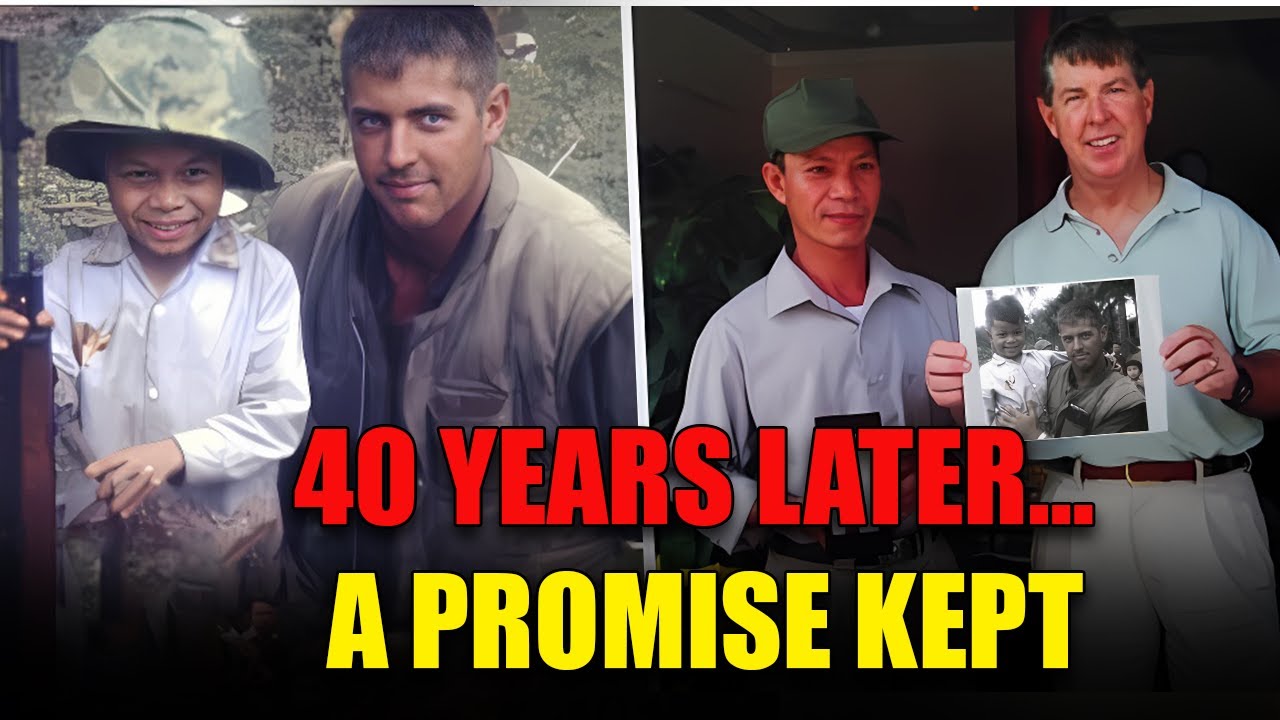
Phil Seymour was 20 years old in December 1966 when his boots first touched Vietnamese soil. His world was chaos: firefights, patrols, the sound of helicopters cutting through humid skies. But war was never just bullets and battles. It was also the small, quiet hours in between, and it was in those moments that his story began.
Stationed near Hoi An, he and his fellow soldiers often rode across the river into town. The narrow streets were alive with children, their laughter rising above the tension of war. Most came running toward the soldiers, not with fear but with curiosity. They tugged at their uniforms, asked for candy, begged for cans of meat.
The soldiers, young men themselves, found joy in giving. Among that lively crowd, one boy stood apart. His name was Cam, and he was about nine years old, thin but strong, with a gaze that carried both shyness and pride. Unlike the others, Cam never begged.
Instead, he arrived with offerings: bananas, coconuts, limes, a fair trade for the soldiers’ rations. That honesty, that small act of dignity, made Cam unforgettable. Phil often noticed the boy hanging back quietly while others scrambled for gifts. If he had nothing to trade, he simply smiled and watched.
His presence was calm, almost grounding, amid the chaos. Then, one afternoon in June 1967, Phil told Cam he was going on leave, a short trip to Thailand before returning to duty. He crouched down and asked gently what the boy would like him to bring back. Cam hesitated.
His English was limited, his world small. Then his eyes shifted to Phil’s wrist. The watch, he whispered. Phil laughed and promised he would bring him one.
True to his word, he bought a new watch in Thailand: small, sturdy, perfect for a child. He tucked it carefully into his gear, ready to hand it over. But war does not care for promises. By the time Phil returned, missions had changed, orders were different, and circumstances pushed him away from Hoi An.
He never saw Cam again. Still, the watch remained with him. It was carried across battlefields, across oceans, and eventually back home to America. Most soldiers left their memories of Vietnam locked away, too painful to revisit.
But Phil’s memory was tied to a single face, a single smile, and a promise unfulfilled. Life after war took Phil down a path of service and success. He stayed in the military, climbing the ranks for 27 more years. Along the way, he earned a master’s degree in law, became a lawyer at the Pentagon, then rose to chief prosecutor before retiring in 1995.
He had a wife, Lynn, and together they built a good life: stability, achievement, respect. But amid all that accomplishment, one small object remained tucked away: the watch. Most people would have forgotten. It had been a child’s casual request made in broken English during a time of war.
Surely, after 40 years, that boy would have forgotten too. But Phil had not. For him, the promise represented something larger. It was innocence in a time of brutality, a bond of trust across cultural and political divides, a reminder that even in the darkest days of war, humanity could shine through.
He often told himself that he would die with the watch in his drawer, never delivered, always unfinished. That thought weighed heavily on him. Then, in the winter of 2007, fate offered a chance. Friends of Phil’s family planned a trip to Southeast Asia with a stop in Hoi An.
It had been over four decades since he had last set foot there. The streets he knew would be different, the children grown, the town rebuilt. Still, he felt he had to go. Packing his bags, he slipped the watch inside along with old photographs of Cam’s family.
He carried no guarantees, only hope. When he arrived in Hoi An, the town was buzzing with life. Tourists filled the streets, lanterns glowed over the river at night, and markets spilled over with color and sound. Beneath the modern face of the town, Phil searched for traces of the past.
With the help of a local guide, he began asking questions, showing photos, describing the boy he once knew. It seemed impossible. Forty years had passed. A boy of nine would now be nearly 50.
Who could remember such a small detail from so long ago? Yet persistence paid off. One afternoon, the guide led him to a modest home. There they met a man, not Cam himself, but his younger brother.
The brother listened quietly as the guide translated Phil’s words. Then slowly he nodded. Yes, he remembered. And yes, Cam was alive.
A meeting was arranged. The next day, a man walked toward Phil. He was no longer the barefoot boy of Hoi An. He was 49 years old, a carpenter by trade, his hands rough from labor, his face marked by time.
It was Cam. At first, he looked puzzled, almost wary. Who was this foreigner, this American standing before him? Then the guide explained that 40 years ago, this man had been a marine.
He had known a boy named Cam, and he had carried a gift, a watch, ever since. Cam’s expression froze. His eyes widened. Slowly, realization swept over him.
He remembered the soldiers who came into town. He remembered the one who often carried a little dog on his back. He remembered the laughter, the kindness, the sense of adventure amid war. And though the watch itself had faded from memory, the man standing before him did not feel like a stranger.
Phil reached into his bag. His hands trembled as he pulled out the watch, worn but intact, its ticking heart still alive after all these years. This is yours, he said simply. Cam stared, shaking his head almost in disbelief.
At last Phil pressed it into his palm. Two men, once separated by war and oceans, embraced. Tears blurred the decades between them. For Phil, the weight lifted at last.
If I had broken a promise to an adult, he later explained, I wouldn’t have carried such regret. But to a child, to a child who never begged, who always smiled, who gave more than he took, that was different. The watch was never just a gift. It was a bridge.
From that bridge, a new chapter began. Phil and his wife Lynn grew close to Cam’s family. When they learned that Cam’s daughter Vi had left school due to financial hardship, Lynn quietly stepped in to help. Five years later, in 2012, Phil and Lynn returned to Vietnam once again.
This time, it was not for a reunion of promises past but to celebrate Vi’s graduation. They bought plane tickets for Cam and his wife so they could travel to Saigon. It was Cam’s first time on an airplane. He brought gifts from his hometown, simple things yet filled with love, and hosted a small party in his daughter’s dorm.
In that joyful gathering, laughter replaced the echoes of war. The watch had become more than an object. It had become a symbol of friendship, of family, of two lives forever intertwined. Today, Vi, the little girl whose future was changed by that connection, calls Phil and Lynn often.
She speaks not as a stranger to benefactors but as family. Two families, once separated by war, now linked across oceans and generations. A soldier, a boy, a watch, and a promise that proved that even in the shadow of war, kindness can outlast time itself.