On the night of October 3, 1973, thousands of fans packed Nashville’s Ryman Auditorium, unaware that three blocks away a tragedy had already unfolded. Inside the Hermitage Hotel, Jim “Big Chief” Weatherington, the legendary bass singer whose stage moves a young Elvis Presley had once studied and copied, lay dead on his bed. His heart had stopped just minutes before he was due to perform. The convention that night became a memorial before it ever became a concert, and the crowd learned that Big Chief had died before he could take the stage.
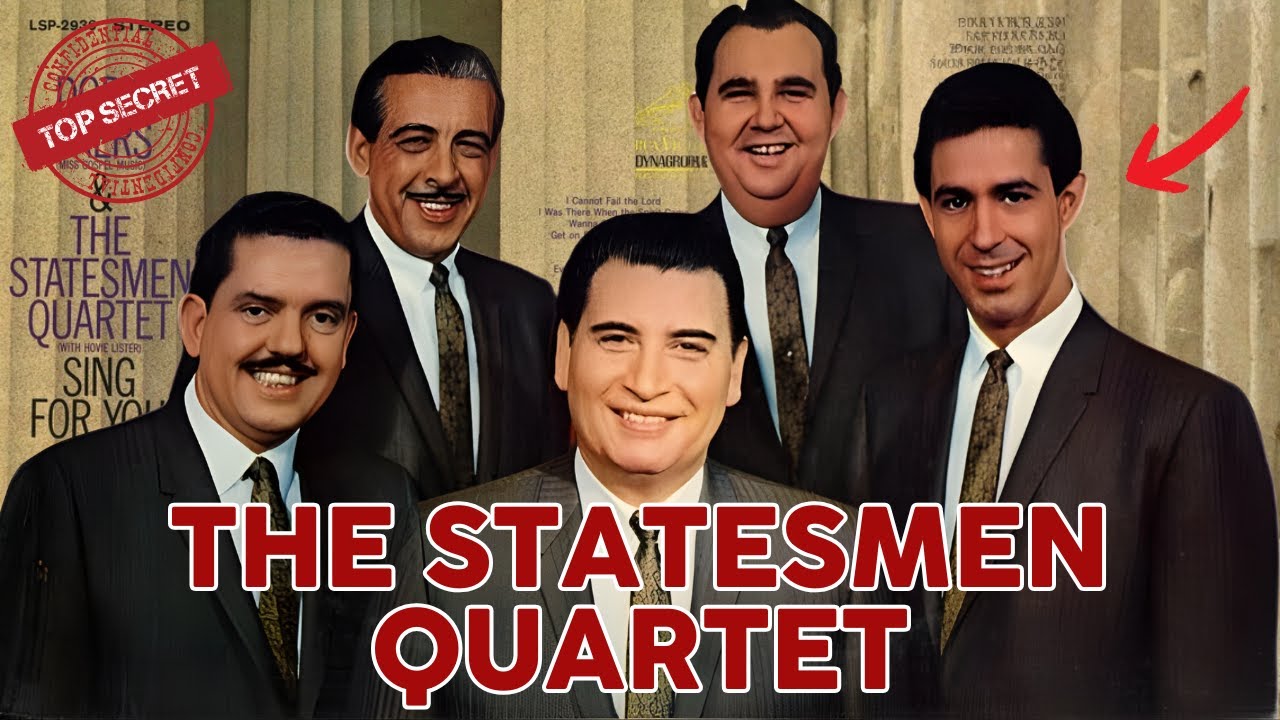
The story of the Statesman Quartet begins in the American South of the late 1940s, when the line between church and concert hall was beginning to blur. Hovie Lister, born in 1926 in Greenville, South Carolina, grew up in a deeply religious world where church wasn’t just a Sunday obligation but the center of social life. He was an ordained Baptist minister who wore pink suits, drove fast cars, and attacked the piano with a percussive, honky-tonk style that owed as much to the juke joints as to the hymnal. He wanted to create something the gospel world had never seen: a quartet of personalities, men who looked as good as they sounded and commanded a stage like movie stars.
In 1948, in Atlanta, he found the anchor he needed in Jim Weatherington, a towering man with a cavernous bass voice that seemed to come from deep within the earth. Weatherington, known affectionately as Big Chief, was the perfect counterweight to Lister’s manic energy. Together with tenor Rosie Rozell and baritone Doy Ott, the Statesman Quartet was born in October 1948. Their breakthrough came from an accident.
Chief, despite his imposing presence, was a man of nerves. During fast rhythmic numbers, his left leg would shake involuntarily, an uncontrollable spasm that moved in time with the beat. Any other manager would have ordered him to stand still. Lister saw a hook.
He told Chief never to stop that leg. The move became their signature, and audiences reacted with a frenzy that shocked the gospel establishment. Women screamed. Teenage girls treated the four singers like heartthrobs.
The Statesmen wore electric blue and red suits instead of drab black, pushed their tempos with syncopation, and turned the church house into something that felt dangerously close to a carnival. Traditionalists called them blasphemous. Lister welcomed the controversy, telling critics that to catch fish you had to use shiny bait. By the early 1950s, the Statesmen had become a phenomenon.
Lister secured a massive sponsorship deal with Nabisco, putting the quartet on salary, on billboards, and on television. Their syndicated TV show beamed their music into homes across the South and Midwest. The money rolled in. They bought a custom-designed tour bus they called the Eagle, one of the first of its kind, and traveled over a hundred thousand miles a year, sleeping in shifts, living on diner food and black coffee.
Behind the glamour, the life was brutal. The constant vibration of the bus, the rich southern diet, and the endless miles took a physical toll on Chief, who developed high blood pressure and struggled with his weight. He would step off the bus gray with fatigue, clutching his chest, blaming indigestion and the road. The brand was joy, and they couldn’t show weakness.
They smiled, sang harder, and drove faster. In Memphis, a shy teenager with greasy hair and acne regularly slipped into the Ellis Auditorium to watch the Statesmen. Elvis Presley didn’t just admire their music. He studied the way women leaned forward when Chief stepped to the microphone, how his tailored suit hung on his broad shoulders, and most of all how that left leg shook in time with the gospel boogie.
Years later, when critics called Elvis’s gyrating hips vulgar, Lister watched from his living room with a knowing smile. He recognized the big chief shake. By the early 1970s, the classic era of the Statesman was over. The music industry had moved on.
Contemporary Christian music was rising, and quartets were being pushed to the margins. But Lister refused to quit. He kept rebuilding the group, kept touring smaller venues, and kept telling stories about Chief, conjuring the ghost of his friend on stage. The final act came in the 1980s, when Lister helped form the Masters V, a supergroup of surviving gospel titans that included Jake Hess, James Blackwood, Rosie Rozell, and J.
D. Sumner, the deepest bass voice in recorded history, who had spent years touring with Elvis until the King’s death in 1977. The group won a Grammy and toured the country, proving that the old sound still had power. But for Lister, every time he looked at the bass microphone, he saw Chief.
The hole that opened in room 418 of the Hermitage Hotel never closed. As the 1990s wore on, time caught up with the survivors. Rozell passed away. Blackwood’s health failed.
Lister’s own health declined, and cancer began its slow work. He retired to his home in Georgia, surrounded by photos with Elvis, gold records, and Nabisco posters. He didn’t complain about the pain. He told stories about the boys, keeping the Statesmen alive by speaking their names.
On December 28, 2001, Hovie Lister passed away. The world was too loud and distracted to stop for his death, but in the quiet corners of the South, in the rural churches and living rooms of the faithful, a deep silence fell. The happy rhythm had finally stopped. The legacy of the Statesman Quartet reaches far beyond gospel music.
They helped define the vocabulary of the modern lead singer and proved a star could serve a higher power. They are godfathers of rock and roll. Elvis didn’t just listen to their records. He studied them, absorbed their style, their swagger, and their moves.
The DNA of rock and roll is double stranded: one strand the blues of the Mississippi Delta, the other the white gospel quartet of the 1950s. Perhaps their most enduring legacy is the cautionary story they told through their own lives, the cost of bringing joy to millions while the joy consumed the men who delivered it. The Ryman Auditorium still stands today, polished and preserved for tourists with smartphones. In a glass case, tucked away in a museum corner, there is a photo of four men in matching suits, smiling, looking invincible.
Southern gospel has retreated to the margins of American culture, but its influence echoes everywhere: in the harmonies of the Eagles, in the showmanship of pop stars, in every singer who steps to the front of the stage and demands the audience’s attention. Hovie Lister and Jim Weatherington are not household names, but they built the road everyone else drives on. And on quiet nights in Nashville, when the crowds are gone and the Ryman is dark, the old-timers say you can hear something in the rafters: the faint driving sound of a boogie-woogie piano and the deep rolling thunder of a bass voice.
The music is still shaking.