In the autumn of 1881, a valley in West Central Pennsylvania that no longer appears on most road maps held a town called Yarrow Pass. It was a small place, home to 312 people, mostly farmers descended from Welsh and Cornish miners who had settled there in the 1780s. By the 1880s, the veins of iron and copper that had drawn their ancestors had long played out, and the people had become farmers, quiet and watchful, slow to invite strangers in. The valley sat in a bowl, with only one road in and one road out, and the same road at that, winding through a notch in the ridgeline barely wide enough for a wagon.
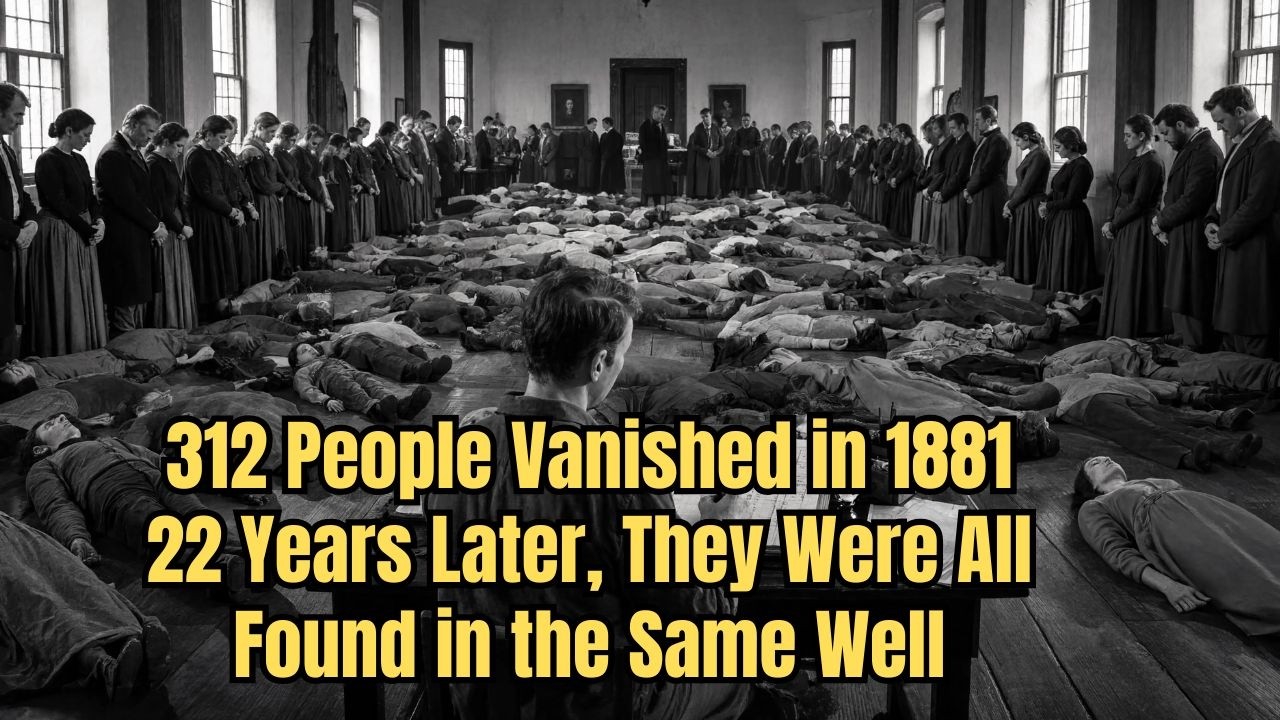
On the morning of October 29, 1881, a circuit preacher named Algernon Whitlock rode into Yarrow Pass to give a service he had given seven times before that month in other valleys. He arrived around half past nine. The first thing he noticed was that the bell at the meeting house was not ringing. The second was that the road through town was empty.
Not just quiet, but empty. Chickens wandered into the road. Smoke rose from only one chimney. The pump at the center of the square was still running, its bucket overflowing, water spilling into the dirt.
He told himself the kinds of things a sensible man tells himself, that there was a barn raising, a wedding, a wake. But none of those reasons would have emptied the town completely. He got down from his horse and walked to the meeting house. The door was unlocked.
No one was inside. Hymn books lay open on the pews, and a half-eaten piece of bread sat on the lectern where he himself would have stood. The bread was still soft. He went to the general store, unlocked as well.
Two cups of coffee stood on the counter, gone cold but not yet skinned over. The cash drawer was open. A ledger lay mid-entry, the pencil still resting in the crease. The last line read “4 lb of nails to L.
Penhallow on account,” and the pencil had stopped before the price could be written in. He went to the blacksmith’s house. The forge was still warm. A horseshoe sat on the anvil, half-finished, metal recently red.
The smith’s leather apron hung on a peg by the door, which was strange, because a smith does not leave his apron behind. He went to seven more houses. The same thing in each. Cooked food on tables, beds made, laundry on lines.
In one kitchen, a kettle was still warm to the touch. In another, a knife had been left on a cutting board next to half a turnip. In a third, a Bible lay open at Ezekiel 37, the chapter about the valley of the dry bones. He noted that one.
He could not stop himself from noting it. Dogs came to him whining, the only sound he had heard since arriving. They followed him at a distance of ten feet, and when he stopped, they stopped. He later told the sheriff he had never felt so watched in his life, and said that the dogs were not the ones doing the watching.
They were doing what he was doing, looking for whatever was watching them both. By the time he got back to his horse, just after eleven in the morning, he had searched roughly a quarter of the town. Yarrow Pass had 312 people in it the night before. He could account for none of them.
He rode hard to the next valley, Murchison Hollow, and from there a rider was sent down to the county seat. By late afternoon a party of six men came back up the road with him, led by Sheriff Octavius Meade, a heavy-set man of 47 with a neatly trimmed brown mustache. He had been a soldier in the war and had seen towns emptied by disease, by raid, by fire. He knew what those looked like.
This was not that. The party arrived just as the sun was setting. The town was untouched. Nothing was broken, nothing burned, nothing overturned.
No bodies in the houses, no blood on the floors, no signs of struggle. Cattle were still in their pens, horses still in their stables. A pie left to cool on a windowsill at the Huff farmhouse was now stone cold, but otherwise perfect, with two flies on the crust. It was, Sheriff Meade would write later in a report no one outside his office would read for the next twenty-two years, as if every soul in the valley had been called away to dinner and simply forgotten to come back.
The sheriff split the town into quarters and had his men search every house, barn, cellar, outhouse, cistern, and hay loft. He himself walked the road from the eastern notch back into the center, looking down at the dirt. He was looking for the footprints of 312 people walking somewhere together, because 312 people cannot move through a valley without leaving a road like a trampled wheat field behind them. He found no such tracks.
This was the moment, he told the coroner, when he understood that whatever had happened in that valley had not happened in any way he knew how to investigate. There were no tracks because nothing that walked on the surface of the earth had carried them away. Around nine in the evening, a young deputy named Phineas Marbury came back to the square at a run. He had been searching the western edge of town, where the road curved up toward the higher pasture.
There was an old stone well there, sixty feet deep by local reckoning, on what had been the property of a man named Ulysses Cobbett. The latch on the wooden cover was still latched when the deputy first saw it. He had to open it himself to look down. He did not say what he saw when he got back to the square.
He just told the sheriff he needed to come. He had taken his hat off somewhere between the well and the square, and was holding it in both hands in front of him the way a man holds a hat at a funeral. The sheriff did not bring his men down into the well that night. He posted a guard and rode hard for Hephzibah, returning by dawn with three more men, two long ropes, a pulley rig, and the county coroner, a patient man named Tobias Quennell who had nineteen years of experience.
They rigged the pulley at first light, and Quennell volunteered to go down first. He was forty feet down before he called for the men above to stop. He stayed at that depth for almost ten minutes without saying anything. When he was raised back up, his hands were shaking.
He sat on the wall of the well for a long while before he could speak. All he said was, “They are all in there, every one of them. 312 people in a well 60 ft deep with a mouth no wider than 4 ft across. ”
The space inside a well sixty feet deep and four feet wide is roughly seven hundred and fifty cubic feet.
The volume of 312 adult bodies, even pressed together with no room between them, is somewhere in the neighborhood of twelve hundred cubic feet. The numbers do not match. They cannot match. And yet, according to the men who went down over the next four days, they were all there, every single one.
The recovery took four days. Forty-three men were involved. Each man went down for no more than half an hour at a time. Two refused to go down a second time.
One came up after his first descent and walked off into the woods without his hat, and was not seen in Hephzibah County again. The sheriff did not pursue him, writing that the man had a right to go where he wanted after what he had been asked to do. The bodies were brought up one at a time with rope and pulley, wrapped in canvas, and laid out in the meeting house. Coroner Quennell cataloged each one, matching every name against a census register updated the previous spring.
Each name on one list appeared on the other. There was no one missing. There was also, as the sheriff noted in the second paragraph of his report, no obvious cause of death on any of them. No wounds, no bruises, no marks of strangulation, no signs of poison.
No water in the lungs, though the lower bodies had been submerged in about three feet of water at the bottom. They were just dead, 312 people in apparently good health on the evening of October 28 and dead by morning, with no marks and no apparent reason, arranged at the bottom of a well that could not have held them. The coroner noted one consistent feature on his second pass through the bodies. He wrote it down in the formal report in a single sentence, and then never spoke of it again.
The eyes of every single person in that well were open, and they were all looking up. In a private letter to his brother, preserved by the family and made public in 1947, Quennell wrote that the bodies were arranged, not stacked, not thrown, not piled. Arranged. Their heads turned in the same direction, all facing what would have been east at the bottom of the well.
None of them tangled, none overlapping. It had the look of something done by hand, slow and patient, the way a clockmaker lines up small parts on a felt cloth before beginning his work. He wrote that whoever had done it had not been in a hurry, and had not been alone, and had wanted very much for it to be tidy. The county did not want this story to leave the county.
The railroad was making decisions about where to extend its lines in that part of Pennsylvania, and a story like this could do real economic damage. Sheriff Meade and his superiors wrote the incident up as a fever, a wasting fever of unknown origin that had passed through Yarrow Pass in a single night. The bodies were buried in a single mass grave east of the meeting house. The Cobbett well was filled in with stones and sealed at the top with mortar, a small fence put around it.
The road into Yarrow Pass was officially closed the following spring. There was, of course, a problem with the fever story. A wasting fever does not move 312 people into a well. A wasting fever leaves bodies in beds, in chairs, slumped against door frames.
It does not arrange them at the bottom of a sealed well in a column sixty feet high with their eyes open, looking up. The sheriff asked each of the forty-three men individually not to speak of what they had seen. He did not threaten them. He simply asked, saying that there were things in the world the world was not yet ready to have explained to it, and that whatever had taken the people of Yarrow Pass might be one of them.
He asked them not to give it more. The silence held for twenty-two years. The story was finally released in 1903, not by any of those men, but by Sheriff Meade himself, in his last year in office. He was sixty-nine, and had carried the report in his own safe for two decades.
He told a young reporter from the Philadelphia Inquirer that he was making it public because he did not want it to die with him. The story ran on page four of the Sunday edition on May 3, 1903, under the headline “A Mountain Mystery Now 22 Years Old. ” It was reprinted in seven other papers over the following ten days, and then passed out of the newspapers and into half-memory. There was no follow-up investigation, no government inquiry.
By then, the forest had taken most of the valley back. The meeting house roof had collapsed. The well remained, sealed, fenced, on private land. The family that owns the land, by all accounts, has never opened it.
There is one more thing. A surveyor named Wendell Garrick stayed in Yarrow Pass for nine days in late September 1881, about a month before the disappearance, mapping disputed property lines. His journal, donated to the Historical Society in Carlisle and read by a graduate student in 2000, records that he slept poorly, having the same dream three nights running, standing in the meeting house with the whole town, all of them looking up. He wrote that the dogs of the town had not barked at night since the new moon.
He wrote that there was a sound in the valley at night, coming from somewhere west of the Cobbett property, up toward the high pasture. It was, he wrote, the sound of a great many people speaking very quietly at a great distance, all at the same time, with a rhythm that rose and fell, paused, and began again. He left at first light on October 3. He never returned to the valley.
He refused for the rest of his career any contract that would take him into the western part of the state. He married in 1885 and had a long, happy life, but for all forty-four years of his marriage, he insisted the bedroom window be shut every single night, and would sit on the edge of the bed afterward with his hand pressed flat against the window sill, as if he were holding something down. His wife wrote that the last thing he said on the night of his death was that he could hear them coming. He did not say who.
And in Murchison Hollow, the next valley over, a farmer named Lavinia Sturbridge recorded in his journal on the evening of October 28, 1881, that about sundown there was a sound from over the ridge he could not account for, like the singing of a great crowd of people very far away, the words not words and the singing not singing, rising and falling like a tide three times before it stopped. His next entry, on October 31, reads in full: “The people of Yarrow Pass are all dead. Whitlock came down at first light yesterday and the sheriff has gone up. Annelise is no better.
I will write no more about the past. ” He never wrote another word about it. His great-granddaughter, Pernilla Sturbridge Haywood, who still lives on that farm, told the story of a family rule passed down for four generations: that you close the kitchen window before sunset on the 28th of October every year. She said her grandmother had told her it was for the singing, and the look in her grandmother’s eyes had been enough to make the rule hold.
She said she still did it. She said one year she had forgotten, and standing at the sink with the window open, she felt all the small hairs at the back of her neck rise at once, the way an animal feels when something has come up behind it. She said she had almost heard something, a sound that had begun somewhere on the other side of the ridge and had not been able to come the rest of the way because she had not opened the door for it. She closed the window so fast she cracked one of the panes.
She has never forgotten the date again. She asked, if the story was told, to say the rule out loud. She said it could not hurt. She said it might help.
She said she did not know.