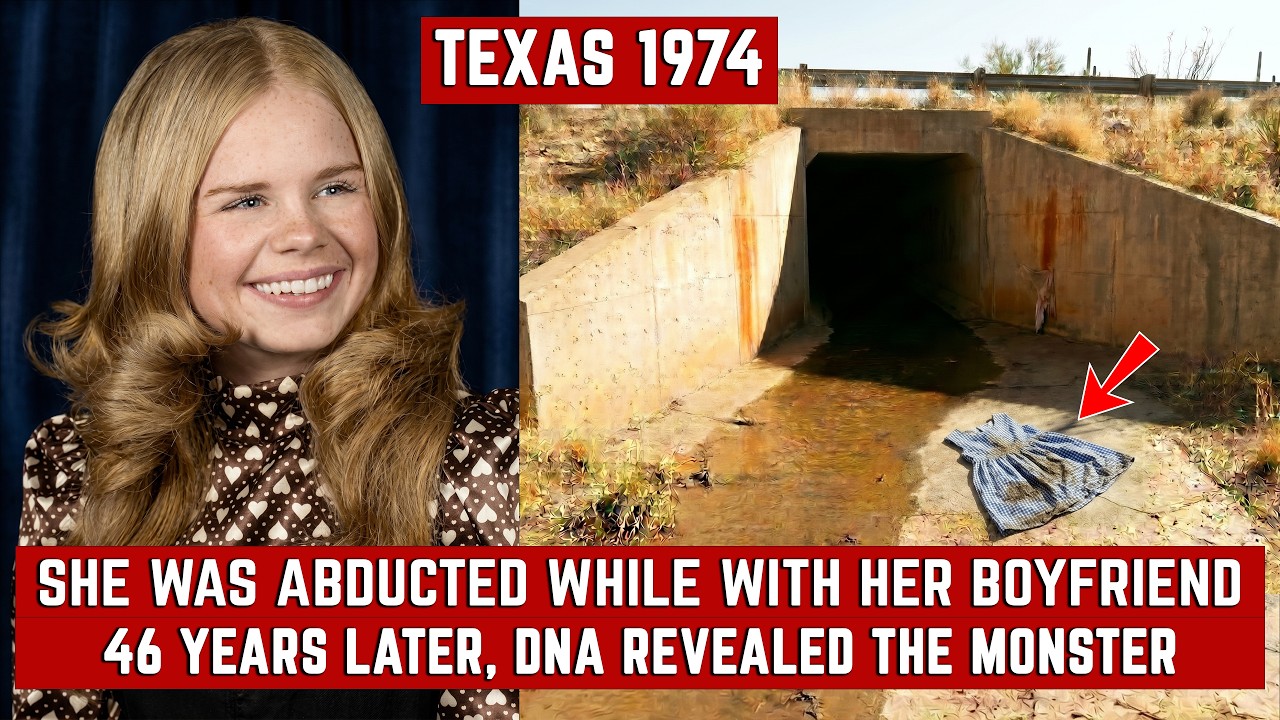
On September 21, 2020, police in Fort Worth, Texas, placed Glenn Samuel McCurley under arrest, more than 46 years after the abduction and murder of seventeen-year-old Carla Jean Walker. The arrest came after a private forensic laboratory managed to extract a usable DNA profile from evidence that previous tests had nearly consumed, and after investigators matched that profile to a family tree that led them to a name already buried in the case files—a man who had been questioned in 1974, cleared by a lie detector test, and allowed to walk away. The case began on the night of February 17, 1974. Carla Walker, a junior at Western Hills High School, had spent the evening at a Valentine’s dance with her boyfriend, Rodney McCoy, an eighteen-year-old quarterback for the school’s football team.
After the dance, the couple drove around Fort Worth in his mother’s Ford LTD, stopping at the Brunswick Ridglea Bowl so Carla could use the restroom. The parking lot was empty. The passenger door flew open, and a man pointed a gun at Rodney. Before Rodney could react, he was struck across the head and lost consciousness.
The last thing he heard was Carla’s voice telling him to go get her father. Rodney regained consciousness around 1:00 a. m. , drove to the Walker house, and delivered the news to Carla’s father, Layton Walker, a retired Air Force lieutenant colonel.
Walker grabbed his pistol and drove to the bowling alley, where police found Carla’s purse on the ground near the car, along with a magazine clip from a . 22 Ruger that had fallen from the attacker’s weapon. Three days later, Carla’s body was found in a culvert near Benbrook Lake, about thirty minutes south of Fort Worth. She had been alive for two of those days, during which time she had been beaten, raped, injected with morphine, and strangled.
The evidence collected from her clothing and from her body was logged and stored, with investigators fully aware that their laboratory capabilities in 1974 were not sufficient to turn biological evidence into a named suspect. What they could work with was the magazine clip. It was traceable to a purchase record, and when investigators ran . 22 Ruger sales across Fort Worth, one name stood out.
Glenn McCurley was a thirty-year-old truck driver with a prior conviction for car theft, who lived less than a mile from the bowling alley, and whose wife had been out of town on the night of the murder. When questioned, McCurley was cooperative. He explained that the Ruger had been stolen from his truck six weeks before the murder, that he had not reported the theft because he was a felon who wanted to avoid police attention, and that he had been home alone. He agreed to take a lie detector test, answered every question calmly, and passed.
His name was removed from the suspect list. McCurley returned to his life. He had been drinking heavily on the night of the murder, which also happened to be his eleventh wedding anniversary, but none of that was known to investigators at the time. He continued working, raised his children, and lived in the same neighborhood for decades.
Carla’s parents, Layton and Doris, never stopped pressing for answers, but both died without learning the truth. Her brother Jim, who was twelve years old when his sister disappeared, grew into adulthood carrying what he later described as a silent rage, anger without a target. Rodney McCoy left Fort Worth and settled in Alaska, unable to stay in a city full of reminders. The case sat open for years.
In 2019, Fort Worth police rediscovered an anonymous letter buried in the original case files, written in 1974 and signed not with a name but with a sequence of binary numbers. It read, “Kill Carla Walker in Benbrook. ” The letter was posted on social media in the hope that someone would recognize the handwriting, and it attracted renewed attention to the case. The decisive breakthrough came through a television network.
In April 2020, the Oxygen Network aired an episode covering Carla’s case on a program hosted by cold-case investigator Paul Holes, who had previously worked on the identification of the Golden State Killer. After the episode aired, Holes connected detectives Jeff Bennett and Leah Wagner with Astrium, a private forensic DNA laboratory in The Woodlands, Texas, designed specifically to work with degraded biological evidence. The network funded the testing at a cost of fifteen thousand dollars. Earlier attempts by other laboratories had consumed nearly all of the remaining sample, which meant Astrium’s analysis was the last possible chance.
Using genome sequencing technology developed for biomedical research, the laboratory rebuilt a complete DNA profile and uploaded it to the public genealogy database GEDmatch, where it was matched to a distant relative and, from there, to a named family tree. On the morning of July 4, 2020, Astrium’s CEO called Detective Bennett with the surname: McCurley. Bennett opened the binder he had carried for years, found the entry, and asked whether the family included a man named Glenn Samuel McCurley. The laboratory checked and confirmed it did.
In July 2020, investigators collected trash that McCurley had placed on the public street for pickup, which carries no legal expectation of privacy. DNA from that trash matched the DNA from Carla’s clothing. Investigators then asked McCurley for a voluntary cheek swab, and he agreed. That swab also matched.
On September 21, 2020, he was arrested. In the interrogation room, McCurley initially denied knowing anything about the murder. Over the course of the questioning, however, he admitted to events of that night, describing himself as alone, drinking since half past four in the afternoon, and driving around Fort Worth after dark. He eventually confessed.
When asked why he had not released Carla, he said he had been afraid she would report him. A search of his home uncovered the Ruger . 22 where he had claimed it had been stolen forty-six years earlier; it had been hidden in the house the entire time. McCurley’s trial began in August 2021.
He pleaded not guilty, with his defense arguing that the DNA evidence was flawed and that the confession had been coerced. On the morning of the third day, the judge announced that McCurley had submitted written documents confessing to the abduction and murder of Carla Walker and wished to change his plea. On the record, he acknowledged that doing so meant surrendering his right to a jury verdict. The judge asked him how he pleaded.
McCurley answered, “Guilty. ” He was sentenced to life in prison without the possibility of parole. After sentencing, when asked why he had changed his plea, he said he had suffered enough. Carla’s sister, Cindy Stone, had stood in the courtroom and asked him directly whether he had harmed anyone else, a question she repeated during her victim impact statement, telling him that the families of any other victims deserved to know.
McCurley gave no answer. He was considered a person of interest in at least three other unsolved killings of young women in Fort Worth from the 1970s and 1980s, but he denied involvement every time he was asked. He died in July 2023, taking whatever he knew with him. The case also established a legal precedent.
The forensic genetic genealogy method used by Astrium survived a Daubert hearing, the American standard for scientific admissibility in court, clearing the way for the technique to be used in other cold cases across the country. Senator John Cornyn of Texas subsequently proposed the Carla Walker Act, federal legislation intended to create dedicated funding for advanced DNA technology. For Jim Walker, who spent forty-six years carrying his sister’s case, the outcome brought a form of resolution. As he said in the courtroom that day, a lot of healing happened in that room, not just for his family, but for the community.
He also offered the man convicted of his sister’s murder something unexpected: We don’t hate you. We’re praying for you.