The Davenport Hotel in Spokane, Washington, locked its doors for the last time in 1985. Presidents had slept in its rooms, and mining kings had celebrated fortunes pulled from Idaho mountainsides in its ballrooms, but on that day, the grandest hotel between Minneapolis and Seattle fell silent. It would remain that way for seventeen years. Pigeons roosted in the ornate halls, rainwater crept across the lobby floor, and the chandelier that once lit a room of millionaires hung in darkness over crumbling plaster.
Spokane had been one of the wealthiest small cities in the American West, but its decline had not come from a single disaster. It had been hollowed out by something slower, more systemic, and deeply American. And the strange part, the part that made Spokane different from a dozen other declining cities, was where its fortune had come from in the first place. It did not manufacture anything particularly famous.
It was not a major port or a railroad terminus. Spokane got rich because the men who dug silver, lead, and zinc out of mountains in another state decided this was where they wanted to live. The story begins with James Glover, a farmer and entrepreneur who arrived at Spokane Falls in 1873 and saw what others had missed: a massive waterfall on the Spokane River with enough power to drive mills and attract industry for generations. He bought land, filed claims, and began promoting the area with relentless optimism.
He was right to believe in it. The Northern Pacific Railway arrived in 1881, connecting the settlement to the national rail network, and the town incorporated the same year. Growth was immediate and chaotic. By the late 1880s, Spokane was a boomtown of wooden buildings, wooden sidewalks, and wooden ambition, looking like a hundred other frontier towns racing to become something bigger.
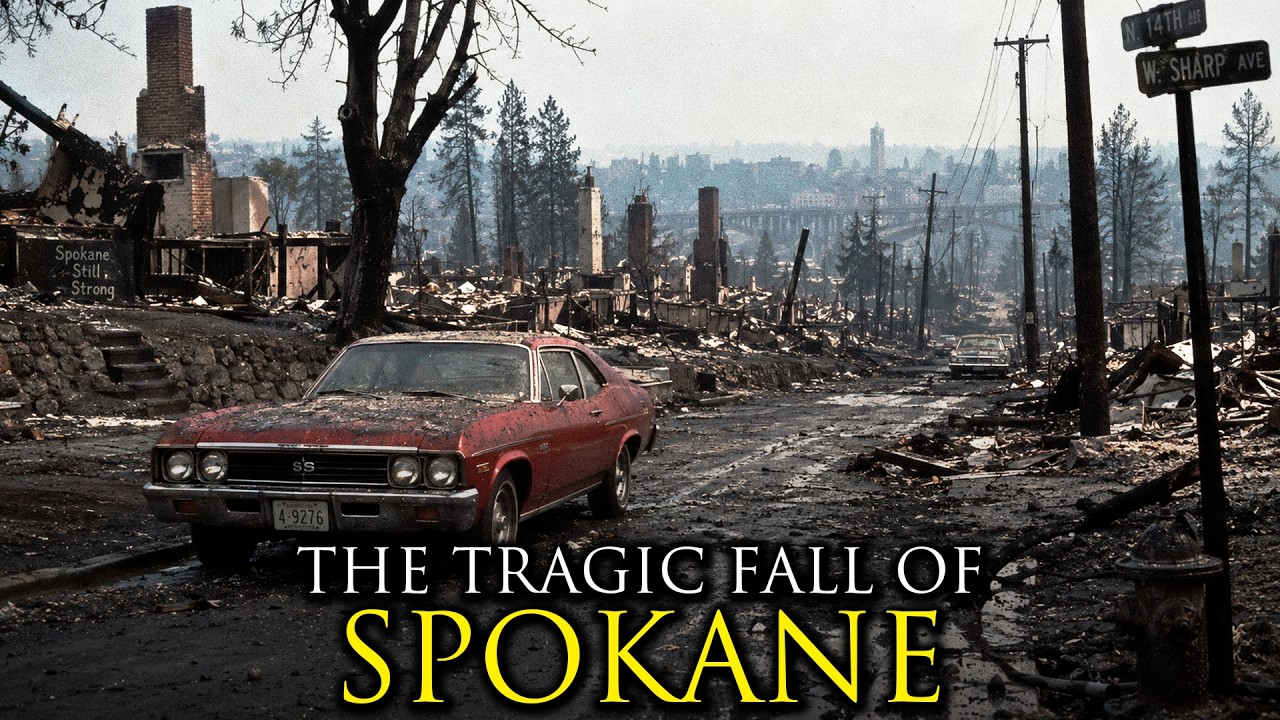
Then, on August 4, 1889, everything burned. A fire started downtown. The exact origin is debated, but within hours it consumed virtually the entire commercial core. Roughly thirty-two blocks were destroyed—banks, hotels, shops, newspaper offices, the Northern Pacific Depot, all of it gone.
Damage was estimated at several million dollars, an enormous sum for a city that size. Photographs taken afterward show block after block reduced to rubble, with chimneys standing alone above the ash. What happened next defined the city’s character. The people did not leave.
They did not shrink. They rebuilt immediately, aggressively, and in brick and stone rather than wood. Within a year, new buildings were rising on the same blocks that had burned. The message was unmistakable: this city was not temporary.
The fire, paradoxically, made Spokane grander, replacing cheap construction with masonry buildings that had weight, permanence, and architectural ambition. The money to justify that belief was already flowing. The Coeur d’Alene Mining District, tucked into the mountains of northern Idaho about seventy miles to the east, was one of the most productive mineral deposits ever found in North America. By the early twentieth century, the mines in what locals called the Silver Valley were pulling fortunes out of the earth—silver, lead, zinc, at a pace that made investors across the country take notice.
The Bunker Hill and Sullivan mine alone operated for decades and produced ore worth hundreds of millions over its lifetime. The Hercules mine, discovered around 1901 by a group of prospectors including Harry Day, struck one of the richest veins of silver and lead ore anyone had ever seen. Almost overnight, the owners became millionaires many times over. But nobody wanted to live at the mines.
The Silver Valley was remote, harsh, and industrial, a rough and functional place for workers, not for families with ten million dollars. Spokane, sitting at the intersection of several rail lines with a dramatic waterfall running through its center and a climate more hospitable than the Idaho mountains, became the place where the mining money went to be spent. And the spending was breathtaking. The man most responsible for channeling that ambition into stone was architect Kirtland Cutter.
He had studied in Europe and understood grandeur not as decoration but as a statement of permanence. The mining elite lined up to hire him. He designed mansions along the South Hill, where the wealthiest families built homes overlooking the city below. He designed commercial buildings downtown that would not have looked out of place in Philadelphia.
And then came the Davenport. Louis Davenport had started with a small restaurant near the falls in the 1890s, by some accounts little more than a waffle stand. He was not a mining baron. He was a hospitality man with an enormous vision.
Around 1914, his grand hotel opened, and it was unlike anything the Inland Northwest had seen. Cutter designed it. The lobby alone was vast, with ornate plaster work and a fireplace that reportedly drew guests just to sit beside it. The hotel boasted crystal chandeliers, ballrooms where the region’s wealthiest gathered, and presidential visits.
The Davenport was not just a hotel. It was Spokane’s argument that it belonged among the great cities of the West. For a while, the argument held. By 1910, Spokane’s population had passed one hundred thousand, a remarkable figure for a city so far from any coast and so young.
It was the undisputed commercial hub of what locals proudly called the Inland Empire, stretching across eastern Washington, northern Idaho, western Montana, and parts of Oregon. Mining companies made their financial decisions in Spokane banks. Timber outfits negotiated their contracts on Riverside Avenue. Wheat farmers shipped their grain through the city.
The banks were substantial, projecting the kind of solidity mining investors needed to see. The streetcar lines reached into newly developed neighborhoods, many of them the vision of J. P. Graves, who understood that you could sell real estate far more profitably if you also built the streetcar line connecting it to downtown.
He developed residential neighborhoods, extended tracks to reach them, and built amenities, including what became Manito Park, to make the land desirable. On a Saturday evening in 1915 or 1920, you could walk from the Davenport east along Riverside Avenue and feel, if you did not look too far into the distance, like you were in a city that had already arrived. The truth was more complicated. The wealth that built Spokane was extracted wealth.
It came out of the ground in another state, was converted to cash by companies and owners who could eventually invest it anywhere they chose, and was spent in Spokane only because the people holding it preferred its climate and social life. The city was not producing this wealth. It was hosting it. And the distinction between producing and hosting turns out to be one of the most dangerous things that can happen to a place.
When mining output began its long, uneven decline, not a sudden crash but a decades-long contraction as the richest ore bodies were exhausted, Spokane had no backup. Timber helped for a while. Agriculture moved through the city. But nothing replaced the concentration of mining wealth that had built downtown, filled the mansions, and justified the Davenport.
The city did not collapse. It just quietly stopped growing. By the 1940s and 1950s, population growth had stalled. The explosive ambition was gone, replaced by maintenance, keeping what existed rather than building anything new.
Then came forces that would hit Spokane harder than the mines ever could. The first was the automobile and the federal highway system. The Interstate Highway Act of 1956 transformed the geography of American commerce. Interstate 90 was routed through Spokane, and like highways everywhere, it restructured which parts of the city mattered.
It moved people past downtowns, made suburbs accessible in ways streetcars never did, and physically severed neighborhoods, creating dead zones where buildings faced concrete and noise instead of walkable streets. The second force was suburban retail. Shopping malls and big box stores built on cheap land at highway interchanges offered parking that downtown could not match. The money did not leave Spokane.
It left downtown Spokane, which for the buildings and businesses there amounted to the same thing. The third force was urban renewal, done with the best intentions and devastating in practice. Federal programs offered cities money to demolish blighted areas and replace them with modern development. In practice, they demolished thousands of irreplaceable buildings across America, often the very buildings that gave cities their character, density, and economic resilience.
Older buildings with lower rents housed the small businesses, the immigrant enterprises, the repair shops that kept downtowns alive. Remove them and you got parking lots and vacant lots waiting for development that never came. Spokane lost buildings this way. Stone and brick structures that had survived the fire of 1889, rebuilt with the express intention of permanence and paid for by mining wealth, were torn down.
And in many cases, progress turned out to mean a surface parking lot, the lowest possible economic use of land that was once among the most valuable in the city. Demolition did not solve decline. It accelerated it. The Davenport, through all of this, kept going barely.
Its grandeur faded by degrees. The chandeliers still hung, but the clientele thinned. The ballroom still hosted events, but fewer of them. The plaster cracked, maintenance was deferred, and as downtown hollowed, the Davenport hollowed with it.
Then came 1974, the strangest chapter in the city’s story. Spokane hosted the World’s Fair, Expo ’74, the smallest city to do so in modern memory. Civic leaders had identified the gritty railroad yards along the Spokane River and proposed transforming the area into a fairground that would become a permanent urban park. The idea was visionary, and by most measures, the fair was a genuine triumph.
Over five million visitors came. For six months, the world’s attention turned to the city. Afterward, the fairgrounds became Riverfront Park, still the centerpiece of downtown, still anchored by the falls. But there was a cost.
To build Expo ’74, the railroad infrastructure that had defined the riverfront for nearly a century was demolished. The old Great Northern Depot was torn down. The switching yards, the freight buildings, the rail connections that had brought the mining wealth in the first place—all cleared. Only the clock tower survived, a fragment left standing because someone decided it was picturesque enough to keep.
The railroads had made Spokane, the mines had filled it with wealth, and the city tore down the railroads to build a park themed around environmentalism. But the sustained economic revival civic leaders hoped the fair would trigger proved far harder to achieve. The attention faded, and Spokane was left with a beautiful park in the middle of a downtown still losing ground to the suburbs. The 1980s were brutal.
The regional economy struggled, timber markets weakened, and the mining industry offered no lifeline. Spokane’s population was not collapsing, but it was not growing either. And in 1985, the Davenport Hotel closed its doors. It did not burn down.
It did not collapse in an earthquake. It just became too expensive to operate in a downtown that no longer generated enough foot traffic to fill its rooms. For seventeen years, one of the finest hotels in the Western United States sat empty. There were proposals to save it, but none succeeded.
The building sat in a kind of civic purgatory, too important to demolish, too expensive to restore, too damaged to leave alone much longer. Then the story turned one more time. Around the year 2000, a couple named Walt and Karen Worthy bought the hotel. Worthy was a Spokane-area businessman who had built his money in construction and development, and he saw something in the building that a spreadsheet would not show.
Restoring the Davenport was not a renovation; it was closer to a resurrection. Skilled craftsmen repaired the ornamental plaster by hand, matching the original techniques. The lobby’s signature fireplace was restored. The Marie Antoinette ballroom was brought back.
The chandeliers, which had hung in darkness for almost two decades, were cleaned, repaired, and rehung. The hotel reopened in 2002, and by almost any measure, it became one of the great American preservation success stories. Spokane today is in a complicated position. Downtown has seen real reinvestment.
Riverfront Park underwent significant renovation in the 2010s. New restaurants and businesses have opened, and the metro area’s population has grown, partly fueled by people priced out of Seattle and Portland. The South Hill mansions are still there, beautifully maintained, and the Davenport stands again at the center of it all. But walk a few blocks in any direction, and you will find the gaps: the surface parking lots where four-story stone buildings used to stand, the empty storefronts, the functional but forgettable infill that replaced something older and better.
Every gap is a building that was demolished because the economics of the moment said tearing it down was the rational choice. The economics of the moment are always rational. It is the economics of the century that tell you whether the decision was wise. The question Spokane raises is whether the structures America has created—the tax codes, the highway formulas, the zoning laws, the entire financial architecture of development—will ever catch up to what Americans say they value.
In most American cities, it is still easier and cheaper to tear down than to restore. The Davenport’s chandelier hangs in a restored lobby now. It took seventeen years of emptiness and tens of millions of private dollars to save one building in one city. It happened to be magnificent enough, famous enough, and located in a city where one couple cared enough to do what the system itself would never have done on its own.
Across the country, other buildings, less famous, less photogenic, but no less important to the blocks they anchor, are still waiting.