The man who did the most to build Steak and Ale was also the man who made it disappear. Norman Brinker grew up on a ten-acre farm in Roswell, New Mexico, an only child who learned early how to turn whatever was in front of him into money. He raised rabbits at ten, sold dogs, and ran a paper route he liked to describe as 120 miles long. He paid his own way through the New Mexico Military Institute, served two years in the Navy, and became skilled enough on horseback to make the United States Olympic riding team, competing at the 1952 Summer Games in Helsinki.
A farm kid from Roswell riding for his country. Whatever Brinker touched, he turned into something bigger, and that instinct defined everything that followed. After the Navy, Brinker landed in San Diego, finished college at San Diego State, and went to work for Robert O. Peterson at a small chain called Jack in the Box.
Peterson became his mentor, and Brinker later said everything he did in the restaurant business started with what he learned in that kitchen. Treat people right. Let ideas come from the people doing the work. Never stop watching your customers.
Within two years, Brinker was president of the company, holding roughly a twenty percent ownership stake. During that time, he married Maureen Connolly, known as Little Mo, the first woman to win all four Grand Slam tennis titles in a single year. They had two daughters before she died of ovarian cancer in 1969 at just thirty-four. The loss stayed with him for the rest of his life.
When Jack in the Box went public in the early 1960s, Brinker cashed out and moved to Dallas. He opened a coffee shop called Brinks, sold it after two years, and used the money to do the thing that changed everything. On February 26, 1966, the first Steak and Ale opened its doors in the Oak Lawn neighborhood of Dallas. In 1966, if you wanted a steak, you had two options: cook it yourself or put on a jacket and go to a proper steakhouse where the bill made your wallet flinch.
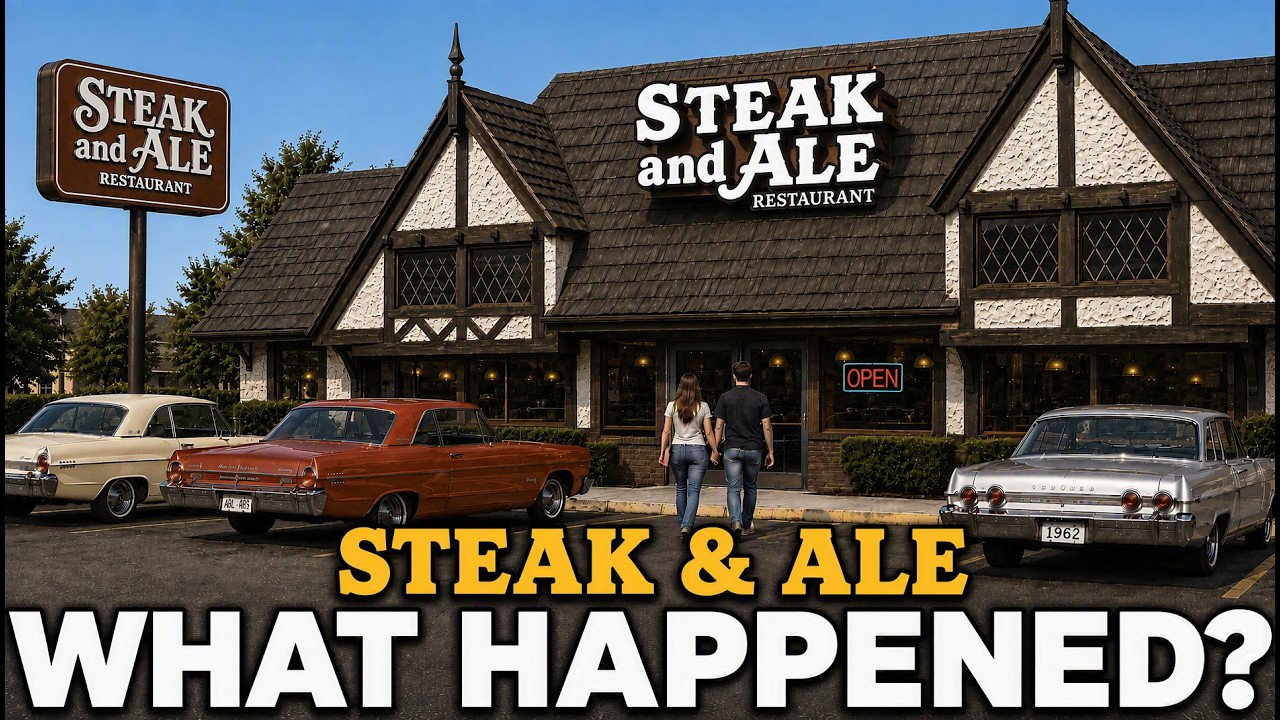
The middle of the market, regular families who wanted a nice night out without dressing up or draining the bank account, had nowhere to go. Brinker built the place that didn’t exist yet. He modeled it after an English inn. Low ceilings, stucco walls, wrought iron, lighting so dim you could barely read the menu.
The whole place was designed to make you forget you were in a strip mall. The menu was printed on a butcher’s cleaver that each server carried in a leather pouch. Prime rib ran about $6. 45 in the mid-1970s.
Steak and lobster, $8. 95. But the real innovation, the one that spread across the entire country, was the salad bar. Steak and Ale is widely credited with putting the self-serve salad bar on the map in American restaurants.
Brinker didn’t do it because it sounded fancy. He did it because a steak takes time to cook and he needed something to keep people happy while the kitchen worked. A practical fix to a timing problem that turned into one of the most copied ideas in the history of American dining. The salad bar wasn’t the only thing.
The server who walks up and says, Hi, my name is so-and-so and I’ll be your server tonight, that started at Steak and Ale. Free soft drink refills. Value-priced lunch menus. Warm honey wheat bread with honey butter before the meal.
Ideas that seem like they’ve been around forever. They haven’t. One guy in Dallas came up with most of them in one restaurant, and within a few years, every one of those ideas was showing up in places Brinker had nothing to do with. The concept was loose.
That’s the first thing he gave away without realizing it. The whole idea. Brinker once told the Associated Press, My goal is to wipe out dining room lights across the country. The darkness was the trick.
Dim the lights low enough and a strip mall disappears. You’re not eating dinner off a highway anymore. You’re somewhere. The second location opened in Houston in May 1967.
By the end of 1968, there were thirteen restaurants across Texas, Oklahoma, Florida, and California. In states where liquor laws didn’t allow the word ale in a restaurant name, Brinker opened the exact same concept under a different name: The Jolly Ox. Same beams. Same cleaver.
Same salad bar. Different sign out front. Brinker took the company public in 1971 as SNA Restaurant Corporation with 28 locations. By 1976, there were roughly 109 Steak and Ales across the country, and that’s the year Brinker sold.
Pillsbury bought Steak and Ale for roughly $100 million in a stock swap. Brinker got Pillsbury stock, an executive vice president title, and a seat on the board. He was rich, he was connected, and he was now operating inside one of the biggest food companies in America. The decision looked like a triumph at the time, but it was the hinge the rest of the story swings on.
By the early 1980s, the brand was big enough that a young Whitney Houston, before she was Whitney Houston, sang the jingle for a Steak and Ale television commercial. At its peak in the late 1980s, there were 280 Steak and Ales across the country. The managers who ran them didn’t just stay in the system. They learned Brinker’s whole playbook, and then they went out and used it.
Two of Brinker’s general managers later founded Outback Steakhouse. Others fanned out across the restaurant industry, landing at chains across the country. People called them Brinker’s brood. That’s the second thing he gave away.
The people who knew how to make it work. While Brinker was still inside Pillsbury, he created another chain called Bennigan’s, an Irish pub theme aimed at the young singles crowd, famous for the Montecristo sandwich and two-for-one happy hours. The two chains became corporate siblings. In 1982, Pillsbury spun them both off into an independent company, S & A Restaurant Corporation.
From that point forward, their fates were tied. But Brinker wasn’t just managing someone else’s restaurant division. He was watching everything, and all of it was teaching him what the next version of casual dining looked like. It didn’t look like a Tudor castle with a cleaver menu.
It looked simpler, brighter, louder, cheaper to build. So in 1983, he left. He walked away from Steak and Ale, from all of it, and took over a tiny Dallas chain called Chili’s. Twenty-three restaurants.
Thirty-five million dollars in sales. A speck compared to what he’d already built. That’s the third thing he gave away. Himself.
The man who created Steak and Ale from nothing, sold it for a hundred million, launched Bennigan’s, and trained half the restaurant managers in America, left all of it behind for a 23-location burger joint. He poured everything into Chili’s. The hospitality instincts, the atmosphere-first thinking, the management training system he’d created at Steak and Ale. All of it.
By 1991, the company was renamed Brinker International. Chili’s, Romano’s Macaroni Grill, and a growing list of brands underneath it. 1,600 locations across 28 countries. 62,000 employees at its height.
The man who invented the sit-down steak dinner for the rest of us had left his original restaurant behind and put together an entire empire of competitors. And it wasn’t just Brinker. Every one of those managers he’d trained, the Outback founders, the people shaping Applebee’s and TGI Fridays and Ruby Tuesday, they were all running the exact same playbook. The one Brinker wrote at Steak and Ale.
Against Steak and Ale. By the late 1980s, the category Brinker had basically invented from nothing was so crowded, so saturated with chains selling affordable dinners in casual rooms, that the original couldn’t breathe. The whole middle of the market he’d created was now wall-to-wall competition, and most of it had his fingerprints on it somewhere. By the mid-1990s, Steak and Ale was a restaurant from 1966 trying to survive in a world it had accidentally built.
The dark Tudor rooms felt dated. The heavy steak and salad bar concept that had seemed so fresh in the 1960s now looked tired next to the brighter, louder places that had sprung up on every corner. Chili’s had a bar scene and fajitas sizzling past your table. Outback had the Bloomin’ Onion and a line out the door.
Applebee’s had a location in every town with a stoplight. All of them were selling the same basic promise Brinker had come up with, a nice meal in a casual place at a fair price, but they were doing it with newer buildings, bigger menus, and marketing budgets Steak and Ale couldn’t match. After the spin-off in 1982, Steak and Ale eventually landed under Metromedia Restaurant Group, and the reinvestment stopped. The buildings got older.
The menu sat still. The darkness that used to make you feel like you were somewhere now just made the place feel old. They tried to stop the bleeding. Steak and Ale rolled out an early evening value menu in the mid-1990s.
Lower prices, a free drink, a dessert, 25-cent wine samples. It didn’t move the needle. When your competition is a hundred restaurants that all borrowed your idea and updated it for the current decade, a cheaper price tag on the same tired room doesn’t fix anything. Norman Brinker, the man who started all of it, was across town running Brinker International, opening new Chili’s at a pace that would have made his 1966 self dizzy.
He wasn’t watching Steak and Ale fade from some distance. He was actively putting up the restaurants that were making it irrelevant. The concept was on every corner, the people he trained were running the competition, and the founder himself was leading the charge. All three things that made Steak and Ale what it was, gone.
All three pointed right back at the original. It wasn’t spite. Brinker wasn’t trying to bury his first restaurant. He was just building the next thing, and the next thing happened to eat the first thing alive.
On January 22, 1993, right in the middle of all this, Brinker was nearly killed in a polo accident in Florida. A high-speed collision left him with 32 broken bones, weeks in a coma, and paralysis on one side. He fought his way back to work within about six months. He wrote a book about it called On the Brink, and helped launch a major breast cancer foundation through his wife Nancy.
But the one person in the world who might have known how to save Steak and Ale was now putting himself back together. And by the time he retired from Brinker International in 2001, Steak and Ale was already too far gone. On July 29, 2008, a Tuesday, Metromedia Restaurant Group filed for Chapter 7 bankruptcy in the Eastern District of Texas, forced into involuntary liquidation by its lender. All 58 remaining Steak and Ale locations closed that same day.
About 150 of its sister chain locations went down with them. The two chains Brinker created side by side, gone on the same morning. Staff found out by phone call. Some locations taped a single piece of paper to the front door: We are closed.
Thank you. Forty-two years of birthdays and first dates and Friday night steaks, and the goodbye was a sheet of printer paper on a locked door. On June 9, 2009, six days after his 78th birthday, Norman Brinker died of pneumonia while on vacation in Colorado Springs. He never saw Steak and Ale reopen.
But the people who loved it never let go. A Facebook group called Steak and Ale’s Comeback, started in 2013, has grown to nearly 55,000 members. People post real memories, the exact booth they sat in on a Friday in 1983, the server who knew their order by heart, the specific Steak and Ale where they had their rehearsal dinner. The single most searched thing connected to Steak and Ale, even now, is the Hawaiian chicken recipe.
Former employees have been sharing the original marinade for years: soy sauce, sherry, unsweetened pineapple juice, red wine vinegar, sugar, and garlic. People aren’t just nostalgic for the restaurant. They’re standing in their own kitchens trying to bring back the specific taste of a Tuesday night in 1984. In 2015, a company called Legendary Restaurant Brands, run by Paul and Gwen Manjimali, bought the Steak and Ale and Bennigan’s names.
After years of announced and delayed comebacks, the first new Steak and Ale finally opened on July 8, 2024, inside a hotel in Burnsville, Minnesota. The salad bar is back. The cleaver menu is back. The prime rib and the Hawaiian chicken are back.
Whether it sticks, whether you can bring back a feeling that only existed in a specific time and a specific place, that’s the part nobody can answer yet. The original Steak and Ale, the dark beams and the stained glass and the warm bread, is gone now. But for a while there, it was really something.
A place that made a Tuesday night feel like an occasion, then quietly disappeared while everyone was busy eating at the places it inspired.