In March 1992, a memo went out from the front office in Benton Harbor, Michigan. After nearly fifty years, the kits were done. The catalog was finished. The doors were closing.
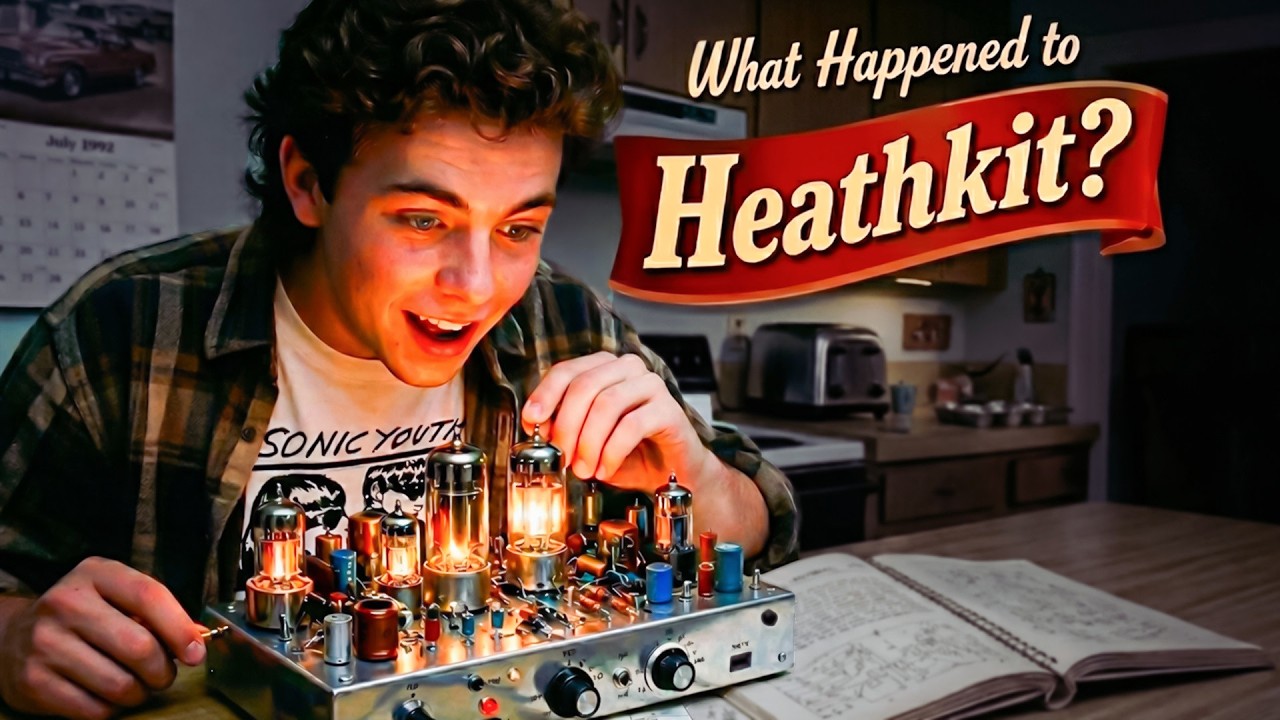
For almost half a century, a brown cardboard box had been an American classroom—a box that could turn a fourteen-year-old into someone who could open a few hundred parts, spend two weeks at the dining room table, and walk away with a working television set he had built with his own hands. Not a model. Not a toy. A real television that pulled in real channels, snowy at first, then sharp.
Benton Harbor sits on the eastern shore of Lake Michigan, about two hours up the highway from Chicago. In 1935, it was a small industrial town with a railroad spur, a few machine shops, and not much else. That was the year a businessman named Howard Anthony bought what was left of a bankrupt little aircraft company called Heath. The original founder, Edward Heath, had died four years earlier when a small plane he was test flying went down outside Chicago.
The company had limped through the Great Depression and finally given up. Anthony bought it for almost nothing, moved what was left to Benton Harbor, and spent the next decade keeping the lights on with aircraft parts and small subcontract work for the war effort. Then 1945 happened. The war ended.
The defense plants shut down overnight. The federal government sat on warehouses full of radio gear, oscilloscopes, vacuum tubes, and radar parts—millions of dollars’ worth of brand-new electronics with no army left to use them. They auctioned it all off for scrap metal prices. Howard Anthony raised his hand.
He ended up with more electronic gear than his building could hold, and he stored it in friends’ barns, in neighbors’ garages, in every dry corner of Benton Harbor that wasn’t already full of something else. Inside one of those piles was a small lot of cathode ray tubes—five-inch screens originally built for radar sets. Anthony’s team looked at them, looked at the rest of the pile, and asked a simple question: what if they sold this stuff to people who wanted to build their own equipment? In July 1947, they shipped their first kit, an oscilloscope.
Every part labeled, every wire pre-cut, a booklet thick as a phone book that walked through every solder joint. The price was $39. 50. A factory-built oscilloscope from a company like Tektronix would run several hundred dollars at the time.
This one would run a couple of evenings at the kitchen table. They printed 500 flyers. The story goes that 350 of them came back as orders. That was the moment a small Michigan factory accidentally figured out what nobody else had: millions of Americans didn’t just want to own a piece of electronics.
They wanted to build it. A Heathkit manual wasn’t an instruction sheet. It was a teacher. It assumed you knew nothing.
It explained what a capacitor did, why this resistor was here, how the signal moved through the chassis. Every section ended with a paragraph that said, in plain English, here is what you just built, and here is why it matters. A kid in Ohio with no engineering degree could spend two weeks at the dining room table and end up with a stereo amplifier that worked. And he didn’t just end up with the amplifier.
He ended up understanding it. The catalog grew. By 1954, Heathkit was doing $10 million a year in sales. By the mid-1970s, that number had climbed to nearly $90 million.
Shortwave receivers, color television sets, hi-fi tube amplifiers, stereo tuners, oscilloscopes, frequency counters, electronic organs you could build in your living room, clocks, garage door openers, even a kit to build your own robot. By 1981, the catalog listed more than 400 different products. Then there was ham radio. The DX60, the HW-101, the SB-101—these were transceivers that took a hundred hours or more to build.
Real soldering, real alignment with a meter and a screwdriver, the kind of project that took three months of evenings and most of your patience. But the night you finished, the night you turned it on, dialed in twenty meters, and heard a voice from Argentina come through your headphones on a radio you had built with your own two hands—that was a feeling you didn’t forget. That feeling is what Heathkit was actually selling. It wasn’t a product.
It was a promise: an ordinary person working in their basement after dinner could build the most complicated piece of equipment in the house. That promise built a generation of engineers, technicians, ham operators, repairmen, and hobbyists. For many of them, the first time they ever picked up a soldering iron was at the kitchen table with a Heathkit manual in front of them. Then the world started to change.
In 1979, Zenith Electronics bought the Heath company for around $63 million. On paper, it looked like good news—Zenith had national distribution, real money, and a respected American brand. Heathkit had a loyal customer base and a factory that knew how to ship 400 different products. But Zenith didn’t really want the kits.
What Zenith wanted was the engineering team that had been quietly building personal computers, the H8 and the H89, at the back of the Benton Harbor factory. Within two years, those computers were rebranded as Zenith Data Systems, and Zenith started selling pre-assembled machines to corporate buyers and the federal government, including business with the Air Force. Computers became a growing share of the company’s revenue. The kits, the heart of the brand for thirty years, were now a sentimental side business.
The second shift was on the factory floor. Through the 1980s, the electronics industry moved away from the kind of components a person could solder by hand. The big resistors and capacitors and transistors with long wire leads—the through-hole parts a hobbyist could stick into a board and solder from underneath—were being replaced by surface-mount technology. Tiny black chips soldered to the surface of a board by a robot that could place 30,000 parts an hour.
You couldn’t build that at the kitchen table. You couldn’t even see it without a magnifying glass. The third shift was the price tag. In 1955, building a Heathkit stereo receiver saved you real money—maybe half what a department store charged for the same thing assembled.
By 1985, a Japanese-built receiver sat on the shelf at Sears for $179, fully assembled with a warranty and a remote control. The kit on the next shelf cost $230 and asked you for forty hours of your evenings. That math used to be easy. Now it didn’t work anymore.
Through the late 1980s, the catalog got smaller every year. Product lines were retired one by one. Loyal customers who had built a Heathkit every Christmas since 1962 would open the new catalog in October and find their favorite radio was gone, their favorite test gear was gone. The company was quietly shrinking around them.
Then, on March 11, 1992, Zenith made it official. After forty-five years and millions of kits shipped, the Heathkit electronic kit business was done. The retail stores closed. The catalog stopped going out.
The phones in Benton Harbor stopped ringing. A company closing isn’t usually a historical event. Companies close every week. But this one closed something bigger than a catalog.
A kid who built a Heathkit shortwave receiver at thirteen grew into the kind of adult who fixed their own car, who wired their own garage, who didn’t call somebody when the dishwasher quit. They had been taught in a very specific way that the machines in their life were not strangers. They could open them. They could understand them.
They could put them back together. And when their own child turned twelve, they could pull the same green-covered manual off the shelf and say, try this one. I’ll help you with the tricky parts. That kind of confidence isn’t something a school teaches.
It’s something you build with your hands, one solder joint at a time, on a kitchen table in front of someone who believes you can do it. That is the real thing that got buried in 1992. Plenty of the aerospace engineers who worked on the Apollo program had cut their teeth on Heathkit gear in high school. The ham radio operators who handle emergency traffic when a hurricane knocks the cell towers down—many of them came up on Heathkit equipment.
The technicians who built the early internet, who wired the phone system, who kept the broadcast stations on the air through the seventies and eighties—for a lot of them, it all started with a brown cardboard box on the kitchen table. Heathkit didn’t die because the kits got worse. It died because the world around it changed. Manufacturing changed.
Prices changed. And the companies that took over stopped building for people who wanted to understand their own machines. In 1975, you built your electronics. In 2025, you replace them.
We didn’t just lose a catalog. We lost the assumption behind it. Heathkit assumed something about its customer that no major American electronics company assumes anymore. It assumed you were smart.
It assumed you were patient. It assumed that if somebody handed you a 400-page manual and a bag of parts, you would figure it out. That assumption built a country. The Heathkit name has come back a few times since 1992.
The brand has changed hands several times, and you can still buy a kit today if you look for it. The spirit of the thing didn’t die either. It just fragmented. Today it lives in Arduino boards and Raspberry Pi computers, in maker spaces and 3D printers, and in garages full of tinkerers across the country.
Millions of people are still building things. They’re just doing it without a single brown box on the kitchen table to bring them all together.