On the night of October 16, 1859, twenty-two men crossed the bridge over the Potomac River into the quiet town of Harpers Ferry, Virginia. They were not soldiers but farmers, laborers, freedmen, and idealists, led by a fifty-nine-year-old abolitionist with a white beard and burning certainty. His name was John Brown. Their target was the federal armory at Harpers Ferry, one of the most important weapons facilities in the United States, where thousands of rifles sat guarded by a single watchman.
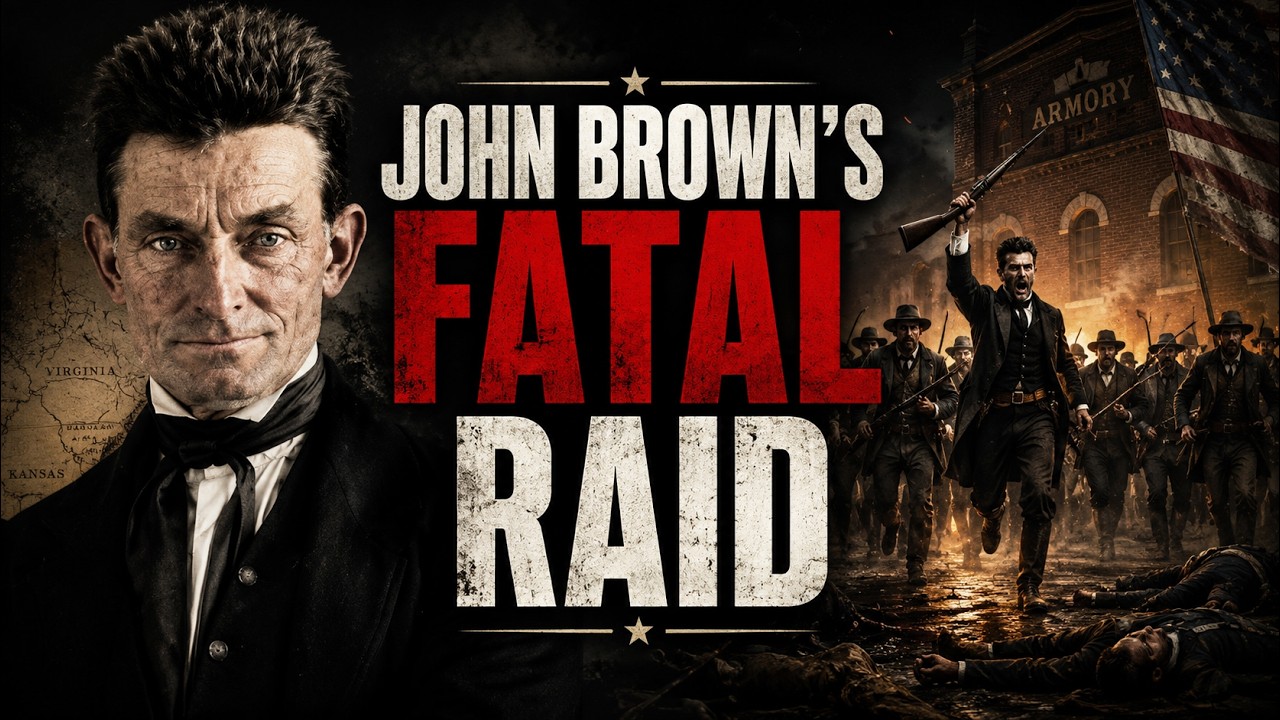
He handed over his keys without a fight. The telegraph lines were cut. By midnight, John Brown controlled the federal armory without firing a shot. He waited for the enslaved people of the surrounding countryside to rise up and join him.
They never came. Within thirty-six hours, the raid was crushed, Brown was captured, and ten of his men, including two of his sons, lay dead. By every practical military measure, Harpers Ferry was a disaster. Yet this brief, failed assault did something that four decades of political compromise could not.
It convinced many white southerners that the North was willing to use force to destroy their way of life, and it forced many northerners to confront the unsettling possibility that the man on the gallows in Virginia might not have been entirely wrong. To understand the raid, one has to understand John Brown. Born in 1800 in New England and raised in a deeply religious Calvinist household, Brown grew up in a home that served as a stop on the Underground Railroad. He tried farming, tanning, and business ventures, and one after another they failed.
He buried nine of his twenty children. By his late fifties, by almost any worldly measure, he looked like a failure. What he had was a theology. He believed in an Old Testament God of justice and judgment, and he saw slavery as an open insult to that God.
He believed with absolute certainty that God had chosen him personally to strike what he called the death blow to American slavery. Most abolitionists believed in speeches, newspapers, and elections. Brown believed in violence. Kansas gave him a battlefield to prove it.
In the late 1850s, the struggle over whether Kansas would be a free or slave state turned the territory into a low-grade civil war that newspapers called Bleeding Kansas. In May 1856, after a pro-slavery mob attacked the anti-slavery town of Lawrence, Brown led a small group to a pro-slavery settlement along Pottawatomie Creek. They pulled five men from their cabins in the dark and cut them down with blades. Kansas made Brown a wanted man and, in some anti-slavery circles, something like a hero.
He was building toward something larger. By 1859, Brown had quietly raised funds from sympathetic northern abolitionists and sketched a plan: seize the federal armory at Harpers Ferry, arm enslaved people in Virginia, and spark a wider uprising that would spread through the Appalachian Mountains. Frederick Douglass told Brown he was walking into a steel trap and would never get out alive. Brown thanked him and went ahead anyway.
In his own mind, he was not a failed businessman or even a radical. He was a prophet. Harpers Ferry was not a sudden outburst of madness. It was the culmination of a lifetime.
The raid started quietly. Brown’s men crossed the Potomac bridge in near silence, took the armory without a shot, and then waited for an uprising that never came. By Monday morning, October 17, armed townspeople and local militia were converging on Harpers Ferry, and a militia force cut off the bridge across the Potomac, Brown’s most direct escape route north. The first of Brown’s men to die was Dangerfield Newby, a tall freedman who had joined the raid because his wife and children were still enslaved in Virginia.
He had tried for years to buy their freedom, only to see the price raised beyond reach. When his body was searched, letters from his wife were found on him, pleas for him to come and save their family. After the raid, she was reportedly sold deeper south. By midday, Brown’s situation was catastrophic.
His men had killed several townspeople, including the mayor of Harpers Ferry, and the mood had shifted from shock to fury. A white flag sent out with a message was met with gunfire. Brown and his remaining followers pulled back to a small brick fire engine house on the edge of the armory grounds, dragged fire engines against the doors, and prepared for a last stand with nine hostages inside. President James Buchanan ordered in the Marines.
By late afternoon, around ninety US Marines were on a train heading for Harpers Ferry under the command of a colonel recalled from leave at his home in Arlington, Virginia. His name was Robert E. Lee. His volunteer aide was a young cavalry lieutenant named J.
E. B. Stuart. Nearly two years before the Civil War began, two future icons of the Confederacy stood outside a tiny brick building facing a man who wanted to destroy the slave system they would later fight to defend.
At dawn, Stuart walked up to the engine house under a flag of truce and offered terms: surrender and be protected from the crowd and brought to trial. Brown refused and tried to bargain for safe passage. Stuart stepped back and waved his hat, the signal. Twelve Marines rushed forward using a heavy ladder as a battering ram.
On the second strike, they smashed a hole. Lieutenant Israel Green forced his way inside, found Brown near the doorway with his wounded and dying sons around him, and knocked him to the ground. In less than three minutes, it was over. Ten of Brown’s men were dead, seven were captured, and John Brown, bloodied and unconscious, was alive.
The raid had lasted about thirty-six hours. As Robert E. Lee watched the battered old man carried out on a stretcher, he had no way of knowing what he was really delivering to the nation. He had captured a criminal.
The country was about to create a martyr. When Brown’s trial opened in Charlestown a week later, he was so weak from head wounds he had to lie on a cot in the courtroom. His first court-appointed lawyer saw only one possible strategy: plead insanity. Brown refused.
“I am perfectly unconscious of insanity,” he told the court. He would rather hang as a sane man than live as a mistake. The trial ran just six days. The jury took less than an hour.
On November 2, 1859, John Brown was convicted of treason against Virginia, murder, and conspiring with enslaved people to rebel. The sentence was death by hanging thirty days later. Then the judge asked if he had anything to say. Brown stood up and spoke.
He did not beg for mercy. He said he had acted on behalf of God’s despised poor, that helping the enslaved was not wrong but right, and that the laws he had broken were wicked and unjust. Then he said that if it was deemed necessary that he should forfeit his life and mingle his blood with the blood of his children and with the millions in bondage, he would submit. “So let it be done.
”
Reporters raced his words north over the telegraph wires. Ralph Waldo Emerson would later say that only the Gettysburg Address could stand beside Brown’s final statement. Henry David Thoreau called him a man of rare moral courage. For six weeks, as Brown waited in his cell, the terrorist of Harpers Ferry faded, and in his place a martyr took shape.
Brown understood exactly what he was doing. “I have been whipped, as the saying is,” he admitted in a letter from jail, but he believed he could recover all the lost capital by hanging a few moments by the neck. He had failed as a soldier. He meant to succeed as a symbol.
On the morning of his execution, he handed his jailer his watch and a folded note, his last written words. December 2, 1859, dawned clear and cold. Virginia’s governor, terrified of a rescue attempt, ringed the execution site with more than a thousand soldiers. Among the troops were a young artillery officer named Thomas J.
Jackson, not yet called Stonewall, and a young actor named John Wilkes Booth, who borrowed a militia uniform just to get close enough to watch. Brown rode to the gallows sitting on his own coffin. At around 11:00 a. m.
, the trapdoor fell. The note he left behind said he was now convinced the crimes of this guilty land would never be purged away but with blood. In the North, church bells tolled across New England, businesses closed in some cities, and Emerson called him a new saint. In the South, people read every word of those tributes, and that reaction scared them more than the raid.
But the real shockwave was just beginning. The raid had lasted about thirty-six hours. The panic it unleashed lasted for years. By 1859, roughly four million people were enslaved in the United States, and in many southern counties they outnumbered white residents several to one.
The entire system depended on keeping those millions controlled and unable to organize. That system already had a nightmare: Nat Turner, whose 1831 revolt in Virginia killed dozens of white people before it was put down. Harpers Ferry did not just poke that fear, it confirmed it. What made it worse in southern eyes was who led it.
Turner had been a black preacher rising from within the system. Brown was a white Northerner crossing into a slave state to arm enslaved people and spark revolt. The danger was no longer just internal. It was coming from outside.
Southern newspapers called the raid the natural result of Northern abolitionist doctrine and, in some cases, the true face of the rising Republican Party, no matter how loudly Lincoln and others condemned Brown. Then came the discovery that turned fear into panic. Searching Brown’s Maryland farmhouse, Virginia officials found letters and papers showing he had not acted alone. He had been funded by a small circle of wealthy northern abolitionists known as the Secret Six, ministers, reformers, and businessmen from Boston and beyond.
When their involvement leaked into the press, it hit the South like a bomb. The reaction was a cold, sinking terror. Radical secessionists, the fire-eaters who had spent years arguing that only leaving the Union could protect the South, suddenly sounded less extreme. Harpers Ferry became their exhibit A.
States responded not with more speeches but with guns. Militias that had been half social clubs drilled in earnest. Legislatures diverted money to weapons and training. The South was not just afraid, it was arming.
The North was splitting. The Republican Party, barely six years old, was trying to sell itself as a sensible, law-and-order alternative. When news of Harpers Ferry hit, Republican leaders rushed to distance themselves. Abraham Lincoln insisted that John Brown was no Republican and that his violence was both illegal and useless.
Northern newspapers mostly agreed at first, calling the raid the work of a madman. But while politicians and editors rejected Brown, a small group of influential writers and thinkers began to speak of him in almost sacred terms. Thoreau called him an angel of light. Emerson called him a new saint.
Victor Hugo, writing from Europe, predicted that Brown’s death would open a crack in the Union that would eventually tear it apart. White southerners could not tell which voice was the real North. Which North was the true North, the one at the podium condemning Brown, or the one ringing church bells and singing his name? Edmund Ruffin, a fire-eating Virginian, took the iron pikes Brown had ordered for his planned uprising and mailed one to every southern governor, engraved “Sample of the favors designed for us by our Northern brethren.
” It was pure theater, but it worked. The 1860 presidential election was only months away. In the southern mind, John Brown had already shown them what a Republican future would look like. When Lincoln won the presidency without a single deep South electoral vote, secessionists saw it as the final proof.
South Carolina moved first in 1860. Six more states followed before Lincoln took office. In February 1861, they formed the Confederate States of America. By April, Confederate guns were firing on Fort Sumter.
Historians still argue how much of this was because of John Brown. The road to war had many milestones. But Harpers Ferry did something those other crises didn’t. It made the danger feel immediate and physical on both sides.
For years, the debate over slavery had been conducted at a distance. Brown ended the abstraction. He picked up weapons, crossed a river, and turned the argument into gunshots in a real town, hostages in a real building, and a gallows in a real field. He forced Americans to stop treating slavery as a theoretical problem and face it as a physical reality heading toward a physical reckoning.
On the morning of his execution, Brown handed his jailer a note: “I, John Brown, am now quite certain that the crimes of this guilty land will never be purged away but with blood. ” He was hanged at 11:00 a. m. on December 2, 1859.
Sixteen months later, the first shots of the Civil War roared over Charleston Harbor. Brown had seen it coming. He didn’t start the fire.
He was the first one who stopped pretending he couldn’t smell the smoke.