Before the first shot was fired, something else was already destroying them. This is the story of a road cut in relentless succession: a soldier’s diary entry from a man convinced he was a coward, a general who punished exhaustion as if it were cowardice, and a Philadelphia doctor who discovered a new kind of heart disease. It is the rhythm of unbroken dust. In June and early July of 1863, the Army of the Union was on the move.
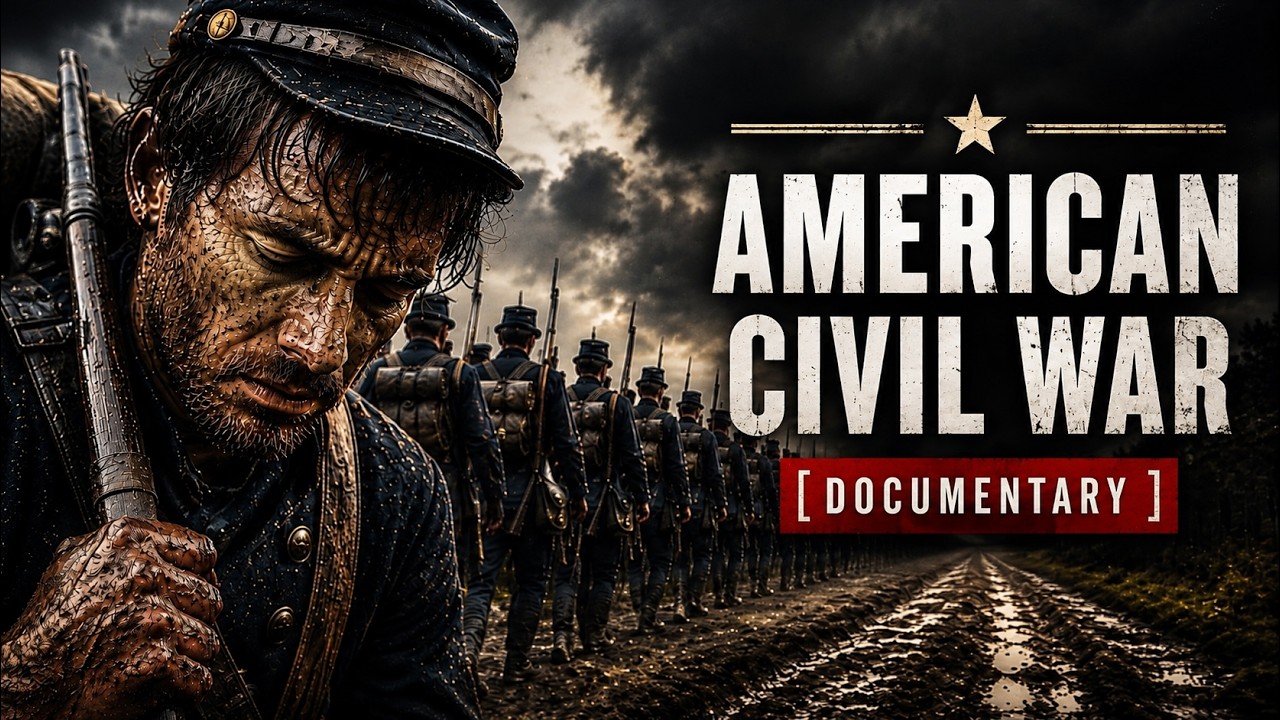
Not a single march, but an unending series of them. Twenty-three miles in heavy rain, then forty miles without rest, then another twenty. Each mile added weight to bodies already carrying forty pounds of equipment in temperatures exceeding one hundred degrees. Cutting a single mile takes roughly two thousand steps.
For American Civil War soldiers, the usual daily march was twelve miles: twenty-four thousand times a man had to consciously move his foot forward on an ordinary day. By the time the shooting started, their bodies were already broken. But what happened to their minds along the way was far worse. This is the story of one campaign in particular and what it reveals about every forced march like it.
Not the war’s biggest battle, not its most famous charge, just the roads and the men who walked them and what that walking did to their minds. On the evening of July 1, 1863, the men of the Union Sixth Corps received orders that would define the next forty hours of their lives. For the previous week they had been in motion, crossing rivers, covering distance, pushing north under urgent operational pressure. That Wednesday evening, a courier rode his horse up the hill to Sixth Corps headquarters, foam at the horse’s mouth, its flanks bleeding from constant spurring.
Within minutes, orders went out to the commanders of thirty-six regiments and eight artillery batteries. Fall in. Move now. Nearly forty miles away, two armies had already collided that morning at a small crossroads town called Gettysburg.
The Sixth Corps, nearly sixteen thousand men, was ordered to march there. In the dark, in the heat, under conditions no army had time to prepare for. The men of the Fifth Wisconsin did not know where they were going. Some hoped for Westminster, only ten miles down the road.
But a kind-hearted farmer corrected their course while handing out cups of milk. There was a battle raging, and everyone now understood the battle was their destination. The steps that had been light and balanced became heavy and mechanical within an hour. Night swallowed the column.
They marched in pitch darkness, no moon, only a pale glimmer of stars hiding behind the clouds. There was a reason no halt was declared. If the columns stopped, exhausted men would fall where they stood and be left behind, asleep in the middle of the road, swallowed by an army moving on without them. Just after midnight, a band near the head of the column began to play the Battle Hymn of the Republic.
The melody rang across the dark fields, the men picked up its rhythm and began to sing. First dozens of voices, then hundreds, then, by some accounts, what seemed like the entire corps booming the refrain into the Maryland night. Ten thousand voices singing “His truth is marching on. ” For a while, the march had a musical rhythm.
It did not last. By mid-morning the heat was past ninety degrees. By afternoon it would exceed one hundred. The column itself stretched nearly ten miles from front to rear, so long that the rearguard was barely leaving camp while the forward elements had already covered miles of road.
Thousands of boots, hundreds of wagon wheels, the hooves of artillery horses, all grinding the dry road into a choking fine powder three or four inches deep in places, rising with the July heat to hang over the column like fog. There was no singing anymore. Men staggered and stumbled along the road as if drunk. Now and then a rifle slipped from a soldier’s grip and clattered against the stony road while the man carrying it folded and collapsed into the roadside dust.
His comrades pulled him aside, laid his rifle beside him, and closed ranks to keep the column moving. No one had time to do anything else. There was a battle waiting, and it would not wait for stragglers. A military surgeon writing during the war described the ordinary experience of a soldier on a hot day’s march with precise clinical detail.
The back of a man’s head grows painfully hot no matter how he tries to protect it, wrapping it in a silk handkerchief, turning his cap backward, or stuffing green leaves inside as a temporary insulator. His heart, the surgeon wrote, beats violently. He breathes rapidly with his mouth open, inhaling air already hot and heavy with dust. None of this has anything to do with cannon fire.
This is simply what marching does to a body covered in wool, carrying fifty pounds of iron and leather under a Virginia or Maryland sun. Long before a soldier ever saw the enemy, the road itself had already begun to work against him. As one soldier wrote of the Gettysburg campaign, they marched about forty miles without rest, sleep, or time to make coffee. No chance for the simplest refreshment, nothing of ordinary human comfort that might quiet a frantic mind.
By the time the leading troops reached Gettysburg, they had reached what those men themselves described as the limit of human endurance. Then in the afternoon, the character of the march changed again. From somewhere ahead, over the rolling hilltops the road wound through, came the low sound of artillery fire, and above the treeline appeared faint white clouds of bursting shells. For men who had spent hours convinced the road might never end, that sound, as one soldier later put it, was like the effect of a spur on an exhausted horse.
It did not make the fatigue disappear. It gave the body an additional reason to keep moving anyway. Here lies the true story of the Civil War soldier. Not on the battlefield where history books linger, but on the road leading to it, where almost no one thought to look, where the mind was already collapsing before the bullets began to fly.
There is a certain sound a marching column makes that no single word fully captures. Thousands of boots striking hard earth or broken stone in something close to harmony. Not perfectly synchronized, but close enough that the ear stops hearing individual footsteps and begins to hear one continuous rhythm instead. Low and regular, like a heartbeat through a stethoscope.
Soldiers on both sides wrote about this rhythm constantly, more than about anything else concerning the march. Because once a man walked inside that sound for six, eight, or ten hours, it stopped being background noise and became something closer to a second pulse. A pulse belonging to the entire column rather than any single man within it. That rhythm did something to the mind that silence never could.
It filled the hours in a way that left no room for distraction, no relief for attention. There was nothing to do but keep pace with a rhythm that neither slowed nor stopped. Mile after mile after mile. For men marching toward a battle whose outcome they could not predict, that rhythm became a countdown they could not halt.
Each step brought them fractions of a second closer to whatever was waiting. Officers understood, even without formal psychology, that music could hijack that rhythm and steer it toward something more bearable. A band playing near the head of the column could momentarily transform dread into something closer to a sense of purpose. Ten thousand voices singing battle hymns instead of ten thousand men silently listening to the sound of their own boots.
But music required breath a man did not always have to spare. It also required faith, if only for a few minutes, that the thing waiting at the end of the road was worth singing toward. And when that faith faltered, the rhythm returned to what it had always been underneath the music: a clock pendulum counting the distance between a man and the worst thing that had ever happened to him. In battle, the mind receives a mercy it finds nowhere else in a soldier’s day.
Adrenaline floods the body. Training takes over. Instinct makes the decisions. There is no room for a man to sit with his fear, because his body is already moving, already committed, already past the point where thinking would help.
The march offers no such mercy. Hour after hour, there is nothing to do but walk and think and then walk more. And the mind, given all that empty road and unstructured time, does not go to a comfortable place. Osborn Oldroyd, a soldier in the Twentieth Ohio, recorded this precisely in his diary.
In May 1863, hours before an expected attack on Confederate fortifications at Vicksburg, he was seized, as he wrote, without warning. Terror, awe, and exhaustion so severe that he sat down hard against a tree. He questioned himself in that very moment, unsure whether he was afraid or had simply skipped breakfast. He reached into his haversack for a piece of hardtack and found he could not swallow it.
He drank from his canteen. It did nothing to calm him. Then came the thought that frightened him more than the coming battle itself: the conviction that he must be a coward, for what honest, brave man felt this kind of dread and still had to rise and walk toward it anyway? He trembled as if feverish, got back to his feet, and walked toward the fight because there was no escape, only the choice of how to face it.
That single diary line contains nearly everything this story is about. A man who had done nothing wrong, who was not weak, who would in fact fight bravely that day, sitting alone with a fear so intense it closed around his throat. And the first thing that came to his mind was not sympathy. It was accusation.
Surely I am a coward. Modern psychologists have a name for this particular kind of suffering: anticipatory dread. The specific torment of watching harm approach with plenty of time to imagine every detail of it before it actually arrives. Oldroyd was not the only one whose body kept its own records.
The dread of the march was not confined to the mind. It erupted violently in the body long before the first shot was fired. William Henry Yelverton recorded the physical panic that seized him just before the Battle of Winchester. He did not describe enemy maneuvers.
He described his nervous system collapsing under the weight of anticipation. One second, he wrote, you want to rush forward. The next second you are looking for a rock or a tree to hide behind. Sometimes your heart races a thousand beats a minute.
Other times it seems not to move at all. Your knees begin to shake. He was not wounded. But he was, in every sense of the word.
Both men described not the fighting but the minutes and hours immediately preceding it, because that is where the real damage was occurring. Somewhere around the eighth or ninth mile of a long march, even with no battle at its end, something in a man’s mind begins to break down. The eyes stop tracking anything specific along the roadside. The face goes empty, slack, losing whatever expression it carried that morning.
Soldiers who marched together for years wrote about comrades who simply stopped responding when spoken to, while their boots kept finding the path worn by ten thousand boots before them, without any clear direction from the man wearing them. One soldier wrote that men lay along the roadside by the dozens, utterly exhausted. Not wounded, not shot, simply unable to continue. This is a documented response to sustained physical and psychological stress, well understood by modern medicine.
The mind detaches from the body because the body’s suffering has become too unbearable to remain fully present for hour after hour, mile after mile. This is not weakness and not shirking of duty. It is a nervous system doing the only thing left to it when there is no other exit from the situation in which it finds itself trapped. Not every long and brutal march produced this kind of collapse, and that exception deserves careful thought because it tells us something exhaustion alone cannot.
In the spring of 1862, Confederate General Thomas Jackson led fewer than seventeen thousand men on a campaign through Virginia’s Shenandoah Valley that earned his soldiers a nickname still remembered today: Jackson’s Foot Cavalry. Over forty-eight days, Jackson’s army covered nearly six hundred and fifty miles and fought five pitched battles against three separate Union forces outnumbering them by more than three to one. At one point they marched forty miles in just thirty-six hours to escape pursuers slowed by spring rain and mud. In another part of the same campaign, they marched fifty-seven miles in fifty-one hours.
By any purely physical measure, this was an ordeal at least as harsh as anything the Sixth Corps endured in its race toward Gettysburg the following year. Yet Jackson’s men did not emerge from the Valley Campaign broken. They emerged feared by the enemy and full of pride in what they had just accomplished. So what was truly different?
Not the distance, which was actually harder. Not the weather, as most of the campaign took place in the same thick Virginia spring humidity that soaked every other army and every woolen uniform that marched through that region. What was different was the purpose of the marching and who commanded it. Jackson’s men clearly understood that their speed and endurance were the weapon.
Every mile they covered was a mile the enemy had no time to answer. That realization transformed severe exhaustion into proof of their effectiveness rather than a countdown to inevitable slaughter. The soldier’s fear on the road to Gettysburg was fear of an ending entirely beyond his control. The soldier’s exhaustion in the Shenandoah Valley was, at least for much of that campaign, clear evidence that his side was winning and that his suffering was achieving something real.
It also helped that Jackson’s campaign was built almost entirely on maneuver rather than attrition. His men were not simply marching toward a fixed point on the map where a battle was certain to occur at a set hour, as the Sixth Corps raced against time toward fighting already underway at Gettysburg. They marched to create opportunities, striking at Kernstown, then vanishing back through the valley before Union forces could organize a response, only to reappear days later where no one expected them. That variability and unpredictability had a double psychological effect.
Jackson’s own men rarely knew when the next fight would come, sparing them the anticipatory dread that accumulated mile after mile on marches with a known destination and a known hour. In this particular case, that uncertainty may well have protected them from the very thing that broke men on more predictable marches elsewhere in the war. None of this negates the physical cost. Jackson’s own army suffered its share of stragglers and collapses along the way.
No forced march of that length happens without losses from men who simply could not keep up. But this matters enormously for understanding the psychological factors at work. The same weight, the same wool, the same merciless heat could produce very different mentalities depending on what the soldier believed was waiting at the end of the road and who was asking him to keep marching. Dread is not merely a result of miles marched.
It is a result of what those miles are believed to lead to, and whether a man trusts the cause he has been asked to march for. Then, on a particular march, after the tenth or eleventh mile, the sound of the entire world changes. Soldiers rarely identified the sound as artillery bombardment the first time they heard it. They called it thunder.
A low, rolling sound rising from a distant horizon. The kind of sound that means nothing at all until a man looks up and realizes the sky above him is completely clear of clouds. The body reacts before the conscious mind finishes processing the thought. This is not metaphor or dramatic license.
During and after the war, a Philadelphia physician named Jacob Mendez Da Costa began systematically studying hundreds of young soldiers who passed through military hospitals. They suffered from a set of symptoms that on the surface appeared identical to serious heart disease: irregular pulse, sharp chest pain, shortness of breath appearing with the slightest exertion, and a heart that seemed to be trying to escape the ribcage. Careful physical examination revealed no organic defect in the heart itself. Da Costa named the condition “irritable heart,” and the soldiers who suffered from it gave it a simpler name that stuck: soldier’s heart.
Through his work at a specialty hospital in Philadelphia called Turner’s Lane, Da Costa carefully studied hundreds of young soldiers throughout the war. Unusually for the medicine of that era, he continued to follow some of them after the war, to see whether the condition faded once the marches and fighting stopped. It was in fact the first accurate clinical description of what the exhausted, terrified human body does under sustained anticipation of imminent violence. Cortisol flooding a system that no longer has any reserves to offer.
A heart racing to meet a threat the legs and arms can no longer fully confront. Da Costa published his complete findings in 1871, six years after the war ended, in a paper still cited today as one of the founding documents of clinical cardiology in the United States. Built entirely on the bodies of exhausted infantrymen who marched too many miles toward too many battles. Forty miles of continuous motion does not simply fade away the moment the cannons begin.
Instead, it is buried under a new layer of raw panic in bodies already running on their last reserves. Surgeons in both armies documented thousands of men who fell to sunstroke, dehydration, and exhaustion before ever reaching the firing lines. A soldier who had just marched forty miles without rest was expected to steady his rifle, aim with precision, and hold his ground on legs that could barely carry him an hour earlier. This is the context no one writes about in official battle reports.
Yet it is the context in which virtually every major battle of the Civil War was actually fought. Not every man reached the battle line intact. Along nearly every long march of the war, a number of soldiers dropped out of the marching column and simply stopped moving. The military system had a ready word waiting for them: stragglers.
The assumption among officers tended to be direct and merciless. These were the cowards and shirkers, men who lacked whatever quality the men who kept marching possessed. The punishment for straggling could be severe. Confederate Brigadier General Charles Winder once ordered thirty men from his own brigade tied and gagged, a punishment involving bound wrists and ankles and hours of detention under the summer heat, as a public lesson for lagging during the march.
Half of those thirty men deserted that very night. The rest, according to the account that circulated, publicly swore that Winder’s next battle would be his last. It was Federal fire that killed him in the fighting that followed shortly after. A general punished exhaustion as if it were cowardice, and his own brigade swore he would not survive the next battle.
He did not. Whatever lesson the brigade was meant to learn from that punishment, the men who received it did not emerge having learned obedience. They emerged knowing exactly who they considered their real enemy. Consider that moment again.
A soldier who has marched eleven miles carrying fifty pounds of gear, spending each of those miles silently rehearsing his own possible death in whatever form the coming battle might take, reaches a point where his legs physically cannot take a twelfth step. This is not, in its essence, a failure of the body. The body has already done everything a human being could ask of it for eleven continuous miles. Something else entirely made that decision.
Facing one final mile that ended in canister and rifle fire, the mind issued an order the legs obeyed instantly and without argument. Stop. From the officer’s viewpoint on that line, it looked exactly like cowardice. From the inside, it was closer to a circuit breaker tripping.
A mind silently refusing to allow its body to walk one more step toward what it had already understood was coming. With no vocabulary yet available to either party to call it anything other than a simple failure of character. But we know better now. That body was not failing.
It was doing the only thing it could do. Soldier’s heart did not disappear the moment the guns fell silent at Appomattox. In those same years, a Philadelphia neurologist named S. Weir Mitchell was treating a completely different set of war patients for something he chose to call “nerve injury,” a condition in which physical wounds seemed to leave behind lasting psychological damage, for which 1860s medicine had no other language.
Two separate physicians working during the same war from entirely different angles, one cardiac and one neurological, each independently arrived at the same essential truth: what the human mind endures in war leaves a real and lasting mark every bit as much as any bullet, even in cases where no visible wound appears anywhere on the body. Neither term fully survived into the next century. Fifty years later, in the trenches of World War I, doctors began calling an almost identical set of symptoms shell shock. In World War II, the same underlying condition was renamed combat stress or battle fatigue.
By 1980, the American Psychiatric Association finally settled on the name that has remained in use ever since, the name still used in every veterans’ hospital in the country today: post-traumatic stress disorder. Different wars, entirely different weapons, a full century of medical terminology appearing, disappearing, and being replaced. Beneath every one of those names sits the same soldier, the same racing heart, the same mind desperately trying to bear a burden it was never created to carry alone. But there is a quieter part of this history too, a part rarely appearing in popular accounts of the war.
For more than a hundred years after Appomattox, historians largely assumed that Civil War soldiers were simply tougher than modern men, immune to the kind of psychological wounds we now take for granted in every war since. The records from places like the Trenton Insane Asylum in New Jersey tell a different story. One case recorded there describes a soldier badly wounded at the Battle of Pittsburgh Landing, known today as Shiloh, in April 1862. He spent the next two years recovering in a veterans’ hospital before finally being discharged to return to his parents.
The moment he arrived, his family noticed something was wrong. He was, in the words recorded at the time, dull, distracted, and absent in his manner. A man who had physically survived his wound but had never really come home in a way his parents could recognize. His condition only deteriorated over the following years.
In 1866, his parents made the decision to commit him to the asylum, believing rightly, as the timeline shows, that what had happened to him had occurred somewhere between the battlefield at Shiloh and his final discharge from the army. Veterans were admitted to institutions like this in the post-war years under diagnoses such as mental disturbance. Their families and doctors quietly drew a direct line between what the man had seen and done while wearing the uniform and the condition in which he returned home. Decades before anyone had the word for it, before anyone had the language to call it anything other than simple weakness or failure of mind, the connection was there all along, understood by people in fragments, without the framework to build it into something larger.
So they noticed it and documented it, preserving it in hospital records and letters home under a diagnosis the modern world would eventually learn to understand. Forty miles separated a Civil War soldier from a battle whose contours he already knew in intimate and horrifying detail. Some men covered every one of those miles. Some covered thirty.
Some covered twenty. Some covered eleven and then stopped suddenly on the road. Not because they were weaker than the men still marching beside them, but because something in their minds had already made the calculation the rest of the army would not openly acknowledge for another hundred years. The war did not merely break bodies on that road.
It produced the first true medical record of a wound that medicine, more than one hundred and sixty years later, is still trying to find the right name for. Perhaps that is the part worth contemplating longest. Not the miles, not the mud, not even the battles that followed at the end of every road. But the fact that an entire army on both sides of that war spent four years pushing men to the very edge of what the human mind could endure, and then punishing those who reached that edge for reaching it.
Because none of the participants yet had the vocabulary to describe it as anything but weakness, decades before they had the framework to understand it as a wound, generations before they had the language to name it properly. The men who stopped at the eleventh mile were not an exception to the story of the Civil War soldier. In a very real sense, they were the story itself, told with honesty perhaps for the first time.