On July 28, 1980, John Favara vanished from the face of the earth. He had been a neighbor of the Gotti family in Howard Beach, Queens, and four months earlier, his car had struck and killed twelve-year-old Frank Gotti, dragging the boy’s body nearly two hundred feet before bystanders could stop the vehicle. Police ruled the death an accident and filed no charges. Favara was never seen again, and his disappearance remains one of the most chilling unsolved cases connected to organized crime in New York City history.
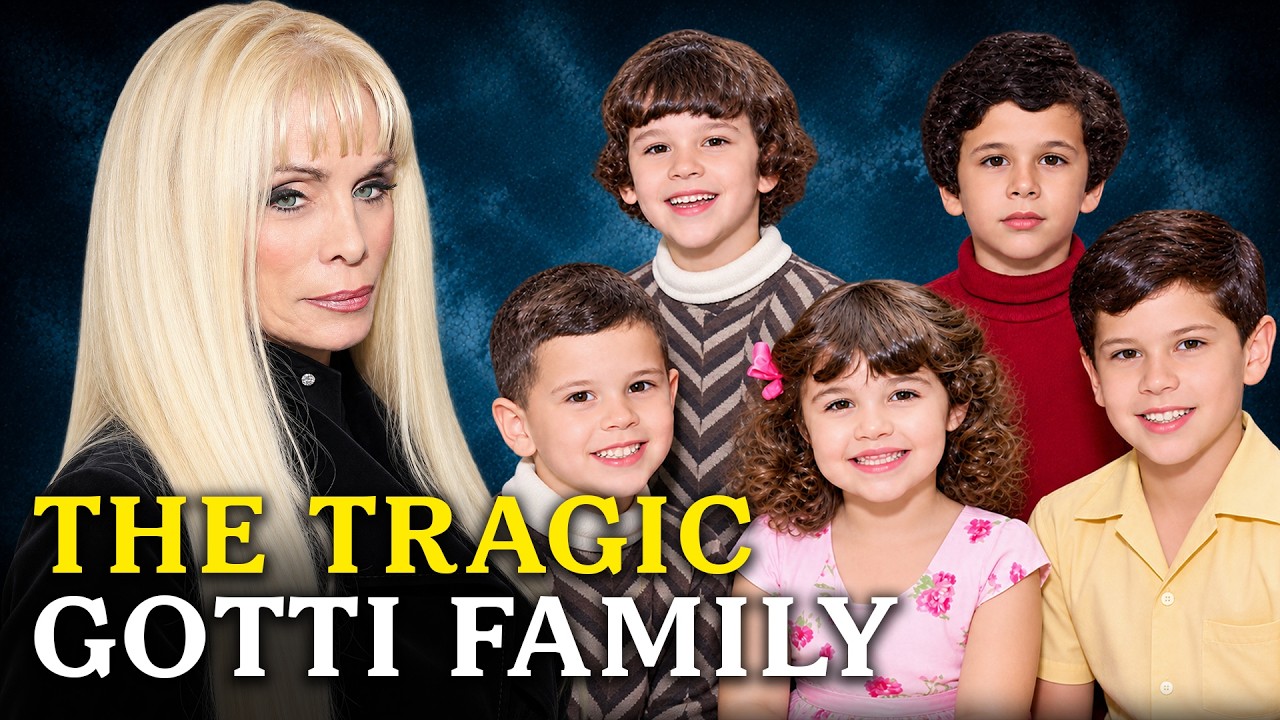
Neither John Gotti nor his wife Victoria ever spoke publicly about what happened to the man, a silence that came to define how the family handled tragedy for the rest of their lives. Long before John Gotti became the most feared crime boss in America, he was a young man from the Bronx trying to build a life in New York. He met Victoria DiGiorgio at a Brooklyn bar in the late 1950s. She had been married once before and had a young child from that relationship.
They married on March 6, 1962, by which time their first daughter, Angela, had already been born. Over the next twelve years, the couple had four more children: Victoria in 1962, John Angelo, known as Junior, in 1964, Frank in 1967, and Peter in 1974. During the early years of the marriage, Gotti’s criminal career was still forming. He spent considerable time in prison during the mid-to-late 1960s on hijacking charges, leaving Victoria to raise the children largely on her own with modest finances.
She managed the household, disciplined the children, and provided whatever stability the family had. By 1972, after his release, Gotti became a fully initiated member of the Gambino crime family, setting the family on a path toward extraordinary wealth and danger. Then came the tragedy that reshaped everything. On March 18, 1980, Frank Gotti was riding a borrowed minibike near a construction site close to the family’s home in Howard Beach.
A neighbor, John Favara, reportedly driving under the influence of alcohol, struck the boy with his car. Rather than stopping, the vehicle dragged Frank’s small body for an estimated two hundred feet before other neighbors managed to halt the car. Frank died from his injuries. Police investigated and ruled the incident an accident, declining to file charges.
For the grieving family, and for much of the community, that decision felt like a denial of justice. For Victoria, the loss was nearly unbearable. According to accounts later shared by her daughter, also named Victoria, in a 2009 memoir, John Gotti himself admitted that telling his wife their son had died was among the most difficult things he had ever done. He described the sight of her sitting in the hospital waiting room as something that genuinely frightened him for the first time in his life.
In the aftermath, Victoria fell into a deep depression, reportedly became suicidal, and remained largely bedridden for nearly a year. That grief soon turned into something more dangerous. In the days following the accident, Victoria crossed onto Favara’s property carrying a baseball bat, striking his car repeatedly and lunging at him directly, though she reportedly never landed a blow on the man himself. Later that year, the family took her to Florida, hoping the distance would offer some relief from the grief that now clung to every corner of the neighborhood.
Then, four months after Frank’s death, Favara disappeared. He has never been found. Neither John nor Victoria ever addressed the disappearance publicly for the rest of their lives. As Gotti’s power grew throughout the 1980s, he earned nicknames like the Dapper Don and the Teflon Don for his ability to repeatedly avoid conviction.
Victoria maintained the family’s modest two-story home in Howard Beach, a house that reflected a surprisingly ordinary lower-middle-class lifestyle despite the criminal empire her husband was building beyond its walls. Friends described this as a deliberate choice, an attempt to preserve some semblance of normal childhood for the remaining children. Of all the children, Junior most directly mirrored his father’s path. As John Gotti’s legal troubles mounted, culminating in a 1992 conviction for murder, racketeering, and obstruction of justice that sent him to federal prison for life, Junior stepped into the role of acting boss of the Gambino family while still in his early thirties.
His tenure proved less durable than his father’s. In 1998, he was arrested on gambling and extortion charges, pleaded guilty the following year, and received a sentence of just over six years. After his release in 2004, he faced several more legal proceedings, but prosecutors never secured another conviction, with multiple trials ending in hung juries and mistrials. During this period, Junior made a decision that would have seemed almost unthinkable within the traditional codes of organized crime: he publicly stated his intention to leave that world behind.
Victoria, deeply distressed watching her only son follow in his father’s footsteps, reportedly confronted John directly, threatening to cut off contact if Junior’s involvement continued. Junior eventually settled into a quieter existence on Long Island, married Kimberly Albanese in 1990, and raised six children. He has since published his own memoir and worked to publicly distance himself from his father’s legacy. His sister Victoria charted a different course.
She married Carmine Agnello, a scrap metal dealer, in 1984 against her parents’ disapproval. The couple had four children, though their first daughter, Justine, was tragically stillborn nine months into the marriage. They later had three sons: Carmine Jr. , John, and Frank, named in memory of the brother Victoria had lost so tragically.
Carmine Agnello’s business dealings eventually drew federal scrutiny, leading to his arrest and imprisonment on extortion and arson charges. In 2003, with her husband still incarcerated, Victoria filed for divorce on grounds of constructive abandonment, ending the nineteen-year marriage and gaining ownership of the family’s Long Island mansion. That same period brought the family renewed public attention. In 2004, A&E premiered a reality television series called Growing Up Gotti, featuring Victoria as a devoted single mother raising her three teenage sons under the weight of the family’s notorious reputation.
The show became the highest-rated program in the network’s history at the time of its debut, drawing more than three million viewers for its premiere and running for three seasons until December 2005. Victoria had already published several novels during the 1990s and early 2000s, and she later wrote a 2009 memoir offering her own account of growing up as the daughter of one of America’s most notorious crime figures. All three of Victoria’s sons grew into adulthood having spent a formative chunk of their teenage years on national television. Carmine Jr.
briefly pursued a career as a recording artist, appearing on VH1’s But Can They Sing? and announcing plans for a hip-hop album, though the project never achieved significant commercial traction. John Gotti Agnello, the middle son who carried his grandfather’s name, stepped away from public life almost entirely, marrying his longtime girlfriend Alina Sanchez in 2015 and building a quiet suburban family life on Long Island. Frank Gotti Agnello, the youngest, likewise moved out of the public spotlight following the conclusion of the family’s reality show.
Angela, the eldest daughter, took a different approach entirely. Rather than pursuing public notoriety, she has spent much of her adult life working to portray her family in what she considers a more accurate and sympathetic light, pushing back against sensationalized portrayals of her father in books, documentaries, and films. She has spoken out periodically in interviews connected to documentaries and retrospectives, but never sought the sustained media attention her sister Victoria built. Peter, the youngest child, born in 1974, grew up during the peak years of his father’s public profile.
Unlike Junior, he chose not to pursue any direct involvement in organized crime, instead building a legitimate business career, eventually establishing tattoo parlors alongside his wife. Of all five children, his path arguably represented one of the more successful examples of building a stable life outside the shadow of his father’s criminal empire. Victoria DiGiorgio remained married to John Gotti for the entirety of his imprisonment. She never publicly turned against him, even as his former underboss Sammy the Bull Gravano cooperated with federal prosecutors and helped seal his conviction.
Gotti died on June 10, 2002, at the Federal Medical Center in Springfield, Missouri, succumbing to throat cancer while serving his life sentence, bringing an end to a marriage that had lasted exactly forty years. Following his death, Victoria inherited a considerable sum of money and stepped back almost entirely from public life. She has faced her own health challenges in recent years, including a heart attack and, in 2013, a stroke, but she remains alive, watching from a distance as her children and grandchildren continue navigating their own relationships with the extraordinarily complicated Gotti name. Across the full arc of the family’s story, what emerges is not the simplified mythology of a single infamous crime boss, but a sprawling, multigenerational American family shaped by grief, loyalty, and reinvention.
From a grieving mother who once chased a man with a baseball bat across her own neighbor’s lawn to grandchildren building careers in music, martial arts, and quiet family life, the Gotti family’s story stretches far beyond the courtroom drama and tabloid headlines that first made their name famous.