On the morning of August 11, 1992, Barbara Bush stood on the lawn at Kennebunkport, Maine, while reporters questioned her husband, the President of the United States, about another woman. She said nothing. Not one word. The 73-year-old in the pearl necklace offered no defense, no denial, no comment.
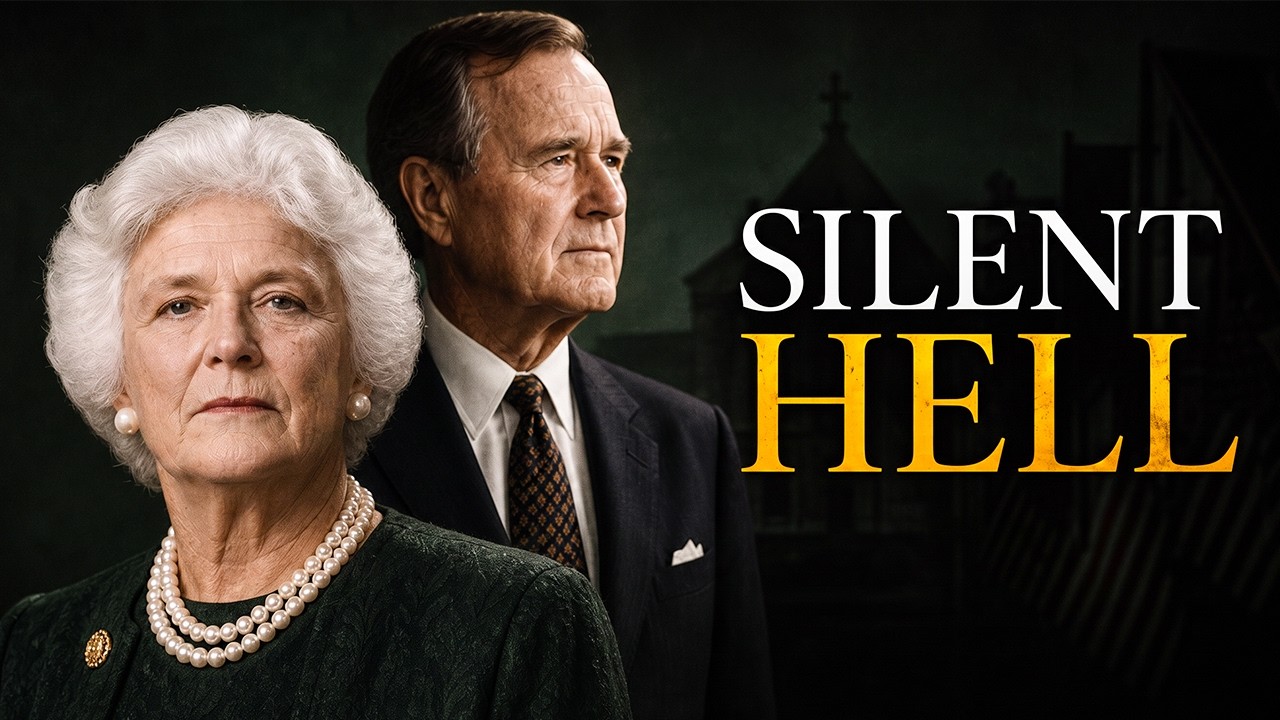
Sixteen years earlier, she had been the one pulling her car to the side of the road, waiting for the urge to harm herself to pass. She had told no doctor. She had told only one person. And now, on the most public stage in America, the woman who had spent a lifetime never giving a careless answer stood silent while her marriage became national news.
The story had broken that morning in the New York Post, whose front page blared “The Bush Affair,” placing the President’s photograph beside that of his longtime aide, Jennifer Fitzgerald. The President had just concluded two days of friendly talks with Israeli Prime Minister Yitzhak Rabin when a journalist raised the headline. Bush said he would not comment. Then he did, calling the story a lie.
It was the only time he directly denied the allegation. The source of the story was thin. No witnesses. No documents.
No photographs. Just a footnote in a book about a Washington lobbyist, written by Susan Trento. The footnote quoted Louis Fields, a former ambassador involved in disarmament talks, who claimed that in 1984 he had arranged a guest house for Bush and Fitzgerald and that it had not been a business trip. Fields had given this account in a 1986 interview with the writer’s husband.
He died of cancer in 1988. When Newsweek later listened to the audio tape of the follow-up interview, Fields sounded far less certain than the footnote suggested. The biggest sex scandal attached to George H. W.
Bush rested on the words of a dead man, spoken vaguely in someone else’s book. A reporter from the Baltimore Sun watched Barbara throughout the press conference. He described her expression shifting from confusion to focus, then to disbelief, and finally to irritation. She said nothing because she said nothing.
She had been hearing versions of this rumor in Washington since the mid-1970s. For nearly two decades, she had made the decision not to react publicly. That morning, with the story now national, she did not change her habit. The discipline had been learned early.
Born in Rye, New York, Barbara Pierce was the third of four children. Her father, Marvin Pierce, was an executive at McCall Corporation, which published McCall’s and Redbook. The family money came from magazines, respectable upper-middle-class Westchester money, enough for boarding school and country club memberships, but not enough for a grand estate in Maine. That distinction would matter later, because she married into a different level of family entirely, and she understood it from the first week.
Her mother, Pauline Robinson Pierce, was the daughter of an Ohio judge. Barbara described her as having a gift for making Barbara feel too big for any room. At the family dinner table, her older sister Martha was encouraged to eat while Barbara was told she had had enough. Her younger brother Scott had a cyst on his shoulder requiring years of treatment and hospital visits, and her mother’s attention naturally went to him.
By age eleven, Barbara had absorbed the lesson: stay cheerful, be useful, cause no trouble. She perfected it. Decades later, when biographer Susan Page was allowed access to Barbara’s diaries, she noticed something revealing. In a diary Barbara assumed no one would read for years, one of the first things she regularly wrote about any other woman was whether she was thin.
Barbara Bush was the First Lady of the United States. She was still keeping score. She was sent to Ashley Hall, a girls’ boarding school in Charleston, South Carolina, where she was popular, indifferent to academics, and highly skilled at the task she had been taught: adapting to her surroundings. She was not rebellious.
She was not pursuing a career, because girls of her class in 1941 were not generally offered that path. She was, it seems, looking for a family where being needed would not be temporary. She found it at a Christmas dance in December 1941, at the Round Hill Country Club in Greenwich, Connecticut, weeks after Pearl Harbor, when every seventeen-year-old boy in the room was calculating how quickly he could join the military. Barbara Pierce was sixteen.
George Herbert Walker Bush, a senior at Phillips Academy, spotted her across the room and asked a friend to introduce them. They danced until the band played a waltz, he admitted he did not know how to waltz, and they sat and talked instead. That origin story would hold for seventy-seven years, told identically by both of them, separately, for decades. What the story left out was who he was on paper.
His father, Prescott Bush, was a partner at Brown Brothers Harriman and later a U. S. senator from Connecticut. His mother, Dorothy Walker Bush, ran the family culture through a book of rules.
The Walkers had a summer home on an island in Maine called Walker’s Point. To a girl from Rye whose father printed magazines, this was not just a nice boy. It was a different altitude. He enlisted in the Navy on his eighteenth birthday, June 12, 1942, the day he graduated from Andover.
He named his three planes after her: Barbara, Barbara the Second, and Barbara the Third. They became secretly engaged in 1943, with the engagement announced that December. She entered Smith College in the fall of 1943, played on the soccer team, and, by her own cheerful admission, did not excel academically. Then came September 2, 1944.
His plane was hit over Chichijima. He completed the mission, bailed out over the water, and was rescued by the submarine USS Finback. The two crewmen who had been with him, Ted White and John Delaney, did not return. He was twenty.
She was nineteen, reading about it in letters. The experience set a permanent tone in the relationship before the wedding even took place. He had been shot down. He had lost two crew members.
Whatever he needed, there would always be something at home bigger than her own troubles. She left Smith in her second year and never returned. Later, in front of audiences, she would joke that she was the only member of her family who never finished college. Everyone laughed.
It remained true. Their wedding was set for December 19, 1944, delayed by his leave schedule. He returned home on Christmas Eve, and they were married on January 6, 1945, at the First Presbyterian Church in Rye. Her town.
Her father’s church. He stood at the altar in his Navy blues. She was nineteen. The date was the first documented example of a rule that governed seven decades of their life together: the calendar belonged to his obligations.
First the Navy. Then Yale. Then the West Texas oil business. Then the Republican National Committee.
Then Beijing. Then Langley. Then campaigns. Four months later, the war in Europe ended.
Within a few years they moved to New Haven, where he finished Yale in two and a half years, and in July 1946 their first child, George W. , was born. Then she did something that made her life considerably harder. She stepped out of the family orbit.
Prescott Bush’s son could have become a partner on Wall Street, living twenty minutes from his mother. Instead, in 1948, George Bush took an oil job in Odessa, Texas, moving his twenty-three-year-old wife and infant to a rented duplex nearly two thousand miles from anyone they knew. She was enthusiastic. She said so at the time and repeated it her whole life.
It was her own house at last, not run by anyone else. In Odessa, the bathroom was shared with the other half of the duplex, where two women regularly entertained male clients. She never told her family. They moved on to Midland, where the housing was better and there were other young couples like them, Ivy League twentysomethings hunting for oil leases while their wives raised children on the same streets.
She loved it. For a few years in West Texas, she had neighbors who knew her as Barbara, not as someone’s wife. That, she would never have again. Their marriage would eventually involve twenty-nine homes in about seventeen cities.
She kept the number at hand for the rest of her life and delivered it as a joke. It was not a joke. Twenty-nine times she packed up a household. Twenty-nine times she found new doctors, schools, churches, grocery stores, and built a social circle from nothing, then left it.
In September 1949, her father was driving with her mother somewhere near Rye. He reached for a cup of coffee on the seat, the car left the road, and Pauline Pierce was killed. Barbara was twenty-four and pregnant. She did not attend the funeral.
Her husband thought the journey too risky in her condition, so she stayed in Texas. The mother who had spent Barbara’s childhood telling her she had eaten enough died suddenly, leaving everything unsettled, and Barbara was not in the room when the family gathered to say goodbye. She never changed her account of this decision. She never complained about it.
She recorded it and moved on. That pattern was now established. Three months later, on December 20, 1949, she gave birth to a daughter. They named her Pauline Robinson Bush, after the grandmother she would never meet, and called her Robin.
In the spring of 1953, Robin was three years old. She woke up one morning without her usual energy and told her mother she did not know what she would do that day. Maybe she would lie on the grass and watch the cars go by. Barbara thought it was temporary.
She took her to the pediatrician in Midland, who ran blood tests and asked her to bring George in that afternoon. It was leukemia, already advanced. The doctor’s advice was standard for 1953: take her home, keep her comfortable, do not prolong her suffering. It would be quick, he said.
They could not accept it. Through Barbara’s uncle, they arranged for Robin to be admitted to Memorial Sloan-Kettering in New York for transfusions and bone marrow work, treatments that in 1953 were closer to research than medicine. Barbara essentially moved to New York. George commuted from Texas, handling the business and raising the seven-year-old son who did not know how sick his sister was.
Barbara told her granddaughter on television in 2012 what she did during the transfusions. She had to leave the room every time. She could not watch. She stayed, but she made a rule for herself and followed it for seven months: she did not cry in front of Robin.
Friends and family who were around them noticed the division of labor. He cried. She did not, because someone in that hospital room had to be strong, and it was never going to be him. Robin died on October 11, 1953, two months before her fourth birthday.
Barbara was at her side, holding her hand. She was twenty-eight. Her hair had begun turning white, and she stopped coloring it. Four decades later, that white hair became her most recognizable feature, part of the grandmotherly image that made America respond to her.
The warmth of that image had originated in a Manhattan hospital room. They donated Robin’s body for research. The day after she died, they played golf. People have debated that fact for decades, but it likely proves only that two twenty-year-olds had been holding their breath for seven months and did not know what to do with their hands.
Barbara carried the next part alone. Around 1958, five years later, she wrote her mother about the absence in their household, saying they had a daughter who was still with them, whom they could not touch but could feel. It was a beautiful letter, later read aloud on television, and Barbara read it herself on camera near the end of her life. She had language for grief and a place to keep it.
She wrote letters to her mother, friends, and children, and eventually kept a diary she preserved for fifty-seven years. He had no such outlet. By the mid-1950s, raising four sons under twelve in a state where she was known only through her husband, she had become somewhat desperate with monotony, with no way to say so. The Bush family was not just a family.
It was a system, and Barbara had married into it as an outsider from Rye. Dorothy Walker Bush ran that system. The rules were real and known to everyone: do not talk about yourself, do not boast, do not lose gracelessly, do not win too loudly, and compete at everything from tennis to horseshoes to swimming to cards, from breakfast until dinner. Walker’s Point in Kennebunkport was the court where the rules were enforced.
It was not Barbara’s house. It was not even her husband’s house; he did not buy it until 1981. Every summer she brought her children to a peninsula owned by her husband’s family, where her mother-in-law presided over a family scoreboard. Barbara excelled.
She learned the rules faster than anyone and eventually enforced them better than Dorothy did. Her sons all told versions of the same truth: their father was the one you sought approval from, their mother was the one you feared. She mocked, humiliated people at the dinner table, and ruled. The family called her the Enforcer.
The role required a woman who had learned at eleven how not to be a problem and who now performed that duty full-time, professionally. Politics began in 1962 when he took over the Harris County Republican Party. He lost a Senate race in 1964, won a House seat in 1966, lost another Senate race in 1970, and was appointed by Nixon to be ambassador to the United Nations, which meant New York and the Waldorf Towers. In 1973, Nixon made him chairman of the Republican National Committee, a job that meant defending the party during Watergate, one of the most sordid duties in American political life.
Barbara made a decision that revealed how the marriage operated by then: she stopped reading newspapers and stopped watching the news. She said later that she had cut herself off from the flow of information so she would not know what people were saying about her husband. In 1974, they went to China. He was made chief of the U.
S. liaison office in Beijing before full diplomatic relations were established, and for just over a year they lived somewhere with almost no Americans, no political fundraising, no family compounds, no in-laws, no children at home. They rode bicycles. They studied Chinese together.
She described it as one of the happiest periods of her life and very good for their marriage. When the family system, the calendar, and the constituency were removed, they genuinely liked each other. In late 1975, Gerald Ford called him home to run the CIA. He was fifty.
Their children were grown or gone. He now had a job he could not discuss with her: where he went, what he did all day, why he was late. The role she had always been allowed to play, the one who knew everything and handled everything, was now legally forbidden to her. She broke down.
It lasted about six months. She would pull the car to the side of the road while driving and wait for the wave to pass, and the thoughts were about ending her own life. She did not see a doctor. She told no one, not a friend, not her sister, not her sons.
In 1976, the wife of the Director of Central Intelligence could not behave like a psychiatric patient; it would have become a story, and she knew it. She told exactly one person. Him. He offered to quit the job.
She said no. She kept the entire episode secret for eighteen years, until after his presidency had ended, after the election was won, when revealing it could no longer harm anyone. Then she told it on her own terms. At fifty, she had already proven she understood the difference between a secret and a dated secret.
What she did not mention in her memoirs was another story circulating in Washington at that same time. In the mid-1970s, rumors about her husband and Jennifer Fitzgerald were already moving through the capital. Fitzgerald had come to work for him at the Republican National Committee in 1974, gone with them to Beijing, followed him to the CIA, and remained beside him through the vice presidency, controlling his schedule so tightly that other aides openly complained and repeatedly tried to have her removed. No one ever produced definitive proof of an affair.
What is certain is that Barbara Bush spent nearly twenty years in rooms with people who believed things about her marriage and never gave any of them a reaction to use. Her depression had come in 1976. The rumors were in the air in 1976. Susan Page, working from the diaries, connected the two subjects without claiming proof.
It was the honest version, and it was dark enough on its own. Recovery came through work, and through that work she began building something of her own. In the early 1980s she acquired four things she had never had before: a husband who was now Vice President, which meant a permanent staff and a press operation; a microphone; a purpose; and an audience that had no idea she could be anything other than affable. The cause was literacy, born of her years teaching her dyslexic son Neil to read.
She chose it in the early 1980s and never let it go. She wrote a book in 1984 narrated by the family dog, C. Fred Story, donating the proceeds to literacy charities. In 1990 she did it again with Millie’s Book, which sold extremely well.
In 1989 she founded the Barbara Bush Foundation for Family Literacy, an institution with her name on the door, her board, her money, and her own agenda, established independently while her husband was President. In 1984, during the campaign against the Mondale-Ferraro ticket, she made a comment to reporters about Geraldine Ferraro, saying she could not say the word she wanted to use, but it rhymed with rich. It spread everywhere. She had to call Ferraro personally to apologize.
After forty years as the family’s most disciplined public performer, she had undone it in one sentence recorded on an airplane. She never made that mistake again. Six years later, Wellesley College tested her. She was invited to speak at the 1990 commencement, and about 150 students signed a protest letter saying she had been chosen for her husband’s achievements rather than her own.
It became national news, and in fairness, for a woman who had left college at nineteen and never returned, it was a legitimate question. She did two things. She brought Raisa Gorbachev, wife of the Soviet leader, at the very moment the Cold War was ending, turning a protest story into a diplomatic event. And she gave a speech in which she told the students to choose their own paths and remember that human connections matter more than résumés.
Then she added the line that ended the controversy: somewhere in the audience there might be someone who would follow in her footsteps and become First Lady of the United States. She wished that person well. She received a standing ovation from the very students who had signed the petition. By the time her husband’s presidency was in trouble, she was his greatest asset.
Her approval ratings stood far above his throughout his term. In 1992, when his popularity had collapsed and the party was desperate, she was deployed as the last uncontested popular thing the Bush brand had left. Which brings the story back to the lawn in Kennebunkport. The President called the story a lie.
Barbara Bush stood there with an irritated expression, saying nothing, because she understood something the rest of Washington did not. Whatever she said that day would become the headline. Her silence produced nothing, and nothing was the only answer they could never use against her. He lost the election in November.
They returned to their home in Houston. Their marriage then became what it had probably been for twenty years: not a romance, not a hell, but a family institution run by two signatures. It lasted two more decades. She wrote her memoir in 1994 and revealed the depression.
She published a collection of her correspondence in 1999 titled All the Best, a wonderful book, and it was worth noting that she had chosen which letters to include. She controlled that side of the correspondence. Her side of it barely survives. In 2000, they brought Robin’s remains to the presidential library at College Station, knowing they would eventually rest there themselves.
That year their eldest son was elected President, making Barbara Bush the second woman in American history to be both the wife and the mother of a President. She used the position as one might expect: usually privately, occasionally publicly, in ways that embarrassed the family. In 2015 and 2016, while Jeb was running for President, she said on national television that there had been enough Bushes and the country should look at someone else. Then she flew to New Hampshire and campaigned for him anyway.
In June 2016 she had a heart attack. She told Susan Page she blamed Donald Trump for it. She also said she no longer considered herself a Republican. None of that appeared in her memoirs.
It came in interviews during the last six months of her life, and it was her final move, one that reframed everything before it. In the summer of 2017, at age ninety-two and in failing health, she agreed to cooperate with Susan Page on a biography. She gave five long interviews. She encouraged more than a hundred friends, associates, and family members to speak, including two former Presidents.
And at the end, she gave Page access to her diaries, kept for decades and reaching back to 1948, along with her personal papers and correspondence. Those papers are sealed at the George Bush Presidential Library until 2053. She chose the biographer. She chose what would be released and what would stay sealed.
She set the release date for a year when every person who could oppose her would be dead. Page’s choice of title was not her favorite. She let the biographer know it. She suggested instead a title of her own: The Fat Lady Sings Again.
It may have been the funniest or the saddest sentence in the entire story, perhaps both, and it leads straight back to that dinner table in Rye, where a girl was told she had had enough. Barbara Bush died on April 17, 2018, at age ninety-two. Two days earlier, she and her husband had sat together in the den of their Houston home. Seven months later, he died.
Their marriage had lasted seventy-three years and three months, the longest of any presidential couple in American history. So return to the lawn in Kennebunkport. The image you were supposed to take from it was a loyal wife standing beside a wronged husband, the marriage as a symbol of reassurance, the pearls, the white hair, the grandmother of the republic. The woman actually standing there was someone who had buried a three-year-old child while her husband left the room during transfusions, who had missed her own mother’s funeral, who had packed up twenty-nine homes, who had come back from the edge of death in 1976 without telling a single person, and who had correctly decided that the one thing in that family she could fully own was the record.
She was not refusing to speak. She was choosing the year she would speak.