On the afternoon of April 4, 1865, a small boat—an admiral’s barge, low in the water, rowed by twelve sailors—made its way up the James River toward Richmond, Virginia. Smoke still hung over the Confederate capital. Whole blocks had burned to their foundations, leaving bare brick walls exposed to the sky, and ash drifted on the river like gray snow. The boat bumped against the destroyed wharves, and a tall man stepped ashore.
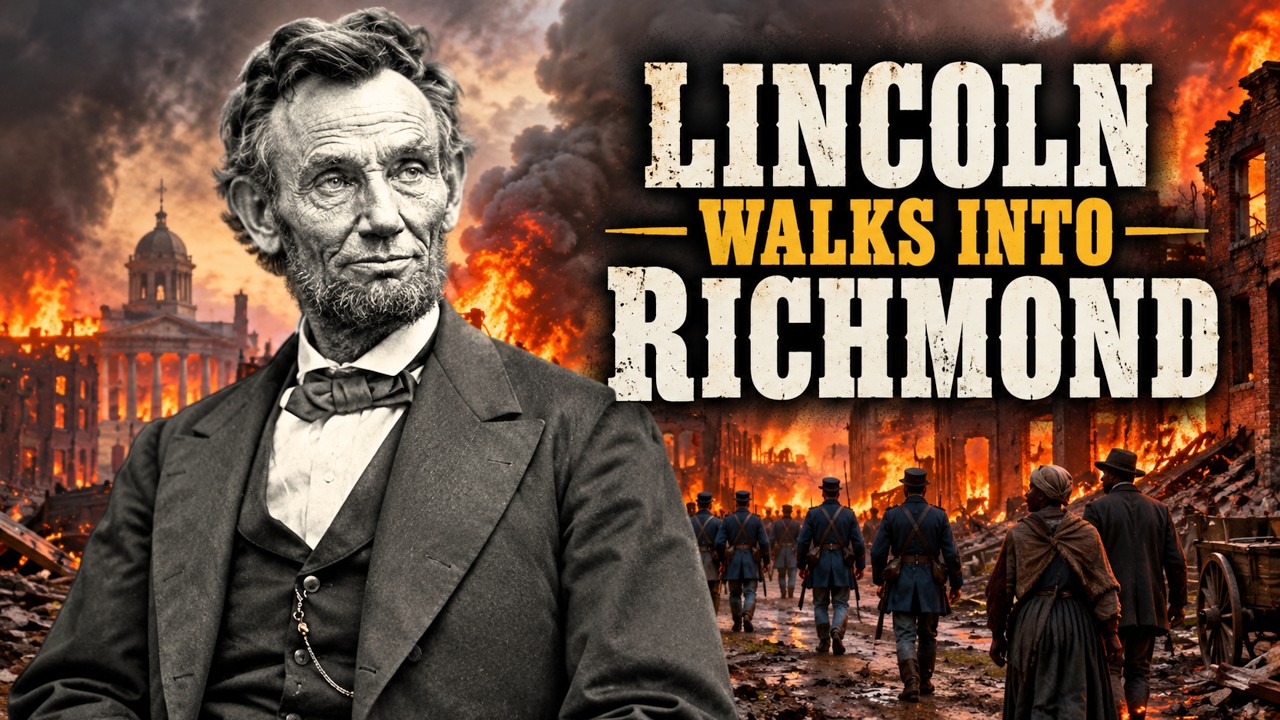
He wore a plain black suit and a tall silk hat. His face was long and tired. He was fifty-six years old. His name was Abraham Lincoln.
There was no army waiting for him, no band, no honor guard, no cannon salute. Only the sailors from his own boat, a few of them carrying rifles, constituted his protection. But the place itself mattered. This was the heart of the rebellion.
For four years, the men who had waged war against the Union had issued their orders from this city, which was still full of their soldiers, their anger, and their weapons. Two days earlier, it had been burning out of control, and the most powerful man in the United States had just walked into it, almost alone. His advisors had urged him not to come. The admiral who brought him up the river had been anxious the whole way.
Lincoln came anyway, bringing his twelve-year-old son Tad, who walked beside his father into the ruins. He had not come to give a speech or raise a flag. He had come to see the enemy’s house from the inside, and to answer one difficult question waiting for him there. Two days before, another man had fled this same city under cover of darkness.
Now Lincoln walked into it in broad daylight. The distance between those two choices is the essence of the story. The story begins two days earlier, on the morning of Sunday, April 2, 1865. Richmond seemed peaceful.
Church bells rang across the rooftops, and families dressed in their finest and walked to services in the mild spring air. But beneath it all came a low rumble from the south: artillery, from Petersburg, about twenty-five miles away. For nine months, Robert E. Lee had held the Petersburg lines, the shield in front of Richmond.
If Petersburg fell, so would the capital. That morning, it fell. Ulysses Grant had been wearing down Lee’s army for nearly a year. The day before, Union forces had shattered the Confederate flank at a crossroads called Five Forks.
On Sunday morning, Grant threw his full weight against the Petersburg lines, and the lines collapsed. Lee knew what it meant. He sent a telegram north to Richmond advising that the city be abandoned that very night. In Richmond, Jefferson Davis sat in his usual pew at St.
Paul’s Episcopal Church. The Confederate president was a thin, erect man whose health had been failing. His face was pale. As the rector conducted the service, a church sexton walked quietly down the aisle carrying a folded message and placed it in Davis’s hands.
Davis read it. Those seated nearby saw the color drain from his face. He rose and left the church without a word, while the service continued behind him. Minutes later, the sexton returned and touched the shoulders of other Confederate officials.
One by one, they rose and left too. A murmur spread through the pews. Something grave had happened. Davis went directly to the War Department offices on Ninth Street and issued his order: the government would leave Richmond by evening.
The calm vanished entirely. Clerks dragged boxes of official records into the streets, stacked them, and set them on fire. Four years of Confederate archives rose as smoke over the sidewalks. Roads clogged with wagons, and officials raced for seats on the last train south.
The Confederate treasury was loaded onto a special train—gold and silver coins guarded by young naval cadets—and dispatched toward Danville. Davis did not rush. He waited through the afternoon, still hoping for a different telegram from Lee, hoping to hear that the lines had somehow held. That message never came.
Around four o’clock, the official announcement reached the public: the government was abandoning the capital. Panic spread from house to house. People buried silver in their gardens, sewed money into their clothing, and begged for places on already-full carriages. Banks emptied of coin.
Families loaded what they could onto wagons and left the rest behind. By evening, the roads out of the city were jammed for miles. Davis had sent his wife Varina and their children south days earlier. Now he said goodbye to the house on Clay Street.
At eleven that night, he boarded a train that pulled out of Richmond into the darkness, bound for Danville. He would never see the capital again. Behind him, the city he left was turning on itself. General Richard Ewell had taken command of Richmond’s defenses with clear orders: deny the enemy anything useful.
Burn the tobacco, burn the cotton, burn the warehouses along the river so the Union could not seize them. On paper, it was a logical military decision. In reality, it was a catastrophe waiting for a spark. The warehouses stood in the heart of the city, pressed tightly against homes, shops, and banks.
A fire that started there would not stay there. As the last Confederate troops prepared to cross the James River and blow the bridges behind them, they lit the fuses. The rebellion had ruled from Richmond for four years. Now its own army set the city alight.
In the early hours of April 3, flames rose into the night sky. No one remaining in Richmond knew how far they would spread or who would come through the smoke to stop them. The fire began small, but it did not stay small. Confederate forces had torched the tobacco warehouses near the river.
Night winds from the southwest caught the flames and pushed them deeper into the city. Fire leaped from rooftop to rooftop. Shockoe Slip ignited, then the financial district, then block after block of Richmond’s commercial heart. Mills, stores, foundries, and hotels burned at once.
There was no one left to fight it in any organized way. The government had gone, the army had gone, and the fire had helped. On the riverbank, the Confederates blew up their own warships. The ironclads that had guarded the James exploded with tremendous force, shattering windows two miles away.
Burning debris rained down on the rooftops. The city arsenal held tons of gunpowder, and when the flames reached it, it exploded; the blast was felt across the river, with shells flying into the streets. Then the mobs came. Law and order collapsed with the government.
Prisoners fled the state penitentiary. Escaped convicts and looters filled the streets. People who had been hungry for months broke into warehouses and found food that had been stored while they starved. That discovery turned fear into fury.
Barrels of whiskey were drained into gutters to keep men sober, but it did not work. People knelt in the streets and scooped up the liquor. Drunk crowds surged through the smoke, looting shops while the buildings above them burned. Richmond was tearing itself apart before the sun came up.
By dawn on April 3, nearly a third of the city was burning. The entire commercial district was vanishing, and the flames were creeping toward Capitol Square, where thousands of panicked people had gathered with whatever they could carry. Into this scene entered the United States Army. Richmond’s mayor, Joseph Mayo, had gone out in the first daylight carrying a letter of surrender.
He met the advancing Union forces east of the city and handed it over. There was no one left to defend it. The Union commander was Major General Godfrey Weitzel, a young engineer of German birth, not yet thirty, who led the Army of the James. At 8:15 that morning, he formally took possession of Richmond at city hall.
The vanguard of Weitzel’s forces was the Twenty-Fifth Corps, made up largely of United States Colored Troops—Black soldiers, many of them born into slavery, now marching in Union blue through streets full of fire. A Black war correspondent named Thomas Morris Chester reported that the 36th Regiment of U. S. Colored Troops was among the first to enter the city.
For these men, this was no ordinary occupation. Many of them had been held as property, some sold on auction blocks only a few streets away. Now they carried rifles into the capital of the men who had claimed to own them. Then they put those rifles aside to save the city.
Weitzel issued the order: fight the fire. His soldiers found the few remaining fire engines and got them working, formed human chains to pass buckets, and tore down buildings with their bare hands to create firebreaks. Union troops worked alongside the Black residents of Richmond who had remained, Black and white, soldiers and civilians, passing water in the same lines. The men who had come to seize the city spent their first hours saving it.
The firefighting continued most of the day. By afternoon, the winds died down, the firebreaks held, and the flames stopped short of Capitol Square. Weitzel did not stop at the fire. Seeing people gathering in the square with nothing, he ordered army rations distributed to them.
For many, the first food they had seen in days came from the army they had been taught to fear. About forty city blocks had turned to ashes, and hundreds of buildings were gone. But Richmond survived, saved in large part by the very people the Confederacy had fought a war to keep enslaved. That was the city Abraham Lincoln was about to enter.
Lincoln had been close the whole time, a fact most people forget. He had not been in Washington. For weeks, he had lived on a steamer at City Point, Virginia, Grant’s supply base and headquarters downriver from Richmond. He arrived in late March to be near the front as the war approached its end, meeting with his generals, reviewing troops, and riding out to see the ground where the fighting had occurred.
He wanted to witness the end of the war with his own eyes rather than read about it in telegrams days later. Days before, he met with Grant, General Sherman, and Admiral David Dixon Porter and told them plainly what he wanted from the war’s end: no mass executions, no bloody vengeance. Let the Confederate soldiers return to their homes and farms. He even hinted that he would not mind if Davis escaped the country rather than face trial and the gallows.
When word came that Richmond had fallen, Lincoln did not hesitate. He wanted to go there personally, immediately. Porter was worried about the idea. Richmond was a burning ruin full of desperate people, and no one could guarantee the president’s safety.
But Lincoln had made up his mind. On the morning of April 4, they started up the James River. Porter’s flagship, the USS Malvern, was accompanied by a fast gunboat, the Bat, for protection. Lincoln stood on deck watching the devastated countryside pass by.
The river resisted them the whole way. The Confederates had spent years obstructing the James to keep the Union navy out, and now that same work blocked Lincoln’s path. The waterway was a graveyard: sunken ships rested just below the surface, broken boats and shattered pilings choked the channel, dead horses floated in the current, and torpedoes—mines of that era—waited under the water. Ahead of them, Richmond’s smoke rose in thick gray columns over the horizon.
The men could see the destruction long before they reached it. The Malvern could go no farther; her draft was too deep to pass the wreckage ahead. Porter made the call: if the flagship could not reach Richmond, the president would go in a smaller boat. They lowered the admiral’s barge, a plain boat crewed by twelve sailors.
Lincoln climbed in. Tad came with him, as did Porter, a few officers, and the president’s personal guards. A tugboat took the barge in tow but then ran aground on the debris. Lincoln found the whole thing amusing, telling Porter it was good for a man to be humbled.
The sailors cast off the towline and took up the oars, rowing the President of the United States the rest of the way by hand. There was no fleet, no formations, no cannons. Just a small boat, twelve rowers, and a tall man in a black hat sitting in the stern. Porter later wrote that he would have preferred a more dignified arrival for his commander in chief, but instead they got a leaky boat and hard work against the current.
They landed at the wharves in the lower part of the burned city. The streets ahead looked empty. There was no reception committee, no generals, no honor guard. No one had even been told the president was coming.
Porter felt frustrated: he had brought the commander in chief to the enemy’s capital, and not a single soldier stood to greet him. Lincoln stepped out of the boat onto the shore, the first American president in office to enter the Confederate capital. He had come not as a conqueror on horseback but as a man stepping from a rowboat into the ashes. The silence did not last.
Within minutes, those same streets became the most crowded and dangerous places he had ever walked. The first to spot him was a Black laborer near the wharf, who recognized the tall figure in the black hat from the newspapers and let out a shout: the great day had come, the president himself was in the street. Word spread faster than fire, faster than any telegraph. Within minutes, people poured from every door and alley, by the dozens, then by the hundreds.
Most of them had been enslaved only days before. Now they were free, and the man who had freed them stood before them in the heart of their masters’ city. Crowds pressed around him. People wept openly, reached out simply to touch his coat, and called him Father Abraham.
Some described him as the Christ who had finally come. Others sang hymns. An old man pushed forward and fell to his knees at Lincoln’s feet, and others began to kneel with him. Lincoln was deeply uncomfortable.
He asked the man not to kneel. “Don’t kneel to me,” he said. He told them to offer their prayers to God and thank Him for their freedom. His words were gentle but sincere.
He did not want to be worshipped; he wanted these people to stand on their own feet as free citizens of the Republic. The sailors closed around the president. There were no more than twelve of them. The crowd became so dense and joyful that it was unintentionally dangerous; a man could be crushed in such a surge.
The sailors fixed bayonets and formed a ring—not to repel an enemy, but to protect the president from being killed by love. Then Lincoln began to walk. The Confederate White House stood near the center of the city, about two miles from the wharf, and he walked most of that distance on foot. The route passed straight through the burned district.
Heat still radiated from the ruins in waves, piles of brick and timber still glowed, and occasionally a charred wall collapsed into the street. Smoke drifted across the road and made the men cough. Ash covered everything, including the president’s black coat and tall hat. Witnesses said he looked around at everything with quiet interest.
He was not in a hurry and did not seem afraid. He saw the ruined capital with his own eyes, block after block. The crowds followed him the whole way, growing larger as he walked. The newly freed filled the streets on both sides, occupied windows and the doorways of buildings that had not burned, and the sound was overwhelming—cheers, weeping, hymns, and prayers all at once.
At one point, a small group of Union soldiers turned a corner and nearly ran into their president, hardly believing it. Lincoln was walking on foot through Richmond, guarded by a handful of sailors. He asked them the distance to Davis’s house. They pointed the way and joined him to help.
He considered the risk, simply and without exaggeration: this was the capital of an enemy that had fought for four years to kill Union soldiers, full of defeated, armed, angry men, any of whom could fire a single shot from a window. Lincoln had almost no guard. He walked through it anyway, in public, at a slow pace, for nearly two miles. He had been warned.
He did not seem to care. Not everyone in the streets was cheering. Behind the shutters of fine houses, white families watched in silence. Their world had ended that week, and in their eyes, the man passing their windows was the cause of their ruin.
They did not come out, but they did not shoot either. They simply watched him go by. The contrast was the whole story, embodied there in the smoke. Two days earlier, Jefferson Davis had slipped out of this city in darkness, fleeing by night train and leaving the place to burn.
Now Lincoln came differently—in broad daylight, on foot, slowly, through open streets, in full view of everyone. He did not sneak in, and he did not ride in armor. He walked. The rebellion had left its capital in secret; the Union returned to it with the sunrise.
Finally, the crowds and the smoke parted. Ahead stood a large gray house on a rise, quiet and untouched by the fire: the house Jefferson Davis had left two days before. Lincoln climbed the steps and went inside. What awaited him in that house was the purpose for which he had crossed a broken river and a burning city.
The house on Clay Street was not a palace. Southerners called it the Confederate White House, but it was actually an elegant three-story brick home painted pale gray. Inside, it was comfortable but modest. Porter, who saw it that day, was struck by how plain it was.
Davis had not surrounded himself with royal pomp; he had lived much like any ordinary, reasonably well-off citizen. Now it belonged to the United States Army. General Weitzel had made it his headquarters when he took the city, running his operations from the home from which the Confederate president had fled. Most of the staff had gone, but the housekeeper remained.
Davis had left instructions before fleeing that the house should be handed over in good condition to whoever took command of the occupation forces, so the rooms were tidy, the furniture in place, as if the family had merely stepped out for the afternoon. Lincoln walked through the front hall, past tall plaster statues, moving slowly through the rooms. He was seeing the inner sanctuary of the men who had tried to split the country in two. The rooms were well kept but not lavish: crimson wallpaper, long reception halls with fine furniture, delicate touches everywhere that spoke of the woman who had run the house.
Military maps still hung on the walls where the rebel cabinet had studied them. It was an ordinary family home that had run an extraordinary war. Then he reached Jefferson Davis’s office. Accounts differ on the exact room and chair, as they do with much of this day, but the essence remains in memory.
Lincoln crossed into the office and sat down in Jefferson Davis’s chair. There was a moment of silence. His long frame settled into the seat, and he stretched out his long legs. One witness said the president looked pale and exhausted; another watched him lean back and simply take in the scene.
For four years, the man who had sat in this chair had run the war against the Union, signed the orders, made the appointments, and held the rebellion together by sheer force of will. Two days earlier, he had been sitting here. Now he was gone into the night like a hunted man, and Abraham Lincoln sat in his place. Lincoln did not gloat.
Those present recorded no sense of triumph in him. He made no speech and did not boast over the defeated enemy. He quietly asked for a glass of water. That was all he wanted.
There is a simple human weight in that. He had crossed a broken river and walked through fire to reach this chair, and when he reached it, he asked for water and sat still. Some of the officers could not contain themselves, calling for three cheers for the president, and they cheered. To more than one man in that room, the moment felt like the true end of the war, not on a battlefield but in a quiet room, with an empty chair finally filled.
Outside, crowds gathered around the house, having followed the president from the river, and cheered in the street below. General Shepley, the new military governor, came out and spoke to them. Lincoln stayed in the mansion only a short time. He had not come to enjoy the spoils but to see, think, and plan what came next.
Because the fighting was not quite over. Lee’s army was still in the field to the west, fleeing, with Grant in close pursuit. Davis was still at large somewhere to the south, talking of continuing the war. The Confederacy was collapsing, but it had not fully fallen.
Sitting in that captured house, Lincoln had to decide what kind of peace would follow: mercy or punishment, reunion or revenge. He had held strong feelings on this for months, and within the hour one of his generals would put the question to him aloud. The answer he gave inside that house would shape everything that followed. Lincoln did not want vengeance.
He had said so for months. Now, amid the ruins, he had to determine what mercy would actually look like. While he was in Richmond, General Weitzel put the question to him directly. Weitzel now had to govern a defeated, hungry, angry Southern city and asked the president how to treat the inhabitants.
Lincoln’s answer was brief. He said he preferred not to give orders about it, but if Weitzel wanted his advice, here it was: let them up easy. That was all. Three simple words that contained Lincoln’s entire vision for the end of the war.
No mass arrests, no firing squads for ordinary soldiers, no foot on the neck of the defeated South. The goal was not to crush the region into the dirt but to bring it back into the Union and let the country recover. He had said much the same weeks earlier in his second inaugural address, speaking of malice toward none and charity for all, of binding up the nation’s wounds. Now, in the enemy’s capital, he was giving those words practical form.
Weitzel had to be firm but not harsh, maintain order, feed the hungry, and let the anger cool. There were practical matters as well. A delegation of Southern men was waiting to see Lincoln, including John Campbell, a former Confederate official and former U. S.
Supreme Court justice. Campbell wanted to discuss terms of peace. Lincoln met with him but with caution, making no easy promises. He told Campbell to return the next morning for a proper meeting down by the river.
Lincoln was generous of spirit, but he was not naive. He knew the war had to end on Union terms. Slavery was over, and the nation would be reunited; those points were not negotiable. Later that day, a carriage was brought, and Lincoln and Tad rode around the city.
They saw the landmarks that had haunted the Northern mind for four years: the Virginia State Capitol, where the Confederate Congress had met, and Libby Prison, where captured Union men had suffered. Lincoln looked at it all. Then he returned to the river. The Malvern had worked her way up to Rocket’s Landing by evening.
Lincoln boarded her and spent the night there. The next day he finished his business and left Richmond. He never returned. It was April 4 and 5, 1865.
The days that followed moved quickly. On April 9, just five days after Lincoln’s walk through Richmond, Robert E. Lee surrendered to Grant at Appomattox Court House. The war in Virginia was over.
The great rebel army laid down its arms. Lincoln returned to Washington, where the city was in the midst of boisterous celebrations. The long nightmare was nearly over. He threw himself into the hardest work of his life—not winning the war, but winning the peace.
He never got the chance. On the night of April 14, Lincoln went to Ford’s Theatre. There, an assassin shot him. He died the following morning, April 15, 1865.
Eleven days. That was all the time between his walk through Richmond and his death. Eleven days between the peak of his presidency and the end of his life. The peace he had sketched in Davis’s occupied house did not last long after him.
The men who came after him struggled bitterly over how to treat the South. Reconstruction became harsh in some places and was abandoned in others. The cautious, generous path Lincoln had indicated was never fully taken. But the image remains fixed and clear: a tall, tired man in a black coat, stepping from a small boat into a burning city, walking two miles through the ashes, almost unguarded, while thousands of newly freed people wept around him.
Sitting quietly in his enemy’s seat, asking not for revenge but for a glass of water. Telling his general to let them up easy. Abraham Lincoln had taken the capital of the rebellion. He took it not with fire or sword or the display of a conqueror, but on foot, in silence, and with mercy.
That was what he found, and what he left behind, in the ruins of Richmond.