In 1860, on the edge of the Virginia woods, Dr. Gideon Cross lived in a house he built with his own hands, far enough from town that the church bells could not reach him. He called it solitude. The townsfolk called it something else.
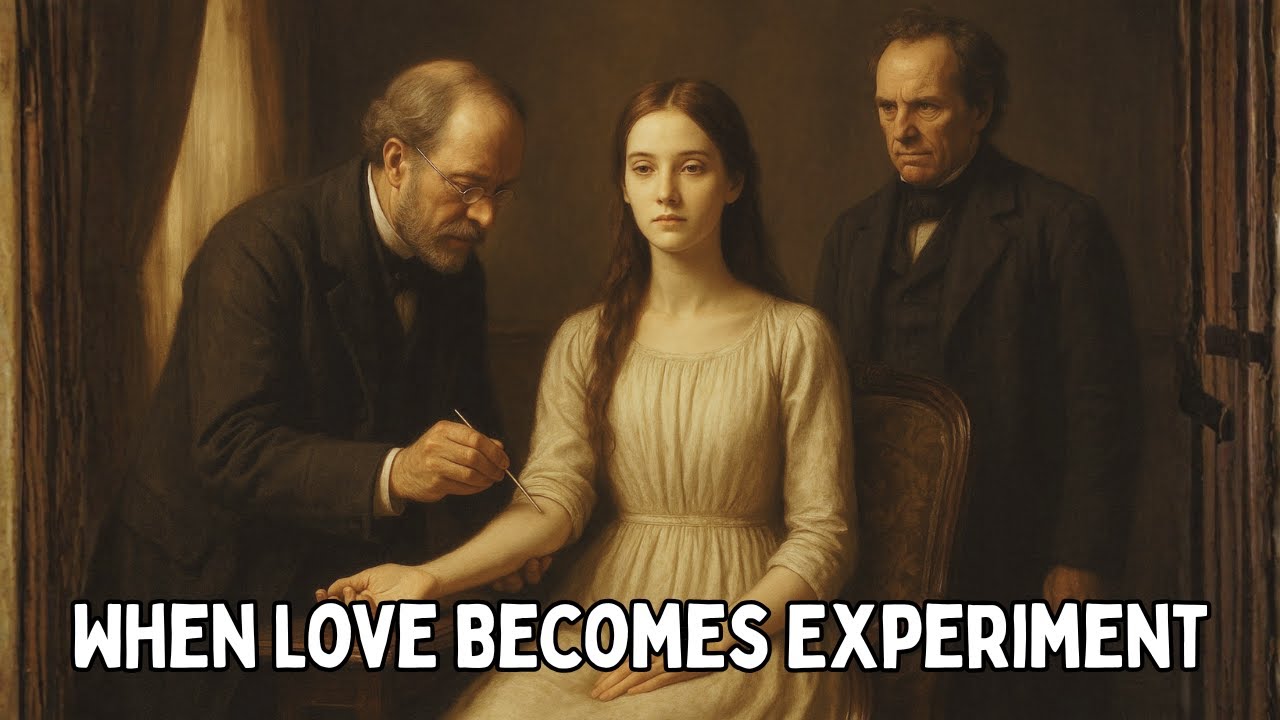
The tall gray mansion on Black Hollow Road stood shrouded in fog, its shutters closed, its rooms so still that a whisper sounded like thunder. Inside lived his only daughter, Maren Lee Cross, a girl unlike any other. She could not feel pain. When she was a child, she burned her hand on the stove and did not cry.
The doctor called it a miracle. But by the time she turned eighteen, he began to call it a curse. And so he made it his life’s work to fix her, no matter what it cost. Caleb had worked the land at the Cross estate since he was a boy.
He knew every creak in the floorboards and every sigh of the wind through the shuttered halls. He had watched Maren Lee grow. Pale as porcelain, quiet as snowfall, she wandered barefoot through frost without shivering. When she slipped on the steps and split her chin open, the blood was dark and too much, but she did not cry.
She simply looked at him and asked if it was bad. For years, Gideon kept meticulous notes in small leather-bound books, recording her name alongside words like threshold, reflex, and response. The people in town whispered that the doctor was practicing something unholy, that he had traded faith for science and made his daughter the price. Caleb tried not to believe it.
He had raised her like a sister. But lately, even he found it hard to look at her without feeling a chill. Maren Lee asked her father one question again and again in her still, soft voice: “Will I ever feel it, Papa? ” And every time he answered, “I’ll make sure you do.
”
The sessions began in silence. No birds sang near the house anymore. Even the wind seemed to pass it by. Gideon kept to his study, where the smell of medicine and ash hung thick in the air.
He wrote for hours, his pen scratching against the paper. When he called for her, she came immediately. He would take her wrist between his fingers, testing her pulse, pressing a thumb against the blue veins beneath her skin. Still no reaction.
Do you feel this, Maren? No, father. Should I? Gideon’s temper grew worse with each passing afternoon.
The doctor who once healed others now spoke in riddles about thresholds and limitations, about how feeling was the essence of life itself. He accused God of cruelty for making a creature unable to feel His design. At night, Caleb heard the faint click of locks above. Gideon had begun his experiments again.
Maren sat in the study chair, eyes steady, her father’s instruments gleaming beside her. He asked if she was ready. She nodded once. If it helps you, father.
Caleb noticed small changes in her. The way she lingered by the fire longer than before. The way she pressed her palm against the greenhouse glass until condensation gathered and ran down her fingers. Once he caught her outside in a downpour, arms outstretched, mud soaking her gown, whispering into the storm.
When he pulled her inside, dripping and pale, she only said she thought maybe the cold would hurt. Her voice trembled for the first time he could remember, not from fear, but from hope. That more than anything frightened him. Gideon called them sessions, never tests, never experiments.
In his mind, those words belonged to science. What he did, he said, belonged to love. The study smelled of iron and candle smoke. On the long table lay his instruments, polished, gleaming, arranged with the precision of prayer.
Maren sat quietly beside them, her hands folded in her lap. Caleb stood in the hall, close enough to hear, not enough to be seen. He always told himself he shouldn’t listen, but the sound of her voice kept him there. Gideon began with questions, always the same ones.
Do you feel this? No, father. And this? No.
Sometimes there was the faint hiss of flame, the low click of metal meeting skin. Gideon spoke calmly, like a teacher at a lesson, and Maren’s replies were calm too, steady, unbroken. That frightened Caleb more than any scream could. One night the sound changed.
Caleb heard a sharp cry, brief, cut short. He rushed to the door, but it was bolted. When it finally opened, Gideon’s face was streaked with sweat. Her hand twitched, he whispered, half in wonder, half in terror.
It’s a beginning. Behind him, Maren sat still as ever, her gaze unfocused. Caleb saw the mark on her wrist, faint but real. She traced it with her finger, memorizing the shape of what pain should feel like.
I think I almost felt it, she said. And Gideon, his eyes wet, whispered back, Then we’re getting close, my darling. The next morning he left for Richmond to retrieve new instruments. Caleb was told to keep the house quiet and the fires low.
In the study he found the journal Gideon always kept locked in the drawer, now lying open as if waiting. The handwriting began like a doctor’s record, dates and anatomical observations. Then it changed. The lines grew frantic.
If pain is the proof of life, then she is unproven. I must force the body to remember. And near the last page: When she bleeds but does not cry, something divine watches. Caleb closed the book quickly, his stomach tight.
For the first time he saw the madness that had crept into the man he’d once trusted. In late March, a carriage arrived from Richmond. Out stepped Dr. Harold Fenwick, once a colleague of Gideon’s, now a cautious stranger.
There are rumors, he said. About your daughter, about your work here. I came to see the truth for myself. Fenwick took Maren’s wrist gently and pressed the tip of a pen against her skin until it broke.
A bead of blood rose, and still she sat perfectly still. The other doctor stepped back, visibly shaken. This isn’t medicine, Gideon. This is torment disguised as study.
But Gideon only smiled, hollow and terrible. I’ve already come too far. After the visitor left, Maren began to change. Her quiet took on a new edge, not peace but distance.
She wandered barefoot through the house, humming a slow tune that never seemed to end, her mother’s song. Her father’s experiments grew longer. Caleb could hear the faint hum of the generator Gideon had built, the sound of a current running through wire and bone. One night he heard laughter from the study, high, bright, wrong.
She laughed, Gideon whispered, dazed. It means she felt something. But Maren said softly, I didn’t laugh because it hurt. I laughed because you wanted it to.
Gideon accused Caleb of interference, of contamination, of turning his daughter against him. You’ve overstepped, he said, and struck him. Maren appeared in the doorway. If you hurt him again, she said quietly, I’ll never let you fix me.
Then Gideon locked himself in the study for three days. When he emerged, he was clean-shaven, dressed neatly, the wildness hidden behind a terrible calm. It’s time. Maren didn’t ask what for.
She only nodded, as if she’d been waiting for the words. The bolt slid. From inside came the hum of the generator and the smell of heated metal. Pain redeems.
Pain awakens. Forgive me. Maren’s voice followed, quieter. I forgive you, father.
Caleb slammed his shoulder into the door until it splintered. Gideon stood behind Maren, wires trailing from the generator to the cuffs around her wrists, a faint current dancing along the metal. Not enough to kill, but enough to burn. Caleb tore the wires free and caught her as she slumped forward.
I felt it, she whispered. It hurt, and it was beautiful. The next morning, a carriage with the county seal appeared through the fog. Sheriff Amos Clay and his deputy came to investigate the rumors that had been growing like vines.
They moved through the house slowly. Nothing out of place. Then they reached the study, where the generator still smelled faintly of burnt oil. Maren sat by the window, her wrists wrapped in fresh cloth.
Are you here to see if I’m alive? she asked. The sheriff studied them both. I don’t see a crime here, doctor, he said slowly.
But I see something worse. You be careful with that girl. When the carriage rolled away, Gideon’s calm shattered. Maren rose quietly.
No one needs to take me, father. I think I’ve already left. That night she woke screaming. It’s inside me, she gasped.
It’s burning. Her eyes darted toward the corner of the room. She’s here. Mother’s here.
She says the pain was never meant for me. When she looked back at Caleb, he realized what terrified him most. Maren wasn’t afraid of the pain. She was beginning to love it.
She began to read her father’s journal, left open on his desk as if he wanted her to find it. To save her, I had to unmake her. To teach her pain, I had to become it. Forgive me, Margaret.
I’ve done what only God should do. Maren’s voice was calm, steady, but her face looked older, worn down by understanding. He thinks love is something you prove by suffering. Maybe that’s why he could never love anything he didn’t hurt.
That night, Gideon locked himself in the study again. A crash echoed upstairs. Caleb ran toward it, but Maren’s voice stopped him. Let him be.
He’s setting the altar. When Caleb burst through the door, Gideon stood over his desk, a bottle of ether smashed at his feet, pouring lamp oil across the floor. Don’t you see? The body is the vessel.
The soul is the flame. He struck a match. The oil caught, a thin line of fire crawling across the floor like something alive. Maren appeared in the doorway, the firelight dancing in her eyes.
Father, she whispered, if pain is holy, then you’ve already become a saint. The flames climbed the drapes. Smoke filled the room. Gideon fell to his knees, reaching out to her through the heat.
Maren, wait. Stay with me. But the flames reached him first. And when his voice finally stopped, the only sound left was the crackling of wood and the slow, steady breathing of a house learning to die.
Caleb pulled Maren down the hallway. He’s still in there, she whispered. He’s gone, Caleb said. We can’t save him.
She broke free at the sight of her mother’s piano, pressing one trembling hand to the burning lid. This time she flinched. Her eyes widened. I feel it, she whispered.
Caleb, I feel it. They burst through the front door into the night. Behind them the house roared, a cathedral of fire, every window spilling light onto the dark Virginia field. Maren collapsed on the grass, her body shaking with coughs that sounded like sobs.
Her skin was warm, truly warm, for the first time he could remember. She turned her head toward the burning house. The reflection of the flames danced in her eyes. Do you think he’s with her now?
Caleb swallowed. I think he’s finally stopped feeling. Only the magnolia tree stood, blackened at the trunk, but blooming white as snow. Two weeks after the fire, the people of Black Hollow finally came.
They combed the ruins for days, finding bits of scorched metal, shards of glass, and bones too small to be certain of. No one would build there again. But on quiet nights, when the fog rolled in from the river, they said you could still hear a faint piano playing from beneath the ashes, soft, broken notes that never resolved into a song. Some nights a candle could be seen drifting along the current, its flame steady despite the wind.
People began calling it the candle of Black Hollow. Some said it was Maren Lee’s spirit, waiting by the water for the father who mistook salvation for cruelty. Others said she never died at all, that she lived quietly in the hills, lighting a candle each night to keep the fire that made her alive from burning out completely. Caleb never returned to the town.
He wandered south, then west, working the fields until his hair turned white. But every night he carried a single candle in his pack. When he lit it, he whispered her name, not in grief, but in reverence. He once said to a farmer’s child who asked about his scars, Some pains don’t come from wounds.
They come from love that stayed too long. In time, the house on Black Hollow Road returned to the earth. The magnolia tree stood watch, its white petals falling like snow into the river. Beneath the water, the reflection of two candles glowed side by side, one bright as life, one dim as memory, and together they moved slowly downstream, carried by a current that asked nothing of them, because in the end, pain had done what love never could.
It had made her real.