On the morning of April 26, 1865, a local photographer named Thomas Banks set up his camera on the bank of the Mississippi River at Helena, Arkansas, hoping to capture a steamboat passing by. Steamboats made good pictures. What he captured instead was one of the strangest photographs of the Civil War. The vessel that filled his frame was the Sultana, a 260-foot side-wheel steamer with three decks of white-painted wood and two tall smokestacks.
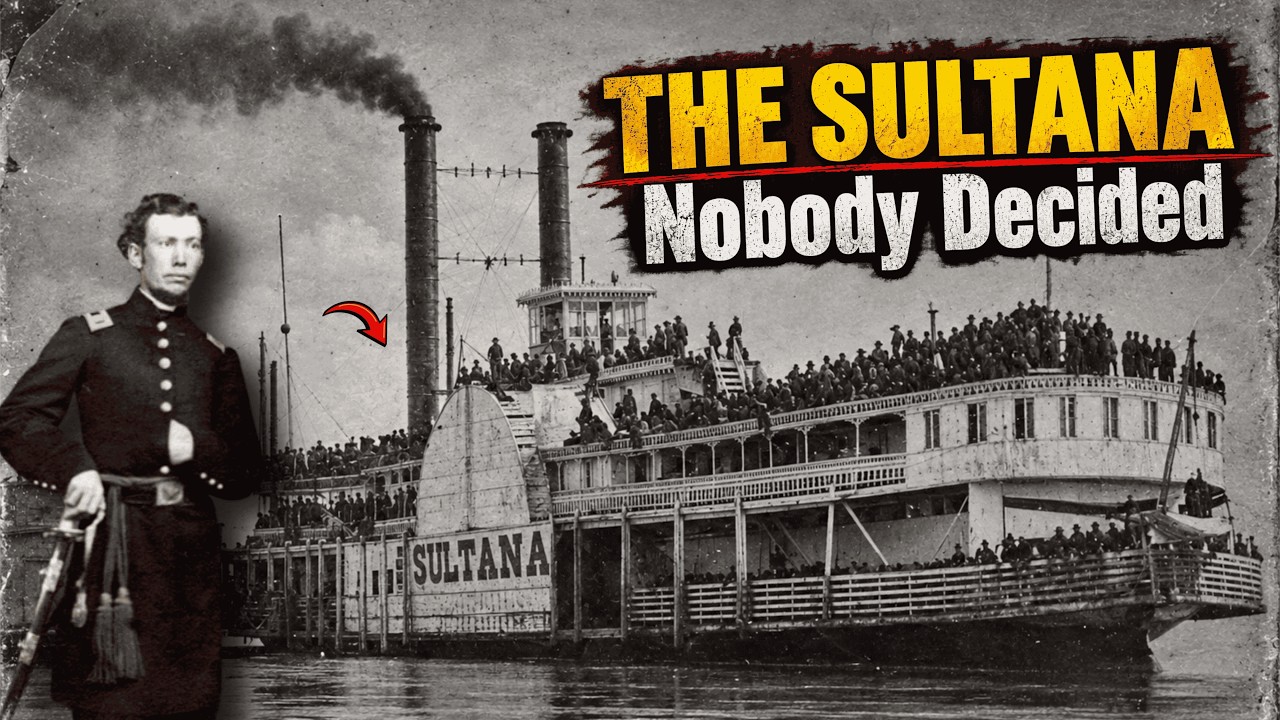
Every railing, every stairway, every inch of open deck was packed with men, so tightly crowded that the camera could not distinguish them as individuals. They were simply texture. Some of them had heard there was a photographer on shore and moved to one side to be in the picture, hoping to say later that they had been aboard the boat that brought them home. So many moved at once that the Sultana visibly listed.
Her license permitted her to carry 376 passengers. When she left port that day, she carried more than two thousand men. About twenty hours later, seven miles north of Memphis, at two in the morning, three of her four boilers exploded simultaneously. By most counts, more Americans died in the river that night than went down with the Titanic.
Nearly every man in that photograph had already survived the Confederate prisoner-of-war camps. They had been starved for a year at Andersonville and Cahaba, released in April, and marched to the dock at Vicksburg to go home. The ship that came for them carried more than five times her designed capacity, and the officers standing on the dock could see it. At least one of them said so out loud.
Still, they loaded her. In the spring of 1865, thousands of Union soldiers released from Confederate prisons were held at a temporary camp four miles east of Vicksburg, called Camp Fisk, waiting to be returned home. Most came from two camps: Andersonville in Georgia, which had become the northern word for the worst thing imaginable, and Cahaba in Alabama, a converted cotton warehouse where men slept on the ground and the river flooded in March. Many were from East Tennessee, a Confederate region that had refused to join the Confederacy.
Its mountain counties had voted against secession and sent thousands of men north through the lines to join the U. S. Army in regiments like the Third Tennessee Cavalry. These men had fought their own neighbors.
When they were captured, they were treated as traitors, not prisoners. The Third Tennessee Cavalry fell almost as a unit at Sulphur Branch Trestle near Athens, Alabama, on September 24 and 25, 1864, when Nathan Bedford Forrest surrounded the garrison and forced its surrender. The white Tennessee prisoners were sent to Cahaba, which they called Fort Morgan, and remained there for seven months. In March 1865 the Alabama River overflowed and flooded the prison four feet deep.
There was no dry ground for six days. The men slept standing or not at all. When they were released and brought to Camp Fisk, army surgeons recorded what came out of the camps: men weighing under a hundred pounds, with scurvy loosening their teeth, chronic dysentery, frost-damaged feet, and night blindness from malnutrition. These were the survivors.
These were the ones the Confederacy had chosen to march on foot. They had one goal: home in the North, and between them and it ran a river full of northbound steamboats. Word spread through the camp in the third week of April that a boat was coming. Word also spread, recorded in the survivors’ own accounts, that Vicksburg officers were taking money from steamboat owners to fill their boats and that the coming boat would be overcrowded.
The men heard this and fought each other to get aboard when the Sultana docked at Vicksburg. They had been told the boat would be crowded. They boarded anyway, because the alternative was more waiting, and they had already endured everything a man could endure of waiting. One of them, a Michigan soldier and Andersonville survivor named Chester Berry, later put it as clearly as it could be put.
The one great thought was home, the dearest spot on earth. The prospect of reaching it soon made them willing to bear any amount of crowding. The Sultana was two years old, a good boat, launched at Cincinnati in January 1863 and working the St. Louis to New Orleans line.
Her captain, James Cass Mason of St. Louis, was in financial trouble. He was one of three investors who had bought her in March 1864, and by mid-April 1865 he had sold most of his share to cover expenses. He had a small stake and the captain’s job left, and the war that had kept river boats busy was ending.
During the war the War Department contracted with private steamboat operators to move troops, paying per head: five dollars per soldier, ten per officer. A boat carrying her legal load of 376 men, mostly enlisted, netted under two thousand dollars. A boat carrying two thousand men netted ten thousand. And there was another factor.
Lee had surrendered at Appomattox on April 9. Prisoners of war were a limited commodity, shrinking fast. Once they were moved, there would be no more government contracts like this one. Every steamboat captain on the lower Mississippi understood that.
There was a last payday on the river, and then nothing. Mason hung a pair of elk antlers between the Sultana’s smokestacks, an old river custom, a captain’s way of telling every boat he passed that his was the fastest. He had built a reputation to match, and reputation cost money to keep. The man who could have stopped it sat in the quartermaster’s office in Vicksburg.
Colonel Reuben Hatch, the chief quartermaster, was from Illinois. His brother Ozias Hatch was Illinois secretary of state and a personal friend of Abraham Lincoln. Historians who examined his record concluded that this connection was why Reuben Hatch remained in the army. In 1862, while quartermaster at Cairo, Illinois, Hatch was accused of defrauding the government over lumber purchases, arrested, and ordered to face a court-martial.
His brother, with the governor and state auditor, wrote to Lincoln asserting his innocence and demanding the president intervene. Lincoln sent the letter to the judge advocate handling the prosecution, asking for his opinion. Then Lincoln appointed a civilian board to investigate. Two of its three members were from Illinois.
Hatch was cleared, the court-martial never happened, and by the final spring of the war he had been promoted to chief quartermaster of a major river depot, with the authority to decide which steamboats got government business. Whether Hatch took money from James Cass Mason has never been proven. There was no confession, no signed document, and everyone who might have known either died in the river or spent the rest of his life denying it. What can be said is the shape of the thing.
A man previously investigated for taking money from the army was, in April 1865, the man deciding which boat would carry two thousand released prisoners north. A system that would not remove such a man had already made its decision. The Sultana arrived from New Orleans in the third week of April with about a hundred passengers and brought word of Lincoln’s assassination, which Mason spread at every stop. Somewhere below Vicksburg, one of her four boilers began leaking.
Her chief engineer lowered the pressure and saved her. She limped into Vicksburg. A local boilermaker named R. G.
Taylor came aboard to examine her. He found a bulge. A section of iron in one boiler had distended outward under pressure and cracked along a seam. Taylor’s diagnosis was that two boiler plates needed to be cut out and replaced, about three days of work.
Three days was the deciding factor. In three days the prisoners would leave Camp Fisk. There were other boats on the river and other captains who wanted that contract. The boat tied to the Vicksburg wharf, its boilers opened, was a boat watching ten-thousand-dollar steamboats pass it by.
Mason and his chief engineer asked for a temporary patch instead, something to hold until St. Louis, where the work could be done properly. Taylor refused and left the boat. Then he came back and did the work.
He riveted an iron patch over the bulge. The patch was thinner than the plate around it, and to fasten it he drilled a row of rivet holes through the boiler wall, a row of holes in metal that had already failed once. The two burned plates that needed replacing stayed in place. The whole job took about a day.
The Sultana had tubular boilers, a design that passed hot gases through tubes inside the water. They were efficient but known to be temperamental. The water level had to be kept above the hot surfaces. If the boat listed, the water shifted, exposing metal sitting directly over the coal fire.
That metal grew fiercely hot. When the boat rolled back, the water hit it and flashed instantly to steam, spiking the pressure. A tubular boiler on a level boat was a reliable machine. A tubular boiler on a leaning boat was a bomb with a long fuse.
Taylor finished his work on April 24, and as he worked, the prisoners began arriving from Camp Fisk. Loading the Sultana took most of that day. The prisoner transfer was the responsibility of Captain Frederick Speed, an assistant adjutant general who spent the day at the parole camp finishing the prisoner lists. On the dock, the officer in charge of putting men aboard and counting them was Captain George Williams.
Both got the numbers wrong. Williams believed the total was under fifteen hundred; the real number was close to two thousand. Captain William Kerns, an assistant adjutant general working on the Vicksburg wharf, watched what was happening and tried to stop it. He went to Hatch and told him too many men were boarding one boat.
He pointed to the answer, tied in plain sight. The steamer Pauline Carroll had arrived in port and was tied at the same wharf, with room for a thousand men, and almost no one on her. Hatch telegraphed the parole camp asking if there were more prisoners than the Sultana could hold. Kerns went to Brigadier General Morgan Smith, commander of the district, and asked him to use his influence to move part of the load onto the Pauline Carroll.
The parole camp replied that all the men could go on one boat. Smith did nothing. Hatch did nothing. There was a reason Kerns’s warning carried so little weight, which came out in testimony.
He was offered a bribe to keep the load on the Sultana. He neither refused it nor reported it until after she had sailed. The officers responsible for the load heard that money was being offered on the Pauline Carroll and concluded that splitting the men between the two boats was the trick. The Pauline Carroll steamed north without them and reached St.
Louis without a single death aboard. Four men had the power to stop it. Speed controlled the transfers at the camp. Williams kept the count on the dock.
Hatch ran the quartermaster’s office and chose the boat. Smith commanded the district and treated it as a transportation matter. One man tried. Kerns raised the alarm, and it looked serious.
No one decided to put two thousand men on the Sultana. That is precisely how it happened. A decision no one makes is a decision no one can walk back. By late on the evening of the 24th, by the most careful reconstruction, some 2,130 people were aboard: nearly 1,960 released prisoners, 22 guards, 85 crew, and 70 paying passengers, including women and children traveling upriver.
Among them were wives who had come south to collect their husbands. One was a Wisconsin woman named Ann Anis and her daughter Isabella, whom the family called Bell. Isabella was seven, the youngest of the Anis children. Ann’s husband Harvey had fought at Shiloh with the Eighteenth Wisconsin, then taken a commission as lieutenant in the U.
S. Colored Infantry. He fell ill; Ann traveled from Oshkosh with Bell to nurse him, and by the third week of April the family was waiting in Vicksburg for one thing: his discharge papers. The papers were signed, somewhere in the post office.
The Anises decided not to wait and booked passage north on the Sultana. The upper deck sagged under the weight, so carpenters put in extra supports. One of the Third Tennessee men later wrote that they came aboard like a flock of sheep. He counted 2,141 passengers, noted that this was almost six times the number she was licensed to carry, and his arithmetic held up better than the army’s for 160 years.
Harvey Anis, in uniform, was given an officer’s cabin near the middle of the boat. The clerk pointed out what was obvious to the crew and had not been fixed: the deck was sagging under the extra supports. Anis said later that a great fear came over everyone because of the number of passengers and the top-heavy weight. Mason was heard worrying about the boat’s stability.
She sailed late that night. The Mississippi in the last week of April 1865 was in flood. Spring snowmelt and rain had pushed it over its banks along most of its length. In some stretches between Vicksburg and Memphis the water ran two or three miles wide, swift and cold, over drowned treetops and through fields where there was no bank to swim to.
The Sultana pushed north against a current she was not designed to fight with a load she was not designed to carry. She rolled. Survivors described her lurching heavily side to side from the weight on her upper deck. Every roll moved the water in the boilers.
On the morning of the 26th she reached Helena, and when the men crowded to the rail to be photographed, she listed so sharply that officers shouted at them to move back. That evening she reached Memphis and unloaded her cargo, about 300,000 pounds of sugar pulled from her hold. That should have righted her. Instead, it did the reverse.
The weight low in the boat was gone, and what remained was stacked on deck above the waterline, packed from boilers to roof. She left Memphis heavier than she had arrived. A few men went ashore in the city for a few hours. A small number did not come back, for no reason beyond chance.
Just after midnight the boat crossed the river to Hopefield on the Arkansas side to load coal, about a thousand bushels, heavy weight low in the boat. At about one in the morning on April 27, the Sultana left the coal barge and turned north into the flooded river. Most of the men aboard were asleep on deck. Ann Anis was awake.
She said later the boat was perfectly quiet at the moment of the explosion, running smoothly, not fast, and the men aboard conducted themselves very well. There was no noise, no quarreling, only a little motion. Whatever caused the water to go down in the boilers that night, by her account, it was not a moving crowd. Around two in the morning, about seven miles above Memphis, three of the four boilers exploded, one and then two more within a fraction of a second.
The boat had been rolling for two days with low water in her boilers. The official investigation blamed the combination and the patch put on at Vicksburg. The blast tore upward and forward, ripping open the middle of the boat, destroying the pilothouse, and dropping both smokestacks through the deck. Everything above the boilers fell into the hole where they had been.
The men sleeping directly above were dead in the first half-second. Then came the steam. A boiler explosion does its worst damage with what leaks out, not what breaks. Superheated steam rolled across the crowded decks like a wave, burning the men in its path beyond anything nineteenth-century medicine could do.
Chester Berry woke suddenly, hit by a piece of wood that split his scalp. When the steam cleared enough to see, the man sleeping beside him, a soldier named Levi Bosley, was dead, burned in place. Then the boat caught fire. She was built of wood, she carried coal, and her fireboxes had just been opened.
The fire took hold amidships and spread outward in both directions, which meant that within minutes the survivors were split into two groups, one forward, one aft, with fire between them. So they went into the river. The Anises were asleep in their cabin. Steam came into the passageway.
Harvey shut the cabin door against it and tried to open the guards’ door; it was stuck. Someone outside shouted that the boat was broken. He tied a life preserver to his wife and one to himself. The preserver was adult-sized; there was nothing to fit a seven-year-old.
So he pulled a board from the cabin wall to put his daughter on. He took them to the stern, tied a rope to the lower deck, and climbed down first with Bell. Ann started down behind them. A man jumped from the upper deck, struck her, and knocked her off the rope into the hold.
By the time she was pulled out and came down the rope again, her husband and daughter were already in the water. She went down holding a piece of board. The fire ran along the tiller she was holding and burned it from her hands to her shoulders, and she had to let go. She stayed in the river for roughly nine miles.
The last she saw of her family was Harvey holding the child, his hand slipping off the board. In one detail that seems invented and is not, the Sultana carried a live alligator in a wooden crate as a ship’s mascot. A soldier killed it with a bayonet and used the crate as a float. Men who could not swim went into the water anyway, because the alternative was burning.
Men who could swim grabbed men who could not, and both drowned. The survivors’ accounts return again and again to this, to being seized in the dark by a drowning man and to what they did about it. Chester Berry wrote about his own experience for the rest of his life. A man near him in the water was crying that he could not swim.
Berry told him to find a board, then, in fear and impatience, said something else: drown, you fool. He never learned what happened to the man. He wrote twenty-seven years later that he had regretted that single act all those years. The water was cold, the current fast, and the men in it had spent the past year starving.
Some made a hundred yards and stopped. Many had nowhere to swim to. The river was three miles wide there, and the banks were underwater. Men who reached what they thought was land found drowned timber, clung to treetops, and waited for hours in the dark April water.
The wreck burned down to the waterline, then drifted and sank near the Arkansas shore. Most of the rescue came from people who eight weeks earlier had been the enemy. Arkansas farmers on the west bank heard the explosion and hurried to the shore with anything that floated. One man, John Fogelman, lashed logs into a raft and went out again and again.
A newspaper of the time reported that Fogelman and three neighbors working log rafts saved nearly a hundred people, and that his house had been turned into a hospital. Boats came from Memphis. Crews pulled men from the water in the dark. Confederate soldiers, camped nearby, some of them released within the month, went into the river for Union prisoners.
At dawn the port of Memphis began taking in survivors, then bodies. Hospitals received about 780 people; 31 of them died. Bodies recovered from the water were laid in coffins along the levee until Memphis ran out of coffins, and then laid along the levee under sheets. Most were never found.
The river was high and fast. Bodies continued to be found downstream for weeks, some hundreds of miles south. Ann Anis was rescued and taken to a hospital in Memphis, treated for burns, shock, and exposure. She was among the few women who came out of the river alive.
She stayed in Memphis about a month, moving between morgues along the waterfront, looking at hundreds of recovered bodies, trying to find her husband and daughter. Neither was ever found. The final death count was never settled, and the uncertainty is part of the story. Initial estimates from passenger counts and survivors suggested about 1,164 dead.
The War Department investigation under General Hoffman, completed only three weeks after the disaster, put the total at 1,238. The Memphis customs service estimated 1,547. Estimates range as high as 1,800. The reason the true number is unknown is that the army never kept an accurate count of who came up the gangplank.
That gap is the record. The central failure of the Sultana, the one that killed those men, is that the United States Army did not know how many of them there were. The disaster was investigated four times. General Cadwallader Washburn held an inquiry at Memphis.
Colonel Hatch appeared before it and denied any role in the overloading. Testimony was given against him, allegations that he had taken a bribe from the ship’s owners. Washburn cleared him and placed responsibility on Captain Frederick Speed. Secretary of War Edwin Stanton ordered a separate investigation under General William Hoffman.
Hoffman found Hatch’s failure to intervene a neglect of duty and named Hatch and Speed the officers most deserving of blame. On June 3, 1865, Reuben Hatch was relieved as quartermaster. Quartermaster General Montgomery Meigs, after reading Washburn’s report, recommended a court-martial. On July 28, 1865, Reuben Hatch was honorably discharged from the U.
S. Army. When Speed faced court-martial the next year, Hatch was summoned to testify and ignored it. Then he was summoned again, and ignored it again.
War Department officials noted that a man acting that way seemed to feel some responsibility for the disaster. Nothing was done about it. Frederick Speed was the only man tried. The court-martial convicted him of overcrowding the Sultana.
The army’s judge advocate general reviewed the conviction and reversed it, because Speed had spent that day at the parole camp and had not put a single soldier aboard. Captain George Williams, who did the loading, was never tried. Speed was honorably discharged. How many people were held responsible for the deaths of at least 1,164 American soldiers?
No one. The country did not care. On April 26, the day before the explosion, John Wilkes Booth had been cornered in a tobacco barn in Virginia and shot. That was the news.
Lincoln had been dead twelve days, still being carried by a funeral train stopping in every city. Lee had surrendered eighteen days earlier. On April 28, 1865, a newspaper reader in Ohio was reading about the death of the president’s assassin, and somewhere below it, in smaller type, about a steamboat sinking on the Mississippi. The men who survived spent the rest of their lives trying to set it right.
They formed survivor associations in the North and in Tennessee, held annual meetings for decades, lobbied Congress, and saw a monument erected in Memphis in 1916, fifty-one years after the sinking. The last of them, Charles Eldridge of the Third Tennessee Cavalry, died in 1941 at ninety-six, seventy-six years after he went into the river. Some had to fight to survive even afterward. About two months after the disaster, Chester Berry’s mother in Michigan received official word from Washington that her son had died on the Sultana.
He had not. He was alive, recovering from a fractured skull, and when he later applied for a pension for that injury, he had to prove, against his own government’s paperwork, that he was alive. Ann Anis returned home to Wisconsin and applied for a widow’s pension. The government refused.
The reason given was that Harvey Anis’s resignation had been accepted and his discharge signed before April 27. Officially, he was a civilian when he drowned. The widow of a civilian was owed nothing. The papers had never reached him.
He died waiting for them, aboard a boat he had taken because he was tired of waiting, carrying a child for whom he had made a float because military life preservers did not come in her size. Ann Anis fought that decision for seven years. She finally received her pension, seventeen dollars a month, only by a private act of Congress passed to give it to her. In 1982, a team led by a Memphis lawyer named Jerry Potter went looking for the wreck.
They found charred black planks and timbers thirty-two feet below the surface in an Arkansas soybean field, about two miles from the Mississippi’s present channel. The river had changed course over the past century, leaving the boat under a farm. She is still there. It was decided to leave her alone.
The Helena photograph survives too. The faces of the men in it are still distinct. Five dollars per soldier, ten per officer.
That was the rate the United States government paid to bring its soldiers home from the prison camps, and it was the only number in this entire story that anyone in Vicksburg had bothered to get right.