A scratched, oxidized piece of metal, smaller than a postcard, has fueled two of the most enduring myths about one of the American West’s most famous outlaws. For more than a century, this tintype has been held up as proof that Billy the Kid was a left-handed, half-mad killer. The truth, when examined through the careful eye of a forensic investigator, tells a different story. It reveals a young man nearing the end of his violent life, and it exposes how a simple misunderstanding of 19th-century photography created a legend that Hollywood would happily repeat for generations.
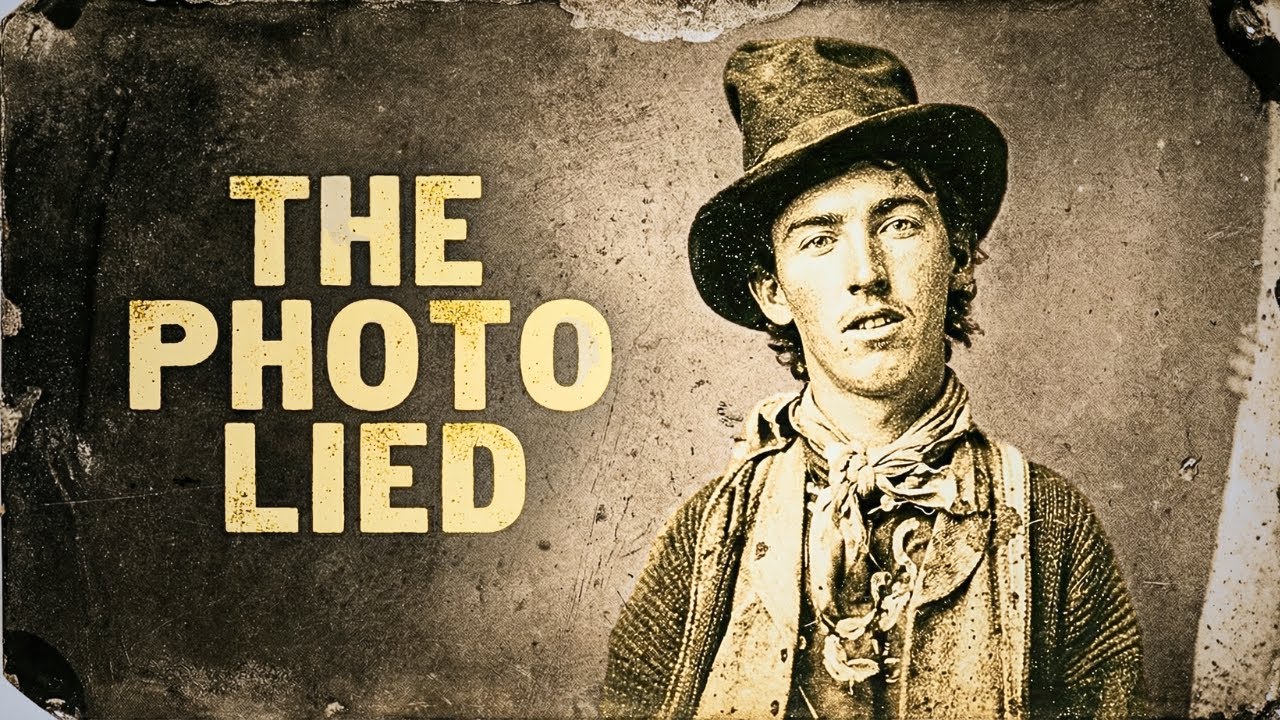
The image in question, known as the Dedrick tintype, is the only confirmed photograph of Billy the Kid. It depicts a face that matches contemporary descriptions of the outlaw. Witnesses who knew him described his boyish features, his slightly prominent front teeth that stuck out like a squirrel’s, and his narrow jaw. The man in the photo is not a chiseled movie gunslinger but a young man of about 20 or 21 who appears tired.
The clothing reinforces the identification. He wears a practical slouch hat, a dark vest, a bandana, and layered garments. In his hands is a Winchester Model 1873 rifle, the firearm that became known as the gun that won the West. On his hip rests a revolver.
This is the kit of a working gunman, neither a rich cattle baron nor a destitute drifter. He was armed, equipped, and functional. This particular copy of the photograph has a history as remarkable as the man in it. Billy reportedly gave it to his friend Dan Dedrick, who was involved in cattle rustling and possibly counterfeiting.
Dedrick kept the tintype for the rest of his life, and upon his death in 1938, it passed to his nephew Frank Upham. The Upham family held onto it for decades before selling it at auction in Denver in 2011. The winning bid came from billionaire and Old West enthusiast William Koch at 2. 3 million dollars, making it the most expensive 19th-century photograph ever sold, a record that still stands.
The tintype measures about 2 by 3 inches. It is a ferrotype, an image captured directly onto a thin sheet of iron coated with a dark lacquer. It was the cheapest, fastest form of photography in its era, and the wear and scratches on this copy suggest it was handled, carried, and perhaps tossed in a drawer, not treated as a precious family heirloom. The identification of the man in the photo as Billy the Kid rests on more than the clothes and the face.
The chain of custody is well documented, and people who knew him confirmed its authenticity. His girlfriend, Paulita Maxwell, interviewed in the mid-1920s, said the photo was taken in Fort Sumner in 1880 by a traveling photographer. She recalled that Billy posed for it standing in the street near Old Beaver Smith’s Saloon. She never liked the picture because it made him look rough and uncouth, not the man she remembered.
According to one account, Billy posed for four identical tintypes that day, captured on a single metal plate by a camera with multiple lenses, then cut apart and distributed. Of those four, three are accounted for. One went to Dan Dedrick. Another went to Pat Garrett, either taken when he captured Billy in December 1880 or acquired after the outlaw’s death.
A third reportedly went to Deluvina Maxwell, a Navajo woman who worked for the Maxwell family and was a devoted friend to Billy. That copy was last seen by author Emerson Hough in Fort Sumner in 1904. The fourth tintype has been lost to history. The most significant part of the legend born from this image concerns the outlaw’s handedness.
For decades, the placement of the revolver on his left hip served as proof that Billy the Kid was left-handed. Hollywood adored this detail, making him different, memorable, and slightly sinister. There was just one problem. Tintypes are mirror images.
The chemistry of the ferrotype process flipped whatever the camera saw when it was developed onto the metal plate. When the image is reversed, the gun is on his right hip, the vest buttons align correctly, and the rifle is held in his left hand, the way a right-handed person would naturally hold it. The photo itself provides its own evidence. The rifle has a loading gate that appears on the left in the image, but Winchester only made Model 1873s that load on the right side.
The photo must be reversed. This correction aligns with the historical record. People who rode with Billy, fought against him, and jailed him described him as right-handed. Pat Garrett, the man who ultimately killed him, said Billy drew with his right hand.
Contemporary newspaper accounts never once mentioned him being left-handed. Western historians James Horan and Paul Sann announced as early as 1954 that Billy was right-handed and carried his pistol on his right hip. The myth had begun because people trusted what they saw without understanding the technology that created it. The tintype first reached the public through an engraving used in Pat Garrett’s 1882 book, published a year after Billy’s death.
The image was reprinted endlessly in dime novels, magazine articles, and histories of the Lincoln County War, and nobody ever mentioned that tintypes are reversed. Assumption became fact through repetition. By the time Hollywood told the story in the 1930s and 1940s, the left-handed detail was carved in stone. Paul Newman portrayed him as a lefty in The Left-Handed Gun in 1958, and dozens of films and television shows followed.
The same image that created this myth also offers a glimpse into Billy’s life and state of mind at the time it was taken. His gear was expensive. A Winchester cost about 25 dollars, and a Colt revolver another 15 to 20. With the hat, vest, cardigan, and boots, he was carrying close to 70 or 80 dollars worth of equipment, at a time when a cowboy earned about 30 dollars a month.
He either had money saved, was being paid well, or was supplementing his income outside the law. The most revealing detail might be in his eyes. He is not looking at the camera, but appears distracted, uncomfortable, and tired. In the 1870s and 1880s, an exposure required standing perfectly still for several seconds, and most people stared directly into the lens.
Billy did not. He looks like someone who did not want to be there. He had already been involved in the Lincoln County War, killed at least a couple of men, and had people actively trying to kill him. Just months after this photo was likely taken, in December 1880, Pat Garrett captured him.
Posing for a photograph when you are wanted by the law was a risk. The image could be used to identify him. It could be circulated to lawmen in other territories. Billy may have taken the risk to send the photo to someone, a girlfriend, family, or a keepsake to prove he was still alive.
Or he may have simply been young enough, only 20 or 23, to want a picture of himself even if it was dangerous. The tintype does not show an evil man or a heroic Robin Hood. It shows a young man who had already killed men and would be dead within 18 months. He looks like someone caught up in circumstances he may not fully control, someone who knows his life is dangerous and uncertain.
The myth of the left-handed killer collapses when the technology is understood. The photo corrects a legend and reveals a human being. This scratched, oxidized piece of metal, made for pocket change and likely meant to be discarded, survived fires, floods, moves, and more than a century of neglect to become the only confirmed image of one of the most famous outlaws in American history.
It stands as the most honest evidence we have about Billy the Kid, not the stories, not the movies, but a single, flawed image of a young man who had no idea he would still be famous 140 years later.