On a quiet stretch of Virginia backroad, not far from where the Potomac bends toward the sea, there stands a small highway marker. Most drivers never slow down for it. It names the man who once lived here, a counselor, a minor colonial title, almost an afterthought. It says nothing about the fact that this man once owned more land and more people than almost anyone else in Virginia.
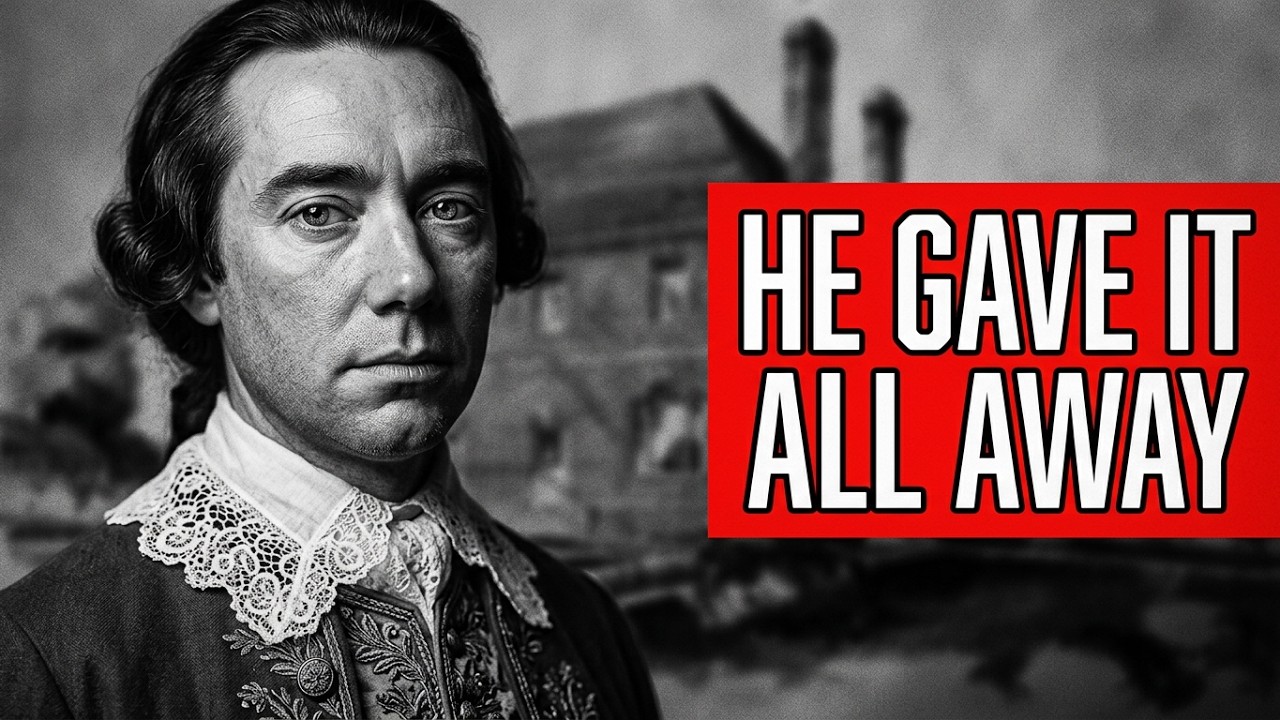
And it says nothing about the September morning in 1791 when he walked into a county courthouse and did something no one, not Washington, not Jefferson, not a single one of his fellow founding fathers, was willing to do. He gave it all away. This is the story of Robert Carter III, master of Nomini Hall, and the deed that would eventually free more enslaved people than any other private act in American history before the Civil War. To understand what Robert Carter did, you first have to understand what he stood to lose.
He was born into the closest thing colonial Virginia had to royalty. His grandfather, Robert King Carter, had been one of the wealthiest men in British North America. By the time the title and the land passed down to young Robert III, the family held something close to 80,000 acres and hundreds of enslaved men, women, and children spread across Virginia’s Tidewater and the Shenandoah Valley. In the center of it all sat Nomini Hall, a grand brick mansion on the countryside of the Northern Neck.
The kind of house with its own orchards, its own boat landing, its own resident tutor for the children. A visiting Princeton graduate named Philip Fithian lived there for a year in the early 1770s and kept a journal of what he saw. Dances, fine imported wine, a family of extraordinary wealth living exactly as Virginia’s ruling class was expected to live. By any measure available to a man of his era, Robert Carter had already won.
He sat on the governor’s council. He served in the militia. He had status, comfort, and more property, human and otherwise, than he could easily count. And for most of his life, he ran his plantations the way every other planter of his class did.
He bought and sold enslaved people. He extracted their labor to build his fortune. There was, on paper, nothing to suggest he would ever be remembered as anything other than one more wealthy Virginia slaveholder among hundreds. Something changed that.
Historians still argue about exactly when the shift began, but they agree roughly on where it started. Inside Robert Carter’s own restless mind. In 1787, his wife of nearly forty years, Frances Ann Tasker Carter, died. Carter had already spent years drifting through different faiths, sitting with Anglicans, then Baptists, searching for something that fit.
In the aftermath of her death, he found it for a time in the teachings of the Swedish mystic Emanuel Swedenborg, whose followers preached that true religion had to be lived out through action, not simply professed on Sundays. Carter began to apply that idea to the one part of his life that religion in Virginia rarely touched: slavery itself. He didn’t announce a crusade. Neighbors who knew him later described a private, almost stubborn man who wasn’t someone who went out and shouted about his views.
But quietly, his actions started to speak for him. He sent his two youngest sons away to college in Rhode Island, specifically so they would grow up outside the reach of plantation slavery. And he refused to let them return to Virginia even when their own mother died. He did not want them coming home to a house still built on bondage.
By the early 1790s, Carter had reached a conclusion that almost no one else of his wealth and standing in Virginia was willing to reach. He believed slavery was, in his own words, contrary to the true principles of religion and justice. And he believed that conviction created an obligation. Virginia law made manumission difficult.
A 1782 statute allowed individual slaveholders to free the people they enslaved, but doing it all at once, freeing hundreds of people in a single stroke, would have been financially catastrophic and legally vulnerable to challenge from Carter’s own family, who stood to inherit that wealth. So Carter did something more careful and, in its own way, more radical. He designed a plan for gradual emancipation, one that would hold up in court, satisfy the letter of Virginia law, and stagger the process so that it couldn’t easily be undone. On the first of August, 1791, he signed it.
He called it his deed of gift. On September the fifth, he walked it into the district court in Northumberland County and had it entered into the record. The document ran for pages. First, a long list of names, 452 of them, men, women, and children, along with their approximate ages.
And then, at the end, Carter’s own explanation for what he was doing. The deed of gift would become the largest single act of emancipation in American history before the Civil War, larger than any private manumission that came before it in the United States. Its effects were quiet and slow. Carter did not announce his decision publicly, and he did not free everyone at once.
The deed staggered the freedom of the people it named, with schedules designed to protect the legal standing of the action against the inevitable challenges from his heirs. The people named in the deed did not simply walk away. Many of them continued to work the land, some for years, as the plan unfolded. But the legal status of the document was the point.
Once recorded in the court, it could not be undone by a change of heart or a moment of doubt. It bound Carter’s estate, and through it, his heirs, to a future they had never agreed to. His family did not accept it quietly. Carter’s own children and grandchildren challenged the deed in court, trying to reclaim the human property they had expected to inherit.
The legal fight dragged on for years after Carter’s death in 1804, and some of the people named in the deed never saw the freedom it promised them. The courts chipped away at parts of the document, and some of those it was meant to free remained in bondage longer than Carter intended. And yet the core of what he did survived. Hundreds of men, women, and children were eventually freed through the deed of gift.
No other private slaveholder in America before the Civil War would match what Robert Carter set in motion on that September morning in 1791. The deed transformed the lives of the people it named, most of whom had no voice in the matter when it was signed. They went from being property to being people with a future that did not belong to anyone else. Carter himself died in 1804, quietly, away from the grand estate where his fortune and his family’s power had been built.
He was buried in a modest grave, and his name slipped out of the dominant story of American history as quickly as it had entered it. The family fortune collapsed under the weight of his decision. The grand house of Nomini Hall eventually fell into ruin. Today, a small marker on a Virginia backroad is almost the only public reminder that the man who lived there once owned more land and more people than nearly anyone else in the colony.
The marker says nothing about the nearly four hundred and fifty enslaved people he freed, or the fact that for a brief moment, one of the most powerful men in Virginia decided that the only thing he could do with his wealth was give it away.