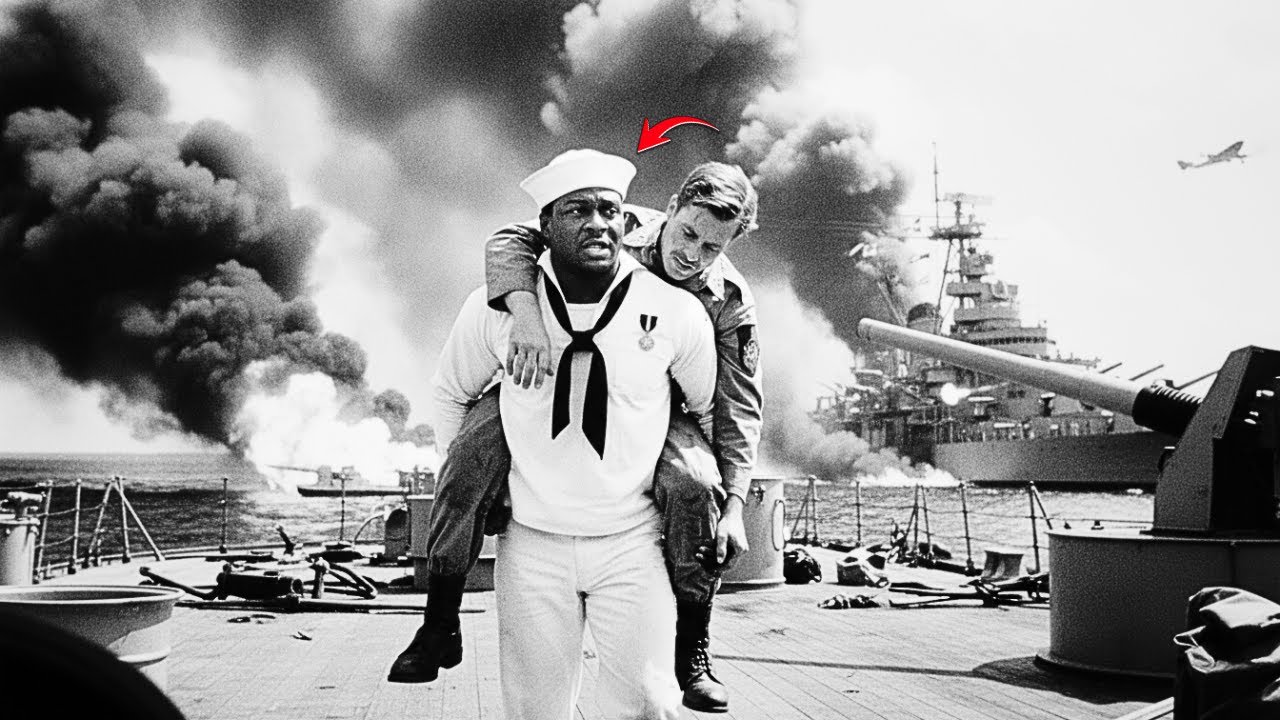
On the morning of December 7, 1941, Doris Miller was below deck aboard the USS West Virginia, collecting laundry. He was a mess attendant, a cook, one of the few roles the segregated United States Navy allowed Black sailors to hold. Nineteen minutes later, he was cradling his dying commanding officer in his arms. Within the hour, he was manning an anti-aircraft gun he had never been trained to fire, shooting at Japanese planes with a precision the Navy had never thought to teach him.
Before the morning was over, he would swim through burning oil to escape his sinking ship. Doris Miller was born on October 12, 1919, in Waco, Texas, on a sharecropper’s farm. His parents, Conry and Henrietta Miller, worked land that was not theirs in a region governed by Jim Crow. Segregation was written into law and custom, and opportunity for a Black child in rural Texas was almost nonexistent.
But Miller was tall, powerful, and athletic. At Moore High School in Waco, he became the varsity fullback, a 200-pound force on the football field. He was soft-spoken and polite, but his actions spoke clearly enough. By 1939, the Great Depression had crushed America, and jobs were scarce.
For a Black teenager in Texas, the future seemed predetermined: work the land, accept the limitations, ask for nothing more. Miller decided to ask for more. On September 16, 1939, less than two weeks before his twentieth birthday, he enlisted in the U. S.
Navy at a recruiting station in Dallas. He reported to Norfolk, Virginia, for basic training, where the Navy offered him the only path available to a Black sailor: mess attendant, third class. He could cook, serve food, and clean. He could not be trained as a gunner, could not hold command, and could not rise through the ranks like white sailors.
He accepted, because accepting was the only option. In January 1940, Miller was assigned to the USS West Virginia, a Colorado-class battleship of 32,000 tons armed with eight 16-inch guns. She was the flagship of the Pacific Fleet, stationed at Pearl Harbor. Miller served breakfast on one of the most powerful ships in the American navy, but he also discovered he was good at more than cooking.
The ship’s athletic program made him its heavyweight boxing champion, and his shipmates and officers respected him, even if the system did not allow him to advance. On the morning of December 7, 1941, Japanese carrier planes struck Pearl Harbor without warning. At 7:55 a. m.
, the first wave of hundreds of aircraft delivered bombs, torpedoes, and machine-gun fire. The West Virginia, moored on battleship row next to the USS Tennessee, was a primary target. Below deck, alarms screamed and explosions rocked the ship. Miller’s first instinct was to report to his battle station, but he found it destroyed, its anti-aircraft gun obliterated by a direct hit, the compartment filled with shrapnel and dead sailors.
He looked for someone who needed help. On the bridge, Captain Mervyn Bennion was commanding his ship when a bomb fragment tore through his abdomen. The wound was mortal. Miller saw the captain collapse and ran to him, dragging him to cover while Japanese planes continued to dive on the ship.
Bennion, even as he was dying, told Miller to leave him and help the others. Miller could not save the ship, which was taking repeated torpedo hits and sinking, but he could move to the next task. At about 8:10 a. m.
, Lieutenant D. C. Johnson, the ship’s communications officer, was manning a port-side anti-aircraft gun and needed ammunition. He shouted at Miller to start loading rounds.
Miller had never been trained to load or fire a weapon, but he began feeding heavy, sun-hot ammunition into the gun as explosions rocked the ship. When Johnson had to leave his position, the gun fell silent. Japanese planes were still strafing the deck, and there was a loaded . 50-caliber machine gun with no one pulling the trigger.
Miller picked it up. He had watched the other sailors fire the guns and understood how they worked. “I just pulled the trigger and she worked fine,” he later said in his quiet Texas accent. “I had watched the others with these guns.
I guess I fired her for about 15 minutes. I think I got one of those planes. They were diving pretty close to us. ”
For fifteen minutes, a mess attendant who had never been trained to fire a weapon, a Black sailor operating equipment he was legally forbidden to touch, manned an anti-aircraft gun and fired at enemy aircraft.
No one stopped him. The system that had kept him in the galley had broken down in the face of catastrophe. When the bombs started falling, regulations and racism no longer mattered. Only courage mattered, and Miller stood and fought.
But the West Virginia was beyond saving. The order came to abandon ship. As sailors poured over the side into the harbor, Miller pulled man after man from the water. The harbor was a nightmare of burning oil from the USS Arizona and other ships, flames, smoke, and chaos.
He dragged wounded and drowning sailors to lifeboats and floating debris. Eventually, he had to escape himself. He dove into the water and swam three to four hundred yards through burning oil, machine-gun fire, and thick smoke, diving underwater to survive. He reached shore as one of the last three men to escape the West Virginia.
Of roughly 1,500 crew members, he had helped save an uncounted number of lives. In the days after Pearl Harbor, America searched for heroes. The Navy celebrated officers who died at their posts, but buried in the chaos of early reports was the story of an unidentified mess attendant who had manned a gun he was never supposed to touch. Officers who had seen Miller at the anti-aircraft gun and shipmates who had watched him pull sailors from the water reported what they had witnessed, but the Navy did not know how to categorize a Black man who had fought with courage and competence that defied its racial hierarchy.
The reports identified him only as an unidentified mess attendant. The Black press would not let the story disappear. The Pittsburgh Courier investigated, published his name, his photograph, his story, and the NAACP became involved. Doris Miller was no longer invisible, and America was forced to confront what it had been avoiding.
Admiral Chester Nimitz, commander-in-chief of the Pacific Fleet, made a choice that would matter. On May 27, 1942, he presented Miller with the Navy Cross, the first ever awarded to a Black sailor. At the ceremony, Nimitz said, “This marks the first time in this conflict that such high tribute has been made in the Pacific Fleet to a member of his race, and I’m sure the future will see others similarly honored for brave acts. ”
After receiving the Navy Cross, Miller was sent on a war bond tour, an unprecedented role for a Black sailor.
He traveled alongside white war heroes, spoke in Oakland, Waco, Dallas, and at the Great Lakes Naval Training Station, where the first graduating class of Black sailors heard from the man who had shown them what was possible. He appeared on a Navy recruitment poster with the headline “Above and beyond the call of duty. ” In a letter to the Pittsburgh Courier, the newspaper that had first identified him, Miller wrote, “You have opened up a little for us, at least for the ones who were following me, and I hope it will be better in the future. ” He was not celebrating himself; he was hoping his actions would open doors for others.
His courage began to change the Navy. In May 1942, Robert Lee Thornton became the Navy’s first Black petty officer. By 1944, the Navy introduced an officer training program for Black sailors. Integration began slowly, but the door Miller had opened at Pearl Harbor never fully closed again.
In May 1943, Miller reported to the USS Liscome Bay at Puget Sound Navy Yard. The newly constructed escort carrier had a crew of about 960 sailors, and Miller, promoted to cook third class, was back to being a sailor doing his job. The Liscome Bay left Pearl Harbor in November 1943 and joined the Northern Task Force heading to the Gilbert Islands to support the invasion of Makin. On November 20, the Battle of Makin began, and aircraft from the carrier launched in support.
On November 24, 1943, Thanksgiving Day, at approximately 11:20 a. m. , a Japanese submarine made contact with the Liscome Bay and fired a Type 95 torpedo. It struck the carrier on her starboard side, hitting the aircraft bomb magazine.
The magazine detonated instantly, and the ship was torn apart in seconds. She sank in 23 minutes. More than 600 men out of a crew of approximately 900 died. Miller, working in the galley when the torpedo struck, was among them, almost certainly killed instantly.
He was 24 years old. His parents, Conry and Henrietta Miller, received word that their son was dead on November 24, 1943, exactly two years after Pearl Harbor. Doris Miller was never forgotten. In 1973, the Navy named a destroyer escort, the USS Miller, after him.
A park, a YMCA, schools, and a dining facility at Naval Station Pearl Harbor were named in his honor. In 2020, the Navy announced that a new aircraft carrier, the USS Doris Miller, would be named for him, the first aircraft carrier named for an African American. The real legacy of Doris Miller was not in buildings or ships. It was in what happened when courage was allowed to operate without constraints.
A young Black sailor, forbidden by regulation even to touch a gun, picked up that weapon and fired at the enemy, not to rebel or make a point about civil rights, but because there was a gun, an enemy, and his ship needed him. In doing that simple, necessary thing, he changed America. After December 7, 1941, it became impossible to argue that Black sailors were incapable of fighting.
The door he opened never closed again.