On the night of May 13, 1945, five days after the war in Europe had ended, an eighteen-year-old sentry at the old naval academy in Flensburg-Mürwik heard footsteps in the darkness. He called out the challenge. There was no answer. He called again, then fired.
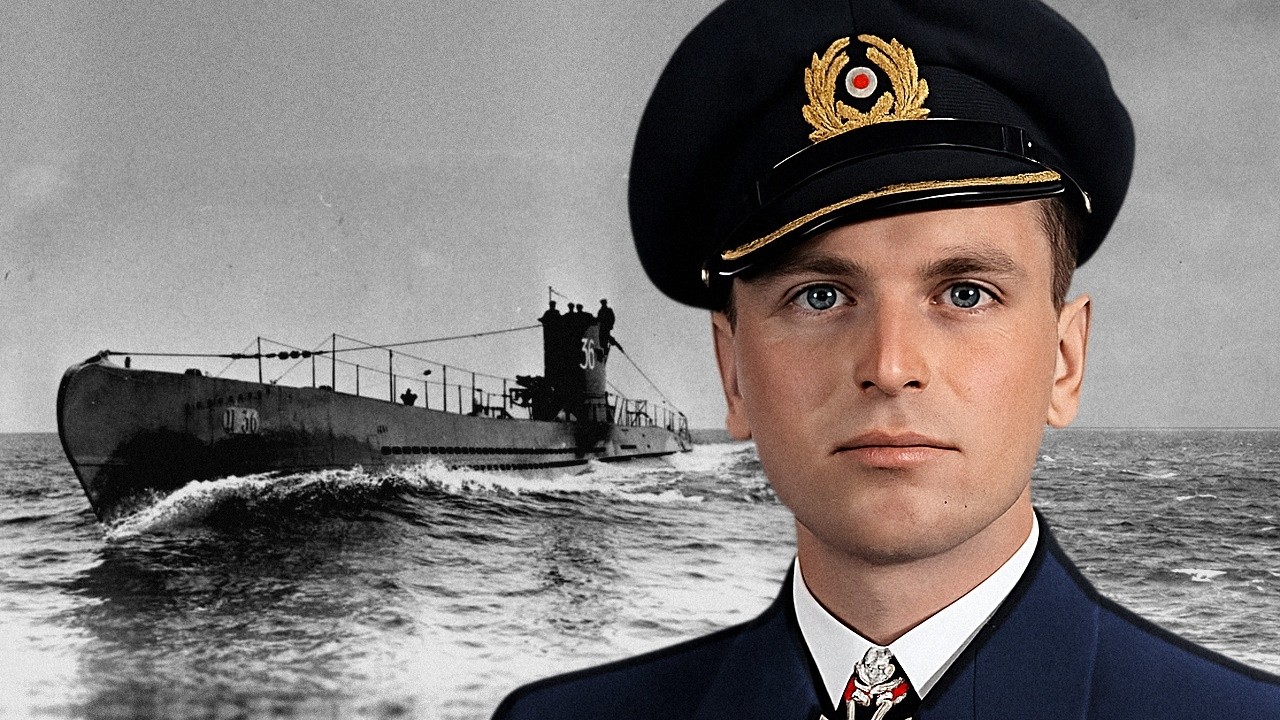
The man who fell dead on the path was the academy’s commander, Wolfgang Lüth, a U-boat captain who, by tonnage sunk, had been the second most successful of the entire Second World War. He had just returned home from his fifteenth war patrol and had not survived a single week of peace. The most successful of them all was not in Germany that night. Otto Kretschmer was sitting in a Canadian prisoner-of-war camp, where he had been held for three years.
Ten years later, he would wear a German naval uniform again, this time inside NATO. Some of Germany’s top U-boat aces never came home at all. Others returned to ruins, interrogation rooms, and courtrooms. A few left Germany for good.
For every one of them, the same question followed: had they been honorable sailors or the sharp edge of a criminal regime? The end for the U-boat arm came in pieces across a handful of chaotic days in early May 1945. Adolf Hitler was dead, and Grand Admiral Karl Dönitz, the man who had built and led the U-boat force since the 1930s, had been named his successor. Operating from the naval base at Flensburg-Mürwik on the Danish border, Dönitz ordered his submarines to cease hostilities on May 4 and sent a farewell message to crews still at sea, telling them they had fought like lions.
Yet the Navy had prepared another plan for that moment. Its code name was Regenbogen, Rainbow, and it meant the mass scuttling of every remaining boat so none would fall into Allied hands. In the early hours of May 5, the order went out, then was canceled within minutes because the surrender terms agreed with the British forbade the destruction of ships. Many commanders ignored the cancellation.
On that single day, eighty-seven boats went to the bottom of German harbors and bays, forty-one of them in Gelting Bay alone. The man who had signed away the Navy’s fleet was Admiral Hans-Georg von Friedeburg, Dönitz’s successor as commander-in-chief. He was the only German officer present at all three surrender signings: on Lüneburg Heath on May 4, at Reims on May 7, and in Berlin on May 8. On May 23, 1945, the day the British arrested the Flensburg government, Friedeburg took his own life with poison.
The numbers behind those weeks were staggering. The German U-boat memorial at Möltenort near Kiel records 739 boats lost in the Second World War and more than 30,000 men killed. Roughly 400 boats had disappeared with every man aboard. Few branches of any armed force suffered losses on that scale.
The survivors were a minority, and the famous captains among them a smaller minority still. Most of the celebrated names had died long before the surrender. Günther Prien, who had sunk the battleship Royal Oak inside Scapa Flow, was lost with his crew in March 1941. Joachim Schepke died the same month, crushed on his own bridge when a British destroyer rammed his boat.
Wolfgang Lüth was one of those who had made it. Born in Riga in 1913, he had sunk 46 merchant ships and a French submarine across 15 patrols, a total of 225,000 gross register tons. In August 1943 he became the first U-boat commander to receive the diamonds to the Knight’s Cross, the highest grade of the decoration. In September 1944 he was given command of the naval academy at Mürwik.
When the war ended, the academy became the center of the last German government. Then came the night of May 13. Walking back across the academy grounds in the dark, Lüth was challenged by a young sentry named Matthias Gottlob. Lüth did not give the password.
Gottlob fired once and hit him in the head. A court-martial later cleared the sentry of any wrongdoing. Why Lüth stayed silent was never settled: some accounts suggest he had been drinking, others point to exhaustion or a sentry who simply did not hear a reply. Lüth was buried with full honors on May 16, 1945, six U-boat officers wearing the Knight’s Cross forming his honor guard and Dönitz himself speaking at the graveside.
It was the last state funeral of the Third Reich, held a week after the Third Reich had ceased to exist. The surviving boats faced their own end. Some 156 U-boats surrendered to the Allies. The victors kept thirty of them, divided between Britain, the United States, and the Soviet Union, and studied the newest designs in detail.
The rest were towed out from ports in Scotland and Northern Ireland to a stretch of sea northwest of Ireland. Between November 1945 and February 1946, under the name Operation Deadlight, 116 of them were sunk. Many never reached the target area; rotted from months at their moorings, 56 boats foundered under tow before a single shot was fired. The boats were gone, but the men who had commanded them were not.
Otto Kretschmer’s war had ended more than four years before everyone else’s. Born in 1912, he joined the Navy in 1930 and took command of his first U-boat in 1937. In eighteen months of fighting, from September 1939 to March 1941, he sank 47 ships of around 274,000 tons, more than any other submarine captain of the war. His crews called him Otto der Schweigsame, Silent Otto; he rarely used the radio and preferred to slip inside a convoy on the surface at night and fire at close range.
The end came on the night of March 16–17, 1941, during an attack on convoy HX 112. British destroyers hunted his boat with depth charges and drove it far below safe depth. Kretschmer brought it to the surface under fire and ordered it scuttled. Three of his men died; the rest, including their captain, were pulled from the Atlantic as prisoners.
British interrogators described a quiet, deliberate man who looked more like a student than a U-boat captain. Kretschmer was first held at Grizedale Hall in the Lake District, then shipped across the Atlantic to Camp 30 at Bowmanville, Ontario. As senior naval officer there, he became a leader among the prisoners. In October 1942 the camp erupted in what became known as the Battle of Bowmanville: after the Dieppe raid, Germany had chained Canadian prisoners, and Canada answered by ordering German prisoners shackled in turn.
Around 400 men barricaded themselves inside a building; guards broke the standoff with fire hoses and tear gas. A year later, the German Navy tried to bring Kretschmer home under Operation Kiebitz, with prisoners tunneling toward a U-boat waiting on the coast of New Brunswick. The escape fell apart, and Kretschmer sat out the rest of the war in captivity. Released in December 1947, he came home to an occupied, divided country with no navy and little interest in heroes from the old one.
Then everything changed. The Cold War turned West Germany from defeated enemy into frontline ally, and in 1955 the Federal Republic joined NATO. A new navy was needed, and it needed experienced officers. On December 1, 1955, Kretschmer was among the very first men sworn into the new Bundesmarine.
He commanded the first escort squadron, then the Navy’s amphibious forces, and in 1965 became chief of staff of NATO’s naval command for the Baltic approaches, based in Kiel. The man who had spent the war sinking British convoys was now planning NATO defenses alongside Allied officers. He retired on September 30, 1970. In August 1998, on a Danube river cruise to celebrate his fiftieth wedding anniversary, he fell down a steep stairway and died at the age of eighty-six.
His ashes were scattered at sea. He had been captured as an enemy and come back as an ally. For other U-boat men, the road after the war led into a courtroom. The most important trial was not about any captain but about the admiral who had sent them out.
When the International Military Tribunal opened at Nuremberg in November 1945, Dönitz sat in the dock beside Göring, Hess, and the rest of the surviving Nazi leadership. Part of the case against him concerned the way his submarines had fought, focused above all on the Laconia order. In September 1942, after U-boats trying to rescue survivors of the sunken British liner Laconia had been attacked from the air, Dönitz ordered all efforts to save survivors to stop. To the prosecution, this was close to an instruction to let men die in the water.
Then the defense produced a surprise: written questions to Admiral Chester Nimitz, who had commanded the United States Pacific Fleet. Nimitz confirmed that American submarines had waged unrestricted warfare across the Pacific and as a rule had not rescued survivors when doing so put the boat at risk. In October 1946 the tribunal found Dönitz guilty of crimes against peace and war crimes and sentenced him to ten years, but the judges stated that his sentence was not assessed on the ground of his breaches of the international law of submarine warfare. For many former U-boat men, that sentence became the foundation of a lasting belief: they had fought clean.
One case never fit that belief. In the South Atlantic on the night of March 13, 1944, U-852 torpedoed the Greek steamer Peleus. The captain feared the wreckage would give his position away to Allied aircraft and ordered his crew to fire on debris and rafts with machine guns and hand grenades. Men in the water were killed.
A few survivors drifted for weeks, and their testimony reached British investigators. In October 1945 a British military court in Hamburg tried the captain and four crew members; three were sentenced to death and shot on Lüneburg Heath on November 30, 1945. The Peleus affair remained the only case in which German U-boat men were convicted of war crimes in the Second World War, and the debate over it has never fully closed. Other aces faced accusations for very different reasons.
Carl-Friedrich Mertens was arrested by the French in 1948 for wrongfully sinking a French tanker in 1942; a court acquitted him in 1949. Reinhard Hardegen’s ordeal was stranger still: in January 1942 he had brought U-123 so close to New York that his crew could see the glow of the city. Two months after the surrender, the British arrested him, having confused him with an SS officer of the same name. He was interned at Neuengamme, the former concentration camp near Hamburg now used by the British as an internment camp, and was not cleared until his wife published newspaper articles about the mix-up.
He was released in November 1946 after a year and a half behind barbed wire for another man’s record. Hardegen never put on a uniform again. He joined the Christian Democratic Union, started an oil trading business, and from 1959 to 1979 sat in the Bremen city parliament. Then he did something few of his former comrades attempted: he went back to America as a guest.
He traveled repeatedly to the United States, sought out veterans and survivors of the coastline he had attacked, and worked with the American historian Michael Gannon. In 1990 he returned to Jacksonville, Florida as an honored guest, and many of these meetings ended in lasting friendships with men who had once been his enemies. He died in June 2018 at the age of 105, one of the very last of the wartime U-boat commanders. Heinrich Lehmann-Willenbrock, who had commanded U-96, chose the sea instead of politics.
After a year as a prisoner, his first civilian work was grim: salvaging sunken ships from the Rhine with Mertens. In 1959, commanding the freighter Inga Bastian, he came across the burning Brazilian ship Comandante Lyra and took 57 survivors off the stricken vessel. A man who had spent the war sinking merchant ships was now saving their crews. In 1969 he became captain of the Otto Hahn, West Germany’s nuclear-powered research and cargo ship, one of only a handful of nuclear merchant ships ever built.
Some aces left Germany altogether. Hans-Diedrich von Tiesenhausen, who torpedoed the battleship HMS Barham in the Mediterranean in 1941, spent the war’s end as a prisoner in Canada and was not released until 1947. In late 1951 he immigrated back to Canada and settled in Vancouver, building a new life as an interior designer and nature photographer. Reinhard Suhren, known as Teddy, refused every offer to serve in the new armed forces, saying he would not serve in a military that looked down on all former soldiers as criminals.
He wrote a sharp-tongued memoir and died in 1984; his ashes were scattered over the spot in the Atlantic where his old boat had gone down. Others went back into uniform. Erich Topp, born in 1914, had sunk the American destroyer USS Reuben James on October 31, 1941, more than five weeks before Pearl Harbor, the first United States Navy warship lost in the war. He joined the Nazi party in 1933 and the SS in 1934.
After the war he became an architect, then joined the Bundesmarine in 1958. Within months he was in Washington serving on NATO’s military committee, and he rose to rear admiral, becoming deputy inspector of the Navy. Otto von Bülow, decorated for sinking an American carrier that was in fact a British escort carrier that sailed on unharmed, went on to command a former American destroyer lent to the new German Navy. Klaus Scholtz, who had led a column of men out of Bordeaux on foot in 1944, served in the maritime branch of the federal border guard before moving into the Bundesmarine and commanding the naval base at Kiel.
The new Navy even brought back submarines from the seabed: in 1957 a scuttled coastal U-boat was raised and commissioned into the Bundesmarine, only to sink in a North Sea gale in 1966 with the loss of nineteen of her twenty crewmen. The arguments over the past had not gone away. On December 24, 1980, Dönitz died at his home near Hamburg at the age of eighty-nine. His funeral drew thousands of former servicemen, including around a hundred holders of the Knight’s Cross; the West German government had forbidden serving officers to attend in uniform, because to Bonn, Dönitz was a convicted war criminal.
To the old men gathered at the graveside, he was still their commander. That same year, Lothar-Günther Buchheim, who had sailed aboard U-96 in 1941 as a war correspondent, published the novel Das Boot, and Wolfgang Petersen’s film version premiered in 1981, earning six Academy Award nominations. Many veterans felt it showed the crews in a false light; in 1986 Mertens and another veteran published a book whose title said everything: We U-Boat Sailors Say No, It Was Not Like That. Topp went in the opposite direction, breaking with his old chief in his memoirs.
He said the naval leadership and Dönitz had known of the Holocaust, and that Dönitz’s failure to act came very close to passive toleration of insane crimes. The paths of these men split in every direction after 1945. One was shot by his own sentry five days into the peace. One sat in a Canadian camp and returned as a NATO admiral.
One faced a firing squad on Lüneburg Heath. One was locked up for another man’s record, then built a business and a political career. One rescued sailors from a burning ship and ended his career on the bridge of a nuclear vessel. One settled in the country that had held him prisoner.
One refused ever to wear a uniform again. What joined them was the sea itself, and the shadow of the men who never came back from it. For decades they argued about how they should be remembered. Some insisted they had been honorable sailors in a hard war, pointing to the judges at Nuremberg.
Others like Topp came to believe that honor at sea could not be separated from the regime that had sent them there. The last of them, Reinhard Hardegen, lived until 2018, long enough to see that argument outlive almost everyone who had fought in it.