On the night of December 13, 1862, roughly forty thousand men stared at the sky over a Virginia meadow and believed they were watching the end of the world. A crimson glow hung over the blood-soaked field, cast by a moon that had turned an unnatural shade of red. Beneath it, seven thousand wounded soldiers lay freezing to death in the mud, their shattered limbs locked to the earth by ice. The Battle of Fredericksburg, long summarized in textbooks as a tragic tactical mistake, was in truth one of the most horrifying episodes of the Civil War.
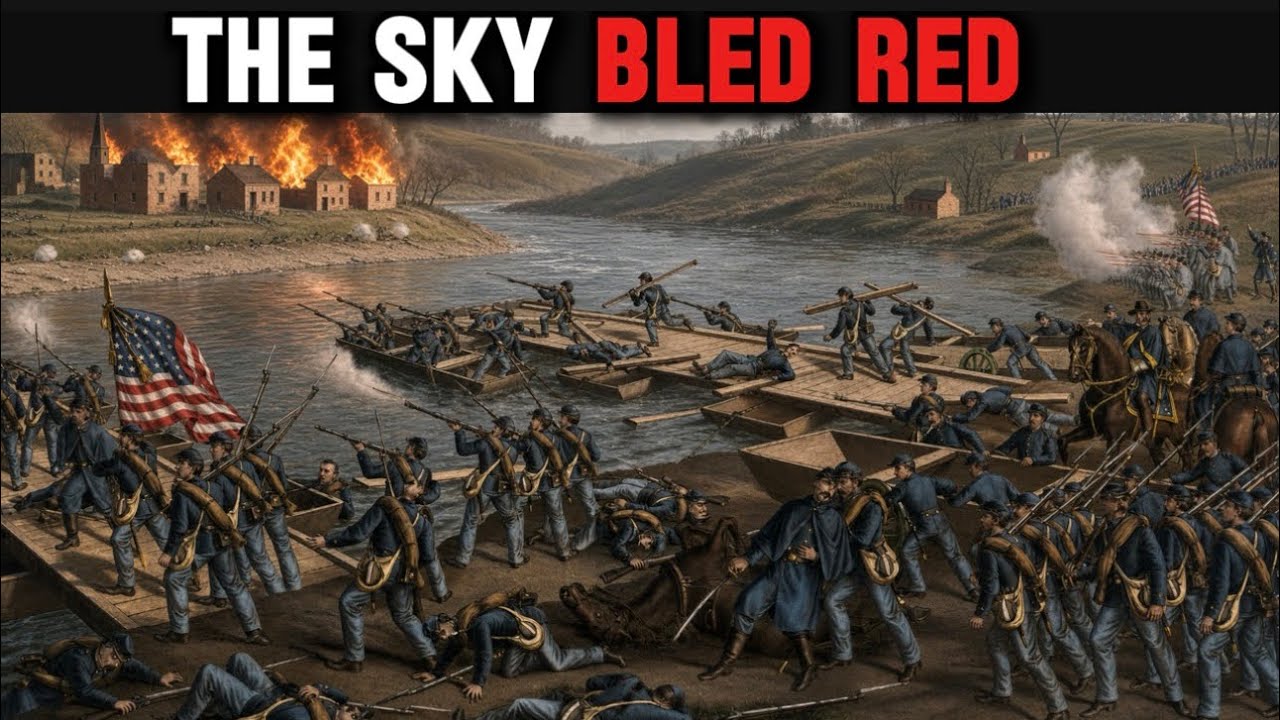
The disaster began before the main battle was even fought. General Ambrose Burnside had planned to rush his Federal army across the Rappahannock River in a surprise movement, catching the Confederates before they could fortify their positions. But the wooden pontoon bridges needed to cross the river were delayed for nearly three weeks in Washington. The Union army sat trapped on the northern bank at Falmouth, watching through telescopes as the enemy turned the heights across the river into an iron fortress.
On the morning of December 11th, Union engineers finally stepped down to the water’s edge in freezing darkness to lay the pontoons. They were met instantly by rifle fire from the opposite bank. William Barksdale’s brigade of Mississippi marksmen had turned the abandoned homes and warehouses of Fredericksburg into a network of sniper nests. Every window held a rifle barrel; every wall was sandbagged.
The Union bridge builders, working in the open with no cover, were cut down in broad daylight. Men were shot through the forehead while carrying beams, their bodies tumbling into the freezing current. Three full rotations of men were swept off the unfinished bridge in less than an hour. From a mansion across the river, Burnside watched the slaughter and finally gave an order without precedent in American military history.
More than 140 heavy guns and field cannons lined the heights and opened fire directly onto the town. For over two hours, shells, iron balls, and incendiary rounds rained down on the historic streets. Brick houses collapsed, timber frames burst into towering flames, and thick smoke turned noon into night. Women, children, and elderly residents who had refused to leave huddled in cellars while falling masonry threatened to bury them alive.
When the smoke cleared, Barksdale’s men crawled out of their reinforced cellars, wiped the brick dust from their rifles, and took up their positions again. Desperate to break the deadlock, Union commanders ordered an amphibious assault. Infantry from Massachusetts and Michigan piled into open wooden pontoon boats and pushed across the exposed river under heavy fire. Dozens were hit before midstream.
The survivors charged up the steep bank with fixed bayonets and fought through the ruined city house by house, kicking down doors and throwing bayonets down dark cellar stairways. By late afternoon, the Mississippi marksmen withdrew. The streets were littered with smashed furniture, fallen chimneys, and hundreds of frozen corpses. The victorious Federal troops, pushed to the edge of sanity, then lost all control and turned on the city itself.
One of the most shameful mass looting incidents of the war followed. Regiments rampaged through the abandoned mansions, dragging velvet couches into the mud, smashing grandfather clocks with rifle butts, and cutting portraits from their frames. Drunken soldiers paraded through the smoke wearing stolen hoop skirts and silk dresses. Rare books were thrown into the streets to serve as stepping stones.
By nightfall, Fredericksburg was a gutted, glowing shell of ash. The next morning, the Union army marched toward the position that would become the war’s greatest slaughterhouse. On the heights above stood Robert E. Lee’s Confederate army, entrenched in a naturally powerful position.
At the base lay a sunken road shielded by a stone wall over four feet high, behind which waited four dense ranks of infantry. On the crest above, dozens of artillery pieces commanded every inch of the open plain. General James Longstreet looked out over the field and gave a chilling assessment: not a single chicken could live on that ground once his guns opened fire. He had positioned his artillery so precisely that they could sweep the slope like a broom.
Burnside, blind to the terrain and clinging to an outdated tactical doctrine, ordered a full frontal assault. He believed that sheer numbers and cold bayonets could break the Confederate line through determination alone. On the morning of December 13th, thousands of Union soldiers stepped out of the town onto a muddy, open plain cut by freezing drainage ditches. There was no cover.
The moment the blue lines appeared, Confederate artillery tore massive gaps in their ranks. Solid iron balls bounced through the mud, tearing off limbs and killing men instantly. Explosive shells detonated overhead, showering the columns with red-hot fragments. Still, discipline held.
The survivors closed gaps, stepped over the remains of their comrades, and kept marching. When they reached rifle range, the stone wall seemed to explode. The defenders fired in rotation, the front line stepping back to hand empty rifles to men behind them who reloaded, creating a continuous storm of lead. Wave after wave of Federal regiments marched into the killing zone and were sheared down within seconds.
The impact was so concentrated that the front ranks were often lifted off their feet and knocked backward into the men behind them. Among those ordered into this storm was the famous Irish Brigade, made up largely of poor Irish immigrants who wore sprigs of green boxwood in their caps. Carrying emerald battle flags with golden harps, they charged up the slope, pushing farther than almost any unit before them. Across the field, behind the stone wall, sat the 24th Georgia, a unit composed almost entirely of fellow Irish immigrants.
They recognized the green sprigs in their enemy’s hats. Tears reportedly streamed down their cheeks as they poured volley after volley into their own countrymen. Of the twelve hundred men in the Irish Brigade, over five hundred fell in fifteen minutes. Burnside sent fourteen separate waves against the same position.
Officers who knew the attacks were organized murder drew their swords and led their men forward anyway. Whole brigades were wiped out in less time than it takes to read a single page. As the short winter afternoon faded, the plain below Marye’s Heights became a sea of torn flesh and broken weapons. Thousands of wounded men lay in no man’s land, too badly injured to crawl back.
Their wet clothes froze solid, encasing them in ice. Blood froze into crimson icicles on their skin. As darkness fell, a single continuous sound rose from the field, a collective groan of thousands of dying men weeping, praying, and screaming for help. Some begged comrades to shoot them.
Others pleaded for water. In Washington, Abraham Lincoln sank into a profound darkness as the scale of the disaster reached the White House. He paced the halls late into the night, reportedly saying that if there was a worse place than hell, he was living in it. The loss of over twelve thousand Union soldiers for zero strategic gain brought his administration to the brink of political collapse.
Across the river, Burnside collapsed under the weight of his failure. Overcome with guilt, he wept openly in front of his staff and announced he would personally lead his old division in one final suicidal assault. His generals physically restrained him and refused the order. On the night of December 15th, the Union army retreated under cover of dense fog.
Soldiers packed mud around the wheels of their artillery and wrapped cloth around their horses’ hooves to muffle sound. Tens of thousands slipped silently back across the Rappahannock, abandoning the town and the bloody field they had paid so dearly to conquer. The next morning, the Confederates advanced onto the abandoned field and found a blackened wasteland. Fredericksburg was a hollowed-out ghost city of standing chimneys and shattered brick, stripped of life and beauty.
The battle had settled nothing except the greatest and most pointless slaughter of the war.