On a Tuesday morning in October 2019, Officer Dana Pruitt was assigned to help archive old case materials at the Callaway County Sheriff’s Office in Missouri. She was given a box labeled with a file number and a year: 1971. Inside, between inventory sheets and interview transcripts, her eyes landed on a physical description of an unnamed person of interest, a man approximately six feet one inch tall, brown-haired, thirty to thirty-five years old, employed in agricultural equipment. Dana stared at those lines.
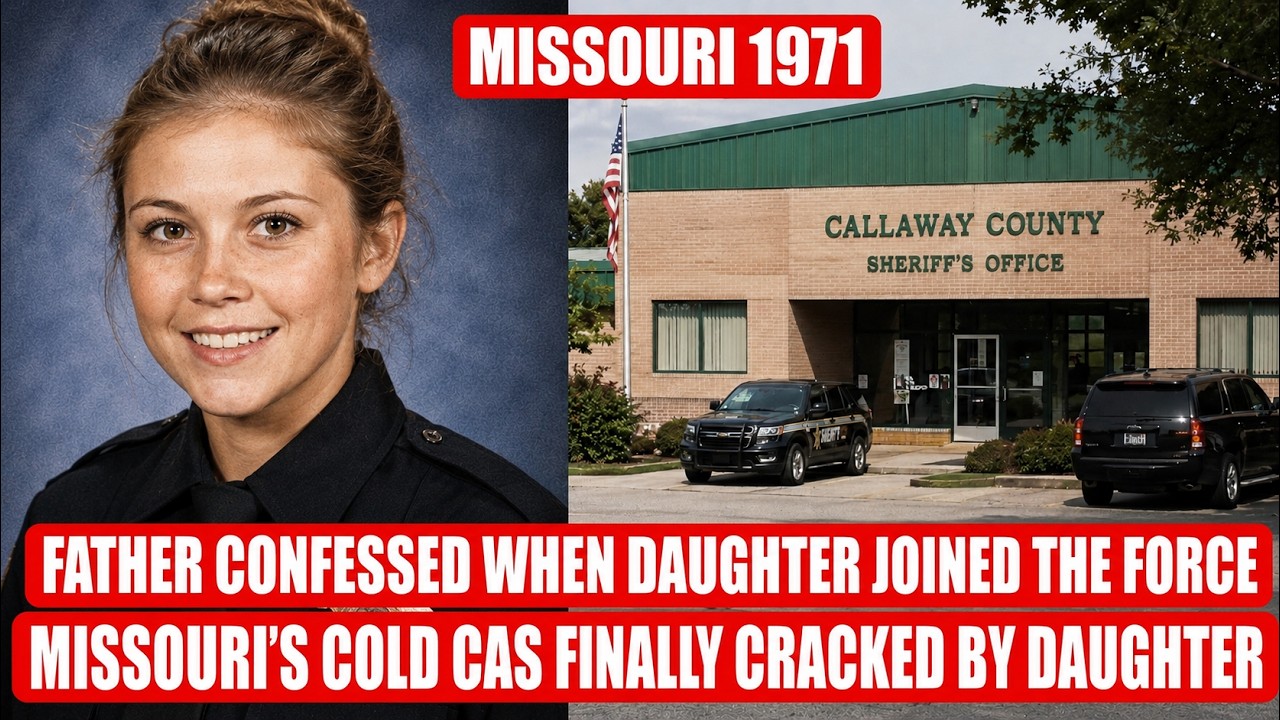
Her father was six feet tall. He had turned thirty-five in October of 1971. He had worked in agricultural equipment for twenty years before moving into sales. She set the file down and sat for a long time.
Then she walked to her supervisor’s office and knocked on the door. She said she needed someone to look at something, and she needed them to tell her she was wrong. Her supervisor could not tell her that. To understand what that moment meant for this case, and for the justice that finally came, it is necessary to go back to the autumn of 1971, to a woman named Loretta Jean Harwell.
Callaway County sits in the center of Missouri, where the river bends south and the land flattens into farmland. In 1971, the county seat of Fulton was a small town of just under ten thousand people. It had a Woolworth’s, a drive-in theater, and a weekly newspaper. Nixon was in the White House, and the Vietnam War was on the news every evening, but Fulton still felt like a place where people knew each other, where neighbors talked from front porches, and where the diner ran the same Tuesday meatloaf special it had been serving since 1954.
Loretta Jean Harwell was twenty-three years old. She had lived in Callaway County her entire life. She had graduated from high school in 1966 and worked as a bookkeeper for Callaway Farm Supply, arriving fifteen minutes early every morning and leaving notes for her boss about anything he should know. She drove a blue 1967 Chevrolet Impala that she had saved two years to buy, and every Sunday she drove her grandmother to the First Baptist Church on Market Street and sat in the third pew from the front, because that was where her grandmother had always sat.
She was engaged to Gary Whitfield, who worked at the grain elevator on Highway 54. He had proposed in June of that year, and they planned a spring wedding. Loretta had already picked out the fabric for her dress. According to original case records, Loretta had become frightened in the weeks before she disappeared.
She told at least two co-workers that a man she knew had been coming around more than she wanted and that he was not listening when she made clear she was not interested. She did not name him in those conversations, at least not in any record that survived. She told her co-worker Dorothy Marsh she thought it would pass, that it probably was not anything serious. Dorothy would repeat that conversation word for word to investigators for the rest of her life, wishing Loretta had named him.
On the last Thursday of October 1971, Loretta drove past the drive-in theater on her way home from work. She was never seen alive again. The timeline, reconstructed by investigators from witness statements, was narrow. At 5:00 p.
m. she clocked out at Callaway Farm Supply. Her boss remembered that she stopped in his doorway to say she would leave the quarterly reconciliation on his desk for Monday. At 5:22 p.
m. , the owner of a filling station on the eastern edge of Fulton saw a blue Impala matching her car pull in for gas and leave heading west on Route B. At 5:45 p. m.
, her fiance tried calling her at her parents’ house, where she was staying while her apartment was painted. No one answered. By 7:00 p. m.
, still no answer. Gary drove the Route B road himself, looking for her car on the shoulder. He did not find it. At 7:30 he called the sheriff’s department.
Within the hour, Loretta’s blue Impala was found parked on the gravel turnout off Keller Road, a quarter mile from the intersection with Route B. The engine was cold. The driver’s door was unlocked. Her purse was on the passenger seat, her keys on the floorboard.
She was gone. A search began that night, and volunteers came out the next morning, neighbors, church members, farmers who left their fields at first light. They searched the creek bottoms and the timber ground along Keller Road. They found nothing.
The car gave up no evidence that made sense. No blood, no signs of struggle. One deputy noted in his report that the driver’s seat appeared to have been pushed back slightly, as though someone taller than Loretta had sat in it. That detail was logged.
It would matter later. The lead investigator was Deputy Raymond Coulter, a methodical and private man who cared about the case in a way his supervisor sometimes had to remind him to keep in proportion. Coulter would go home and sit with the case at his kitchen table. It bothered him, he said in a 1998 interview, the way cold water bothers a bad tooth.
The early investigation produced two persons of interest. The first was a man who had gotten into a dispute with Loretta’s fiance over a fencing contract. His alibi checked out, and he was eliminated. The second person of interest was never formally named in any document released to the public.
Coulter’s notes described him only as a local man known to the victim, approximately thirty to forty years old, who had been reported by colleagues as unwanted in the victim’s company in the weeks before the incident. That man was interviewed once in November of 1971 and released. No further action was documented. By the spring of 1972, the formal investigation had stalled.
Coulter was transferred to a different assignment, and Loretta’s file was moved from active to cold, never officially closed, but no longer receiving working attention. Gary Whitfield waited two more years before he accepted that he would never know what happened to her. He eventually moved away and never returned to Fulton. What institutions failed to do, one woman refused to stop doing.
Dorothy Marsh, Loretta’s co-worker, spent the next three decades writing letters to the sheriff’s department, to the attorney general’s office, and to newspaper editors across mid-Missouri. She sent a letter every year on the anniversary of Loretta’s disappearance. Every October 28th, she sat down and wrote. Most of those letters went unanswered.
Some received form responses. Not one produced a follow-up investigation. Dorothy was seventy-four years old and still writing those letters when the case finally broke open. Dana Pruitt graduated from the state’s peace officer standards program in July 2019, at twenty-four years old.
She had grown up in Callaway County and wanted to be in law enforcement since she was a teenager, drawn to the idea of bringing order to the parts of the world that had gone crooked. Her father, Kenneth Pruitt, had worked in equipment sales since the early 1980s and had been running a small repair shop just north of Fulton for fifteen years. He coached youth soccer in the 1990s. He stood in the front row at Dana’s graduation.
What Dana did not know was that her father had moved to Callaway County from a neighboring county in the fall of 1971, shortly after a woman named Loretta Jean Harwell disappeared on a road he knew well. He had turned thirty-five in October of 1971, and he had worked in agricultural equipment before moving into sales. When Dana brought the file to her supervisor, Sergeant Gail Torrance, she was immediately recused from the investigation, and the case was assigned to Detective Marcus Webb, a twenty-year veteran who had worked cold cases for the Missouri State Highway Patrol before joining the county in 2011. Webb pulled the original case file in its entirety, including Coulter’s reference to the unnamed person of interest and the record of the single interview conducted in November of 1971.
That interview had been with a man who gave his name as Kenneth Arnold Pruitt. He said he had met Loretta Harwell through his work delivering equipment parts to Callaway Farm Supply and had spoken to her on several occasions. He denied any involvement in her disappearance and provided an alibi for the evening of October 28th, saying he had been at a bar in Fulton with two men he named. Those men were contacted.
Both said they recalled seeing him that evening but were uncertain of the exact time. The interview was not pursued further. Webb obtained a DNA sample from a coffee cup discarded by Kenneth Pruitt during a routine traffic stop, which had been quietly arranged without alerting him to the investigation. The sample was compared against biological evidence recovered from beneath the driver’s seat of Loretta’s blue Impala on the night of October 28th, 1971, evidence that had been stored in a sealed envelope in county evidence storage for forty-eight years.
On November 22, 2019, the laboratory confirmed a match. Kenneth Arnold Pruitt’s DNA was in that car. He had been there. The driver’s seat had been pushed back to accommodate someone his height.
Investigators brought Kenneth Pruitt in for formal questioning on a Thursday morning in December 2019. He sat down across from Detective Webb and a representative from the attorney general’s office. He did not ask for an attorney immediately. Over the next four hours, according to the case record, he told investigators he had been obsessed with Loretta Harwell from the moment he met her at the farm supply store in the summer of 1971.
He had driven past her apartment. He had shown up at places where he knew she would be. He had been told more than once, in terms he described as not polite, that she was not interested and that he should stop. On the evening of October 28th, he followed her car from Fulton.
She pulled over on Keller Road when she realized she was being followed. He got into the car with her. She did not survive. He drove her car to the turnout off Keller Road, left it there, walked back to his own vehicle, and went home.
He had never spoken about it to another person, not in 1971, not when he married Dana’s mother in 1988, not in the decades that followed. Loretta’s remains have never been found. He had believed his alibi would hold. He had not counted on his own daughter becoming a law enforcement officer.
He had not counted on a file being digitized. He had not counted on evidence surviving forty-eight years in a sealed envelope. Kenneth Arnold Pruitt was charged with first-degree murder in December 2019. He entered a guilty plea in February 2021, after delays related to health issues and legal proceedings involving his age.
He was seventy years old at the time of his plea. He was sentenced to life in prison without the possibility of parole and is currently incarcerated at the Jefferson City Correctional Center. Dana Pruitt resigned from the Callaway County Sheriff’s Office in January 2020. According to reporting by the Fulton Sun, she issued a brief statement.
She said she did the job she was trained to do, and she had to believe that is what matters. She has not spoken publicly about the case since. Dorothy Marsh, who had written forty-seven letters, one for every October 28th from 1972 to 2018, was reached by a reporter in December 2019. She was eighty-two years old.
When told an arrest had been made, she was quiet for a moment. Then she said she never stopped writing. She just never stopped. There is a photograph on the bulletin board of the Callaway County Sheriff’s Office that has been there for so long no one who works there can remember a time before it.
It is the photograph of a dark-haired woman, twenty-three years old, with a warm face. It was reprinted for the renewed case file in 2019, but the image itself is from 1971, taken at a Sunday church gathering about three weeks before everything changed. Loretta Jean Harwell never got to sit in the third pew from the front again. She never got to wear the dress she picked out.
What she got instead was a co-worker who never stopped writing, a piece of evidence that survived half a century in a sealed envelope, and a young woman who walked through the door of the right building at the right moment and was brave enough to do something about what she found. Justice for Loretta Harwell came forty-eight years late, an unacceptable amount of time, but it cameIn September 2019, Officer Dana Pruitt was walking through the Callaway County Sheriff’s Office during her first week on the job when a photograph on a bulletin board stopped her cold. She had walked past that photo every day of her childhood. It sat on the mantel in her parents’ living room, yellowed at the edges and tilted slightly in its frame.
Her father never let anyone straighten it. The photograph was of a woman named Loretta Jean Harwell, twenty-three years old, dark-haired, with a face people described as warm before they described it as anything else. Loretta had gone missing on the last Thursday of October 1971, and the case had never been solved. Forty-eight years had come and gone.
Now a rookie officer stood in the hallway of the building where the case had lived in silence for nearly five decades, staring at her own reflection in the features of a woman she had never met but somehow recognized. Because Dana Pruitt was Kenneth Pruitt’s daughter, and Kenneth Pruitt was the man who killed Loretta Jean Harwell. To understand what justice finally meant for this case, you have to understand who Loretta was. Callaway County, Missouri, sits in the center of the state where the Missouri River bends south and the land flattens into endless farmland.
In the fall of 1971, it was the kind of place where people still talked to each other from front porches and the local diner ran the same Tuesday meatloaf special it had been serving since 1954. The county seat, Fulton, had a population just under ten thousand. It had a Woolworth’s, a drive-in theater, and a weekly newspaper covering church socials alongside local news. Nixon was in the White House, and the Vietnam War was on the evening news every night, but in Fulton most people still felt safe and known.
Loretta Jean Harwell had lived in Callaway County her entire life. She had grown up on her family’s property on Route B, gone to school in Fulton, and taken a job as a bookkeeper for Callaway Farm Supply after graduating from high school in 1966. Everyone who knew her said the same thing: she was the kind of person who made places feel better by being in them. She kept meticulous records, arriving fifteen minutes early every morning and leaving notes for her boss.
She drove a blue 1967 Chevrolet Impala she had saved two years to buy. Every Sunday, without exception, she drove her grandmother to the First Baptist Church on Market Street and sat in the third pew from the front because that was where her grandmother had always sat. She was engaged to Gary Whitfield, who had proposed in June of that year. They planned a spring wedding, and Loretta had already picked the fabric for her dress.
She was also, according to the people who knew her, beginning to be frightened. Records from the original case file document that Loretta had spoken to at least two co-workers in the weeks before she disappeared, telling them that a man she knew had been coming around more than she wanted, that she had made clear she was not interested, but he was not listening. She didn’t name him in those conversations, at least not in any record that survived. She told her co-worker Dorothy Marsh she thought it would pass, that it probably wasn’t anything serious.
Dorothy would repeat that conversation word for word to investigators for the rest of her life, wishing Loretta had named him. On the last Thursday of October 1971, Loretta drove past the drive-in theater on Old Highway 40 on her way home from work and was never seen alive again. The timeline investigators reconstructed was narrow and specific. At 5:00 p.
m. , she clocked out at Callaway Farm Supply. Her boss remembered she stopped in his office doorway and told him she’d leave the quarterly reconciliation on his desk for Monday. At 5:22 p.
m. , the owner of Deaver’s Filling Station saw a blue Impala matching her car pull in, take on gas, and leave heading west on Route B. At 5:45, her fiance tried calling her at her parents’ house, where she was staying while her apartment was painted. No one answered.
By 7:00, still no answer. Gary drove the Route B road himself, looking for her car on the shoulder. At 7:30, he called the sheriff’s department. Within the hour, Loretta’s blue Impala was found parked on a gravel turnout off Keller Road, a quarter mile from Route B.
The engine was cold, the driver’s door unlocked, her purse on the passenger seat, her keys on the floorboard. She was gone. Volunteers searched the creek bottoms and timber ground along Keller Road, the barns and outbuildings. They found nothing.
No blood, no signs of struggle. One deputy noted that the driver’s seat appeared to have been pushed back slightly, as though someone taller than Loretta had sat in it. That detail was logged. It would matter later.
The lead investigator was Deputy Raymond Coulter, a methodical man who cared about this case in a way his supervisor sometimes had to remind him to keep in proportion. The early investigation produced two persons of interest. The first was a man who had gotten into a dispute with Loretta’s fiance over a fencing contract; his alibi checked out, and he was eliminated. The second was never formally named in any document released to the public.
Coulter’s notes described him only as a local man known to the victim, approximately thirty to forty years old, reported by colleagues as unwanted in her company in the weeks prior. That man was interviewed once in November 1971 and released. Whether the investigation failed to find sufficient evidence or whether something else stopped it in its tracks would not get an answer for a very long time. By spring 1972, the formal investigation had stalled.
Loretta’s file was moved from active to cold, not officially closed, but no longer receiving working attention. Gary Whitfield waited two more years before accepting he would never know what happened to her; he eventually moved to Columbia and never returned to Fulton. What institutions failed to do, one woman refused to stop doing. Dorothy Marsh, Loretta’s co-worker, spent the next three decades writing letters to the sheriff’s department, to the state attorney general’s office, and to newspaper editors across mid-Missouri.
Every October 28th, she sat down and wrote. Most letters went unanswered. Some received form responses. Not one produced a follow-up investigation.
Dorothy was seventy-four years old and still writing those letters when the case finally broke open. The case had been cold for forty-seven years when Dana Pruitt graduated from the Missouri Department of Public Safety’s Peace Officer Standards and Training Program in July 2019. She had grown up in Callaway County and wanted to be in law enforcement since she was a teenager, drawn to making things right, bringing order to the parts of the world that had gone crooked. Her father, Kenneth Pruitt, had been running a small equipment repair shop just north of Fulton for fifteen years.
He was well regarded. He coached youth soccer. He stood in the front row at Dana’s graduation. What Dana did not know was that her father had moved to Callaway County from a neighboring county in the fall of 1971, shortly after a woman named Loretta Jean Harwell disappeared on a road he knew well.
On a Tuesday morning in October 2019, Dana was assigned to help archive older case materials being digitized. She was given a box labeled with a file number and a year: 1971. Inside, between inventory sheets and interview transcripts, was a single evidence log referencing a driver’s seat adjustment in a blue 1967 Chevrolet Impala and a physical description of the unnamed person of interest: male, approximately six foot one, brown hair, thirty to thirty-five years old, employed in agricultural equipment. Dana stared at the description.
Her father was six feet tall. He had turned thirty-five in October 1971. He had worked in agricultural equipment for twenty years before moving into sales. She sat for a long time.
Then she walked to her supervisor’s office, knocked, and said she needed her to look at something and tell her she was wrong. Her supervisor, Sergeant Gail Torrance, was not able to tell her that. Sergeant Torrance immediately recused Dana and assigned the reinvestigation to Detective Marcus Webb, a twenty-year veteran who had worked cold cases for the Missouri State Highway Patrol. Webb pulled the original case file, including Coulter’s notes and the record of the single interview from November 1971.
The interview had been with a man who gave his name as Kenneth Arnold Pruitt. He stated he had met Loretta through his work delivering equipment parts to Callaway Farm Supply and had spoken to her on several occasions. He denied involvement and provided an alibi: he had been at a bar in Fulton with two men he named. Those men were contacted; both recalled seeing him that evening but were uncertain of the exact time.
The interview was not pursued further. Webb obtained a DNA sample from a coffee cup discarded by Kenneth Pruitt during a routine traffic stop that Torrance had quietly arranged without alerting him to the investigation. The sample was compared against biological material recovered from beneath the driver’s seat of Loretta’s Impala on the night she disappeared, collected in 1971 and stored in a sealed envelope for forty-eight years. On November 22, 2019, the laboratory confirmed a match.
Kenneth Arnold Pruitt’s DNA was in that car. He had been there. Investigators brought Pruitt in for formal questioning on a Thursday morning in December 2019. He arrived composed, wearing a collared shirt and a Carhartt jacket.
He did not ask for an attorney immediately. Over the next four hours, according to the case record, he told investigators he had been obsessed with Loretta Harwell from the moment he met her in the summer of 1971. He had driven past her apartment, shown up at places where he knew she would be, and been told more than once, in terms he described as not polite, to stop. On the evening of October 28th, he followed her car from Fulton.
She pulled over on Keller Road when she realized she was being followed. He got into the car with her. She did not survive. He drove her car to the turnout and left it there, walked back to his own vehicle, and went home.
He had never spoken about it to another person, not in 1971, not when he married Dana’s mother in 1988, not in the fifty years that followed. Loretta’s remains have never been found. He had believed the alibi would hold. He had not counted on his own daughter becoming a law enforcement officer, on a file being digitized, or on evidence surviving forty-eight years in a sealed envelope.
Kenneth Arnold Pruitt was charged with first-degree murder in December 2019. He entered a guilty plea in February 2021 after delays related to his health and age. He was seventy years old. He was sentenced to life in prison without the possibility of parole and is currently incarcerated at the Jefferson City Correctional Center.
His daughter, Dana Pruitt, resigned from the sheriff’s office in January 2020. According to reporting by the Fulton Sun, she issued a brief statement: she did the job she was trained to do, and she had to believe that is what matters. She has not spoken publicly about the case since. Dorothy Marsh, who had written forty-seven letters, one for every October 28th from 1972 to 2018, was reached by a reporter in December 2019.
She was eighty-two. When told an arrest had been made, she was quiet for a moment. Then she said she never stopped writing. She just never stopped.
There is a photograph on the bulletin board of the Callaway County Sheriff’s Office that has been there so long no one remembers a time before it. It is a photograph of a dark-haired woman, twenty-three years old, with the kind of face people describe as warm before they describe it as anything else. It was reprinted for the renewed case file in 2019, but the image is from 1971, taken at a Sunday church gathering about three weeks before everything changed. Loretta Jean Harwell never got to sit in the third pew from the front again, never got to wear the dress she picked out, never got any of the ordinary, irreplaceable things she had planned.
What she got instead was a co-worker who never stopped writing, a piece of evidence that survived half a century in a sealed envelope, and a young woman who walked through the door of the right building at the right moment and was brave enough to do something about what she found. Justice for Loretta Harwell came forty-eight years late. That is a long time. It is an unacceptable amount of time.
But it came.