Walter Model was among the most respected defensive commanders in the German army during the Second World War, a master of improvisation who earned Hitler’s trust and the title of the Führer’s best field marshal. Yet by the spring of 1945, that same reputation meant nothing. His army group was trapped, his name was on Soviet war-crime indictments, and he knew the Americans would likely hand him over to face execution. Rather than surrender, he chose to end his life with his own pistol in a forest near Duisburg, instructing his aide to bury him where he fell.
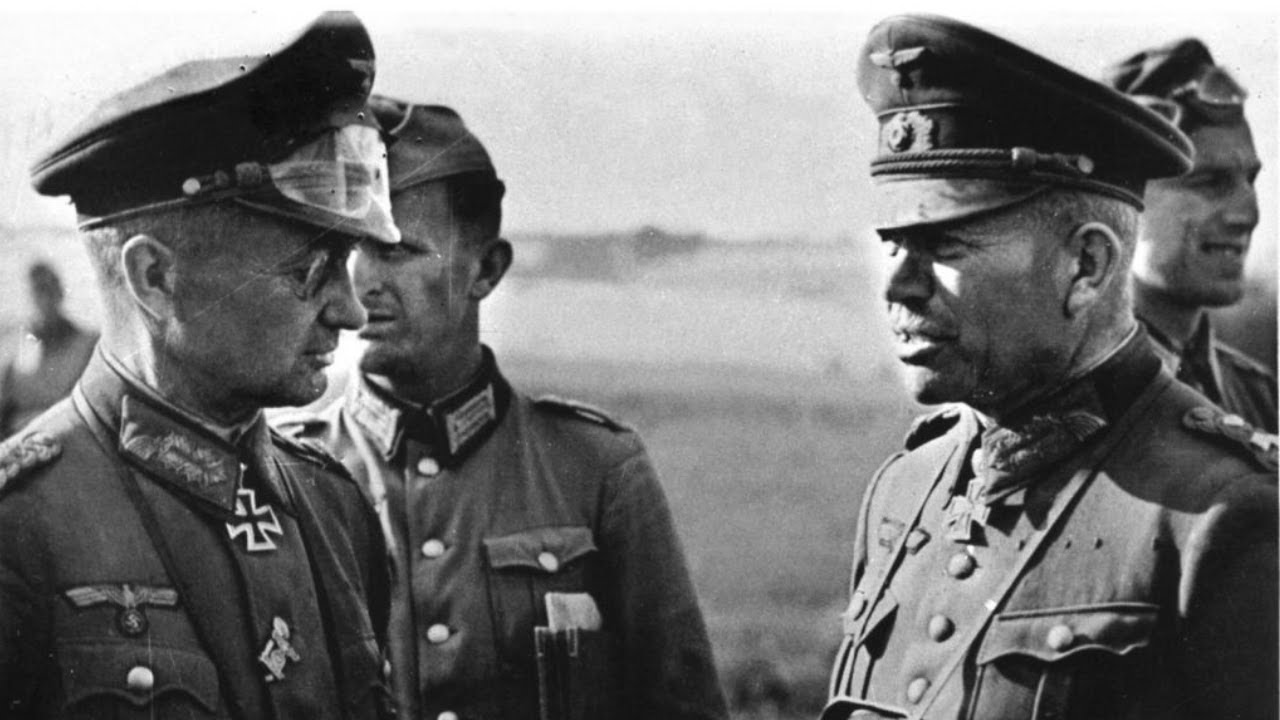
Model had joined the army as a teenager, serving with the 52nd Infantry Regiment on the Western Front during the First World War. Wounded near Ypres in May 1915, he recovered and continued his military career, earning a recommendation for general staff training. By the end of the conflict, he had reached the rank of captain. When Germany was defeated, Model remained in the much-reduced Reichswehr, restricted by the Treaty of Versailles to just 100,000 soldiers.
In the years that followed, he built relationships with other officers who would rise to prominence in the coming conflict, including Friedrich Paulus and Wilhelm Keitel. As Hitler expanded the army during the 1930s, Model commanded battalions and developed a strong loyalty to the Nazi regime. When war broke out in 1939, Model served as chief of staff for the Fourth Corps during the invasion of Poland. The campaign was brief, lasting only about eleven days, but it involved some of the hardest fighting of the entire operation.
He then took part in the occupation of the Lublin region and impressed his superiors during the invasion of France while serving with the 16th Army. His rise was steady, and he was eventually promoted to general. His first senior field command came with the 3rd Panzer Division, a prestigious assignment even though he had little experience leading armored units. His command style was unusually informal.
He mixed with his soldiers, organized training in unconventional ways, and earned their devotion, although some fellow officers disapproved of his methods. When Operation Barbarossa was launched in June 1941, his division performed well, crossing the Dnieper River with relatively light casualties. Weeks of intense fighting followed as German forces broke up Soviet formations. In one large encirclement operation, Model’s forces contributed to the capture of around 665,000 Soviet prisoners of war.
His drive toward Moscow was halted by the onset of winter, when temperatures froze vehicles and weapons alike. Yet he continued to lead his men across the Soviet Union, and his units became involved in anti-partisan operations that descended into mass slaughter. During one assault, he ordered the deportation of all male civilians from the area and directed that wells be poisoned and dozens of villages burned to prevent the establishment of Red Army bases. These actions placed him at the top of Allied lists of wanted war criminals.
The killings of civilians were not limited to SS units; regular army forces like his were involved in what investigators later described as deliberate extermination policies. In July 1943, Model took part in the northern sector of the Battle of Kursk. After the offensive failed, he was sent to Estonia to slow the Soviet advance. By this point, the German position on the Eastern Front was deteriorating, and Model could do little to prevent the Red Army from overwhelming his defenses.
He did manage some victories, but on March 1, 1944, he was promoted to field marshal, becoming the youngest Wehrmacht officer to hold that rank. The promotion could not change the fundamental reality that the war in the east was already lost. Model was then transferred to France and Normandy, where his first task was convincing Hitler to allow the retreat of the German 7th Army and Panzer Group Eberbach. He succeeded in rescuing several units, though they lost most of their tanks, artillery, and heavy equipment.
When Hitler demanded that Paris be held at all costs, Model replied that he would need another 200,000 soldiers and additional panzer divisions. The army did not have them. In September 1944, Model faced the Allied airborne landings during Operation Market Garden. Convinced that the Allies might be trying to capture him personally, he ordered his troops into action and saw an opportunity to counterattack and push the Allies out of the southern Netherlands.
His forces fought well, inflicting a brutal defeat on the Allies at Arnhem. The victory restored much of the confidence he had lost in Normandy. He continued to frustrate Allied forces in the Battle of the Hürtgen Forest, where fighting produced thousands of casualties on both sides. Hitler, however, was preparing one final gamble.
The Ardennes Offensive, later known as the Battle of the Bulge, was launched in December 1944. Model believed the plan was not achievable with the resources available. The attack achieved limited success, but a lack of air cover, inexperienced soldiers, shortages of fuel, and the failure to capture the vital road junction at Bastogne doomed the offensive. Hitler nevertheless ordered Model’s forces to hold their positions and fight to the end.
The Americans soon crossed the Rhine at Remagen, and by April 1, 1945, Army Group B found itself surrounded in the Ruhr pocket. Hitler issued explicit orders: his commanders were to dig in and fight a purely defensive battle. There would be no surrender and no breakout. He also ordered the destruction of much of the region’s industrial centers, and Model ignored that instruction.
The Allies called on him to surrender rather than send his remaining men to their deaths. Model understood the situation, but he was caught between the oath he had sworn to Hitler and his duties as a field marshal. He chose to disband much of his army group instead. The oldest and youngest soldiers were discharged from military service, and the remaining men were left to surrender or attempt breakouts on their own orders.
For this, Army Group B was declared traitors by Joseph Goebbels, Hitler’s propaganda minister. Model knew his reputation in Hitler’s eyes was ruined and that he would likely face execution if he fell into German hands. He had to decide between surrendering to the Allies, whom he knew considered him a war criminal, or taking his own life. He disbanded his command and remarked that he had done everything to justify his actions in the light of history, asking what was left for a commander in defeat, noting that in antiquity they took poison.
Those around him understood that he was contemplating suicide. His decision was confirmed when he learned that the Soviets had indicted him in absentia for war crimes relating to the deaths and executions of approximately 577,000 people in concentration camps in Latvia and the deportation of 175,000 people into slave labor programs. On April 21, 1945, near Duisburg, Model drove with his aide into some woods. A staff officer urged him once more to surrender.
He refused, saying simply that he could not do it, because the Russians had branded him a war criminal and the Americans would surely turn him over to them for hanging. That afternoon, he told his aide, Colonel Pilling, that his hour had come. He led the colonel deep into the forest, drew his pistol, and instructed Pilling to bury him there. He then shot himself in the head.
His aide buried him where he had fallen, giving the field marshal a soldier’s grave in the woods. A decade later, Pilling helped recover the remains and arranged a reburial in a German military cemetery in the Hürtgen Forest. Today, only a small stone marks the grave of Walter Model. He was remembered as an excellent defensive commander with an outstanding talent for improvisation and a sharp eye for detail.
His relationship with Hitler was complicated, and Hitler trusted him completely, calling him his best field marshal and the savior of the Eastern Front. Model often ignored orders he felt he could not follow, but he never broke the faith that tied him to the regime. He lectured his soldiers on complete obedience to Hitler and the Nazi Party, and his troops were involved in numerous war crimes.
In the end, with the war lost and execution likely awaiting him, he chose to die by his own pistol rather than face a courtroom or a hangman’s noose.