Sissy Spacek arrived in Manhattan in the summer of 1967 with a guitar always by her side. She was seventeen years old, a small-town Texas girl carrying a space-age dress she had designed herself and the memory of a high school beauty pageant where she had sung two original songs. A judge from Longview had been so impressed that she had urged the teenager to go to New York and become a star. But the real reason her father allowed the trip was simpler and darker: her beloved older brother Robbie was dying of leukemia, and a reprieve from the emotional weight of that illness seemed like the best gift they could give her.
Sissy had spent her childhood in Quitman, a small town in Wood County, Texas, born on Christmas Day in 1949. Her father Edwin worked as an agricultural agent, her mother Virginia came from English and Irish stock, and her ancestry included the actor Rip Torn, who was her first cousin. She had been performing since the age of six, first in local talent shows, then as one half of a well-known duo with Robbie, dancing Charleston numbers and playing banjo tunes for their neighbors. It was Robbie who gave her the nickname that stuck, calling her “Sissy” for sister.
By her early teens she had saved enough babysitting money to buy a twelve-string guitar and dreamed not of acting but of becoming a female Buddy Holly, returning to Quitman after attending the University of Texas. She later recalled those years as a time when her whole life seemed headed in a single direction. Then the direction vanished. Robbie left the university when he was diagnosed with acute leukemia and came home, where his condition steadily worsened.
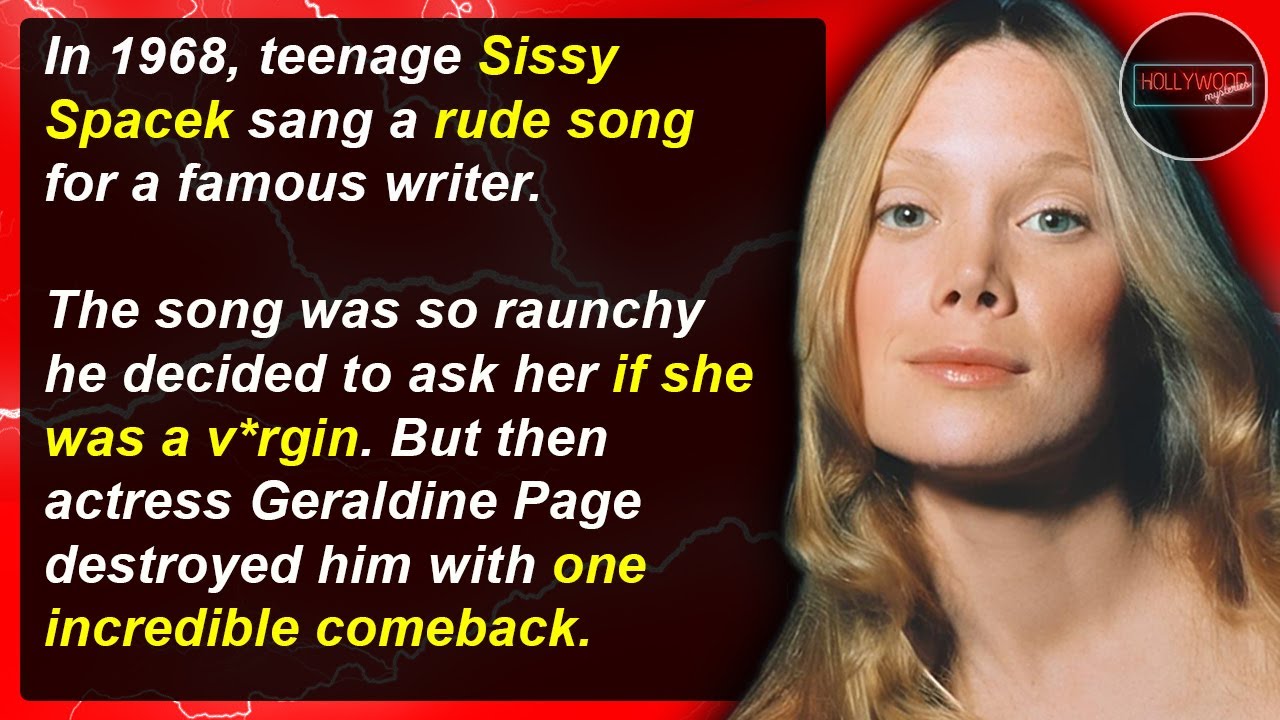
She was allowed to visit her cousin Rip and his wife, the actress Geraldine Page, in Manhattan, and the city overwhelmed her. She fit into the free and expressive young art scene, amazed by the variety of people she could mix with. She told stories of being exposed to all kinds of extraordinary characters, of feeling like a blank page in a world that held no fear for her. One evening Geraldine took her to meet the writer Terry Southern, who was working on a Candy screenplay.
She pulled out her guitar and began singing a song she had written, with the line “I feel his soft touch while I’m sleeping. ” Southern interrupted her and asked, plainly, whether she was a virgin. She was stunned; in Quitman nobody spoke about such things. She assured him that she was, and he asked how she could write such a line.
Geraldine, who had seemed to be asleep on the couch, sat up and answered for her: “Terry, you don’t have to stomp grapes to know what wine tastes like. ”
Through all of this, a nightmare hung over her. A heartbreaking letter arrived from Robbie. It began, “Dear Sissy, how’s my little sister doing?
” The treatment had not worked. They were waiting to see what would happen. They would have to give him another treatment, and he was scared because it hadn’t worked before, and he wanted to get out of the hospital and come see her. He missed her.
He described his loneliness and his fear that he would never leave the hospital to do anything like she was doing. He hoped she and their brother Ed would never get anything wrong like him and have to ruin their whole lives. “That’s all I wanted in life was to be healthy,” he wrote. “Nothing else.
” He asked her to write him every day. She did. She returned to Quitman after the school year had already begun and found that everything had changed. She had missed major practice and had lost her senior-year milestones, but none of that mattered anymore.
Early the next year, Robbie died at eighteen. The loss devastated her. She had lost her brother, her co-performer, and her best friend in a single stroke. She called it the defining event of her whole life.
But she also said it made her brave. Once you have experienced the ultimate tragedy, she explained, nothing else frightens you. It may have given depth to her work, because she had already experienced something profound at an age when most people have not. She forfeited her plans for the University of Texas, losing a two-hundred-dollar deposit, and returned to New York the following summer with a new determination.
Her cousin Rip arranged a meeting with the William Morris agency, but they politely suggested she come back in a few years. A demo she recorded with Eddie Simon, Paul Simon’s brother, went nowhere. An audition for The Tonight Show failed because her voice was hoarse that day. A manager who later built John Travolta’s career told her to drop her accent and go home.
She auditioned for Decca Records, which decided she sounded too similar to another artist on their roster, Loretta Lynn. She did record one single as “Rainbow” for Roulette Records, a folk song scolding John Lennon for posing nude with Yoko Ono on the cover of Two Virgins. It was not a hit. Eventually she turned toward acting.
She enrolled at the Lee Strasberg Institute and spent eight months immersed in method acting, which she embraced completely. “Anything you can use to understand the character and his motivations and to become the character, you should use,” she said. “I’m not above poking my eye to help me cry. ” Her favorite study came after class, walking through Manhattan with friends, cutting across streets, ending up at Max’s Kansas City, always crowded and full of the greatest characters she had ever seen.
In 1970 she appeared as an extra in Andy Warhol’s Trash. Her first real acting role came the following year, as a naive victim of white slavery in Prime Cut, opposite Lee Marvin and Gene Hackman. On that set her bright personality caught everyone’s attention; a crew member described her as so sunny she made you want to put on sunglasses. In 1973, she was sent to interview a writer-director named Terrence Malick.
She remembered his rented Spanish-style home, the drinks his wife served. “From the moment we met, it was neat,” she said. They talked about his script for hours. That meeting led to Badlands, the film that made her a star.
Inspired by the late-1950s killing spree of Charles Starkweather, it told the story of Kit, a rebellious garbage collector played by Martin Sheen, who falls for Holly, a shy baton twirler played by Spacek. Kit murders Holly’s father, and the two run away together, living out a twisted dream. Warner Brothers paired the film with the Mel Brooks comedy Blazing Saddles, and audiences who had just laughed at a silly comedy reacted harshly to the thoughtful and controversial Badlands. The studio shelved it.
But those who saw it praised her luminous performance. It was a hit in Britain and in the small number of theaters where it played in the United States, and it blew away audiences at that year’s New York Film Festival, even overshadowing Martin Scorsese’s Mean Streets. The critic Vincent Canby wrote that Spacek and Sheen were “splendid as the self-absorbed, cruel, possibly psychotic children of our time. ” Spacek credited Malick with transforming her.
“Terry Malick gave me respect,” she said. “That reinforced everything for me. He allowed me to grow an enormous amount. ”
Badlands also transformed her private life.
She met the film’s set designer, Jack Fisk, and they connected instantly because they had the same kind of conviction to work. Two years later they were married. Fisk, an accomplished artist, helped her maintain the freedom to choose projects carefully, and together they built a close-knit team of trusted collaborators. Roles were sparse for a while, and she chose carefully.
In 1976 she played a maid in Alan Rudolph’s Welcome to L. A. , preparing by observing housekeepers in Los Angeles. That performance caught the attention of Robert Altman.
Meanwhile, Brian De Palma called Jack Fisk to ask him to be art director on Carrie, and Fisk told Sissy to read the book. She was horrified by it, but she was eager to work on it. De Palma had her in mind for a different role, but when she was about to leave for New York to film a commercial, he called and offered her the chance to audition for the lead, Carrie White. He downplayed her chances, saying another actress had already impressed him.
She took the shot anyway. For the audition she wore a worn navy sailor dress from her childhood, slicked her hair back with Vaseline, and channeled a girl from her high school who had been relentlessly bullied. “She was beautiful,” Spacek explained, “but she was poor and couldn’t afford clothes… the kids were really brutal with her.
” After the screen test she waited in the parking lot while Fisk reviewed the footage. When he returned, he leaned into the car and shouted, “You got it. ” They sped off before anyone could change their mind. Fisk later said that another actress played Carrie as someone you could hate, while Spacek made you feel hope for Carrie, which made the film twice as effective.
Carrie was a breakthrough hit, a cultural icon that remains hugely influential. Critics praised her transformative performance. Pauline Kael of The New Yorker wrote that Spacek used her freckles, paleness, and whitish eyelashes to suggest a squashed, groggy girl who could go in any direction, and concluded, “I don’t see how this performance could be any better. ”
A year later she gave another haunting performance in Robert Altman’s dreamlike Three Women, playing the timid, childlike Pinky Rose alongside Shelley Duvall.
Altman praised her as “remarkable, one of the top actresses I’ve ever worked with. ” Between 1977 and 1986, Spacek earned five Best Actress Oscar nominations. One of them turned into a win, for her portrayal of Loretta Lynn in 1980’s Coal Miner’s Daughter, an ironic twist given that Decca Records had once rejected her for sounding too similar to Lynn. She performed her own singing in the film, earned a Grammy nomination for the soundtrack, and later released her own country album.
During the 1980s she took on the political thriller Missing with Jack Lemmon, the rural drama The River, The Murder of Mary Phagan, and Crimes of the Heart with Diane Keaton and Jessica Lange, which brought her a Golden Globe. She also starred in Raggedy Man, directed by her husband. By then, she and Fisk had grown disillusioned with Los Angeles life. They retreated to an 85-hectare farm in Virginia, raised their daughters, bred horses, and lived quietly.
She wanted her children to grow up with freedom and not be defined by their parents’ fame. Over time, she learned to ease up on herself, following advice from Jack Lemmon: “It’s either going to happen or it’s not, so don’t give everything over to the misery before you’re even there. ”
In the 1990s she appeared in Oliver Stone’s JFK, The Grass Harp, Affliction, and David Lynch’s The Straight Story. She turned down the role of Thelma in Thelma & Louise because she found the script boring.
In 2001, her performance in In the Bedroom as a grieving mother earned her a sixth Oscar nomination, making her the eighth performer in history to reach that milestone. She continued working steadily through the 2010s in television and film, including Bloodline, Castle Rock, Homecoming, and The Old Man & the Gun. In 2022 she starred alongside J. K.
Simmons in the Amazon series Night Sky. She and Jack Fisk now split their time between their Virginia farm and occasional stints in Hollywood, having turned their barns into studios for painting and recording. She credited her cousin Rip Torn with the advice that guided her career: “If you’re doing this because you love the work, you’ll have a happy life. And he was right.
“