Six months after Pearl Harbor, the man who had planned that catastrophe stood on the bridge of the largest warship ever built. Isoroku Yamamoto was fifty-eight years old, barely five feet three inches tall, and had lost two fingers of his left hand in a battle against the Russians in 1905. On that morning in Hashirajima Bay, he was smiling. He believed the American Pacific Fleet would collapse within ten days.
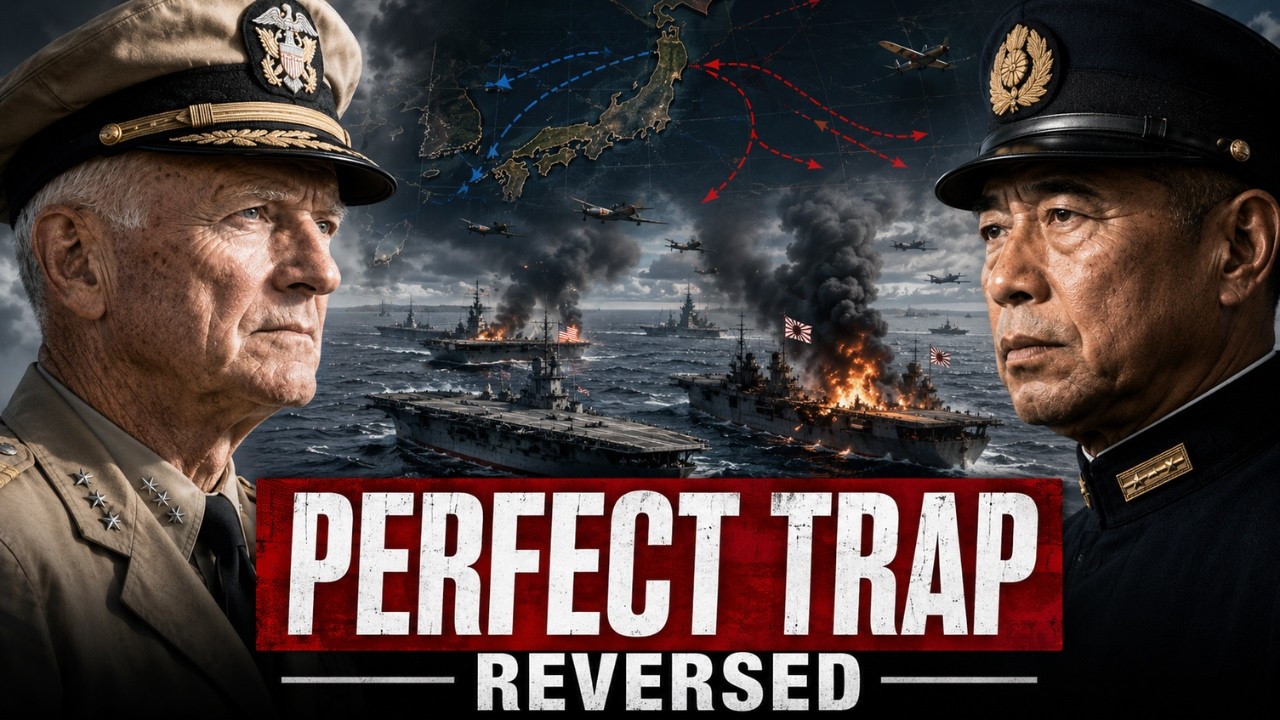
Three American carriers, the only ships absent from Pearl Harbor on the morning of December 7, were being drawn into a trap six months in the making. What he did not know was that a man in a smoking jacket and slippers, six thousand miles to the east in a damp basement beneath Pearl Harbor, had already read his plan, word by word. This is how the most carefully laid trap in naval history closed on the man who set it. At dawn on a June morning, thick fog blanketed the anchorage at Hashirajima, so gray that sailors on the forward ships could barely see their own bows.
Beneath that fog, a fleet began to move. One by one, gray shapes slipped from their moorings and vanished into the mist. No signal flags, no radio traffic, no bugles, no band on the pier. More than 150 warships of the Imperial Japanese Navy put to sea, and the world did not know.
At the heart of this silent fleet stood Yamamoto aboard the battleship Yamato, 65,000 tons of steel armed with nine 18-inch guns capable of hurling armor-piercing shells the size of small cars more than twenty miles. He did not believe he was sailing to war. He believed he was sailing to a funeral, and the corpse waiting for him was the American Pacific Fleet. For five straight months, the war had moved in only one direction: Pearl Harbor, the Philippines, Singapore, the Dutch East Indies, Ceylon, Java, Wake Island.
Every fleet the Allies sent against Japan had been shattered. In the operations rooms of the Combined Fleet, officers no longer spoke of victory but of inevitability. To Yamamoto, that inevitability now had a date, a location, and a victim. The target was a coral atoll in the middle of the Pacific, two small islands surrounding a shallow turquoise lagoon, no more than three square miles of land.
The Americans called it Midway. To Yamamoto, it was merely bait. He did not want the atoll itself. What he wanted were the three American carriers that had escaped Pearl Harbor: Enterprise, Hornet, and what he believed to be the wounded, dying Yorktown.
Remove those three carriers, he reasoned, and the Pacific belonged to Japan. Hawaii would be exposed. America would be forced to negotiate before its factories drowned him in steel. Yamamoto knew something few in Tokyo would admit.
He had visited America, studied at Harvard in the early 1920s, served as naval attaché in Washington, seen the steel mills of Pittsburgh and the assembly lines of Detroit. He knew Japan could not win a long war. He had warned the prime minister himself: give me six months, perhaps a year, and after that I have no confidence. Now those six months were nearly up.
His plan to end the war before American industry awakened was called Operation MI. On paper it looked brilliant. In reality it was arrogance, because the entire plan rested on one assumption Yamamoto never questioned. He assumed the Americans were blind.
He assumed Admiral Chester Nimitz, sitting in his headquarters at Pearl Harbor, was an administrator presiding over a slow collapse. He assumed that when the Imperial Fleet appeared off Midway, the Americans would respond as a frightened, dying enemy should, with hesitation, confusion, and panic. To lure the Americans out, Yamamoto violated one of the oldest principles taught in every naval academy. He did not concentrate his force, he scattered it, splitting his vast fleet into isolated task groups stretched across thousands of miles.
Far to the north, a diversionary force sailed toward the frozen Aleutian Islands of Alaska, carrying two carriers and an invasion force. He expected Nimitz to panic and rush ships north. At the spearhead, aimed directly at Midway, sailed the Kido Butai, the First Mobile Force under Vice Admiral Chuichi Nagumo. A cautious officer in a position demanding boldness, Nagumo commanded the four heavy carriers that had terrorized the Pacific since the war began: Akagi, Kaga, Soryu, and Hiryu, carrying more than 250 aircraft flown by the finest naval pilots in the world, men who had bombed Pearl Harbor, sunk the Prince of Wales and Repulse, and never lost a battle.
Some three hundred miles behind Nagumo came the main body, the battleships, cruisers, destroyers, and Yamamoto himself aboard Yamato. He was hiding because he wanted the Americans to see only the carriers, to sail expecting an even fight, only to discover too late that behind the carriers waited a full fleet of surface guns. It was a careful maneuver, a script, and in this script the Americans had no role. To keep the trap airtight, Yamamoto imposed one iron rule: absolute radio silence.
No broadcasts, no call signs, nothing that might reveal his position to American listening stations. Silence was a double-edged sword, because it meant Nagumo could not communicate with the battleships, the battleships could not communicate with the submarines, and the submarines could not communicate with Yamamoto. Every element of the Combined Fleet, spread across half the globe, now sailed alone. Yamamoto sat aboard Yamato with high-frequency receivers capable of intercepting intelligence from Tokyo, but he had forbidden himself to broadcast a single word.
If something went wrong at the head of his fleet, he could not warn them. He had deafened his men and muzzled his commanders because he trusted the plan more than the men executing it. Four thousand miles to the east, in the damp darkness beneath the Fourteenth Naval District headquarters at Pearl Harbor, the illusion of American blindness was fading. There, in a single reinforced concrete room hidden behind an unmarked door, twenty to thirty men worked shifts stretching twenty hours.
They wore smoking jackets and house slippers against the cold. They rarely went home. This was Station Hypo, and the man running it was a forty-two-year-old lieutenant commander named Joseph Rochefort. He did not look like a warrior.
His uniform, when he wore it, was usually stained with coffee. His hair was uncombed. His eyes were perpetually red. But he was one of the few American officers fluent in Japanese, having spent three years in Tokyo studying the Imperial Navy.
The code he was fighting was called JN-25, the operational code of the Imperial Japanese Navy. On his best days, Rochefort and his team could read only ten to fifteen percent of any message. The rest was fog, but Rochefort had learned to see beyond the fog. Throughout spring 1942, he watched patterns of traffic, call signs, and transmission volumes rise and fall like tides.
By mid-May, he realized something immense was coming. In intercepted messages, he kept seeing two letters: AF, AF, the designation for the target. By studying Japanese reconnaissance flight paths, old interceptions, call signs, and geography, he slowly became certain. AF meant Midway Atoll.
He climbed the stairs, passed the guards, and entered the office of Admiral Chester Nimitz. Nimitz was a fifty-seven-year-old quiet Texan who had spent his career in submarines, not carriers. He had assumed command of the Pacific Fleet less than six months earlier, on Christmas Eve 1941, climbing aboard a submarine because the fleet had no other ship fit for a change-of-command ceremony. He listened to Rochefort without interruption.
Then he made his decision. If Rochefort was right, this was the chance of the war. All of Yamamoto’s ships were about to gather at one point in the ocean. If Nimitz could be there first, in ambush, with what carriers he had left, he could do to Yamamoto what Yamamoto was trying to do to him.
But Nimitz had a problem, and it was not in Tokyo. It was in Washington. When Rochefort’s assessment reached the Navy’s central intelligence section, OP-20-G, the reaction was not agreement but fury. Senior codebreakers in Washington, supported by the Chief of Naval Operations Admiral Ernest King and the Director of War Plans Admiral Richmond Kelly Turner, looked at the same intercepts and reached the opposite conclusion.
They insisted AF was not Midway but somewhere in the South Pacific, perhaps Port Moresby, Fiji, or New Caledonia. Some voices in the War Department even warned the target might be the American West Coast itself. They demanded Nimitz ignore Station Hypo and send his carriers south. Nimitz sat alone at his desk holding two futures.
If he obeyed Washington and Rochefort was right, Midway would fall unopposed, Hawaii would be exposed, and the war might be lost. If he disobeyed Washington and Washington was right, his carriers would be thousands of miles from their posts while Japanese forces bombarded the American mainland. He would be court-martialed and remembered as the admiral who lost the war in hours. He looked out his window at the sunken hulks still rusting in the harbor.
He trusted Rochefort. But belief was not proof. He needed evidence, undeniable, physical evidence, something so clear that Washington could not deny it. He needed the Japanese themselves to tell him where they were going.
The idea came from a man named Jasper Holmes, a forty-one-year-old lieutenant commander, a former submarine officer forced into intelligence by a back injury. Before the war, Holmes had written nautical stories about the Pacific under a pen name. He knew Midway better than almost anyone in the Navy because he had studied every atoll, every reef, every logistical detail of every American outpost. There was one detail about Midway he could not stop thinking about.
Midway had no fresh water. The atoll was nothing but coral and sand, no springs, no rivers, almost no rain. Every drop of drinking water for the entire garrison came from a single source, a massive industrial distillation plant that boiled seawater. If that plant failed, Midway would face an emergency within days.
Any invasion force preparing to attack would have to know this. It would have to plan for it, to bring its own water. Holmes turned to Rochefort in the basement and explained the idea in a few quiet sentences. Rochefort listened.
Rochefort thought. Rochefort went upstairs to Nimitz, and after a long silence, Nimitz gave the order. On May 19, 1942, a message went from Pearl Harbor to Midway, not by radio but by undersea telegraph cable, a copper wire lying on the Pacific floor thousands of feet below any periscope. No Japanese listening station could intercept it.
The message ordered the commander of the Midway base to do something that seemed insane at first glance. He was to send an urgent distress call, in plain, unencrypted English, over open radio channels so anyone in the world could hear it. The distress call was to state that the Midway water distillation plant had suffered a catastrophic failure, that the garrison was running out of drinking water, and that resupply was desperately needed. The message was launched into the Pacific sky, and Pearl Harbor waited.
For the next forty-eight hours, no one at Station Hypo slept well. The future of American strategy now depended on whether some Japanese radio operator, somewhere in the vast network of imperial listening stations, happened to hear an American complaint about a water failure on a coral atoll, decided it was important, and relayed it in their encrypted code. On May 21, Hawaiian antennas picked up a burst of Japanese radio traffic coming from an intelligence center on Kwajalein Atoll in the Marshall Islands. It was encrypted in JN-25.
Rochefort’s team broke it with unusual speed. The words were simple. The words were devastating. The air force is short of fresh water.
The attacking force will be supplied with additional water purification equipment. The Japanese had just told Nimitz, in their own code, that they were heading to Midway. Rochefort carried the intercept upstairs himself. Nimitz read it once, then again.
He did not smile. He did not celebrate. He simply folded the paper carefully and filed it. Then he sent the intercept to Washington.
Admiral King read it. Admiral Turner read it. The institutional resistance simply evaporated. The South Pacific theories died within hours.
Rochefort, the unkempt man from the basement, had been right all along. But knowing where the enemy was going was only half the plan. Nimitz still had to be there when they arrived. He had Enterprise and Hornet, both returning exhausted from the Doolittle Raid on Tokyo.
He needed a third flight deck, and the only one available was abandoned. The carrier Yorktown had limped into Pearl Harbor on May 27, barely afloat. Three weeks earlier, at the Battle of the Coral Sea, a Japanese bomb had pierced her wooden flight deck and exploded deep in her interior, smashing bulkheads, tearing her hull below the waterline, and starting fires that burned for hours. Sixty-six of her men had died.
She had spent two weeks crossing three thousand miles of ocean leaving a trail of black fuel oil. When she entered the Pearl Harbor channel, silence fell among the sailors on the pier. Her superstructure was scorched. Her hull was blistered.
The shipyard engineers came aboard and returned with their decision: Yorktown could not be repaired in Hawaii. She would have to be sent to a fully equipped yard on the West Coast. Even there, the work would take ninety days. Nimitz did not have ninety days.
He had seventy-two hours. He did something no photograph could fully capture. Wearing long rubber boots, he waded into the mud of Dry Dock Number One, ankle-deep in seawater, fuel oil, and debris beneath the keel of the stricken carrier. He looked up at the jagged tear in her side, the wound that was supposed to take ninety days to heal.
Then he turned to the engineer standing behind him and spoke quietly. He always spoke quietly. “We must have this ship back in three days. ” No one answered.
No one argued. What followed was one of the most astonishing feats of industrial mobilization in American history. Fourteen hundred civilian workers swarmed aboard. Welders, shipfitters, electricians, plumbers, mechanics, riggers, boilermakers, from every corner of Oahu.
They worked in shifts that never ended, in temperatures above 120 degrees with no ventilation, standing in toxic sludge up to their knees, holding welding torches over their heads for hours. When a man collapsed from heat exhaustion, another took his place. Nurses rushed from the base hospital with salt tablets and cold water. Some workers did not stop even to eat.
Sailors in the harbor saw a storm of industry, the blue strobing of hundreds of welding arcs lighting the sky brighter than the stars. Rolling blackouts were imposed on Honolulu itself. Civilian neighborhoods sat in darkness while families lit candles so that power could be diverted to Dry Dock Number One. On the morning of May 30, three days after she arrived, the dock was flooded.
Yorktown rose with the water. Her hull was patched, her flight deck level, her elevators working. She was not fully repaired. She was a patchwork, a partially restored ship with structural problems no one had time to catalogue.
But she could launch and recover aircraft, and that was enough. As she slipped past the anti-submarine nets, she carried something no American warship had ever carried into battle. Civilian shipyard workers were still aboard, still welding, still wiring, their torches glowing in the hangar as she sailed. They would finish the work at sea.
Some did not know when they would return home. Nimitz had conjured his third carrier out of nothing. But he still needed a commander for it, and here came another blow. Vice Admiral William Halsey, the Navy’s most aggressive carrier commander, returned to Pearl Harbor a broken man.
The stress of the war’s first months had caused a severe outbreak of dermatitis. His skin was blistered. He had lost twenty pounds. He could not sleep.
When the medical officers saw him, their decision was immediate. He was relieved of command and hospitalized. Everyone in the aviation community assumed Nimitz would choose another carrier admiral, another man with pilot’s wings. But Nimitz made a choice that stunned them.
He gave command of Task Force 16, with Enterprise and Hornet, to Rear Admiral Raymond Spruance, a fifty-five-year-old cruiser officer who had never commanded a carrier in battle and wore no pilot’s wings. The pilots raged. They called Spruance a “black shoe admiral,” a term for officers who had spent their careers on battleships and cruisers rather than flight decks. Some said privately that Nimitz had lost his mind.
But Nimitz was not choosing a pilot. He was choosing a mind, because Yamamoto’s entire plan was built on catching a rash brawler. Yamamoto wanted Halsey. He had set a trap for a lion.
Raymond Spruance was not a lion. He drank only black coffee, endless cups. He walked miles every day for exercise, ten or fifteen miles alone, speaking in short, quiet sentences. He listened more than he talked.
He analyzed battle the way an engineer analyzes a problem of distance, fuel, capacity, and time. He did not lose his temper. He did not seek glory. He could not be baited.
It was Halsey himself, from his hospital bed, who had recommended Spruance for the job. The two men were close friends. Halsey understood better than anyone why Spruance was the right choice for this particular battle. The other task force, Task Force 17 around the rebuilt Yorktown, was commanded by Rear Admiral Frank Jack Fletcher, a cautious, precise, deliberate officer who had watched his sister carrier, Lexington, burn and sink beneath him at the Coral Sea.
He was nominally the senior admiral in the coming battle, but Nimitz had quietly given Spruance freedom to command his own ships. The three American carriers slipped out of Pearl Harbor in absolute silence. No radio transmissions. No radar sweeps that a Japanese listening station could detect.
The ships communicated only with flashing lights and signal flags, as if they were sailors from another age. They vanished into the gray swells of the North Pacific. Their destination was not Midway itself, but a point roughly 325 miles northeast of the atoll, a location with no name on any chart. The Americans called it Point Luck.
It was a matter of engineering. In the central Pacific in early June, the trade winds blew steadily from the southeast. Carriers had to turn into the wind to launch and recover aircraft. When Nagumo attacked Midway, he would be forced to point his carriers southeast, directly toward Point Luck, directly toward the ambush.
He would not know. Thousands of miles to the west, Yamamoto’s plan was already beginning to crumble, and he did not know that either. His grand attack depended on two layers of reconnaissance. The first, Operation K, called for two long-range Kawanishi flying boats to fly from the Marshalls to a deserted reef called French Frigate Shoals, refuel from submarines waiting on the surface, then continue north to fly over Pearl Harbor before dawn to confirm the American carriers were still anchored.
But when the Japanese submarines arrived and raised their periscopes, they saw something impossible. The lagoon was not empty. Two American seaplane tenders were already working in the same waters the Japanese had planned to use. American PBY flying boats were landing and taking off around them.
The Japanese submarines dived and aborted the mission. Operation K ended quietly, without a single Japanese plane reaching Hawaii. And because of the strict radio silence Yamamoto himself had imposed, no one told him his fleet’s eyes had been blinded. The second layer was a picket line of submarines stretched across the Pacific between Hawaii and Midway.
If Nimitz sent his fleet out, they would have to cross this line, and the submarines would report immediately. The submarines were supposed to be in position by June 1, but they arrived on the 3rd. Spruance and Fletcher, sailing in absolute silence, had crossed the picket line on May 29 and 31. When the Japanese submarines finally reached their positions and looked through their periscopes, they saw only empty ocean.
They reported honestly that there was no sign of American movement. Yamamoto read the report aboard Yamato and believed it. He drank his tea, studied his charts, played Japanese chess with his staff officers to pass the time. He was entirely convinced that Yorktown was rusting at the bottom of the Coral Sea, that Enterprise and Hornet were anchored at Pearl Harbor.
He was entirely convinced the trap was closing exactly as planned. He was entirely wrong. At 4:30 a. m.
on June 4, 1942, Vice Admiral Nagumo, standing on the bridge of Akagi 240 miles northwest of Midway, gave the order for the first strike. One hundred eight aircraft rose from the four Japanese carriers into the pre-dawn darkness. Kate torpedo bombers, Val dive bombers, and Zero fighters formed up over the fleet and headed southeast toward Midway. Because Nagumo believed no American carriers were within a thousand miles, he had equipped his first wave with bombs designed for land targets, high-explosive fragmentation bombs useless against armored warship decks.
Because he believed the ocean around him was empty, he sent only seven reconnaissance aircraft to search a semicircle of ocean covering more than one million square miles. It was symbolic, a formality. One of those seven aircraft was assigned to the sector facing directly toward Point Luck. It launched from the heavy cruiser Tone, but as the launch began, the steam catapult on Tone malfunctioned.
For thirty minutes, Japanese mechanics hammered at the machine while the other scout planes climbed into the sky. When the Tone aircraft finally left the deck and turned east, it was half an hour behind schedule. Thirty minutes. That was the length of time the American carriers, hidden beyond the horizon, remained invisible to the Japanese.
The first Japanese wave reached Midway just before 6:30 a. m. They found it defended, but weakly. Marine fighters, obsolete Buffaloes and tired Wildcats, rose to meet them and were annihilated in the air.
Japanese bombs hit the runway, fuel tanks, hangars, and the hospital, but the runway itself, made of hard coral, remained usable. The strike leader radioed Nagumo, stating that a second strike was necessary. Nagumo listened and made his decision. He ordered the reserve strike force waiting in the hangars below, equipped with armor-piercing bombs and torpedoes meant for American warships, to be rearmed with land bombs for a second attack on Midway.
The work began. Hundreds of Japanese mechanics pulled torpedoes from planes, lowered them onto carts, and rolled them to the corners of the hangar. Then, suddenly, at 7:28 a. m.
, the same Tone scout plane that had been delayed broke radio silence. “Enemy ships sighted. ” Nagumo froze on the bridge. It was impossible.
The American fleet was supposed to be in Hawaii. The message was unmistakable. Ten enemy warships in a place where nothing was supposed to exist. For seventeen agonizing minutes, Nagumo waited for more information.
He needed to know what kind of ships they were. At 7:45, unable to wait any longer, he issued a new order. Rearm again. Below decks, chaos erupted a second time.
Mechanics who had just finished removing torpedoes had to reinstall them, struggling to lift 1,700-pound torpedoes onto hydraulic carts, tearing out the land bombs they had just installed. There was no time to return the discarded bombs to the armored magazines, so they piled them on barriers on the deck beside fuel lines. The hangars filled with high-octane gasoline fumes, exposed munitions, working crews, and the flying sparks of welding torches. The hangar of Akagi had become a floating powder keg.
So had the hangars of Kaga, Soryu, and Hiryu. At 8:09, the Tone scout sent another message. The enemy formation appears to include a carrier. Nagumo’s face paled.
But his first strike was now returning from Midway, low on fuel, desperate to land. If he brought his reserve planes up to the flight deck now, his returning pilots would die in the ocean. He made the only choice he believed he could make. He cleared the deck to recover the returning aircraft.
He kept the fully armed and fueled reserve strike force trapped in the hangars below. One hundred fifty miles away, Raymond Spruance was making his calculations on the bridge of Enterprise. He had already launched his aircraft early, sending everything he had into the air. The launch itself was ragged and imperfect.
Some planes took off underarmed. Others failed to find their squadrons. Some circled so long they burned precious fuel before heading toward the enemy. Fletcher launched later from Yorktown, holding some planes in reserve.
The American strike was not one powerful blow but a series of scattered, uncoordinated waves stretched over an hour, each squadron finding the enemy on its own. The torpedo squadrons arrived first. They were flying slow, obsolete TBD Devastators, at the top of their range and without fighter escort because their escorts had gotten lost above the clouds. The first to attack was Torpedo Squadron Eight from Hornet, led by Lieutenant Commander John Waldron, a forty-one-year-old from Fort Pierre, South Dakota, part Sioux on his grandmother’s side.
He had driven his pilots relentlessly for months. Before takeoff, he had written his men a letter, telling them that if only one plane remained in the air after the attack began, he wanted that pilot to press on and hit the target. Torpedo Squadron Eight pressed its attack. All fifteen planes were shot down.
Zeros swarmed them like wasps, tearing them apart one by one. Only one man survived, Ensign George Gay of Waco, Texas. His plane cartwheeled into the ocean, killing his two crewmen. Gay somehow got out of the wreckage and hid beneath a floating black rubber seat cushion while Japanese fighters strafed the water.
From beneath that cushion, he watched the sky burn above him for the next several hours. Torpedo Six from Enterprise arrived and was destroyed. Torpedo Three from Yorktown arrived and was destroyed. In less than an hour, dozens of American pilots died on the surface of the Pacific.
Not a single American torpedo hit a Japanese ship. The Japanese sailors on the carriers watched the slaughter in disbelief, shouting and waving their caps in the air. This was what victory looked like. But the sacrifice had done something the Japanese did not immediately understand.
It drew every Zero in the sky down to sea level, where the torpedo planes were falling. The Japanese combat air patrol was exhausted, low on ammunition, and completely out of position. The sky above the Japanese fleet was now empty. Forty miles away, Lieutenant Commander Wade McClusky, air group commander on Enterprise, was still searching for an enemy he could not find, and his fuel was running out.
He had flown to the point where the Japanese fleet was supposed to be. Nothing was there. Nagumo had changed course to the northeast. Every rule of naval aviation dictated that McClusky turn for home before his whole squadron fell into the ocean.
But he did not turn. He began a widening search pattern, scanning the empty blue sky below. Then, in the clear blue beneath him, McClusky saw something. A single white wake, a Japanese destroyer, Arashi, racing north at full speed, drawing a straight white line across the ocean.
She had just finished dropping depth charges on the American submarine Nautilus, and was now racing to rejoin the carriers. McClusky turned and followed. The wake led him directly to the four Japanese carriers. He climbed to 20,000 feet.
Beneath him, on the flight decks of Akagi, Kaga, and Soryu, hundreds of Japanese planes sat fully fueled and armed, completely exposed. At 10:22 a. m. , June 4, 1942, the sky above the Japanese fleet was clear blue with scattered high clouds.
The Zeros were down near the surface, still chasing the last American torpedo planes, their pilots exhausted and nearly out of ammunition. Above the clouds at 20,000 feet, Wade McClusky pushed his stick forward. Thirty-three Dauntless dive bombers from Enterprise began their dives. At almost the same moment, from an entirely different direction, Lieutenant Commander Max Leslie led seventeen Dauntlesses from Yorktown into their own dives.
Neither American commander knew the other existed. Neither had planned it this way. Two separate squadrons from two separate carriers, launched at different times from different directions, arrived over the Japanese fleet within seconds of each other, at the moment the Japanese combat air patrol was out of position and the hangar decks below were awash in gasoline and bombs. The Dauntless was not a beautiful plane.
It was short, slow, and ugly, with perforated dive brakes that screamed in the wind. When it dove at a 70-degree angle, it made a sound unique in the sky, a mechanical shriek that grew louder as it fell. The Japanese sailors on the flight decks below heard it before they saw it. Some looked up.
Others did not have time. At 10:26, four bombs fell on Akagi. Only one hit directly, piercing the wooden flight deck near the middle elevator and exploding in the enclosed hangar below. The hangar was full of planes being rearmed, torpedoes lying on the deck, land bombs stacked against the bulkheads, exposed fuel lines.
That single American bomb ignited all of it at once. Akagi did not sink. She burned from the inside. The flight deck bowed upward as the hangar turned into a furnace.
The elevator was hurled into the sky. Men in the passageways were killed by the blast wave before the fire reached them. Planes on the flight deck were blown into the sea by successive internal explosions. In the same moment, four bombs struck Kaga in rapid succession.
One exploded near the bridge, killing her captain and most of his staff. Fuel pipes were ruptured, fires became uncontrollable, and ammunition began exploding inside her hull. Seconds later, on Soryu, three bombs from Max Leslie’s Yorktown squadron struck her flight deck almost simultaneously. She was smaller than the other two.
She caught fire faster. Within twenty minutes, her captain ordered the ship abandoned. Three heavy carriers, the pride of the Imperial Japanese Navy, the ships that had bombed Pearl Harbor and swept the Indian Ocean, the ships that had never been defeated, were all burning within five minutes. On Akagi, Admiral Nagumo refused to leave the bridge.
His crew begged him. The fire was climbing. The steel around him was beginning to glow. In the end, his officers forcibly lowered him by rope down the side of the burning ship so he could transfer his flag to the light cruiser Nagara.
He was silent as he was carried away. He did not cry. He did not speak. He had just watched his career destroyed before his eyes.
But the battle was not over. The fourth Japanese carrier, Hiryu, was sailing slightly ahead of the others in a separate division and had not been spotted by the American dive bombers. She was untouched. Her captain, Tomio Kaku, was one of the most respected officers in the fleet.
Her air group commander, Lieutenant Joichi Tomonaga, was a veteran of the China war. Her division commander, Rear Admiral Tamon Yamaguchi, was one of the fiercest carrier officers Japan ever produced. None of them hesitated. Within an hour, Hiryu launched everything she had.
She had one target, and she found it. Yorktown, the carrier that was supposed to be crippled, the carrier repaired by civilian welders in seventy-two hours, the carrier that had crossed three thousand miles of ocean to be here. Japanese dive bombers put three bombs into her flight deck. One exploded in her smokestack and put three of her boilers out of commission.
She lost speed, lost steam, began to drift. An hour later, a second wave of Japanese torpedo planes approached low over the calm water and put two torpedoes into her port side. She listed heavily, her engines stopped, steam poured from her smokestack, and her captain, Elliott Buckmaster, gave the order to abandon ship. The crew began descending cargo nets into the sea.
For several hours, the Japanese believed they had evened the battle. They sent messages to Yamamoto reporting two American carriers sunk. It was a mistake. It was the same carrier, Yorktown, hit twice.
The Japanese still believed they had destroyed two American carriers and that only one remained. They were wrong. A Yorktown scout plane, launched before the second Japanese attack, had found Hiryu alone late in the afternoon, still sailing north, unaware that the Americans still had two intact carriers waiting for her. Spruance, aboard Enterprise, did exactly what he had been chosen to do.
He did not celebrate. He did not pause. He launched again. Twenty-four Dauntless dive bombers, some of them survivors of the morning strike on Akagi and Kaga, took off from Enterprise.
At 5:00 p. m. , they began their dives over Hiryu. Four bombs hit her forward flight deck.
The forward elevator exploded into the bridge. Both her captain, Kaku, and her admiral, Yamaguchi, refused to leave the ship. They stood together on the bridge as the fires spread. They shared a final cup of water.
They ordered the surviving crew to abandon ship. Then they remained on the bridge while the last men went down her sides. She was scuttled by Japanese torpedoes from the destroyer Makigumo on the morning of June 5. Yamaguchi and Kaku went down with her.
Four Japanese carriers had sunk in a single day. Far to the west aboard Yamato, Isoroku Yamamoto read the reports as they came in. Akagi burning. Kaga burning.
Soryu burning. Hiryu burning. At first, he refused to believe it. He ordered a night surface attack.
He ordered the battleships forward. He believed the guns of Yamato could still salvage something from the wreck of his plan. If only he could bring his heavy surface fleet within range of the American carriers, he could turn the battle before dawn. But the Americans did not come to him.
Spruance, with his usual cold precision, steered his carriers east all night, away from the Japanese battleships. He did not chase. He did not gamble. He knew exactly what Yamamoto wanted him to do, and he refused to do it.
Behind him, a staff officer urged him to advance, to finish the enemy, to declare victory. Spruance listened. He did not answer. He held his course east.
By dawn on June 5, Yamamoto understood. He cancelled the operation. He ordered the fleet to withdraw. His staff heard him speak only a few words on the bridge of Yamato.
He spoke quietly. He asked how he would explain this to the Emperor. The retreat was not clean. On June 6, American dive bombers attacked the heavy cruiser Mikuma, damaged in a night collision with her sister ship, and rained fire on her until she capsized and sank.
That same afternoon, a Japanese submarine, I-168, slipped through the American destroyer screen and put two torpedoes into the crippled Yorktown, still half-repaired, and one into the destroyer Hammann lying alongside her. Hammann broke in two and sank within four minutes, taking eighty of her crew with her. Yorktown clung to life for another night. But at dawn on June 7, she finally rolled onto her side and slipped beneath the waters of the Pacific.
The survivors, rescued by other destroyers, watched her go down from the decks of the ships that had saved them. Some wept openly. Others could not look. The battle was over.
The numbers, when finally counted, were as brutal as they were simple. Japan lost four carriers, one heavy cruiser, 248 aircraft, and more than 3,000 men. Among the dead were roughly 110 of her finest pilots, men who had flown from China to Ceylon without losing a single battle. There was no replacement for them.
The Imperial Navy would never train pilots of that caliber again. The United States lost one carrier, one destroyer, about 150 aircraft, and 307 men. It would be tempting, after all this time, to call what happened a miracle, to point to the broken catapult on Tone, the two-day delay of the submarine picket line, Wade McClusky’s decision not to turn back, the arrival of two American dive bomber squadrons over the Japanese fleet at almost the same moment from opposite directions, and say that God himself was flying with the American Navy that morning. But that is not the truth, not the whole truth.
The truth is harder, and in some ways more beautiful. The truth is that Chester Nimitz, the quiet man from Fredericksburg, Texas, listened to a shabby-looking codebreaker in a basement, a man in slippers who had never fired a shot in this war, and believed him. The truth is that Joseph Rochefort, Jasper Holmes, and twenty other men who never wore a combat decoration cracked a code Tokyo swore was unbreakable and made the American fleet see through walls. The truth is that 1,400 civilian welders in Hawaii repaired a battered ship in seventy-two hours because their admiral told them to, and families in Honolulu sat in darkness that week so that power could be used to weld steel.
The truth is that Nimitz chose the cold, quiet man named Raymond Spruance over the beloved brawler Halsey because he understood that Yamamoto had set a trap for a lion, and he refused to send a lion. And John Waldron and forty-four other torpedo pilots flew to their deaths knowing they would not return, and their deaths pulled the Zeros down to the water and cleared the sky. None of that was chance. When chance came, it came because the Americans had already earned it.
On the other side, the Japanese lost for reasons that were not chance either. Yamamoto was brilliant, perhaps the most brilliant naval mind of his generation, but he built a plan so intricate that it could only succeed if the enemy was blind. He convinced himself of that blindness because five months of easy victories had made him incapable of imagining an American commander capable of thought. The radio silence he imposed on his fleet became the silence in which his scouts died unheard.
The battleships he hid three hundred miles behind Nagumo arrived too late to fire a single shot in a real battle. He had convinced himself he was clever. He was not clever. He was confident, and confidence in war is a weapon that eventually turns and cuts the hand that holds it.
There is one more thing that must be said. The men who died at Midway were not only Americans. Aboard Akagi, Kaga, Soryu, and Hiryu, thousands of Japanese sailors died that morning. Deck crews trapped in burning hangars, pounding on jammed hatches that would not open, mechanics who never saw the sky, pilots who never reached their planes, cooks, storekeepers, signalmen.
Some were not yet nineteen years old. Most had never met an American. Most genuinely believed they were fighting to defend their homeland. When Tokyo learned of the disaster, the government hid the truth from the Japanese people for months.
The newspapers proclaimed a great victory. Survivors were secretly transferred to isolated bases so they could not speak to their families. The wounded were placed in closed hospital wards, forbidden to write letters. The families of the dead were not told how their sons had died.
In many cases, they were not told their sons had died at all. Yamamoto himself lived only eleven more months. On April 18, 1943, American codebreakers intercepted a message describing his flight path through the Solomon Islands. It was a routine morale tour to a forward base.
American P-38 Lightning fighters took off from Henderson Field on Guadalcanal, intercepted his transport over Bougainville, and shot it down. His body was found in the jungle the next day, still upright in his seat, one gloved hand resting on his ceremonial sword. His remains were flown to Japan for a state funeral. The code that killed him was the same code Rochefort had begun breaking a year and a half earlier.
The circle was complete. Joseph Rochefort, the man in the basement, the man whose work made all of it possible, was never thanked by the Navy. In the political aftermath of the Coral Sea battle, Admiral King and the Washington intelligence establishment could not forgive Rochefort for being right when they were wrong. He was quietly forced out of intelligence work and reassigned to command a floating dry dock in San Francisco.
He never worked in codebreaking again. Nimitz ignored his repeated requests for the Distinguished Service Medal. He retired quietly in 1947 and lived the rest of his life in Torrance, California, with his wife. He rarely spoke about the war.
He died in 1976 at the age of seventy-six. Ten years after his death, in 1986, the United States government finally awarded him the Distinguished Service Medal. His family accepted it on his behalf at a ceremony in Washington. He never knew.
This is the story of Midway. Not a miracle, not a lucky day for the American Navy on a summer morning in the middle of the Pacific. It is the story of what happens when an arrogant man builds a perfect trap around a single assumption, and a quiet man on the other side of the ocean refuses to be what he was assumed to be. Isoroku Yamamoto sailed to Midway believing he was closing his grip on the last remnants of the American Navy.
He thought he had written the script. He thought he had thought of everything. He thought his enemy was small and blind and afraid. But he was wrong about one thing.
He was the one who walked into the trap, and it had been set for him from the beginning.