The rain had not stopped for three days when Clara was told she would become a bride. The house smelled of wet timber and sickness, and every board creaked like a warning. She was seventeen, barefoot in the muddy yard, hanging linens that whipped against her face, when her grandmother called her inside with that frail, breaking voice that meant something terrible was coming. Inside the dim parlor, the family sat like mourners instead of witnesses.
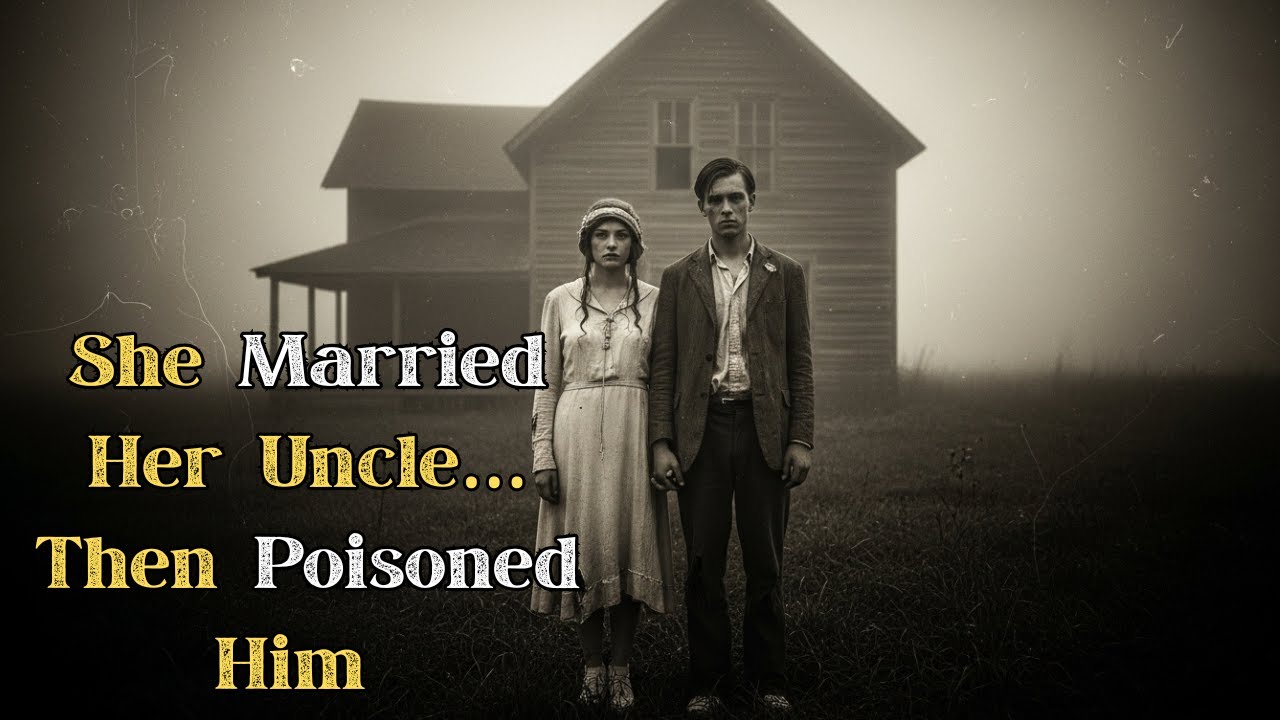
Her uncle Elias stood near the hearth, a tall figure with gray hair slicked back, his pale eyes fixed on her as though she were a creature he had already captured. The priest’s Bible lay open on the table next to a single gold ring that had belonged to her mother. Clara did not understand at first. The words came slowly, thick as syrup from her grandmother’s trembling lips.
She would be joining with Elias. It was the family’s wish. Elias had helped raise her after her parents died, teaching her to read, feeding her when food was scarce, whispering prayers over her when fever nearly took her life. He had always been a shadow that moved silently through their home, stern but necessary.
Now that shadow wanted her as a bride. The villagers had long gossiped about the Hollow family and their obsession with purity. They said mixing blood was sin, that letting an outsider marry in would curse their land. Every girl before Clara had been promised to a cousin, an uncle, or worse.
But Clara had believed her mother’s death had ended that old cruelty. She was wrong. The family still held to a vow made generations ago that no Hollow would ever taint the line with foreign blood. The union between Clara and Elias was not for passion or faith, but for preservation.
Elias approached her with a quiet smile that did not reach his eyes. He took her hand, his skin dry and cold, and whispered that this was how their ancestors kept the family strong. The fire cracked, the priest mumbled blessings, and the storm outside beat against the walls like a desperate warning. In that moment, Clara realized she was not a bride.
She was a sacrifice. The wedding took place in the parlor, lit by candles that melted into the shape of fingers. No music, no guests, just the family’s black Bible, Elias’s trembling hand, and the sound of wind clawing at the shutters. When it was over, he kissed her forehead and told her the family was safe again, as if the whole ceremony had been a spell meant to keep the house from falling apart.
The woods surrounding the hollow estate were older than any memory, a tangle of trees that seemed to lean inward, as if listening. No one in the nearby village dared to enter them after dusk. The locals said the forest was cursed, that it remembered every sin committed beneath its branches, and that the Hollow family’s greatest secret had taken root there long before Clara was born. The villagers claimed the first Hollow bride had vanished into those same woods centuries ago on her wedding night.
Some believed the forest demanded payment, one life for every generation that tried to keep its blood unbroken. On the night after her wedding, when the storm finally quieted, Clara could not sleep. She heard footsteps above her room, slow and deliberate, though everyone was supposed to be asleep. The mirror across the room seemed to hum faintly at first, then louder.
Just before dawn, someone whispered her name. Not through the door, not from the window, but from inside the mirror itself. The next morning, Clara found a small silver vial beside her bed. It was cold to the touch, colder than the air, and on the cap a single word was etched: mercy.
Curiosity grew heavier than fear. She waited until the house fell silent, then crept down to the cellar, a place she had been told never to enter. The air grew colder the farther she descended, thick with the damp scent of earth and iron. In the far corner, behind an old trunk, she found a small wooden chest blackened by time and sealed with an iron lock.
Its lid bore a carving of interlocking rings, the same symbol embroidered into her wedding dress. Inside lay a small child’s dress folded neatly, several letters tied with faded ribbon, and a glass vial half filled with a murky liquid. The vial had a silver cap engraved with the word mercy. The letters were addressed to her mother, written in a delicate, looping script.
Each one spoke of fear, regret, and the same warning: do not let him choose you. When she finally turned to leave, the cellar door at the top of the stairs creaked shut on its own, and her candle went out, leaving her in total darkness. The night of the wedding feast was suffocating. Clara sat at the long oak table, her white dress stained at the hem with mud.
Elias raised his glass. To the union of blood and spirit, he said, his gaze never leaving her face. The wine tasted strange, metallic and thick, and when she took a sip, it burned her throat. A dizziness settled over her, growing stronger until the walls seemed to sway.
Elias’s hand found hers, cold and firm. It’s tradition, he whispered. A Hollow bride must complete the bond before dawn. The words made her blood run cold.
The bond was not about love or faith. It was about ownership, control, continuation. Her vision blurred as the candle flames stretched into long streaks of gold, and a deep ringing filled her ears. Elias leaned closer, his hand brushing the side of her neck as he murmured that the body’s way of surrendering was weakness.
She wanted to pull away, to scream, but her limbs refused to move. Just before her vision went black, she saw Elias’s reflection in the wine glass, smiling, patient, waiting for her to fall. She woke with a start, drenched in sweat, her head pounding. Someone was knocking on her window.
No one should have been outside at that hour, not in the cold, not in the storm. The tapping came again, more insistent, and beneath it a faint voice. Clara, it whispered. Don’t drink the water.
Don’t eat the food. The voice was thin, trembling, unmistakably female, achingly familiar. She moved toward the window and saw a figure standing beyond the glass, pale and shivering in the rain. The woman’s face was shadowed, her hair plastered to her cheeks, her eyes gleaming faintly in the darkness.
She looked as though she had been crying for a very long time. Clara pressed her palm to the glass, and the woman mirrored the movement perfectly. For a moment, it felt as if she were staring at her own reflection, older, hollowed by grief. He did the same to her, the woman hissed.
Your mother tried to run. He buried her in the woods. He poisons them, all of them. The food, the wine.
It’s not love he keeps. It’s blood. Then, as quickly as she had appeared, the woman was gone, swallowed by the rain. From the hallway beyond her door came a single creak, slow, deliberate, as if someone had been listening the whole time.
The next morning dawned gray and silent. Elias had gone into the village, leaving her alone. She wandered the house until her feet carried her toward a narrow corridor hidden behind a moth-eaten tapestry. The corridor led to a room at the far end of the house.
Inside, portraits hung in perfect symmetry, dozens of them, lining the walls from floor to ceiling. Each painting depicted a woman in a wedding dress, pale and poised beside the same man, Elias. Their faces varied slightly, but every bride looked eerily familiar, their eyes sharing the same haunted depth. One portrait near the center of the wall made her knees weaken.
It was her mother, dressed in the same lace gown Clara had worn only nights ago. Each portrait was signed in Elias’s careful hand and dated. Some stretched back more than a century. She stumbled back toward the door, certain she could hear faint voices now, overlapping in the still air, each one repeating the same word in a trembling chorus.
Run. That night, Clara could not sleep. The vial marked mercy sat on her bedside table, glinting in the moonlight. A memory surfaced, faint but piercing: her mother’s last night, the sound of breaking glass, the metallic scent lingering in the air afterward.
She had been a child, half asleep, and believed it was imagination. Now she knew better. Elias returned late. He came to her door without knocking, his voice too calm, too rehearsed.
You look unwell, my dear, he said. It happens to all of us. The body resists what it does not yet understand. He poured her a cup of water, his eyes never leaving her face.
The water shimmered strangely under the lamplight, a faint cloudy film swirling across the surface. Drink, he said softly. It will help you rest. She hesitated, the warning burning in her mind.
When she did not move, his smile faltered, and for a brief moment something dark flickered behind his eyes. Then, with a flash of defiance, she feigned exhaustion and lowered her gaze. Later, she murmured. He nodded once, but the way he lingered in the doorway made her skin crawl.
When he finally left, she poured the water into the fire, watching it hiss and bubble, the smell rising from it sharp and bitter. The scent of poison. Her breath caught. Her mother had died the same way, poisoned on her wedding night by the same man now calling himself her husband.
The letters, the vial, the portraits, they were all fragments of the same story, repeated over generations. Elias had not just inherited the Hollow curse. He had become it. Late that night, she returned to the library.
Stacks of ledgers and journals filled the shelves, each meticulously labeled in Elias’s neat handwriting. She lit a candle and began reading. The entries were written over centuries, all signed with the same name, Elias Hollow. Some were more than a hundred years old, yet the handwriting never changed.
The entries spoke of the preservation of blood, of purity through renewal, of the flesh as a vessel of continuity. One entry written in faded ink read: The bond is eternal. The blood of kin restores what time would steal. I have become what they could not.
Each bride had been his niece, his blood. He had taken them one by one, using their deaths to prolong his own life, feeding his obsession with immortality under the pretense of family tradition. Elias Hollow had been marrying his nieces for generations, consuming their lives to sustain his own. He had never aged, never changed.
Clara understood now that she was not his first bride. She was meant to be his last. The decision came to Clara not in a moment of rage, but in a cold, steady calm. She had uncovered everything, the truth buried in journals and portraits and bones.
Elias had stolen the lives of every woman who shared her blood. The only way to end it was to become none of them had dared to be, his executioner. She waited until the following night, when the moon was high and the forest outside was alive with whispers. Elias sat in the dining hall surrounded by silver and candlelight.
The table was laid with his favorite meal, venison stew, red wine, and a slice of cornbread sweetened with honey. He looked up when Clara entered, dressed not in white, but in her mother’s old black shawl. You’ve come around, then, he said softly, his voice dripping with satisfaction. You’ve accepted what you are.
Clara smiled faintly, her hands steady as she poured him another glass of wine. The poison she had chosen was measured perfectly, just enough to keep him breathing long enough to feel it. It came from the woods, from a pale mushroom that grew near the graves hidden under the trees. The villagers called it the widow’s bloom, a poison that made the blood turn to fire and the heart stop slow.
Elias drank without hesitation. He talked while he ate, spinning stories of family honor and the purity of the Hollow name, his tone that of a man preaching a sermon. Clara listened quietly, watching the tremor begin in his hand, the color drain from his face. His words faltered, then stopped entirely as his breath grew shallow.
He looked at her, eyes wide, not in anger, but disbelief. She leaned closer and whispered, It’s what our blood deserves. The candlelight flickered as he slumped forward, his hand still gripping the edge of the table. For the first time, the house fell truly silent, not the silence of fear, but of something ending.
The fire began as a whisper, a faint crackle beneath the floorboards, growing slowly until the first curl of smoke rose from the parlor. Clara stood motionless in the doorway, the flames reflecting in her eyes as they crept along the curtains and climbed the walls like living things. She had only wanted to burn the letters, the journals, the portraits, everything that bound the Hollow name to its horror. But the fire took more than she intended.
Elias’s body still sat slumped at the table, the poison having done its work long before the flames reached him. The walls cracked, the portraits blistered, their painted eyes melting into streaks of color, as if the house itself was finally purging centuries of sin. She did not leave. She turned back one last time, staring into the inferno, watching the ceiling above the dining room give way.
The fire caught the gold frames of the portraits, and for a moment she swore she saw the faces of the lost brides flicker to life, not in pain, but in release. Outside, the storm broke again, thunder rolling through the valley as rain fell in heavy sheets. The flames hissed but did not die. Villagers miles away later claimed they saw the glow of the fire through the trees, rising like a beacon in the night.
When morning came, nothing remained of the house but blackened beams and the twisted iron frame of the cellar door. They found no trace of Elias. But deep in the ashes, half buried near the foundation, someone found a small silver vial, its cap still engraved with the word mercy. From that day on, travelers passing through the woods spoke of a woman in a burned wedding gown wandering the fog.
Her face pale, her eyes hollow, a faint light flickering in her hand as she whispered to the trees, calling each of them by name.