In the cold October evening of 1967, fourteen-year-old Ruth Callaway stepped out of Blessed Sacrament Parish Hall in Catonsville, Maryland, after Friday choir rehearsal. She had been seen waving goodbye to a classmate at 8:03 p. m. She never reached home.
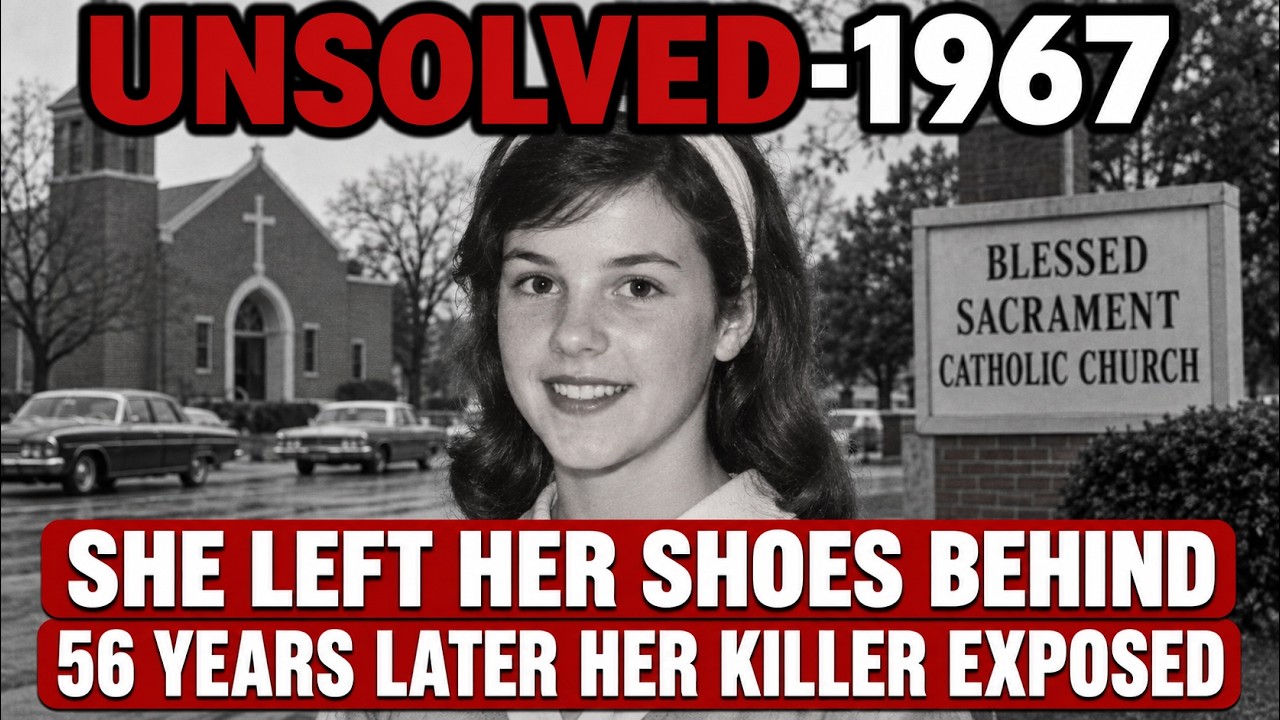
When investigators searched the empty hall, they found her white canvas shoes, size four, set neatly side by side on a folding table near the side door, as though she had removed them out of politeness. She had simply vanished. Ruth had been singing in the youth choir since she was eleven, praised by the director for a clear, high soprano. She was small for her age, dark-haired, quiet, devoted to her Nancy Drew books, which she kept organized by number on a shelf above her bed.
She wanted to be a librarian. She had double-knotted her shoes before leaving, because, as she once told her younger sister Patricia, a loose shoe in the middle of a song was mortifying. Her family, stable and loving, ran on a dependable routine. Her father worked at the Bethlehem Steel Plant; her mother prepared dinner at six.
That Friday, Ruth told her mother she would be home by 8:30 and walked the four blocks to church. She arrived at five to six with a cold, apologizing in advance for being flat. The classmate who waved goodbye saw her pull on her coat near the side door and step outside. The door closed.
The shoes stayed behind. The temperature that night was 41 degrees. The police received the call at 10:17 p. m.
, more than two hours after Ruth was last seen. Her father had driven the four-block route three times before making the call; her mother had stood on the porch calling her daughter’s name into the dark. Officers found Ruth’s coat at 11:40 p. m.
, folded deliberately in an alley behind a dry goods store, not consistent with a fall or struggle. A search with 300 volunteers and dogs ran through the weekend. On Monday, October 23, 1967, Ruth’s body was found in a drainage culvert behind the old Catonsville rail yard, 1. 4 miles from the parish hall.
She had been strangled. Lead detective Harold Getz, a precise and methodical former military investigator, believed from the first week that the answer lay in those shoes. They had been placed inside the building, which meant the person who left them there had access to the parish hall, either before rehearsal ended or in the confusion immediately after. This was not a stranger grabbing a girl off the street.
It was someone known, someone who had been inside that building. Getz compiled a list of 43 men with regular access to the parish hall through maintenance, volunteer organizations, the Knights of Columbus, and adult choir members. By December, he had eliminated 39. One of the remaining four was Edward Fults, a 33-year-old volunteer janitor seen near the hall that evening by two witnesses, who could not account for the full window between 7:45 and 9:00 p.
m. Fults was soft-spoken, cooperative, and helpful in the volunteer search. Getz noted in his file that the subject’s alibi remained unverified for the critical window and recommended continued monitoring. The latent fingerprint lifted from the inside heel of Ruth’s shoe produced no match in 1967.
The technology to do more with it did not exist. In 1969, Edward Fults moved to Virginia. The monitoring ended. The case went cold.
Ruth’s mother, Margaret Callaway, never believed the initial conclusion that her daughter had run away. She kept Ruth’s bedroom exactly as it was. She wrote letters to the department every spring, undiminished in resolve even as hope declined. When arthritis made writing difficult in the early 1980s, she dictated the letters to Patricia, who mailed them without being asked.
Margaret Callaway died in 2004, still waiting. Patricia kept copies of every letter in a manila folder, 31 in all. The case file passed through several cold case units. In 1997, a new team identified Edward Fults, then living in Charlottesville, Virginia, as the primary person of interest.
Investigators contacted him. Fults, 63, was cooperative, remembered the case, expressed sorrow, and declined to provide a voluntary DNA sample. Without grounds to compel one, the department could not move further. The case went cold again.
In 2018, the Maryland DNA database expansion act created provisions for retesting biological material in cold case files using forensic genealogy, the technology mapping DNA from unknown contributors to public ancestry databases and tracing family trees backward to a single source. The latent print on Ruth’s shoe was not DNA, but the shoe had been handled. In the spring of 2022, a technician working through the Maryland Cold Case Initiative examined the original evidence bags and found a faint trace of epithelial cells deposited when someone had gripped the heel of the shoe, preserved for 55 years in the dry archive. The sample was small but viable.
Forensic genealogist Christine Holt uploaded the DNA profile to a public ancestry database. Within three weeks, she identified 17 individuals sharing segments of genetic material with the unknown contributor. She built family trees, eliminated branches, traced lines through birth records, marriage records, census data, and death records. The process converged on a name: Edward James Fults.
In 2023, Fults was 88 years old, living in a Charlottesville retirement community where he was known as a quiet man who played chess on Tuesday afternoons, attended Sunday services, kept a small garden of tomatoes and marigolds, and gave the tomatoes away. He had never married and had no children. In January 2023, investigators coordinating with Charlottesville authorities obtained a covert DNA sample from a discarded coffee cup in the community’s common area. It matched the biological material from the heel of Ruth’s shoe with certainty.
Investigators spent three months assembling the full evidentiary package: the witness accounts placing Fults near the parish hall, his unverified alibi, his 1997 refusal to provide a sample, the DNA, the genealogy chain, and an additional piece of evidence from Getz’s original file, a partial boot print found in soft dirt near the culvert where Ruth’s body was discovered. The boot print indicated size 11 and a half. Edward Fults wore size 11 and a half. It was in his military discharge records and his Department of Motor Vehicles file from 1972.
No one had ever thought to check. On April 3, 2023, Edward James Fults was arrested in the common room of his retirement community. He was sitting at the chess table. He did not resist and did not speak.
He looked, according to one officer, like a man who had been waiting for a knock he had expected for 56 years and was simply relieved it had finally come. Patricia Callaway Marsh was in her kitchen in Towson, Maryland, when the call came. She listened for a long time without saying anything. Then she went to the drawer where she kept the manila folder and held it against her chest.
Fults was charged with first-degree murder. At an evidentiary hearing in September 2023, his defense challenged the genealogical DNA methodology, a challenge raised in courtrooms across the country since such arrests began. The court found the methodology sound. Edward Fults pleaded guilty in November 2023 and was sentenced to life in custody.
He was 88 years old when he was taken from that room. Ruth Callaway had been 14 when he took her life. At sentencing, Patricia read a statement she had been writing and rewriting since 2004, when she buried her mother without an answer. She spoke of Ruth’s voice singing O Come All Ye Faithful every December, high and clear.
She spoke of the Nancy Drew books, packed into a box when the family finally moved in 1978. She spoke of Wendell the dog sitting by the front door. She held up the manila folder and said that her mother had written every one of those letters because she knew the truth was in that building. She was right.
She simply did not live to see it confirmed. Detective Harold Getz died in 1991, never solving the case he believed he had nearly solved in 1967. His original case file, meticulous and organized by date, formed the evidentiary foundation for the 2023 case. His note about Fults’s unverified alibi was cited directly in the indictment.
Ruth Callaway’s white canvas shoes remain in the Maryland evidence archive, part of the permanent case file. The biological material preserved in the inside heel of one of them survived 56 winters in a fluctuating storage facility, two archive relocations, and a flood in 1972 that damaged a significant portion of the cold case storage room. It survived all of that. It waited.
And eventually, it said what it had always known how to say. Ruth wanted to be a librarian. She had double-knotted her shoes because a loose shoe in the middle of a song was mortifying. She had waved goodbye at 8:03 on a Friday evening in October, and she had been trying to go home.
Justice came for her after 56 years.