The night of April 14, 1865, was meant to be the most devastating coordinated attack in American history. Three armed men had orders to strike three targets almost simultaneously, and all of them took their instructions from the same man, the actor John Wilkes Booth. By his design, the nation would lose its president, its vice president, and its secretary of state in a single night. Washington was still ablaze with celebration, five days after Robert E.
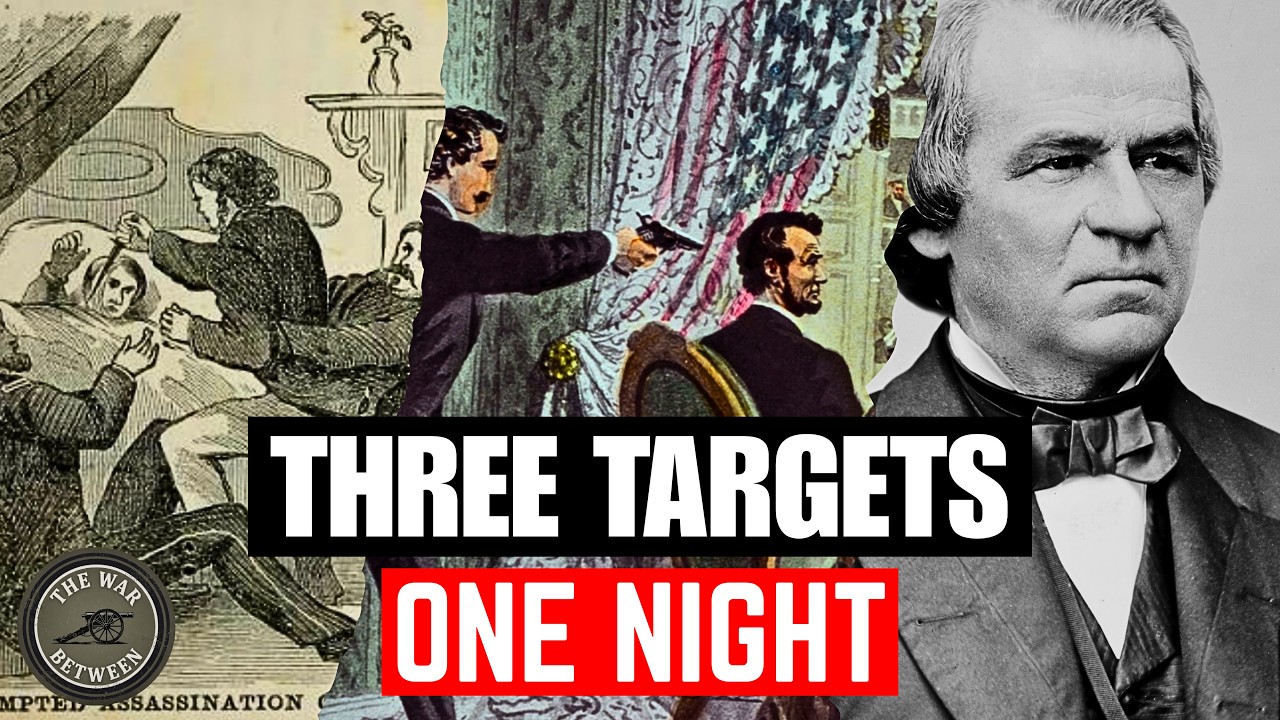
Lee surrendered at Appomattox. Candles glowed in windows, flags hung heavy in the damp air, and crowds still wandered the streets in triumph. The three men moved through that city, each toward a different door, each with the same deadly purpose. What waited behind those doors would be three very different fates.
Around eight o’clock that evening, Booth gathered his men in a room at the Herndon House, a boarding hotel a short walk from Ford’s Theatre. He had news for them. The president would be attending the play that night. General Grant was also expected, but he had left Washington earlier with his wife, taking one of the intended targets out of reach.
For months, these men had conspired to kidnap Lincoln and trade him for Confederate prisoners. But Richmond had fallen, Lee had surrendered, and the kidnapping plan had collapsed. Three nights earlier, Lincoln had spoken from a White House window and publicly suggested that some Black men should have the right to vote. Booth, standing in the crowd below, reportedly swore that would be Lincoln’s last speech.
Now he had a new plan. He gave his orders one by one. He would kill Lincoln himself at the theater. Louis Powell, a twenty-year-old former Confederate soldier of enormous build, would kill Secretary of State William Seward.
George Atzerodt, a twenty-nine-year-old carriage repairman from a small Maryland river town, would kill Vice President Andrew Johnson. All three attacks were to fall shortly after ten o’clock. Booth had thought carefully about the constitutional stakes. If Lincoln died, Andrew Johnson would become president.
If Johnson also died, the office would pass to an obscure senator who would only serve temporarily, and a special election would have to be held. The man legally responsible for notifying the states to hold that election was the secretary of state. In one night, the country would lose its president, his successor, and the official charged with beginning the process of choosing a new government. Whether Booth planned it all in those terms remains uncertain.
Atzerodt later claimed he had refused the order, insisting he had agreed to a kidnapping, not a murder. But most of what is known about that moment comes from Atzerodt himself, and he had every reason to make himself look innocent. What complicates his story is this: that very morning, Atzerodt had rented room 126 at the Kirkwood House, one floor above the vice president’s own rooms. He had signed the register with his real name.
Across the city, the Lincolns were running late. They had taken an evening carriage ride together. Mary Lincoln later said her husband told her the war was truly over and that they must both be more cheerful now. Between the war and the death of their son Willie, they had lived in misery.
Just after eight thirty, they arrived at Ford’s Theatre. The Grants’ seats had gone to a young couple, Major Henry Rathbone and his fiancée Clara Harris. The actors stopped mid-scene, the band played “Hail to the Chief,” and the audience stood and cheered. A single policeman, John Parker, was assigned to guard the president that night.
Shortly after ten, the three men moved through the wet night. At the Kirkwood House, Atzerodt walked into the bar, armed. Upstairs, the vice president had gone to bed early. Andrew Johnson, fifty-six years old, had held his office for only six weeks.
At Ford’s Theatre, Booth left his rented horse in the back alley and climbed the stairs to the dress circle. He knew the building well. He had starred on this very stage in 1863, and Lincoln had watched the performance from the presidential box. Tonight the box was decorated for the president, with flags borrowed from the Treasury Department and a portrait of George Washington hanging in front.
In Lafayette Square, two riders stopped before Seward’s brick house. Herold stayed with the horses while Powell climbed the steps and rang the bell. A young Black servant named William Bell opened the door. Powell held up a small package and said it was medicine from the secretary’s doctor, insisting he deliver it personally.
Bell tried to stop him, but Powell pushed past and began climbing the stairs. At the top, Frederick Seward, the secretary’s son and the assistant secretary of state, barred his way. He told Powell his father was asleep and offered to take the medicine himself. Powell refused.
They argued outside the bedroom door. Frederick’s sister Fanny opened the door to look, and Frederick quickly closed it. For a moment, Powell seemed to give up. He turned and started down the stairs.
Then he spun around, drew a heavy pistol, aimed it at Frederick’s head, and pulled the trigger. The pistol misfired. Powell did not try again. He swung the heavy weapon like a club.
The pistol shattered as it struck Frederick again and again. Frederick collapsed on the landing with a fractured skull. William Bell ran down the stairs and into the street, screaming murder, racing toward army headquarters for help. Powell dropped the pistol, drew a knife, and burst into the sickroom.
The nurse, Private George Robinson, a wounded soldier from Maine, jumped up to meet him. Powell slashed Robinson’s forehead and shoved him aside, pushing Fanny out of the way as she ran beside him toward the bed, begging him to stop. Seward lay on the far side of the bed, covered in heavy blankets, a wire splint holding his broken jaw. According to his family, he realized at once that the man wanted his life, but his first fear was for Fanny.
He struggled to raise his broken body to protect her. Powell leaped onto the bed and, in the dim gaslight, stabbed at Seward’s face and throat. The first blows missed, then struck home. The blade tore Seward’s cheek and sank into his neck.
In the struggle, Seward rolled off the bed and fell to the floor. Robinson rose again, bleeding, grabbed Powell from behind, and pulled him off. Another son, Augustus Seward, rushed in half-dressed, and Powell stabbed them both. Then he broke free and ran for the stairs, stabbing a State Department messenger in the back on the way, and burst out the front door screaming that he was mad.
Herold was gone, having fled at the first cry. Powell was alone in a city he barely knew. The attack had lasted only minutes. On the bedroom floor, in the dim light, the secretary of state lay motionless.
The people who had just fought for Seward’s life were an ordinary group: a young servant, a wounded soldier, a daughter of twenty, and two sons. None of them had expected to fight that night, but none of them had backed away. At the Kirkwood House, the vice president still slept. No one had gone upstairs.
This is the strangest part of the entire night. Of the three killers, Atzerodt had the easiest task. His target was asleep. His own room was one floor away.
He was armed. He had even prepared, having asked a waiter earlier that day where the vice president was, a question the waiter remembered. So why did he never climb the stairs? We do not know what went through George Atzerodt’s mind that night, only that the stairs remained empty.
He was never cut out for this. Born in Prussia, raised in Maryland, he had worked the Potomac at night during the war, ferrying Confederate couriers across the river to Virginia. He knew the currents and the hidden passages. That was why Booth had recruited him, to spirit a kidnapped president across that river.
Now he was one staircase away from a man he was ordered to kill, and he never climbed it. Instead, he walked out into the wet night, rode away, and according to his later account, drifted from tavern to tavern. At some point he threw his knife into the street. Before dawn he was gone.
Back at the Kirkwood House, a knock came at Johnson’s door. It was Leonard Farwell, the former governor of Wisconsin, who had rushed over from Ford’s Theatre. He told Johnson the president had been shot. The two men closed the door.
The next morning, investigators searched room 126. The bed had not been slept in. Under the pillow lay a loaded revolver. In the room was a savings bank book belonging to John Wilkes Booth.
Atzerodt later claimed the weapons were Herold’s. At his trial, his own lawyer described him as a natural coward, arguing that Atzerodt was too afraid to kill anyone. The killer with the easiest target had lost his nerve, while the ordinary people in the Seward house had not. Inside Ford’s Theatre, Booth had reached the corridor to the president’s box.
The president’s footman looked at his card and let him pass. Officer Parker was not at the door, and where he went that night has never been settled. Booth slipped into the dark passage and wedged the door shut with a wooden bar. He knew the play, the comedy “Our American Cousin,” well enough to know that a line was coming which would make the audience roar with laughter.
He waited for it. Onstage, an actor called a departing society lady an “old fossil widow. ” The theater erupted in laughter. In that exact sound, Booth stepped forward, raised a small single-shot derringer behind Lincoln’s head, and fired.
The sound was muffled and heavy. Blue smoke drifted over the railing. For a moment, many in the audience thought it was part of the play. Major Rathbone sprang from his seat and seized Booth.
Booth dropped the pistol and slashed with a long knife, cutting Rathbone’s arm from elbow to shoulder. Booth climbed over the railing and jumped to the stage, about eleven or twelve feet below. According to the traditional account, his spur caught on one of the flags draped in Lincoln’s honor. He hit the floor hard, stumbled, rose, and faced the audience.
Some witnesses heard him shout “Sic semper tyrannis,” the Virginia state motto, meaning “Thus always to tyrants. ” Others remembered different words. He ran across the stage, knife raised, disappeared behind the scenes, mounted his horse in the alley, and galloped into the darkness. In the box, Mary Lincoln screamed.
A young army surgeon named Charles Leale, twenty-three years old, fought his way to the box and found the president slumped in his chair. At first he could feel no pulse. He found the wound behind the left ear, removed a blood clot, and worked the president’s arms and chest to help him breathe. Slowly, breathing returned, but Leale already knew the truth.
The wound was fatal. He made a quick decision: the president could not survive a carriage ride back to the White House. He must be carried to the nearest bed, across the street at Petersen’s boarding house. The patient was too tall for the bed and lay diagonally across it.
For the rest of the night, the United States government was run from the back parlor of that boarding house, where Secretary of War Edwin Stanton took charge, sent telegrams, ordered the city closed, and interrogated witnesses one by one. Through the night, Leale sat beside the bed, holding the president’s hand, so that Lincoln would feel he was still in contact with humanity and had a friend. The hours passed. Breathing became slow and heavy.
Near seven in the morning, the end was close. Mary Lincoln made her final visit. Robert Lincoln, the president’s eldest son, stood at the head of the bed and collapsed twice, sobbing on Senator Charles Sumner’s shoulder. At 7:22 AM, the breathing stopped.
Abraham Lincoln was dead. Witnesses recalled Stanton saying, “Now he belongs to the ages. ” That morning, Gideon Welles, the secretary of the navy, walked to the White House in a cold rain. Hundreds of Black Washingtonians stood outside, mostly women and children, weeping for the man they had lost.
Before noon, in his room at the Kirkwood House, Andrew Johnson took the oath of office. The man Atzerodt had been sent to kill was now president. The government had not fallen, but the man who tried to bring it down was still at large, believing he had triumphed. Minutes after the shooting, Booth raced toward the Navy Yard Bridge, the road out of Washington into southern Maryland.
A guard stopped him and asked his name. Booth gave his real name. No one was supposed to cross after nine o’clock, but the war was over and the rules were lax. The guard let him pass.
Minutes later, Herold crossed too. Around midnight, they reached a tavern owned by Mary Surratt, a widow from Washington who had hosted the conspirators at her boarding house for months. The man running the tavern, John Lloyd, later testified that Surratt had driven there that very afternoon and told him to have the firearms ready, that someone would call for them that night. That testimony would one day help send her to the gallows.
Booth told Lloyd they had assassinated the president and Secretary Seward. He was wrong about Seward, though he would not know it for days. Booth’s left leg was broken. Before dawn, they reached the farm of a country doctor named Samuel Mudd, who had met Booth before and who set the broken leg with a splint cut from a hatbox.
The fugitives slept most of Saturday and disappeared into the Zekiah Swamp by dusk. The manhunt that followed became one of the largest in American history. Thousands of soldiers and detectives poured into southern Maryland. The War Department offered a total of one hundred thousand dollars in rewards.
For about five days, Booth and Herold hid in a dense pine thicket while a Confederate sympathizer named Thomas Jones brought them food, blankets, and newspapers. Search parties sometimes passed close enough to hear them. Jones knew about the reward, which was a fortune in 1865. Asked years later if he had been tempted, he said his word could not be bought for a hundred times that amount.
Booth read the papers in disbelief. He had expected to be welcomed as a hero, but even many Southerners condemned him. He pulled out his diary and wrote that he had struck boldly, not as the papers said, and later that he was in despair, hunted like a dog, and that everything was a curse he had to bear. He compared himself to Brutus, who killed Julius Caesar.
In Washington, the net closed on the others. On the night of April 17, detectives arrested Mary Surratt at her boarding house. As they prepared to leave, there was a knock at the door. A huge man stood there, covered in mud, carrying a pickaxe over his shoulder.
He said Miss Surratt had hired him to dig a gutter. It was Lewis Powell. After three days of hiding, he had walked straight into the hands of the police. The detectives called in William Bell, the young servant who had opened Seward’s door.
Bell picked Powell out of a line of suspects, saying he would know him and that this was the man. A detective later said he had never seen a more positive identification. Three days after that, soldiers arrested George Atzerodt at a relative’s farm in Maryland. Dr.
Mudd was arrested shortly afterward. Booth and Herold crossed the Potomac in a small boat, got lost in the river, and finally reached Virginia. On April 24, they arrived at a farm owned by Richard Garrett. In the early hours of April 26, Union cavalry surrounded Garrett’s tobacco barn.
They ordered the men inside to come out. Booth refused, shouting that he would fight if the soldiers would only give him a chance. Herold surrendered, coming out with his hands raised. A detective set fire to the hay.
Through the cracks in the boards, the soldiers saw Booth rise on his crutch. A sergeant named Boston Corbett fired, saying later that he believed Booth was about to shoot. The bullet struck Booth in the neck and paralyzed him. He was carried to the porch of the farmhouse.
As dawn broke, he asked someone to raise his hands, looked at them, and whispered that they were useless. Officers later reported a final message, a request to tell his mother he died for his country. Shortly after seven o’clock, John Wilkes Booth was dead. He never faced a courtroom.
Eight others did. In May 1865, eight people were tried for conspiracy: Mary Surratt, Lewis Powell, David Herold, George Atzerodt, Dr. Samuel Mudd, and three others. They were civilians, yet a military commission tried them rather than a civil jury.
Critics objected then, and many still do. The prosecution tried to prove the Confederate government was behind the plot, but never succeeded. The evidence pointed, instead, to Booth’s own tight circle. The case against Mary Surratt rested heavily on two witnesses: the tavern keeper Lloyd, who had drunk a great deal that day, and a boarder named Louis Weichman, who was himself a suspect.
The evidence was circumstantial. William Bell testified against Lewis Powell. In 1865, it was rare for a Black man to testify against a white man, but Bell did, telling the court exactly how he had recognized the man who had shoved him aside at Seward’s door. Dr.
Mudd insisted he had not recognized his famous patient. The commission did not believe him and sentenced him to life in prison. Three other defendants were also imprisoned. In 1869, President Johnson pardoned Mudd.
Four were sentenced to death by hanging: Mary Surratt, David Herold, Lewis Powell, and George Atzerodt. Five of the nine officers on the commission asked President Johnson to spare Mary Surratt’s life. Johnson later insisted he never saw their petition. The army’s chief prosecutor said he did.
It was a strange turn: the man Atzerodt had been sent to kill now decided whether the conspirators would live or die. Johnson approved the death sentences. On July 7, under a blazing sun, the four were hanged together in the yard of the Washington Arsenal. The man who had fought his way into Seward’s bedroom and the man who had never climbed the stairs died on the same scaffold.
Atzerodt’s last reported words were a hope that they would all meet in the next world. Mary Surratt is widely described as the first woman executed by the federal government. Whether she knew what Booth planned that night remains one of the great unresolved questions of the case. Look back at that night.
Three men, three doors. At Ford’s Theatre, almost nothing stood in Booth’s way. A servant let him through. The police guard’s post was empty.
The president died. At the Seward house, a pistol misfired, and then a servant, a nurse, a daughter, and two sons stood in the way. The secretary of state lived. At the Kirkwood House, the only thing that failed was the killer himself.
The vice president slept through it all. If all three men had succeeded, the country would have awakened with no president and no vice president. Instead, it awakened with a new president before noon. Frederick Seward recovered and returned to the State Department as assistant secretary in 1877.
Congress later awarded George Robinson a gold medal. The months that followed were cruel to the Seward family. Frances, Seward’s wife, died that June. Fanny died the next year at twenty-one.
William Seward returned to the State Department, carrying scars on his face for the rest of his life, and in 1867 negotiated the purchase of Alaska. History remembers the man who fired the shot. It rarely remembers the young servant who screamed murder in the street, or the wounded soldier who pulled an armed man off a bed, or the daughter who begged him to stop. When George Atzerodt is remembered at all, he is remembered as a coward.
But that night, the fate of the government did not rest on generals or armies. It rested on a staircase, a landing, and a handful of people who made their choices in the dark. Three men, three targets. One pistol fired.
One pistol misfired. One man never climbed the stairs.