On the morning of Tuesday, March 25, 1975, two sisters left their home in Kensington, Maryland, for the second day of spring break and never returned. They carried less than four dollars between them and had promised their mother they would be home by four o’clock. At two in the afternoon, their older brother Jay spotted them laughing over pizza at the Orange Bowl restaurant inside Wheaton Plaza, a busy shopping center half a mile from home. He joked with them for a few minutes and went back to his friends.
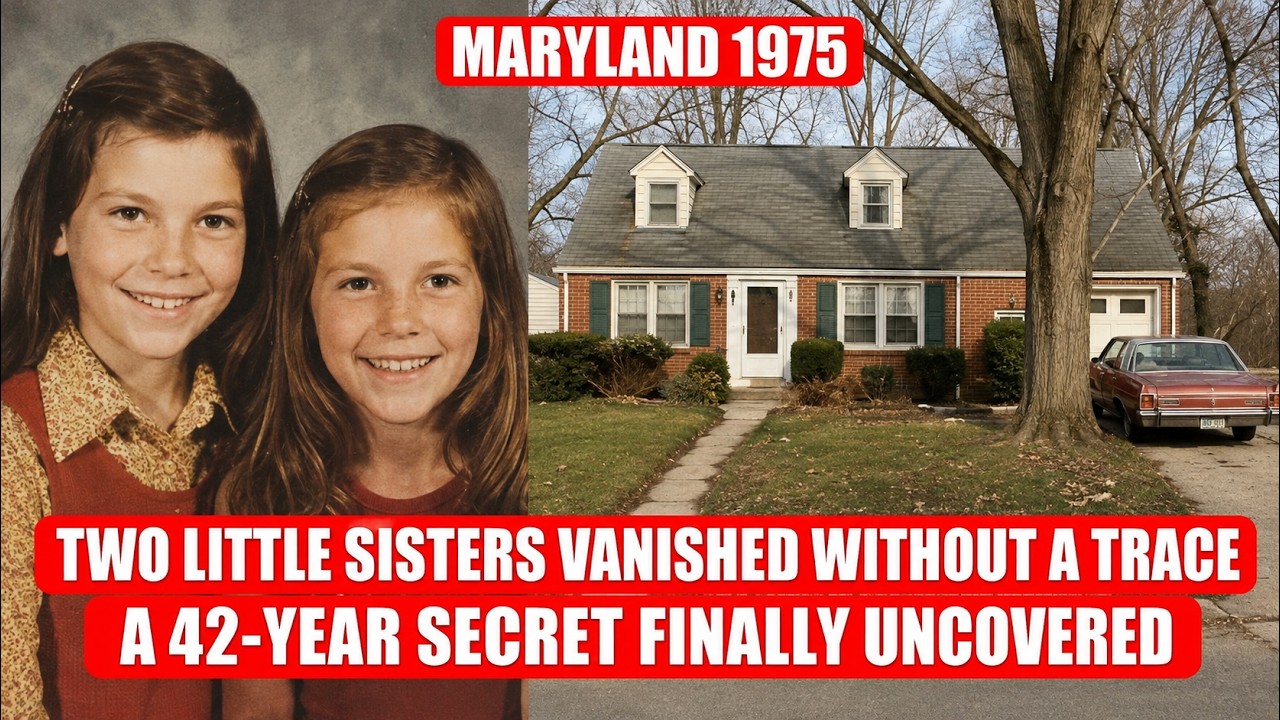
By seven that evening, the largest search in the history of Montgomery County had already begun. It would not truly end for forty-two years. Sheila Lyon was twelve, days away from her thirteenth birthday, a straight-A student who kept her money in a piggy bank and had a John Denver poster on her bedroom wall. Her sister Katherine was ten, days from turning eleven, sharp-eyed and always noticing things.
Their birthdays fell one day apart, and their parents had promised them a special dinner to celebrate. The girls had gone to the mall for an Easter display, pizza, and friends. They were seen by many people that day. One witness described an older man carrying a tape recorder who had spoken to the girls near the Orange Bowl.
A composite sketch of that man would consume three decades of investigation. Investigators tracked him across multiple states, questioned convicted killers and sex offenders with ties to the area, and chased down leads involving men named Mulllinsky and Coffey, each of whom used lures to target children in other cases. Nothing produced a result. But there was another witness, a friend of the Lyon sisters, whose identity remained protected for decades out of fear for her safety.
She told police that before the older man with the tape recorder appeared, she noticed someone else in the mall: a white male in his late teens or early twenties, with long hair and acne scars on his left cheek, staring at Sheila and Katherine in a way that made her uncomfortable. Police drew a composite sketch of him but never released it to the public. They were focused on the man with the tape recorder. The second sketch went into a file, the file into a box, and the box into a records room.
A week after the disappearance, on April 1, 1975, a young man walked into Wheaton Plaza and approached a security guard. He said he had been in the mall the day the Lyon sisters vanished and that he had seen them leave with the man carrying the tape recorder. He was eighteen years old, with long hair, and worked as a carnival game operator, traveling from town to town with county fairs. His name was Lloyd Lee Welch Jr.
Police took him in and administered a polygraph. He failed it. Detectives concluded he was an unreliable witness seeking the nine-thousand-dollar reward that had been offered. They released him.
The case went cold. By 1980 five years had passed. Detective Rodney Engels, the lead investigator, spent half his working time on the Lyon case alone, but every trail ended in a dead end. Jay Lyon, who had watched his sisters eat pizza for the last time, became a homicide detective in the Montgomery County Police Department.
He worked in the same building where the file on his sisters sat in storage, carrying the case not only as a grieving brother but as a professional burden. His father, John Lyon, continued his morning radio show at WMAL, Washington’s leading station, a deep voice warming kitchen radios across the region while his own world collapsed. One colleague recalled that the entire capital area held its breath when the news broke in 1975, and yet John Lyon maintained his composure on air. By 1992 he left broadcasting and joined the county’s victim assistance and sexual assault program, quietly turning his grief toward helping other families survive what his own family had not.
In 1999, John and Mary Lyon placed a stone marker in a local cemetery bearing their daughters’ names, their birth dates, and the date they disappeared. It was not a grave, for there were no graves. It was simply a place to go, a place to rest a grief that had nowhere else to settle. Generations of Montgomery County detectives took their turn on the Lyon case.
Teams pulled the boxes from storage, read the yellowed transcripts, and tried to find the thread everyone before them had missed, and each time the boxes went back to the records room. In 2013, thirty-eight years after the disappearance, Detective Sergeant Chris Homrock was assigned what his predecessors had done: start over. He pulled the boxes, read everything, and worked through witness statements, reports, and interview summaries that dozens of eyes had read over four decades. Buried in the files, he found a six-page statement he had never seen before.
It was Lloyd Lee Welch Jr. ‘s account from April 1, 1975, the carnival worker who had walked into the mall, told his story to a security guard, failed a polygraph, and been dismissed as a reward seeker. Homrock read the statement carefully. Then he pulled out a photograph.
Not the composite sketch of the man with the tape recorder, but the other composite: the long-haired young man with acne scars who had stared at Sheila and Katherine before anyone else appeared. Then he pulled a mugshot. Lloyd Lee Welch had been photographed in 1977 when he was arrested for burglary at a home eight blocks from Wheaton Plaza, where jewelry worth five hundred eighty dollars had been stolen. Homrock looked at the mugshot.
He looked at the composite sketch. They were the same face. Homrock brought in Detective Dave Davis and Deputy State’s Attorney Pete Feeney. The three traveled to Delaware, where Welch had been in a prison cell since 1997 after a conviction for molesting a ten-year-old girl, one offense in a criminal record stretching back to 1973 that included rape, domestic violence, and assault with a knife.
They identified themselves and asked about the Lyon sisters. Welch said he had been at the mall that day and seen the girls leave with the tape recorder man. He said he wished he could help solve the mystery. Over months and years, as investigators returned to Delaware, Welch’s story changed.
It began with small details, then larger ones. In 2014 he admitted that the day after the sisters disappeared, he watched his father and uncle do unthinkable things to at least one of the girls in a basement at his father’s home in Hyattsville, Maryland. He said he heard one of the girls cry out and fled. He said he never saw them again.
He said the basement was at his uncle’s house. Then he changed that too. It was his father’s home, 4714 Baltimore Avenue. Detective Davis went to that address.
The house was still standing. He found the basement, accessible only through a locked exterior door at the rear of the property, exactly as Welch had described in every version of his account. Using forensic light and a chemical spray, Davis entered the room and turned on the blue light. The walls, the floor, the ceiling, all of it lit up.
Blood from floor to ceiling. Someone or something had been slaughtered in that room. What followed was the unwinding of a family conspiracy that had held for nearly four decades. Welch’s cousin Henry Parker, who lived on Taylor Mountain in Bedford County, Virginia, told investigators that Welch had appeared unexpectedly in the spring of 1975 with two large army-style bags in the trunk of his car, each weighing sixty to seventy pounds and stained with red blotches.
Parker said they smelled like death. Parker and Welch threw the bags into a large open fire that burned intensely for days. Neighbors later told investigators that in the spring of 1975 they noticed a burning smell drifting across the mountain. At the time, no one knew what it meant.
In July 2015, forty years after Sheila and Katherine Lyon walked away from their brother at the Orange Bowl, a grand jury in Bedford County, Virginia, indicted Lloyd Lee Welch Jr. on two counts of first-degree murder. He was fifty-eight years old and already serving time. On September 12, 2017, forty-two years after that Easter break of 1975, Welch stood before a judge in Bedford, Virginia, wearing bright orange prison clothes, and pleaded guilty to two counts of first-degree murder.
He was sentenced to forty-eight years in a Virginia correctional facility. He would never leave prison. The bodies of Sheila and Katherine Lyon were never found. John Lyon stood at a podium in the courtroom after the plea.
He had spent forty-two years going to work each day, raising his sons, helping other victims in his county, and carrying a grief most people would never be asked to bear. He looked at the courtroom, at the detectives, prosecutors, and press who had cared about his daughters for four decades, and spoke in that deep voice his listeners had always known, thanking them for treating Sheila and Katherine as if they were their own sisters or daughters. He paused, laughed a small, tired laugh that carried every year of those forty-two, and said, simply, that they were tired and just wanted to go home. John Lyon died in 2025.
Mary Lyon had died the year before, in June 2024. They were buried near the stone marker they had placed decades earlier, bearing the names of their daughters and the date the girls went to Wheaton Plaza and never came home. The case against Lloyd Lee Welch was built without a single body, without a preserved crime scene, without the physical evidence modern prosecutors rely on. It was built on the testimony of people who waited decades to say what they knew, on the forensic light in a basement on Baltimore Avenue, on the smell of death on a mountain in Bedford County, and on a six-page statement and a box of old records that a detective named Chris Homrock chose to read to the end.
Forty-two years, one composite sketch, and the right investigator at the right moment. That, sometimes, is the price of justice.