Eugénie de Montijo was born in Granada in May 1826, the daughter of a Spanish nobleman who had once fought for Napoleon Bonaparte. She was beautiful, sharp-tongued, and fiercely independent, and by the early 1850s her presence in Paris had captured the attention of the most powerful man in France. Louis-Napoleon Bonaparte, nephew of the great emperor, had made himself first president and then, in December 1852, Emperor Napoleon III. He pursued her as he pursued every beautiful woman in his court, expecting to make her his mistress.
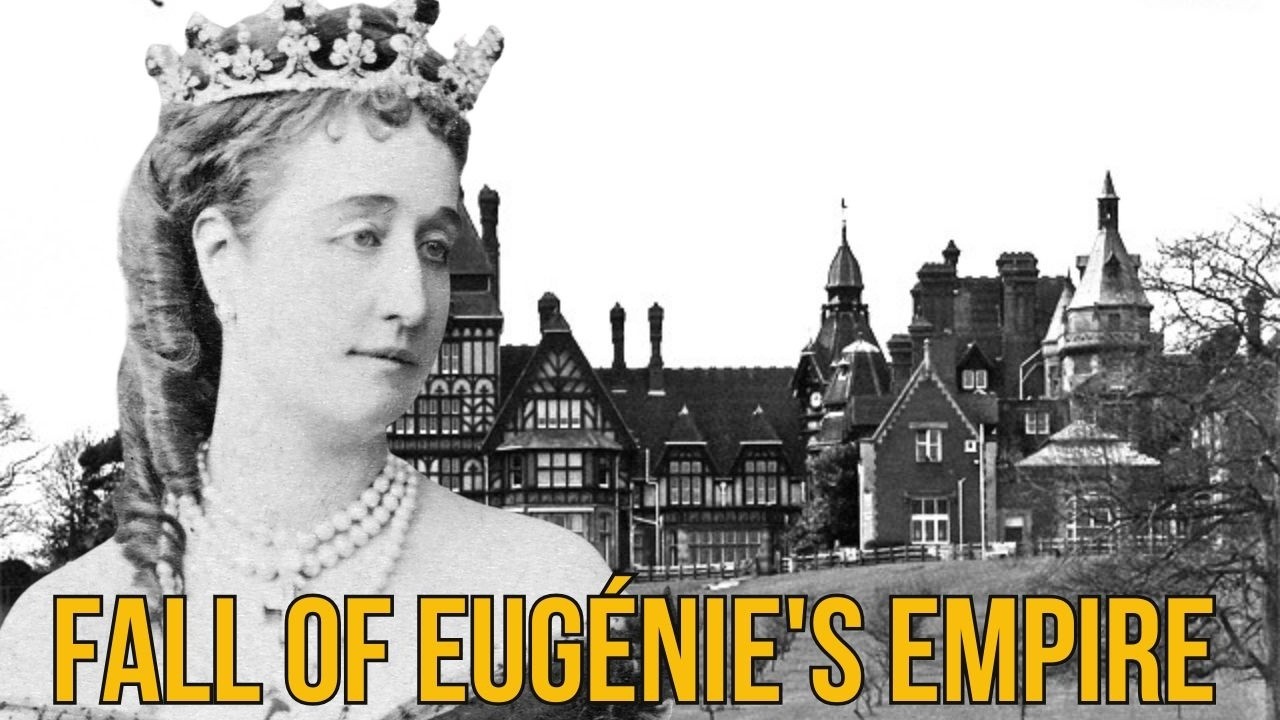
She refused. When he pressed her on how he might reach her, she reportedly told the Emperor of France that the road to her bedroom passed through the church. She would be an empress or nothing at all. Remarkably, she won.
In January 1853, she married Napoleon III and became Empress of the French. The aristocracy was scandalized. She was a foreigner, a Spanish countess, not a princess from a great royal house. But the public was charmed, and Napoleon had what he wanted: the most admired woman in Europe at his side.
Eugénie transformed the French court into the most dazzling spectacle on earth, setting fashions that two continents rushed to copy and effectively creating the concept of the famous fashion designer. But she was more than decoration. She was intelligent, devout, conservative, and genuinely influential. Napoleon trusted her judgment, making her regent of France three separate times in his absence.
She sat in council and shaped policy. She was, in every real sense, a partner in ruling the Second Empire. She had beauty, power, wealth, a throne, and the admiration of the world. Only one thing was missing: an heir.
For three years she remained childless, and the pressure was immense. Finally she became pregnant. On March 16, 1856, after a long and dangerous labor that nearly killed her, she gave birth to a son. The child was named Napoléon Eugène Louis Jean Joseph Bonaparte, but to his mother he was simply Louis, or more tenderly, Loulou.
Paris erupted in joy. One hundred and one cannon shots announced the birth of a boy. There was dancing in the streets and prayers of thanks in the churches. The pope himself served as godfather.
This single precious infant was the future of France incarnate, the guarantee of the Bonaparte dynasty’s survival. But that near-fatal birth left a shadow. Eugénie would have no more children. There would be no second son, no backup, no reserve.
Everything, the dynasty, the future, the entire weight of the Bonaparte name, would rest on the slender shoulders of this one fragile boy. One life, one thread. And the glittering marriage the world envied was not what it seemed. Behind closed doors, Napoleon III was a relentless womanizer, taking mistresses with such openness that it became one of the worst-kept secrets of the court.
For a proud, devout woman like Eugénie, it was a constant humiliation. The warmth between them faded, and she poured her energy into politics and into her son. Loulou became not only her heir but her emotional center, the one relationship that was wholly hers, wholly pure, wholly loyal. She raised him with fierce devotion and high expectations.
He was to become a great emperor, a worthy bearer of the Napoleon name. He grew into a bright, brave, kind-hearted boy, loved by those who knew him and desperate to live up to the enormous legend of his name. The empire he was meant to inherit was sliding toward catastrophe. Napoleon III’s foreign adventures had a habit of starting brilliantly and ending badly.
The most disastrous example was Mexico, where his attempt to install a European puppet emperor collapsed in humiliation and execution. Across the Rhine, a far more dangerous power was rising: Prussia, under the cold genius of its chancellor Otto von Bismarck. Bismarck was systematically uniting the German states into one powerful nation, and he understood that nothing would weld the Germans together more completely than a victorious war against their old enemy, France. He wanted that war.
He maneuvered patiently and ruthlessly to provoke it. In the summer of 1870, France walked straight into the trap. A diplomatic crisis over the Spanish succession was manipulated and inflamed. French honor was wounded.
The war party in the court pushed hard for a military confrontation. In July 1870, France declared war on Prussia. It was the single greatest mistake of the entire empire, and it would destroy everything Eugénie loved. The Franco-Prussian War was a catastrophe almost from the first shot.
The French army, despite its reputation, was outdated, poorly organized, and hopelessly outmatched by the modern Prussian war machine. Within weeks, the French were reeling. Then came the detail that turned a military disaster into a family tragedy. The imperial prince Loulou was only fourteen when the war began, and his father took him to the front.
The boy who was supposed to be the future of France was sent for his baptism of fire, to stand near the fighting so the dynasty could say its heir had faced the enemy. The end came at Sedan. In early September 1870, the Prussians surrounded the main French army, commanded by Napoleon III personally, and bombarded it into surrender. On September 2, the Emperor of the French handed himself and his entire army over to the Prussians.
He became a prisoner of war. Two days later, Paris rose in revolt. The Second Empire collapsed, and the Republic was proclaimed. Eighteen years of empire, parties, fashion, and glittering court dissolved within hours while Eugénie was still in Paris, regent of a regime that no longer existed.
The crowds turned against her. She escaped through a side exit of the Tuileries with the help of loyal companions and, remarkably, her American dentist, Dr. Thomas Evans, who hid her and smuggled her out of the city. Disguised, she fled across France and made a perilous crossing to England.
The Empress of the French, who had set fashions across two continents, was now a refugee. Loulou joined her, having survived the collapse, and eventually her broken husband was released by the Prussians to live in exile. The family was reunited, but in a modest house in the English countryside, in a place called Camden Place in Chislehurst, Kent. They lived as a court in waiting, surrounded by loyal Bonapartists who never stopped believing the dynasty would be restored and Loulou would return to France victorious as Napoleon IV.
In January 1873, Napoleon III died in exile after surgery. The dream congealed into something like desperation. Loulou was no longer just an heir. He was the head of the House of Bonaparte, the living embodiment of the imperial claim, the sole repository of all the hopes his mother and the faithful carried.
The Bonapartists proclaimed him Napoleon IV. He was seventeen years old. He carried the weight of a name associated with the greatest conqueror in European history, and the shame of a father who had surrendered his sword at Sedan. He believed he had to prove, with his own body, that the Bonapartists were still soldiers, still brave, still worthy of France.
In England, he did the logical thing for a young man who needed to become a soldier. He entered the Royal Military Academy at Woolwich, the British training school for artillery officers, and excelled. He was liked, hardworking, and genuinely talented. Queen Victoria was personally fond of him and treated him almost as family.
But an academy is not a battlefield, and a young man trying to prove himself in war does not feel he has proven anything without facing real enemies, real danger, real combat. In 1879, he found it in the worst possible place. Britain was fighting the Anglo-Zulu War in South Africa. After a shocking early defeat at Isandlwana, where Zulu armies annihilated a British column, the war dominated headlines across England.
It was dramatic, dangerous, and exactly the kind of real fighting Loulou craved. He begged to be allowed to join the British forces going to fight the Zulus. Nearly everyone tried to stop him. The British government was deeply worried.
He was not a British citizen. He was the heir to a foreign dynasty, a guest of the nation. If anything happened to him on a British campaign, the diplomatic and political consequences would be a nightmare. Two forces overcame these objections.
The first was Loulou’s relentless determination; he pushed, petitioned, and refused to be denied. The second, more heartbreaking, was his mother. Eugénie, the woman who had fled an empire to preserve her son’s life and loved him more than anything in the world, supported his going. She understood better than anyone what the boy needed.
She knew a future emperor who had never seen war would be a hollow figure, and that her son’s sense of destiny depended on this. Against every protective instinct a mother should have, she added her voice to his. She thought she was helping him win his future. In truth, she was sending him to his death.
An agreement was reached: Loulou would go to South Africa, but in a very limited staff role, as an observer far from real danger. That promise was never kept. Loulou arrived in South Africa in the spring of 1879, burning with enthusiasm, and quickly grew impatient with the restrictions placed on him. The officers around him, perhaps charmed by his personality or unable to refuse a prince, allowed him more freedom than they should have.
On June 1, 1879, he was assigned to a small reconnaissance patrol. It was a scouting party sent to survey terrain and find a campsite for the advancing troops. It was supposed to be routine. The patrol was small, a few men led by Lieutenant Carey, with some soldiers and local guides.
Around midday, they stopped to rest at an abandoned Zulu homestead, in a low area near a river, surrounded by tall grass that blocked visibility. They unsaddled their horses. They made coffee. They lingered far too long in enemy territory without posting proper sentries.
Hidden in the tall grass and the dry riverbed nearby, a group of about forty Zulu warriors watched them. As the patrol finally prepared to mount up and leave, the Zulus attacked. What followed was chaos and panic. Horses bolted.
Men scrambled to mount and flee. In those desperate seconds, things went wrong for the imperial prince. Loulou’s horse, a difficult animal, bolted before he could fully mount. He was running alongside it, clinging to a leather strap on the saddle, trying to leap onto a panicked galloping horse, when the strap broke.
He fell to the ground and was left alone. The rest of the patrol was already fleeing. Lieutenant Carey and the surviving soldiers rode off at full speed for safety. They did not stop.
They did not look back. The imperial prince of France, the boy whose mother had been promised he would be kept from danger, was left alone on foot in the tall grass as the Zulu warriors closed in. He did not beg. He did not run.
He turned to face his attackers. He drew his revolver and fought. The twenty-three-year-old prince stood his ground against impossible odds and fought for his life in the African grass. He had no chance.
The Zulu warriors closed in with their short stabbing spears and killed him. When the British recovered his body the next day, it bore eighteen wounds. Every single one was in the front. Not one was in his back.
He had not been killed while fleeing. In his final moments, surrounded and abandoned, Napoléon Eugène Louis Bonaparte turned and faced his killers to the end. The Zulu warriors, who valued courage above almost everything else, reportedly acknowledged that the young man had fought bravely. They did not know who he was.
To them, he was just an enemy soldier. They could not have known they had just ended a European dynasty, extinguished the male line of the Bonaparte family, and shattered the heart of a woman waiting in a quiet house in England for a son who would never come home. It took two and a half weeks for the news to travel from a riverbank in Zululand to the quiet house in Chislehurst. Eugénie waited in England, confident her son was safe because she had been promised he was kept from real danger.
She wrote to him. She prayed for him. When the news arrived by telegraph, Britain was shocked and shamed. A foreign prince, a guest of the nation, killed on a British patrol through negligence and abandonment.
Queen Victoria was devastated; she had loved that boy. But none of it compared to what waited at Camden Place. Those around Eugénie did not tell her immediately. When the truth finally broke through, the woman who had faced mobs and the fall of an empire with her famous steel will simply collapsed.
The grief was total. Loulou had been her only child. The difficult birth in 1856 had confirmed there would be no others. He was not just her son; he was the sole purpose left to her after the wreckage of everything.
When the empire fell, she had Loulou. When her husband died, she had Loulou. Every hope, every plan, every reason for enduring exile and humiliation was concentrated in that young man. Now he was gone, violently, alone, at the ends of the earth, in a war she had helped convince him to join.
That last truth was the poison at the center of her grief. She had supported his going. She thought she was helping him toward greatness, and instead she had helped open the door to his death. A mother who loses a child to fate can rage at fate.
A mother who feels she helped send her child to his death has nowhere to put her torment except inside herself. She withdrew into darkness so deep that those around her feared for her life and sanity. From that moment until the end of her long life, she wore only black. The most dazzling fashion icon of the nineteenth century, the woman whose colors were copied across two continents, put on mourning black and never took it off.
For forty-one more years, she was always in black, a living monument to a son who died at twenty-three. The death was a political catastrophe beyond one mother’s heart. Loulou had been the head of the imperial house, the only legitimate hope of every Bonapartist who had waited a decade for restoration. He had no children.
He had never married. With his death, the direct line of succession from Napoleon the Great, through Napoleon III, to Napoleon IV ended. There was no clear heir to carry the cause. The Bonapartist movement, a real political force in France, cracked and faded into insignificance.
In that single ambush in Zululand, Zulu warriors who never knew whom they killed ended not only a young man’s life but the future of a dynasty and any realistic hope that the Bonapartes would ever rule France again. In the aftermath, the British army held a court-martial. Lieutenant Carey, who had commanded the patrol, was tried for misconduct, for failure to maintain discipline, for negligence that left the camp exposed, and above all for the question that haunted everyone: why did the patrol flee without any attempt to save the prince? Why did no one turn back?
The proceedings were chaotic and politically charged, and in the end Carey was not definitively convicted. He was controversially allowed to return to service. The verdict was a repudiation of Eugénie. The men who had ridden away and left her son to be stabbed to death in the grass faced no real accountability.
There was no satisfying justice, no clear villain punished, only the unbearable truth that her son had been left alone and nothing could change it. Then Eugénie did something almost unbearable to contemplate. She decided she must go there, to Zululand, to the very spot on the other side of the world where her son had fallen. In 1880, a year after his death, the former Empress of the French, now a woman dressed entirely in black, made the long, arduous journey by sea to South Africa and then overland into wild Zululand, on a pilgrimage to the site of the ambush.
It was a difficult and dangerous trip for anyone in 1880, made by a grieving woman for one purpose only: to kneel where her child had died. She reached the site in the spring of 1880. A simple memorial had been erected near where he fell, and there, in the vast quiet of the African grassland, she finally stood on the ground that had swallowed her son’s future and her own. She spent the night there alone, keeping vigil at his place of death.
Accounts and her own later words suggest she spoke to him, prayed, and tried to feel close to the boy she had lost. One account says that during that vigil, a gust of wind swept through the still night, and the grieving mother desperately took it as her son reaching out to her. She left South Africa carrying the one thing she had left: a firm resolve that her son’s death would not be the end of his story, but that his memory would remain honored, and his courage recorded forever. She had buried her husband.
She had buried her empire. Now she had buried her only child, the last of the line. By every logical measure, her life was over. Yet she lived forty-one more years.
She settled in England in a grand house she built called Farnborough Hill in Hampshire, and there she did the work that became the focus of the rest of her life. She built a memorial to her beloved dead. She founded the Abbey of St. Michael at Farnborough, a Catholic monastery and mausoleum, and placed in it the remains of the two men she had lost: her husband Napoleon III and her son the imperial prince.
She gathered their remains under one roof in a crypt she designed so the emperor and the boy who should have been emperor would lie together forever, under the care of monks praying for their souls. She made herself the guardian of their memory. She preserved Loulou’s rooms and possessions, everything that remained of his short life. She worked to ensure his courage was documented and honored, so he would be remembered not as a reckless young man who died in a pointless war, but as a brave Bonaparte who fell facing his enemies.
Her grief now had a mission: to make her son immortal in memory since he could not be in life. Slowly, something unexpected happened. The grieving widow in black became one of the most respected figures in Europe. Stripped of power, Eugénie was finally free of the political hatred that had surrounded her as empress.
She became a revered, tragic figure, almost a saint in her old age. She maintained warm friendships with royal families across the continent. Queen Victoria remained close to her until her death. People visited her, honored her, consulted her.
She became a bridge to a lost world, a keeper of memory for an entire vanished era. She remained sharp, engaged, and surprisingly modern to the end. She embraced new technology. She traveled extensively, owned a yacht, and cruised the Mediterranean.
A woman born in the age of horse-drawn carriages lived to see the age of airplanes. In 1914, the First World War broke out, and once again France and Germany were locked in mortal conflict, just as in 1870 when war with Prussia had destroyed her world. Eugénie, now very old, devoted herself to supporting the French and British war effort. She gave generously and directed part of her resources to establishing a hospital.
The former Empress of the French, who had lost everything in the last Franco-German war, lived to support the side she had taken in the next one. And she lived to see that war end in a French victory, which had not happened in 1870. In 1918, Germany was defeated and France recovered Alsace and Lorraine, taken from her after the catastrophe of 1870. For Eugénie, that must have carried unbearable weight.
She had seen her husband’s empire die in defeat to Germany. Now, half a century later, this old woman in black lived to see that defeat finally reversed. The wheel had turned full circle, and she alone, of all those who had been there at the beginning, was alive to witness it. Eugénie died on July 11, 1920, in Madrid, Spain, her country of birth, while visiting relatives.
She was ninety-four years old. Born in 1826 at the dawn of Napoleon’s era, she died in 1920 in the age of cars and the modern ruins of the Great War. She had been an empress and a refugee. She had set the fashion of an entire continent and worn black for forty-one years.
She had buried an emperor and an heir to an empire. She outlived her husband by forty-seven years and her son by forty-one. They brought her body back to England, to the abbey she had built at Farnborough, and laid her to rest in the crypt beside the two people she had spent her long widowhood protecting: Napoleon III, her husband, and Loulou, her son. The three were finally together, the imperial family of vanished France, in a quiet English abbey far from the throne they had lost.
Why did the most fascinating woman of her age spend forty-one years in unchanging black? Now it is known. The black was for Loulou. For four decades, Eugénie wore her grief on her body every day because she could not and would not stop mourning her only child, the son she had nearly died to bring into the world, the boy raised to be an emperor, the young man she had helped send to a war that killed him.
The fashion icon gave up color forever because the one thing color could never bring back was her son. Her mourning was not a passing phase. It was a self-imposed life sentence, chosen out of a love that did not fade over forty-one years and did not fade until her death at ninety-four. A woman in black, kneeling alone in the grass of Zululand, eight thousand miles from home, begging the wind for one last touch of her son.
The boy who was born to be an emperor died facing his enemies in the grass, killed in a war that was not his, under a flag that was not his, for a cause that had nothing to do with him, driven by a need to prove himself and abandoned at the decisive moment by the men who were supposed to protect him. His mother, who survived revolution, the fall of an empire, and a faithless husband with her iron will, was finally broken completely by the loss of one young man. She had owned everything the world could give: beauty envied by a century, power most rulers never touched, boundless wealth. She would have traded it all in an instant for one more day with the boy she called Loulou.
In the end, none of it had any value. Not the throne, not the fame, not the glory. The only thing that mattered was her child.
And he was the one thing all her power could not protect.