At the center of the Confederate disaster at Gettysburg stood Lieutenant General James Longstreet, whose own account of the battle exposed a command so tangled in miscommunication and shifting orders that the final assault on the Union line was doomed before it began. Longstreet had opposed the attack from the start. He believed that charging directly at the enemy’s strongest position across open ground was a fatal mistake. But the orders came down from General Robert E.
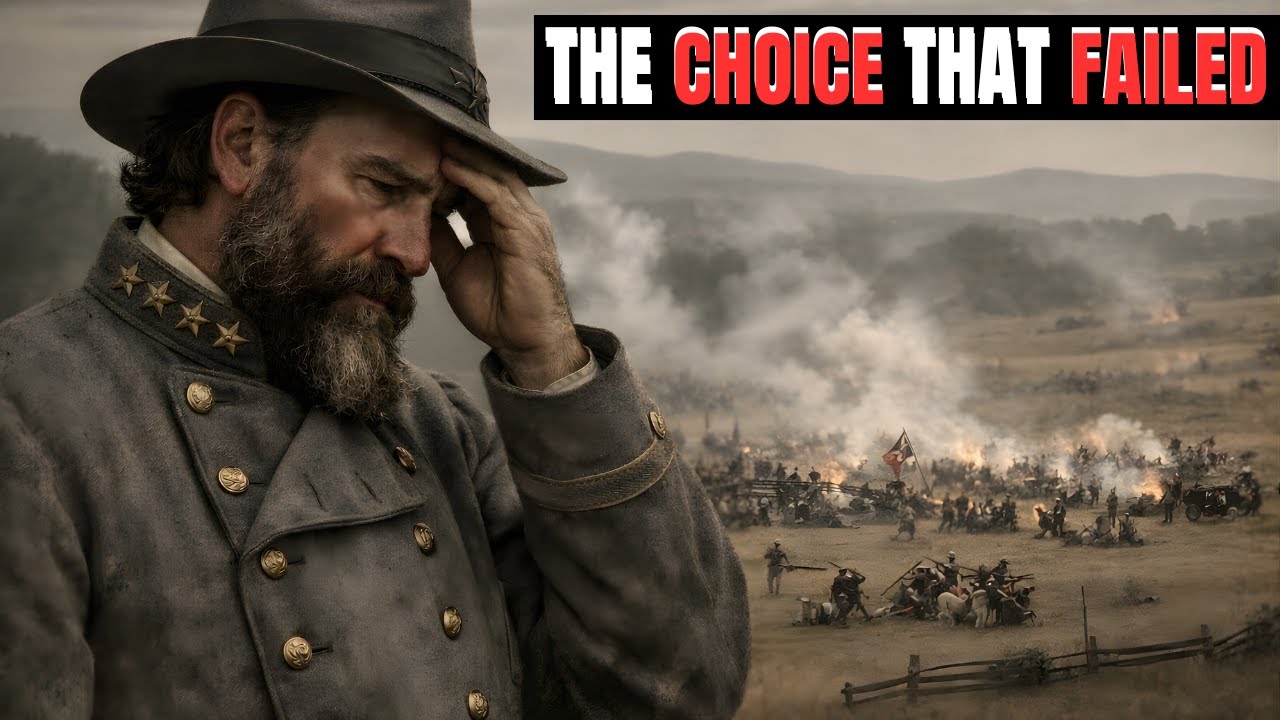
Lee, and the assault column was formed: Pickett’s division, Heth’s division, and part of Pender’s division, all aimed at the heart of the Union position on Cemetery Hill. The opening moves had gone well enough. On the first day of the fighting, Longstreet’s men had secured the ground gained on the right, while the left fell back to the enemy’s original position at the Peach Orchard. They captured four artillery pieces and two regimental colors, small prizes that hinted at greater success.
The following morning, preparations began for a renewed assault from the right, a maneuver intended to flank the enemy’s left. It seemed feasible, though it would take time. Longstreet issued the orders and waited. Then Lee arrived and changed everything.
Instead of the flanking movement, the commanding general ordered a direct strike at the center of the Union line. Longstreet studied the field and saw the problem immediately. The open ground to be crossed was too wide, the enemy’s fire too concentrated, and two-thirds of the men had already fought intensely in the previous days. Only Pickett’s division was fresh.
The odds were against them, and Longstreet knew it. But the order stood. Major General George Pickett was tasked with aligning his troops, using whatever cover the ground offered from enemy artillery, and focusing the attack on the strongest point of the Union defenses. Pickett placed two brigades at the front and held a third in reserve.
Wilcox’s brigade anchored the right flank for protection. Heth’s division, now under Brigadier General J. Johnston Pettigrew, formed two lines supported by part of Major General Dorsey Pender’s division, now under Major General Isaac Trimble. All available artillery from the First and Third Corps, along with some from the Second Corps, was positioned to concentrate fire on the point of attack and the enemy’s left flank.
Colonel Walton, the chief of artillery for the First Corps, and Colonel Edward Porter Alexander oversaw the placement of the batteries and coordinated with other artillery officers to time the bombardment. Around two o’clock in the afternoon, Pickett reported that his men were ready, concealed behind their own guns. Walton was ordered to open fire. The signal cannons crashed, and the Confederate artillery answered with a massive volley.
The enemy’s batteries on their left were silenced, but the guns on Cemetery Hill held their ground with stubborn determination. Many of their pieces were disabled, yet fresh artillery was quickly brought forward. The Confederate cannonade was powerful, but it was not enough. Longstreet rode to Major James Dearing’s battery and saw the truth with his own eyes.
The enemy was replacing their artillery as fast as the Confederates could disable it. He realized then that the attack had to come quickly if anything was to be accomplished before nightfall. He ordered the batteries to replenish their ammunition and prepare to support the infantry. When he learned that Alexander had already signaled Pickett that the time had come, Longstreet gave the final order for the assault to proceed.
It was only then that he discovered the artillery reserves were so low that the guns could offer little meaningful support. Had he known earlier, he later reflected, he would have reconsidered the attack. But by now it was too late to countermand the order. The advance began in excellent formation.
Every regiment maintained precise alignment, pressing forward into enemy fire with steady determination. About halfway to the Union line, a shallow ravine offered brief cover, and the troops paused before pushing on. Then the enemy’s artillery switched to canister shot, a concentrated barrage that tore through the Confederate ranks. The left flank began to lose cohesion, but the advance continued.
Pickett’s men barely hesitated, pausing only to return fire once within range. Major General Richard H. Anderson’s division was sent forward to reinforce the increasingly unstable lines of Pettigrew and Trimble. After intense close-range combat, Pickett’s troops made a final charge, only to withdraw in complete disarray.
The retreat cost more lives than the advance itself. The collapse allowed the enemy to concentrate their forces on Pickett’s division, threatening to destroy it before Anderson could intervene. But Anderson’s position would have been jeopardized if he advanced too far without support. Longstreet ordered him to halt.
Soon the enemy assailed Pickett’s division from multiple directions, driving it back and capturing half of those who were not already lost or wounded. General Wright of Anderson’s division, along with all available officers, was tasked with rallying the scattered troops behind Anderson’s position. Staff officers were dispatched to assist. Expecting a counterattack, Longstreet rode forward to supervise the artillery fire.
The enemy made minor advances, each time retreating when met by Confederate guns. This continued until nightfall, when the Union forces finally disengaged. The Confederate line then withdrew to the Gettysburg road, linking up with the right flank of Lieutenant General A. P.
Hill’s corps. After nightfall, orders arrived to prepare for a general retreat. The necessary work began before dawn on the fourth of July. That night, the troops began their withdrawal, with Longstreet’s command following the rear guard of A.
P. Hill’s corps. Torrential rain and difficult roads slowed the march, but they reached the mountains by the night of the fifth. On the sixth, they moved toward Hagerstown, though the exhausted men and animals could barely keep pace.
Longstreet was deeply concerned that they would not arrive in time to assist their threatened supply trains at Williamsport. They reached Hagerstown at about five o’clock in the evening and encamped two miles from the town. Reports detailing the casualties, losses, wounded, and missing had already been sent. Longstreet closed his account with the formal obedience of a subordinate, but his words carried the weight of a commander who had watched a doomed attack unfold exactly as he feared.
As the gunsmoke dissipated over Gettysburg, the field fell silent, heavy with unanswered questions. Longstreet’s account revealed not only the failures of Confederate command, but also the lingering specter of what might have been. The retreat was more than a physical ordeal. It marked the beginning of a deeper reckoning for the Confederacy, a forced confrontation with the hard truths of a war that was turning against them.
While the Union celebrated its victory, the Army of Northern Virginia marched away carrying the burden of lost opportunity. The assault on Cemetery Hill had been a gamble, ordered against the counsel of the man who understood the ground best, and it had failed with devastating finality. The road to Hagerstown was the road away from victory, and Longstreet, more than most, understood what that meant.