In 1955, the Mississippi Delta was the hardest place in America to be Black. It was the poorest state in the country, with the largest proportion of Black residents, and the Delta was its most brutal stretch. There, Black families survived as sharecroppers on land owned by white planters, and political power rested entirely and rigidly in the hands of white men. In the predawn darkness, a Black woman would wake in a wooden shack with no electricity and no running water, on a plot of land she did not own and never would.
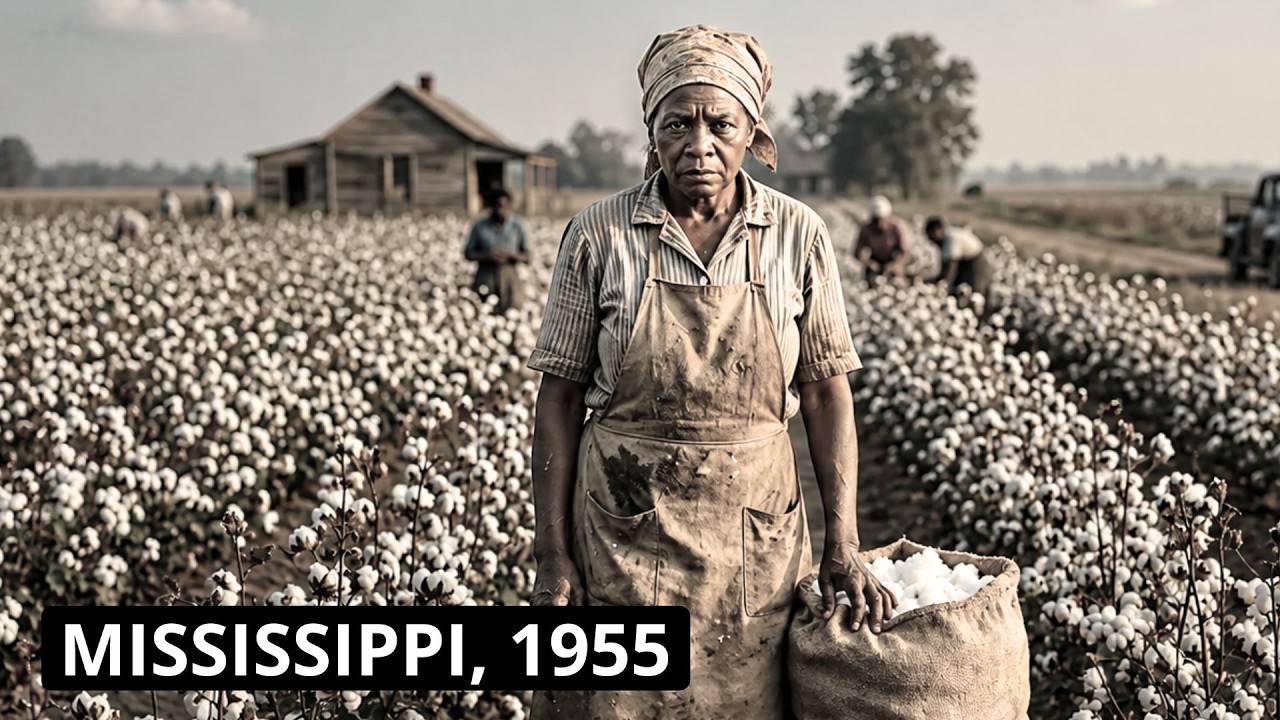
Before she was anything else to the world, she carried three identities, each one a burden. She was Black in a state built to subjugate her, she was a woman without legal protection, and she was among the poorest in the poorest state in the union. Her day began with labor, as it did every day. She rose long before sunrise and walked out into the cold, misty dark, dragging a long sack behind her, bent over the cotton rows until the sun bore down and the light failed.
Sharecropping had replaced slavery across Mississippi, but it had not abolished it. Historians describe it as a new form of bondage that re-enslaved African Americans after Reconstruction. The system was simple and it was a trap. The landowner supplied the land, the cabin, the seed, and the tools on credit.
The family worked the land in exchange for a share of the crop at the end of the year. But the landowner kept the books, and he kept them against the family. When the cotton was weighed and the debts tallied, most sharecropper families found themselves deeper in debt, not richer. They could not leave because they owed money.
They could not protest because both the scales and the law belonged to the owner. Year after year, they worked the same land and got the same result. For women, the trap held an extra cruelty. Their labor in the field was valued below a man’s.
A woman who did the same backbreaking work was paid less for it. In the levee camps along the Mississippi River, where Black workers built and maintained flood control dikes, a full day of hard labor paid one to two dollars. Even there, a Black worker earned about a dollar and a half less than a white worker for the same job. The injustice of being Black, compounded by the greater injustice of being a Black woman, was built into every dollar.
There were no machines to ease the work, only hands and backs. Women picked cotton with their children beside them, because every hand was needed and there was no one else to watch them. A woman worked with a baby at her waist and a sack on her shoulder. She worked through pregnancy and returned to the fields shortly after giving birth.
The cotton harvest did not wait, and the debt never stopped. This labor built the wealth of the Delta, one of the richest agricultural regions in the country, while those who produced it received almost none of it. The planters prospered. The sharecroppers remained poor by design.
When the cotton season slowed, the woman’s work did not stop. She moved from one job to another, and the second job was usually in the home of a white family. There she cooked, cleaned, washed clothes, and raised the children of people who would not let her sit at their table. Domestic service was the largest source of employment for Black women in Mississippi for generations, and its history ran straight back to slavery.
Before the Civil War, Black people in bondage did the household labor of the state, and the relationship between white employers and Black domestic workers that survived until 1955 was its direct inheritance. The titles had changed. The power beneath them had not. The work was governed by paternalism, a relationship in which the white family treated the Black domestic worker not as a hired employee but as a dependent to be governed, directed, and controlled.
She cooked every meal, scrubbed every floor, and raised children from infancy, yet she was called only by her first name while required to address even the youngest white child with a title of respect. There was no set schedule. Domestic workers in the Deep South were often described as living a seven-day week, always on call before the family woke and after they slept. She managed her own home, her children, and her personal needs in whatever scraps of time remained, rising in the dark to make breakfast for a white family and returning in the dark to begin her own household chores.
The pay was tiny, a few dollars for an endless week. And because she worked in a private home, none of the protections the law gave other workers applied to her. There was no minimum wage, no fixed hours, no overtime, and no remedy if her wages were withheld, which they often were. She worked at the family’s whim and could be dismissed at any time for no reason at all.
She endured the daily humiliations of a system that depended on her completely yet refused her dignity. The white family that trusted her to cook and tend their children would not let her drink from the same glass, use the same toilet, or enter through the front door. She was essential and despised at once, indispensable and invisible. Still, the job was necessary, because the few dollars it paid were real.
They put food in her children’s mouths, helped chip away at the endless sharecropping debt, and carried the household through lean months when there was no cotton income. But a greater danger lurked in those white homes, one that also stalked the isolated fields and one that no Mississippi law would ever punish. In 1955, a Black woman in Mississippi lived under the constant threat of sexual violence by white men, and she was certain that if it happened, no court in the state would give her justice. This was not an accident of the system.
It was part of its foundation. Historians who studied the South’s racial structure concluded that sexual control lay at the root of racial control. White society defined Black women in a way that made some white men believe they had a right to their bodies, and they considered that right one of the privileges of being white in the South. A Black woman, especially a domestic worker in a white home or a laborer in the isolation of a field, faced this domination with almost no protection.
The law could do nothing for her. Mississippi’s courts were entirely white and male. The practice enforced through violence and fear was that no Black person’s word would be believed against a white person’s. A Black woman who accused a white man of assault would be disbelieved, blamed, threatened, or simply ignored.
The attacker faced nothing. The justice system was built to shield the white man and silence the woman. The case of Recy Taylor across the state line in Alabama showed how this worked. In 1944, on her way home from church in Abbeville, 24-year-old Recy Taylor was abducted and raped by six white men.
She and her husband filed charges with extraordinary courage. A young civil rights worker named Rosa Parks traveled to Abbeville to investigate and helped organize a Committee for Equal Justice to fight for her. There was no justice. On October 4, 1944, an all-white grand jury, despite identifying the assailants, refused to indict them.
The case was simply dismissed. Alabama took 67 years to offer Recy Taylor an official apology, which came in 2011. What happened to her in Alabama happened to countless Black women across Mississippi as well, with the same result. Historian Danielle McGuire, who uncovered these suppressed cases, wrote that women who were victims of sexual violence almost never received justice in Southern courts.
Yet the women attacked by white men still used their voices as weapons against white supremacy even when the law refused to listen, and the importance of that courage echoed for decades. But in 1955, for the ordinary Black woman of the Delta, the daily reality was a silent threat that lived in every white kitchen and every isolated field, a danger that could not be reported and could not be escaped. Physical violation went even further, with the full support of the state of Mississippi. Black women whispered the phrase among themselves, carrying a terror that the calm words could barely express: the Mississippi appendectomy.
It was not an appendectomy at all. It was the forced sterilization of Black women, often performed without their consent and sometimes without their knowledge, by white doctors in Southern hospitals. The practice grew out of the eugenics movement, a pseudoscience holding that people deemed undesirable should never have children. From the 1920s through the 1980s, that reasoning led to the sterilization of thousands of poor Black women across the South.
Deemed unfit to give birth, they lost the ability to become mothers forever, often while hospitalized for something else entirely. In the Mississippi Delta, the scale was staggering. Legal scholar Dorothy Roberts documented that surgeons routinely sterilized Black women without consent while they were in the hospital for other procedures. In one Delta hospital, 60 percent of women who gave birth were sterilized afterward.
A woman entered the hospital to deliver a child and left without the capacity to ever conceive again, and no one asked her and no one told her. There was a cold purpose behind it. As the cotton industry began to mechanize and the civil rights movement took shape, Mississippi’s white power structure, including the Citizens’ Councils, openly sought ways to reduce the state’s Black population. Their own language was chilling.
They spoke of containing the Black tide that threatened to overwhelm them. Sterilizing Black women was, to them, a tool for controlling the size of a race they wanted to see disappear. The most famous victim of this practice described it in terms the whole nation could not ignore. Though her own sterilization came a few years after 1955, her testimony perfectly described the reality of that year.
Fannie Lou Hamer, a sharecropper from Sunflower County in the Delta, went to the hospital in 1961 to have a small tumor removed and was given a complete hysterectomy without her knowledge or consent. She later testified that at North Sunflower County Hospital, by her estimate, six out of every ten Black women were sterilized. Lying on the operating table, they had the ability to bear children taken from them. In 1955, this was what it meant to be a poor Black woman in Mississippi.
Her labor was not her own. Her safety was not her own. And now, in the most personal matter of all, her body was not her own. The state and the men who ran it had claimed the power to decide whether she would ever become a mother again.
It is difficult to imagine any greater violation. And yet, when this woman reached toward the protections built by her own government, she found herself deliberately left out in the cold. When the United States built its first great safety net during the worst of the Great Depression, Black women in the Mississippi Delta were consciously excluded from it. The two kinds of work she did, farm labor and domestic service, were legally singled out for exposure.
It was a deliberate decision. The law was the Social Security Act of 1935, signed by President Franklin Roosevelt as the cornerstone of the New Deal. It promised security to millions of American workers: old-age benefits for the retired and unemployment insurance for those who lost their jobs. Its purpose was to ensure ordinary people did not become destitute in old age or hard times.
But not for her. The law included a provision forced on it by Southern politicians that entirely excluded two categories of workers: agricultural laborers and domestic servants. Those were exactly the occupations to which Black Southerners, and especially Black women, were confined. The Black woman of the Delta was tied to both jobs at once, a field hand during cotton season and a domestic worker the rest of the year, meaning she was excluded twice over.
Those fighting for Black Americans understood what was happening. When Congress held hearings on the bill in 1935, the NAACP testified that exempting agricultural and domestic workers would broadly deny Black workers the law’s protection. Their words were ignored. The bill passed with the exclusions intact.
The result was a safety net with a great hole placed exactly where Black America stood. Nearly 65 percent of African Americans nationwide were ineligible for Social Security benefits. In the South, where so many were farmers or domestic workers, the exclusion rate was even higher. Charles Hamilton Houston, the brilliant NAACP lawyer, described the law with the sharpest possible image: it was a sieve with holes deliberately made large enough for most Black people to fall through.
So the Black woman who picked cotton before dawn and cleaned white homes until dark, who worked as hard as almost anyone in the country, had no pension waiting in old age. She had no unemployment benefit if she lost her job. The government’s promise of security to American workers did not apply to her. She was expected to labor all her life and, at the end, to find her own way empty-handed.
The exclusions were not permanent. They were phased out in the 1950s, finally bringing domestic workers and farm laborers into the system. But the change came nearly two decades after Black workers had been shut out, two decades of no contributions and no earned protection. The vast gap in wealth between Black and white Americans that resulted echoed through generations.
In 1955, the woman of the Delta still lived in the shadow of that exclusion. The economy, the courts, and the welfare state had all failed her. And the one force that might have changed everything had also failed her: the right to vote, forcibly taken away. Terror kept Black Mississippians from voting.
In 1954, the Supreme Court ruled in Brown v. Board of Education that segregated schools were unconstitutional, and white Mississippi answered with fury. That same year, white businessmen and political leaders formed the White Citizens’ Councils, which used economic punishment and outright terror to crush any Black person who challenged the racial order. Registration for voting could cost a person their job, their credit, their home, or their life.
The men in power issued these threats openly. Thomas Tubbs, chairman of the state Democratic Party, flatly declared that Black people would not be allowed to vote in the August primary and warned that anyone who tried might be whipped. This was not a fringe viewpoint. It was the official position of the party that ran the state.
Then the warnings became corpses. On May 7, 1955, Reverend George Lee, a Belzoni minister and grocer who led a local voter registration drive, was shot at close range and killed while driving. He was among the first Black citizens in his county to register to vote since Reconstruction. No one was arrested.
Months later, on August 13, 1955, Lamar Smith, a 63-year-old farmer and World War I veteran, was shot and killed in broad daylight on the courthouse lawn in Brookhaven, in front of numerous witnesses, for the crime of helping Black citizens cast absentee ballots. The sheriff was there. Three white men were arrested that September, but a grand jury of 20 white members refused to indict any of them, saying no witnesses would come forward. A man had been murdered in public, and the crowd had been cowed into blindness.
That same August, in the Delta town of Money, 14-year-old Emmett Till, visiting from Chicago, was abducted and killed. His body was pulled from the river. In December 1955, another activist, Gus Courts of Belzoni, was shot and survived, later telling the nation how the blood began to flow in Mississippi. The murders were so frequent and so brazen that the NAACP compiled them into a document and gave it a fearless title: M is for Mississippi and Murder.
Black women lived in this suffocating atmosphere. They watched people die for attempting something that might change their world. The right to vote was not abstract. It was a matter of life and death, and that year the answer came in bullets.
The killings of 1955 were the sharp edge of a system designed to be absolute. Their purpose was to keep Black Mississippians, including women, entirely outside of power, unable to vote, unable to hold office, unable to sit on juries, unable to change a single law governing their lives. For Black women, the exclusion was complete. She could not vote to raise the wages paid in the fields.
She could not vote to gain the labor protections denied her. She had no power to remove the officials who looked away when she was cheated or abused, because those officials answered only to white voters. The doors that could have been opened by the ballot were locked tight, and that year proved that murderers stood ready at those doors. This powerlessness was enforced not only through violence but through the daily structure of the plantation.
The planter who controlled a sharecropper family’s debt also controlled their fate. Registering to vote was treated as an act of rebellion with a price attached. All across the Delta, Black farm workers who dared to register were evicted from their cabins and fired from their only employment. Reaching for the ballot meant risking the roof over your children’s heads.
Black families who had worked the land for generations steadily lost everything. Across the Mississippi Delta, Black farmers lost nearly 12 million acres of land over the twentieth century. Six million of those acres were lost between 1950 and 1964, right around the time of this story. Land that could have formed the basis of Black wealth slipped away through debt, fraud, eviction, and punishment of those who fought for their rights.
The Black woman of 1955 stood on land that could be pulled out from under her at any moment. She had no vote to protect herself, no voice in the government that ruled her, and no secure claim to the land she made productive with her own hands. She had been deliberately reduced as far as a free person could be. But her life cannot be described by that powerlessness alone, because it would leave out the source of strength the system could never crush.
The plantation owned her labor, and the state denied her rights. Neither could reach the place where she held her faith, her dignity, and her people. That place was the Black church. One institution existed that white power could not own, tax, or shut down.
The Black church was the beating heart of the community, and the women held it up. It was not only a place of worship, though it was certainly that, a sanctuary where worn people could raise their voices and feel fully human for a few hours. It was the one place the Black community controlled completely. White employers could not step inside.
Plantation rules stopped at its doors. Within those four walls, a Black woman called only by her first name and given orders all week became a deaconess, a leader, a person of respect. The women bore that weight. They raised the money to build and maintain the churches.
They cooked the food that fed the congregation and the sick. They taught the children, arranged the funerals, stood beside the grieving, and held the whole community together in every crisis. The hands that picked cotton and cleaned other people’s houses also sewed the choir robes and set the communion table. In the outside world their importance was counted as nothing, but in the church the Black woman’s labor was honored as the foundation it truly was.
That strength was not only spiritual. It was practical and organized. Out of the Black communities of the Delta grew networks of mutual aid and self-reliance. People pooled their small resources so that those the larger society had failed could help one another survive.
And in 1955, those networks were turning increasingly toward open resistance. A Black doctor named Theodore Roosevelt Mason Howard built an organization called the Regional Council of Negro Leadership, which by 1955 had become the main voice for Black rights in Mississippi. It preached self-help, thrift, business ownership, and above all the right to vote. It organized mass meetings where thousands gathered.
It served as a training ground for a generation of leaders and introduced to the movement two people who would change America: Medgar Evers and a sharecropper named Fannie Lou Hamer. Fannie Lou Hamer was not an exception to the world described here. She was its product. She lived every part of it.
She was a sharecropper in Sunflower County, in the heart of the Delta, and she spent her whole life in the poverty and labor of that world. She knew the cotton fields before dawn. She knew the endless debt. And she knew the deepest violation, because she was the woman who went to the hospital in 1961 for a minor operation and was permanently sterilized without her knowledge or consent.
She gave that terrible practice the bitter name by which the nation came to know it. She had every reason in the world to stay silent and afraid. Instead, on August 31, 1962, Fannie Lou Hamer joined 17 of her neighbors and went to the county courthouse to register to vote. Knowing what had happened to George Lee and Lamar Smith only a few years before, she was evicted from the plantation where she had lived and worked for 18 years.
She was later arrested and beaten so severely that she suffered permanent damage to her body, but she did not stop. She became one of the leading figures of the civil rights movement, the voice of the Mississippi Freedom Democratic Party, standing before the nation to tell the truth about what Mississippi had done to its Black people. She rose from the very bottom of the system, from the powerless position where this story begins, to challenge the conscience of the country. She died in 1977 in Mound Bayou, Mississippi, at the age of 59.
The poor Black woman of the Mississippi Delta in 1955 may have been your grandmother or great-grandmother. She may be the reason your family left the South or the reason they survived there. She woke before the sun for a life that demanded everything from her and promised her nothing, and she carried her children through it on her own back. To remember her is not to dwell in pain.
It is to honor the truth of her survival and to recognize that the dignity and freedom that came later were built on the invincible strength of women whose names were never written down. She was the foundation. Fannie Lou Hamer was her proof.