On September 28, 1998, in a warehouse in London, a woman in a white silk organza dress stepped onto a rotating platform and stood perfectly still while two industrial robotic arms sprayed her with black and yellow paint. She did not flinch. She stood with the stillness of someone who understood that the dress demanded everything: surrender, exposure, and the willingness to be transformed before an audience that had no idea what it was about to witness. Her name was Shalom Harlow.
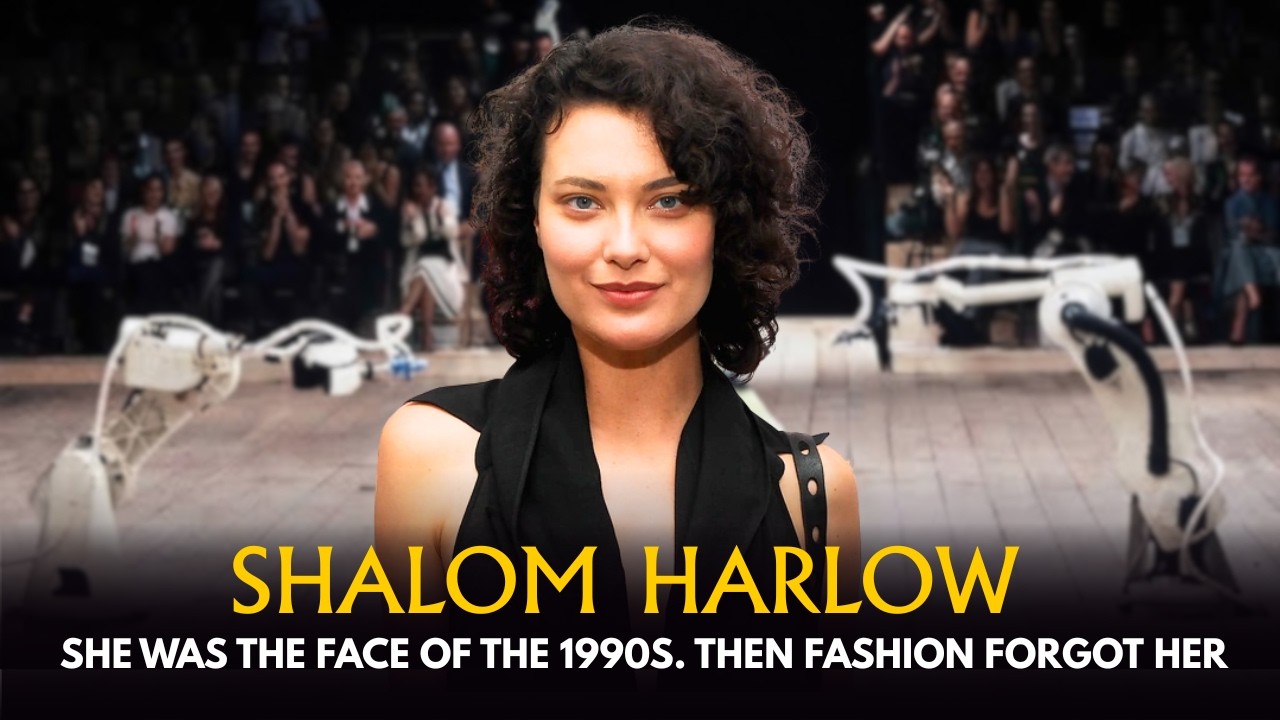
She was twenty-four years old. It was the finale of Alexander McQueen’s spring/summer 1999 collection, and the image of those robots painting that white dress has been reproduced thousands of times since. It remains one of the most iconic moments in fashion history. Harlow was born on December 5, 1973, in Oshawa, Ontario, a mid-sized city on the northern shore of Lake Ontario.
Her family was organized around counterculture values rather than high fashion. Her mother, Sandy Herbert, named her Shalom, the Hebrew word for peace. Her father, David Harlow, worked as a social worker and in real estate. She was a dancer before she became a model, training in jazz, ballet, and tap.
As a child, she dreamed of becoming an astronaut. She was sixteen when a modeling scout named Ann Sutherland approached her at a Cure concert in Toronto and told her she should model. Harlow thought the idea was absurd. Still, she tried it anyway.
What followed was not a gradual accumulation of work but a swift, determined ascent. She moved to New York. Her first American Vogue cover appeared as part of a group in January 1993. By 1994, she was walking the haute couture runways for Valentino in Paris and appearing in New York Fashion Week shows.
By 1995, she was the first-ever winner of the Vogue and VH1 Model of the Year award. She did not represent the polished gloss of the classic supermodel. Her features were angular and expressive. She possessed a dancer’s body language and a face that communicated intelligence and specificity rather than conventional catalog beauty.
Karl Lagerfeld saw it in her. Donna Karan saw it. Versace saw it. Alexander McQueen saw it.
John Galliano saw it. She walked for Chanel, Versace, Dior, Valentino, Ralph Lauren, DKNY, and Jil Sander. She appeared in campaigns for Dolce & Gabbana, Gap, Ralph Lauren, and Lancôme. In 1995, she became the face of Chanel’s Coco perfume.
In 1996, she co-hosted MTV’s House of Style alongside her close friend Amber Valletta. The two had shared an apartment in New York with model Carolyn Murphy in their early years. The friendship lasted three decades; Harlow is the godmother of Valletta’s son. House of Style expanded both women’s visibility far beyond fashion industry circles and made them familiar faces even to people who never read Vogue.
By the late 1990s, Harlow was one of the most famous women in the world. Then came the McQueen show. McQueen, then twenty-nine, was already recognized as one of the most important and controversial designers of his generation. His work repeatedly explored the relationship between the human body and the forces that act upon it.
The earlier sections of the show featured models walking on a floor covered with broken eggshells, designed to crack underfoot. The beauty was bitter and captivating. As the climax, Harlow walked to the center of the stage and climbed onto the white rotating platform. She knew what was coming.
The white silk organza dress was designed to receive paint. She stood with her arms slightly extended, a calm face, and a body ready for what the machines would do. The robotic arms, industrial equipment of the type used in car manufacturing, began their work. The black arm moved first, tracing arcs across the dress that seemed both mechanical and graceful.
The yellow arm followed. The paint spread across the white fabric in patterns that were violent and beautiful at the same time. The industrial force of the machines was real, and the paint was applied with the complete indifference of a machine that does not care about the body it is marking. The white dress became something else.
Shalom Harlow became something else. The audience, which had come to see a fashion show, found itself watching a performance piece of genuine power. Harlow later said in a 2022 interview that what made Show No. 13 remarkable was McQueen’s willingness to create something with real uncertainty.
The robots were programmed but not entirely predictable. The paint fell where the laws of physics dictated, not where an art director had specified. The collaboration between human body and mechanical force was real. The transformation was real.
The vulnerability was real. Since 2022, the dress has been displayed at the National Gallery of Victoria in Melbourne as part of the exhibition Alexander McQueen: Mind, Myth, Muse, with Harlow as the guest of honor at its opening. But the performance that closed the show was also, in a way no one fully understood at the time, the end of a phase in her life rather than the beginning of a new one. After Show No.
13, Harlow said she realized her success had come at a price: her physical and mental health. She had remained silent about her deteriorating condition out of fear it would damage her career. She took a year-long break in 2000, but her health had been damaged in ways that a single year did not resolve. She continued working sporadically, building a parallel film career with appearances in In & Out (1997), Cherry (1999), Head Over Heels (2001), Vanilla Sky (2001), The Salton Sea (2002), How to Lose a Guy in 10 Days (2003), and Woody Allen’s Melinda and Melinda (2004).
These were not merely cosmetic roles; she was building a real acting career with diverse directors and films. In 2013, shortly before her fortieth birthday, the full weight of what had been accumulating for years hit at once. She became bedridden. The diagnosis was late-stage Lyme disease, which had been worsening undetected.
She was also dealing with severe black mold toxicity in her home in Big Sur, California. The combination produced a specific and devastating set of symptoms: neurological effects, general physical exhaustion, cognitive disruption, and physical incapacity that made even the simplest daily tasks extremely difficult. She later described experiencing complex PTSD from the ordeal. The disease took everything she had worked for and built over twenty years, bringing her to a state where she could no longer rely on herself.
Recovery was long and was not a straight path. She worked with doctors and functional medicine practitioners who specialized in complex conditions. She changed her environment. She rebuilt her physical capacity from a completely different foundation than the one the modeling industry had trained her to depend on.
In September 2018, after six years away, Shalom Harlow walked the Versace show during Milan Fashion Week. She was forty-four. The industry, in the midst of a major cultural shift around age, diversity, and body types, welcomed her return with genuine enthusiasm. She also appeared in the Versace spring/summer 2019 campaign.
Forbes had ranked her thirteenth on its list of the world’s highest-paid models in 2007, earning nearly two million dollars the previous year. By industry standards at the peak of her recognition, that figure was modest for someone of her standing. She has not spoken in detail about the financial dimensions of her career. What she has spoken about, with directness, is the pressure to stay silent about declining health because the industry does not tolerate visible fragility, and the cost of that silence.
She has spoken about what it took to rebuild herself. The specific question her career raises is what the 1990s modeling industry owes to the women who built its glory. The 1990s supermodel era was one of the most commercially successful periods in fashion history. Magazines achieved massive sales.
Advertising campaigns generated enormous profits. Fashion shows created cultural events that built brand identities and supported the economic machinery of fashion houses worth hundreds of millions or billions of dollars. The women on the runways, in the campaigns, and on the magazine covers were the primary instruments through which that value was generated. Harlow, for more than a decade, was one of the most effective of those instruments.
What the industry gave her in return included the career, recognition, the first Model of the Year award, Forbes listings, and campaigns for Chanel, Versace, and Dior. What it did not give her was adequate preparation for what the career would demand of her body over time, or sufficient support to deal with the health consequences of those demands, or the space to publicly acknowledge that something was wrong without risking the career her silence was protecting. The white dress from Show No. 13 is now in a museum.
The image of Harlow inside it, calm, present, and being transformed, is one of the most reproduced images in fashion history. The woman who stood inside it, who chose to surrender to what the machines would do, who brought to that moment the same full presence she brings to everything she does, is still here. The fashion world forgot her for a time. It does that.
It forgets people in the specific, institutional way of an industry organized around the next thing, the next face, the next cultural moment. Then came the Versace show in 2018, and the museum began displaying the white dress, and retrospectives began naming what she had been and what she had contributed. Forgetting was never the last word. Born to a mother who named her peace, she stood still while robots painted on her.
She fell ill, rebuilt herself, and returned. She is fifty-one years old. Her work still exists in films, magazines, museums, and on runways. The quality is still there.
The fashion world forgot her. But history did not. The specific quality that a scout noticed at a concert when she was sixteen, which Lagerfeld, Versace, and McQueen each recognized in their own ways, is not something the modeling industry created. It is something the industry found in a girl from Oshawa who trained as a dancer and dreamed of becoming an astronaut, and it put that quality to work in service of selling clothes, perfume, and the idea of what beauty looked like in a particular decade.
The industry used it well. It fell ill. It lost years. It rebuilt itself.
And when she returned to the Versace runway in September 2018, the fashion press covered her comeback as the restoration of something the industry had been missing, something her decades of absence made obvious precisely because it was no longer present. You do not always realize the value of a quality until it is no longer in front of you. Harlow’s return in 2018 was the industry’s public acknowledgment, in a specific way, of what had been missing. The white dress is in a museum in Melbourne.
The image is preserved in the cultural record. She was the face of the 1990s, and it turned out the face was only the surface. What lay beneath it, the dancer’s presence, the genuine vitality, the willingness to stand motionless on a rotating platform and let whatever was going to happen happen, is the thing that remained.
It still remains.