Twice in the twentieth century, the United States government made it a federal crime for ordinary citizens to use a microphone and speak to a stranger over the airwaves as a hobby. Not a black-market hobby, not an unlicensed hobby, but a hobby the government itself had spent decades licensing, cataloging, and sometimes hiring from. Both times, the order came almost overnight. Both times, the silence lasted for years.
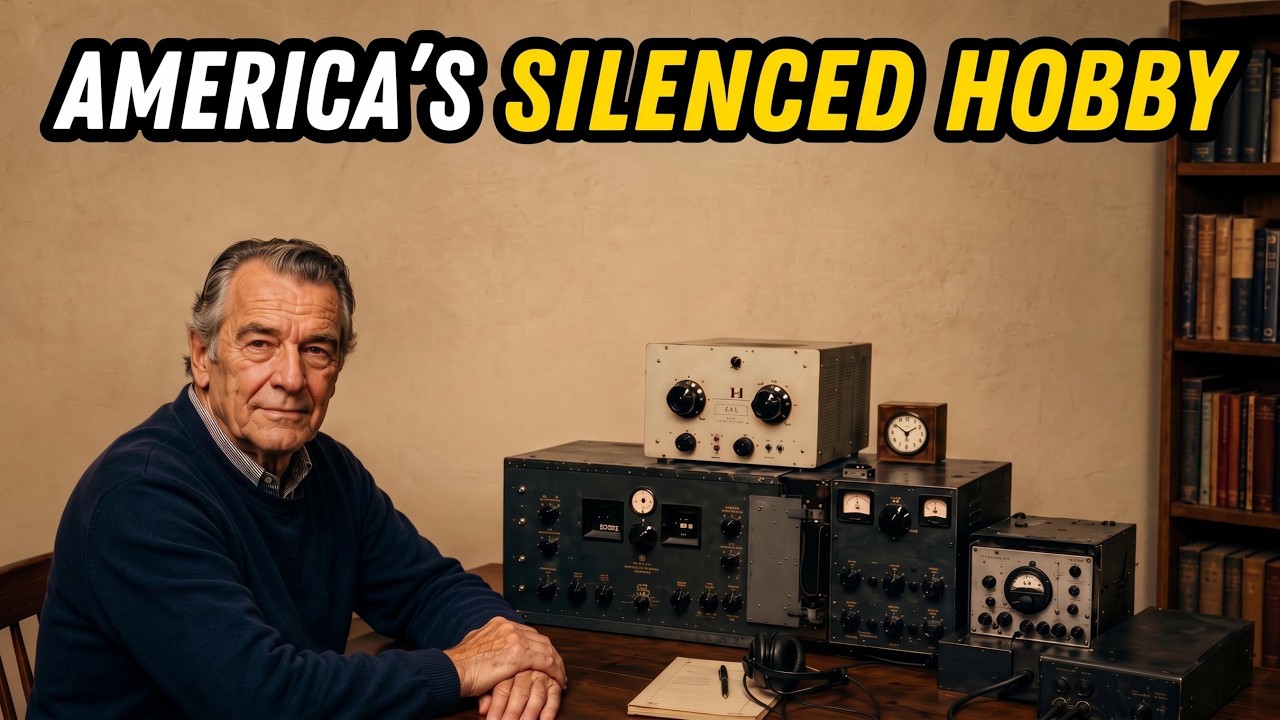
And both times, while the hobby went quiet at home, some of the people who practiced it secretly were sent overseas to do, under far more dangerous conditions, the very thing they had just been told they could no longer do in their basements. The first shutdown came with virtually no warning. To understand why, you have to understand what amateur radio had become by 1917. The Radio Act of 1912 gave the federal government its first real control over the amateur community: call signs, license files, and a wavelength above 200 meters that most professionals considered useless for long-distance communication.
Amateurs adapted anyway. By the time the United States was approaching war in Europe, about 6,000 licensed amateur stations were spread across the country. The American Radio Relay League, founded in Hartford in 1914 by Hiram Percy Maxim and Clarence Tuska, had grown to roughly 3,000 members relaying messages from station to station across distances no single transmitter could cover. Congress declared war on April 6, 1917.
The very next day, April 7, the government moved. Under authority the president already held to close radio stations deemed necessary for the war effort, an executive order shut down most private radio stations in the country or turned them over to government use. For amateurs specifically, the order went further than simply switching off. Transmitters and receivers had to be physically dismantled.
For the duration of the war, it became illegal for any private citizen even to possess a working transmitter or receiver, not just to use one, but to own one in good working order. An overzealous city official in California went so far as to describe possession of a wireless station without a permit as treason, a claim that made the front page of his local newspaper and was certainly a legal overreach, but it captured the mood of the period better than any statute. The mechanics of that shutdown varied. Some stations were confiscated outright by naval officers who arrived and seized the equipment.
Others were sealed in place, a term the government used, and it became so common that Electrical Experimenter magazine published an article that month titled “How the Government Seals Wireless Apparatus. ” Still others dismantled their own gear, packing spark coils and tuning condensers into boxes and storing them in closets, hoping the war would not last long enough for the parts to become obsolete. QST, the monthly magazine of the American Radio Relay League, stopped publishing within a few months. After all, there was no longer a legal hobby to write about.
The equipment that did not end up in closets tells a different story, and it is worth pausing over because it reveals who actually controlled American wireless for the next two decades. During the war, the Navy took complete control of the nation’s high-power commercial stations, including American Marconi’s transatlantic facilities, the American subsidiary of the British Marconi Company. When the armistice was signed, Congress ordered the Navy to return those stations to their original owners. Some Navy officials quietly resisted, having grown accustomed to running the country’s wireless infrastructure themselves, and for a time it was unclear whether American wireless would return to private hands at all.
What actually happened was a settlement largely brokered by the Navy itself. Instead of allowing a foreign company to keep the country’s most powerful transmitters, the government paid General Electric, which held the patents on the powerful Alexanderson alternator, to buy out American Marconi’s domestic interests and merge them into an entirely new American company. That company was incorporated in Delaware on October 17, 1919, as Radio Corporation of America, a name that would dominate the electronics industry for the rest of the century. Its charter specifically barred foreigners from joining its board and capped foreign ownership of its stock, a requirement written directly out of the Navy’s wartime anxiety about who controlled the airwaves.
While the amateur community was getting its hobby back through individual licenses, the commercial backbone of American radio was being permanently reorganized by the same war crisis. What makes the amateur shutdown more than a footnote in history is what happened to the people while their equipment was being boxed up. The Navy had already begun recruiting amateur operators before the war was declared, through a program called the Naval Reserve class, open to anyone who passed a physical exam and could send and receive Morse code at a practical speed. Once the shutdown order took effect, that recruitment channel did not slow down.
It accelerated. Thousands of amateurs enlisted through similar programs to fill communications jobs that were then vacant. Clarence Tuska took an assignment with the Army Signal Corps and helped establish a wireless training school at Ellington Field near Houston. Within about a week, the government made operating a transmitter as a civilian a crime, while simultaneously considering it a patriotic duty when wearing a uniform.
No one sat down and designed that as one coherent policy. It simply happened that way, and it would happen that way again. The ban lasted through the war and extended well beyond the fighting itself. The armistice came in November 1918.
Amateur privileges were not restored until late the following year. Most accounts point to October or November 1919, and sources genuinely differ on the date, which tells you how precisely anyone was tracking a hobby that had legally ceased to exist. Part of the delay was bureaucratic. Part of it, according to at least one popular account of the period, was the Navy’s simple reluctance to give back spectrum it had grown accustomed to controlling.
When the restrictions were finally lifted, amateurs returned to a scene that had changed completely beneath their feet. Vacuum tube technology, developed heavily for military use during the war, was suddenly available to civilians who had left for the front still building spark-gap sets. Surplus wartime components flooded the market. The hobby that returned in 1919 and 1920 was more capable in nearly every respect than the one that had been shut down three years earlier.
That pattern is worth remembering, because it repeats. One of the most enduring pieces of amateur radio’s internal culture dates from that return. According to a story the ARRL tells about its own history, Hiram Percy Maxim, writing under the pen name “The Old Man,” invented a fictional disciplinary device called the “Wouff Hong” at the time amateurs were coming back on the air after the war. A satirical tool supposedly used to punish operators who performed poorly.
It is a small detail, seemingly silly, but it expresses the nature of that period honestly. A community that had spent nearly three years legally forbidden from touching its equipment returned to joking about discipline and professional etiquette, not about the ban itself. The Wouff Hong is still referenced in amateur radio culture today, a century-old inside joke born in the very months the hobby got its voice back. For twenty years after that, the relationship between amateurs and the federal government settled into a more natural regulatory pattern.
The Radio Act of 1927 created the Federal Radio Commission to regulate the chaos of the broadcast boom. The Communications Act of 1934 folded radio regulation into a new Federal Communications Commission, and among its provisions was a section that would become critically important a few years later: Section 606, which gave the president broad authority during a declared national emergency to suspend the rules governing any radio station, shut stations down, and seize their equipment for government use. In 1917, the government had improvised its authority to close amateur stations using hastily assembled war powers. By 1934, that authority was no longer improvised.
It existed in federal law, fully written out, waiting to be activated. By 1940, war in Europe had already broken out, and the American amateur community could sense the direction things were heading long before December 1941. The first concrete restriction came in June 1940, when the FCC, which then had about 55,000 licensed amateurs, prohibited amateur communications with any foreign station or any operator located outside the continental United States and its possessions. Domestic communication was still acceptable.
Contact with a fellow amateur in another country was not. It was a limited rule on paper, aimed at closing any channel foreign intelligence services might use to pass messages through an unwitting amateur, but it was also a clear signal of where official thinking was going months before the fingerprinting project that followed. That year, the FCC began its second and more unsettling phase, requiring licensed amateurs to submit fingerprints and notarized proof of citizenship. A QST editorial that month tried to convince operators not to over-interpret, arguing that a government about to shut down the hobby would not spend that much money and effort cataloging its participants first.
That logic turned out to be almost exactly backwards. The fingerprinting was not reassurance that the hobby was safe. It was the government building a personnel file it would need the moment the hobby stopped. The attack on Pearl Harbor came on Sunday, December 7, 1941.
On Monday, December 8, one day later, the FCC issued Order No. 87, a public notice announcing the immediate suspension of all amateur operations in the United States, its territories, and possessions. Transmissions were prohibited except for a small number of stations specifically authorized by the Defense Communications Board to do approved emergency or defense work. Ordinary conversation, which operators called “chatter,” was completely banned even on those stations.
There is a real technical difference between the two blackouts worth noting, because it is easy to assume the second was simply a repeat of the first on a larger scale, but it was not exactly that. In 1917, the government made mere possession of a working transmitter or receiver illegal. Ownership itself was the crime, which is why so much equipment ended up dismantled in closets rather than just unplugged. Order No.
87 in 1941 was narrower on that specific point. It suspended amateur operations, the act of transmitting, but it did not extend a blanket prohibition to owning or using a receiver. An amateur in 1942 could, in principle, legally listen to shortwave bands even while forbidden from using a transmitter. It is a small difference, but it reflects two entirely different assumptions about where the actual security risk lay.
In 1917, the fear was the existence of unlicensed wireless equipment at all. By 1941, the fear was specifically unauthorized signals leaving the country, not civilians simply listening to what came in from abroad. Four days later, on December 12, President Roosevelt formally activated Section 606 of the Communications Act, the provision that had lain dormant in the law since 1934, and turned over authority for the nation’s radio stations to the War Communications Board. The FCC order moved quickly because it could, on its own administrative authority.
The presidential order, issued days later, marked the government reaching for the tool it had deliberately written into law after the improvisations of 1917, so that no one would have to improvise next time. The ARRL’s response to Order No. 87 is worth noting, because unlike 1917, there was now an established organization equipped to manage the transition rather than simply absorb it. Bulletins went out through the League’s station within days, telling members clearly that no amateur could operate except under a specific federal, state, or local permit, that idle chatter on any authorized frequency was strictly forbidden, and that operators wanting to contribute should register with the emergency corps being organized through ARRL headquarters.
The message read more like a military bulletin than a hobbyist newsletter, because in practical terms it had temporarily become that, an intermediary layer between an already-drafted federal order and the 60,000 individual license holders who needed to know about it quickly. The scale of the second shutdown dwarfed the first. By the early 1940s, nearly 60,000 licensed amateur operators were in the country, ten times the number silenced in 1917. And this time, the silence did not last long, because the government almost immediately needed the very thing it had just taken away.
Within about six months, the FCC and the ARRL established the War Emergency Radio Service, authorized in June 1942. It operated on frequencies far higher than normal amateur bands, around 112 to 116 MHz, later extending to segments near 219 to 225 and 400 to 401 MHz, with a maximum power of only 25 watts, enough for local coordination and not allowing long-distance communication. Licenses under WERS were not granted to individuals as ordinary amateur licenses were. They went to communities and civil defense organizations, although the person actually sitting at the equipment still needed to hold a personal amateur license under that community permit.
This was not a restoration of amateur radio. It was the state borrowing amateur radio’s technical skills in a narrow, controlled, purpose-built form while the broader activity remained suspended. WERS teams handled real emergencies during those years: floods along the Mississippi River and around Lake Erie in 1942, an Atlantic hurricane in 1944, a severe blizzard in western New York in early 1945, using equipment supplied by local government in some cities, including San Francisco. It was a narrow lifeline but a real one, and it meant the gap that had taken six months to establish would not have to be built from scratch next time.
Here the paradox of the shutdown sharpens almost to the point of absurdity. At the very moment the federal government was telling nearly 60,000 Americans they could no longer legally operate a radio transmitter from their homes, another arm of the same government was actively recruiting people from that community to do something far more dangerous with those exact skills on the other side of the world. The Office of Strategic Services, the wartime predecessor of the CIA, established a dedicated communications branch in September 1942 and built its main training school, known as Area C, inside Prince William Forest Park in Virginia. More than 1,500 communications personnel trained there between 1942 and 1945 in courses lasting nine to thirteen weeks, covering Morse telegraphy, cryptography, and the operation and maintenance of specialized shortwave equipment the OSS built for covert operations.
The branch actively sought people with prior hands-on experience in radio equipment rather than starting from scratch, and according to many firsthand accounts, a significant proportion of both instructors and trainees at Area C were licensed amateur radio operators in civilian life. The skill the FCC had made illegal to practice at home was, at almost the same moment, considered valuable enough by the government to actively recruit for. What some of those trainees later did is where the story becomes genuinely dangerous. Field radio operators attached to OSS special operations teams and the joint British-French Jedburgh teams, parachuted into occupied France before and around the Normandy invasion, carried compact shortwave sets into enemy territory and broadcast in scheduled time slots under constant threat from German direction-finding units closing in on their signals.
About 300 Jedburgh teams went in, each consisting of three men: usually an American or British officer, an officer from the country being infiltrated, and a radio operator of any nationality. The operator’s equipment was carefully refined to keep shrinking as the war went on. Early covert sets used by Allied agents in the field weighed about thirty pounds, heavy enough that carrying one any distance on foot was a risk in itself. The lighter models introduced later in the war cut the weight to about nine pounds, small enough to fit in a single diplomatic briefcase, which mattered a great deal to an operator who might need to dismantle the station and move within minutes of finishing a transmission.
Some of the miniaturized high-frequency radio technology that made such sets possible had roots in the same amateur community the FCC had just silenced. Engineers who had taught themselves the basics as teenage amateur radio operators before the war found themselves a few years later building the kind of equipment that allowed a field agent to talk to an aircraft overhead without revealing his position. The silenced hobby and the secret technology were, in more than one case, the same people. The Allied covert radio effort produced a sobering statistic from that period.
Some accounts, including a detailed pictorial history of Allied secret radio operators published years later, put the average life expectancy of a wireless operator operating behind enemy lines in occupied Europe at about six months. Other historical accounts, specifically about British SOE operators, put the figure closer to six weeks. Both figures come from credible sources describing different groups under different conditions in different years of the war. German direction-finding technology improved steadily throughout the war.
The transmission window for an operator was measured in minutes, not hours, and staying on air too long or too frequently from the same location was often what exposed a network. Compare that with the home front. The simple act of sitting down and using a shortwave transmitter to send communications the FCC had criminalized for amateurs in Ohio became, for the smaller number of Americans the federal government itself had trained, one of the most dangerous jobs of the entire war. The numbers of amateurs who served tell their own broader version of this.
By March 1942, just a few months after American entry into the war, about 15,000 licensed amateurs were already in uniform, a figure that kept rising as the war continued, out of a total amateur community of about 60,000 license holders nationwide. That is not a small fraction of the amateur community volunteering. That approaches a majority of amateurs at the height of the war, absorbed directly into military and government service while the hobby itself was legally suspended at home. Even the spectrum the hobby used was renegotiated during the blackout.
In exchange for handing over the entire 80-meter amateur band to expanded wartime military traffic, licensed operators were granted voice privileges on the 40-meter band for the first time, a deal struck while almost none of them were legally able to use either. The war ended in Europe in May 1945 and in the Pacific in August of that year, but amateur radio in the United States did not return immediately when the fighting stopped. According to most accounts, it was late October before the FCC formally began lifting the wartime ban. W1AW, the ARRL station, is generally said to have returned to the air on October 31, 1945, using its transmission to announce the systematic reopening of the amateur service across the rest of the country.
That date carries a small asterisk in some surviving records. Some sources indicate that date does not carry the same degree of certainty as the shutdown dates, but the outlines of the story are not disputed. The second shutdown lasted just under four years, about a year longer than the war lasted for the United States, and was much shorter relatively than the first, given the size of the hobby and the larger war the second time. And as after the first shutdown, the equipment landscape amateurs returned to in late 1945 had changed while they were off the air.
The war had pushed military radio technology forward faster than any peacetime market could have, and when it ended, vast quantities of that equipment became available to civilians as government surplus at a fraction of its original cost. Aircraft radios such as the ARC-5, originally built for military communication and navigation, were stripped down and rebuilt into amateur transceivers by operators who had spent the war overseas or away from the hobby and were eager to get back on the air with something better than what they had stored in 1941. The same basic pattern repeated as after 1919. The ban ends, and the hobby returns with greater capabilities than when it stopped, built in part on what the military had discarded.
What happened next is the heart of this entire story, more than any of the individual shutdowns. The people who lived through 1917 and then 1941 clearly came out of it with a specific practical lesson, and they built an institution around it almost immediately. It had taken about six months to build WERS from scratch in 1942. Not a disaster, but not fast either.
Six months is a long time to have no organized civilian emergency radio capability if a real local crisis hit at the beginning of that period before the service became operational. In 1952, the ARRL and the Federal Civil Defense Administration created something designed specifically to close that gap next time: the Radio Amateur Civil Emergency Service, RACES. Its entire purpose was narrow and specific. If a future president ever needed to activate Section 606 and silence the regular amateur service, RACES gave that same community of licensed operators a set of pre-registered emergency frequencies they could move to immediately, without needing months of building new infrastructure from scratch.
It was, in a very literal sense, an institutional scar, a permanent formal structure built directly out of the memory of how slow and disruptive the previous transition had been. It has never actually been activated at the national level in the seven decades since. No president has ever activated Section 606 against amateur radio again. But operators registered in RACES and RACES-trained coordination have shown up in real disasters since then: hurricane response, the Northeast blackout of 2003, and the days immediately following the September 11 attacks, among other events.
Not because a president silenced anyone, but because the readiness forced by the shutdowns proved useful on its own, whether in wartime or not. Around the same period, the old Army Amateur Radio Service, dormant throughout the fighting, was reactivated, reorganized, and eventually renamed twice. First to the Military Amateur Radio Service in 1948, reflecting the new Air Force’s independence, then in 1952 to the name it still carries, the Military Auxiliary Radio System, a change made specifically to reflect how dependent the program was now on civilian volunteers rather than only military personnel. A Navy and Marine Corps branch followed a decade later, established formally on August 17, 1962, and operational by the start of the next year, in the period immediately following the Cuban Missile Crisis, when the value of a radio network not wholly dependent on commercial infrastructure became clear to military planners once again.
What distinguishes the three branches, Army, Air Force, and eventually Navy-Marine Corps, is that none of them needed a war to prove their usefulness. Unlike the original Army Amateur Radio Service between the wars, built essentially for mobilization and mostly waiting for it to happen, the postwar MARS program spent most of its time on something quieter and, in a strange way, more useful in daily life: connecting phone calls from deployed servicemen overseas to their homes decades before reliable satellite phones or internet existed abroad. During the Vietnam War specifically, MARS volunteers relayed what amounted to shortwave telegrams and connected direct phone calls between troops in the field and their families in the United States, usually limited to a few minutes per call, with the family instructed to say “over” on their end so the radio operator managing the patch knew when to switch the line. In 1969 alone, 30 Air Force MARS stations operating in Vietnam and Thailand, coordinating with about 200 stations in the United States, completed approximately 210,000 of these phone calls in a single year.
None of that required a national emergency declaration or a suspension of the amateur service. It only required the relationship between the two world wars, forged in the shutdowns, to exist on the ground. Look at the full trajectory and it is hard to miss the recurring pattern. The federal government decided twice that amateur radio as a civilian hobby posed a security risk that could not be allowed to continue during a declared war, and both times it moved to stop it almost as soon as war was declared.
One day in 1941, about a week in 1917. And both times, in the years that followed, the government and the amateur community did not simply return to the pre-war status quo. They built something new, designed specifically to make the next transition, if it ever came, faster and less disruptive than the last. Section 606 of the Communications Act exists because the improvisation of 1917 was not something anyone wanted to repeat from scratch.
RACES exists in its current form because the six-month fumbling to build WERS was not something anyone wanted to repeat either. MARS exists in its current form because the interwar Army Amateur Radio Service was too small and underfunded to matter when actually needed. Each of these institutions is, in its own way, a monument to a hobby that was legally halted by federal government decree twice in living memory, and to a community that responded to the shutdowns both times not by withdrawing from the relationship but by building an organizational structure to ensure it never happened again in the same slow, chaotic way. That is a strange kind of loyalty when you think about it.
Most hobbies do not have a formal legal mechanism written into federal law specifically to shut them down in emergencies. And most hobbyists, if they did, would probably not spend the following decades helping design and improve that very mechanism to work better. Amateur radio did both, twice. Part of it is patriotism, plainly stated.
A large portion of this community volunteered, enlisted, and in a significant number of cases headed to places far more dangerous than monitoring stations to keep broadcasting when their country asked. But part of it is closer to institutional memory. A community whose equipment was sealed twice, whose frequencies were reassigned, whose hobby was made a federal crime for the duration of a war, does not come out of that experience naive about how fragile that permission actually is. It comes out of the experience building redundancy: legal redundancy, institutional redundancy, and preparedness plans kept for a crisis no one hopes will happen.
If you look for physical evidence of either shutdown today, you will mostly not find dramatic traces. You will find something quieter and more compelling in its own way. Station logs from 1917 and 1941 sometimes turn up at estate sales and among collectors, and the interesting page is usually not the one with the most entries. It is the blank page, that stretch of weeks or months where the operator simply stopped writing because for a while, legally, there was nothing worth logging.
A silent transmitter leaves no records behind. It leaves an absence, a log with a gap, a call sign engraved on wooden cabinets that went silent on a specific date and did not speak again for years. That kind of evidence does not photograph well, and it does not turn into drama easily, but it may be a more honest record of what actually happened than any dramatic retelling. The equipment itself never stopped working.
What stopped was the permission. Perhaps that is the part worth reflecting on longest: not the transmitters, or the frequencies, or the acronyms the government later created to manage the next transition smoothly, but the simple fact that a hobby can survive having its legal existence completely suspended twice in one lifetime and return both times not just intact but stronger, because the people who built it in the first place never stopped being curious about how the equipment worked, whether with a license or without one, in wartime or in peace.