Around eleven o’clock on the morning of August 9, 1864, a stranger handed a dockworker a wooden candle box at City Point, Virginia, and said the captain was waiting for it on board a ship. The dockworker took it. Why wouldn’t he? Boxes passed from hand to hand all day, every day.
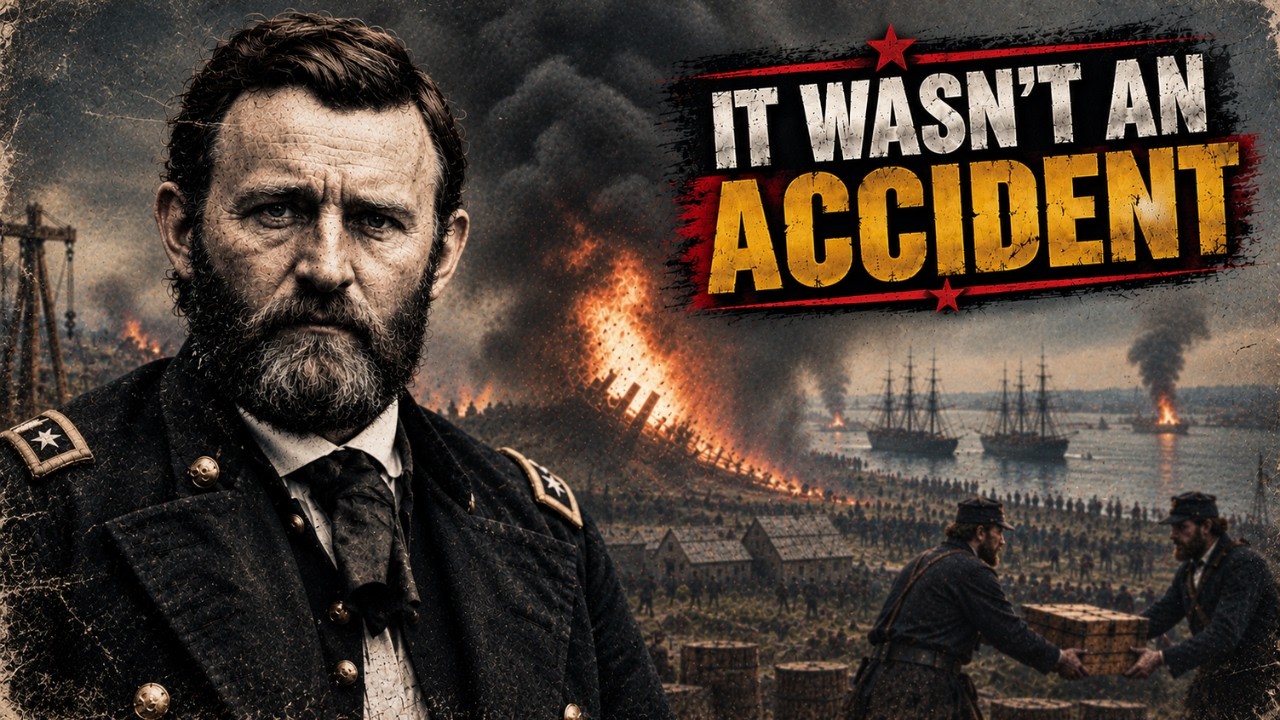
Hardtack, saddles, powder, shells—the entire weight of the Union war effort moved through that waterfront on the strength of an unwritten rule: if someone handed you something and told you where it went, you moved it. You did not ask questions. Forty ships were waiting to be unloaded, and there was no time for any. The dockworker carried the box down into the hold of a vessel already stacked with ammunition, set it down, and returned to his work.
He had no way of knowing it, but he had just started a countdown no one could see. The stranger who had handed him the box did not run. Running was the one thing that would draw attention on a dock like that, and he had spent two weeks making sure no one noticed him. He walked up the bank, past the warehouses, away from the main depot, at the pace of a man with nowhere urgent to go.
He kept that rhythm for nearly a mile. Then he stopped, turned around, and waited. All he could do now was find out whether two weeks of effort had worked. According to his own account, the device exploded about an hour after it was carried aboard.
A hundred yards up the bluff, in a cluster of tents overlooking the entire operation, the general commanding all the armies of the United States was going about an ordinary morning. Ulysses S. Grant had returned from a trip to Washington only hours earlier, meaning the enemy’s device and the commander-in-chief had reached City Point within hours of each other. He sat close enough to the water to watch his war being unloaded.
He had no idea a clock was running anywhere under his command. Neither did the dockworker. Neither did the hundreds of other men on that wharf. In one hour, some of them would be dead.
Most of them did not yet know they were standing that close to a decision that was not theirs to make. To understand why a candle box could kill dozens, you first had to understand what City Point had become. Before the war, it had been a quiet river port where the Appomattox and James rivers met. By the summer of 1864, the Union army had transformed it into one of the busiest harbors on earth.
Grant had crossed the James, bottled Robert E. Lee up in the trenches at Petersburg, and settled into a siege. A siege is not a battle. It is an insatiable appetite.
Everything that army ate, fired, wore, and rode had to come off a boat there first. City Point was feeding roughly one hundred thousand soldiers and sixty-five thousand animals, all of it passing through wharves that never stopped working. The man responsible for making it all function was Brigadier General Rufus Ingalls, Grant’s chief quartermaster, whose planning had turned a river landing into a working port within weeks. By the final winter of the war, the depot’s military railroad stretched twenty-one miles toward the siege lines, and the bakery alone turned out up to one hundred thousand loaves of bread a day.
Ingalls’s genius was not in defense. It was in speed. And speed had one iron rule: no one had time to verify where anything came from. Wharves deep enough for ocean-going vessels, warehouses built faster than anyone could catalog their contents, a military railroad moving shells to the guns that would fire them the same day, bakeries, hospitals, repair shops, ships lined up in the river waiting for a berth sometimes for days—a complete industrial city assembled in months for a single purpose.
Grant had placed his headquarters on the bluff directly above the water. Not out of carelessness, but out of confidence. This was the safest, most heavily guarded, most loyal square mile of Union-held Virginia. The enemy would have needed an entire army to get near it.
In that morning’s coincidence, the Confederate device and the commanding general of the United States had arrived within hours of one another. The Confederacy had no army to spare for an attack. The man who carried the device into the depot had left Richmond four days before the Battle of the Crater, under orders that had nothing to do with that fight. His orders came from a different office entirely, one that had been asking a different question for years: an army that big must trust something.
What was it, and could they get inside it? The answer came from the Confederate Torpedo Bureau, and it was not a weapon a soldier would recognize. In 1864, the word torpedo did not mean what it means now. It was a catch-all term for anything hidden that exploded—river mines, buried shells, booby traps.
The bureau was run by Brigadier General Gabriel Rains, an officer who had spent the war building systems that let a smaller, poorer army defend rivers and roads without tying up troops. Rains faced critics inside his own government. Some Confederate officers thought hidden explosives dishonorable, outside the rules of gentlemanly combat, and said so openly. Rains’s answer was consistent: an army that could not match the enemy’s numbers was entitled to make up for it with cleverness, and a weapon was no less legitimate for being quiet.
What his bureau supplied for this operation was called a time torpedo. Stripped of terminology, it was a simple device: a firing mechanism and a charge of gunpowder, later accounts estimated at about twelve pounds, with a clockwork movement set so that when it reached its appointed point, it released the trigger instead of striking the hour. John Maxwell himself, describing it later, simply called it his machinery and powder, covered by a small box. The image of a candle box comes from later accounts, not from his own words.
Nothing about it hissed or fumed. No fuse burned, no smoke rose, no glow appeared. If you stood over it in a quiet room, you might hear the gears working—the same small mechanical sound of any shelf clock in any parlor in America that year. In the hold of a working barge, under the noise of boots and tackles and shouting, you would hear nothing at all.
Twelve pounds was negligible as a weapon. It would not sink a ship. It would not destroy a warehouse. The men who built it knew that.
It was never meant to be the explosion. It was meant to be the first two seconds of someone else’s explosion—the match, not the fire. Placed next to tens of thousands of pounds of Union ammunition, it was left to finish the job itself. The entire design assumed something almost insulting about the target: if you could only get close enough, the enemy had already assembled the real bomb for you.
All you had to bring was the spark and the patience to leave it where no one would ask questions. The man they sent had done this kind of work before. Captain John Maxwell was a Confederate agent attached to the secret service, with a record of raiding Union ships in Chesapeake Bay the previous year. He was not a theorist.
He had spent the war learning how close a man could get to something valuable if he simply did not look like a threat. His orders came from Captain Z. McDaniel and were approved at the highest levels of the Torpedo Bureau by Rains himself. His instructions were narrower than what he actually did.
He was to use the device against Union ships on the James River. The depot was not the target. That target did not yet exist. It would be found, not assigned.
On July 26, 1864, Maxwell left Richmond carrying the machine. For the journey, he enlisted one companion, a man named R. K. Dillard, whose only recorded qualification was that he knew the ground.
They moved toward the Union lines the only sensible way: slowly, mostly in darkness, with, according to Maxwell’s account, little food left by the end. By August 2, they were in Isle of Wight County. There they heard the news that changed the plan: vast amounts of supplies were being unloaded at City Point. Maxwell made the decision himself.
There was no way to communicate with Richmond and wait for permission. Forget the ships. Put it in the depot. The journey took two weeks to cover the remaining distance, and the slowness is the evidence.
In the dark hours before dawn on August 9, they crawled through the eastern picket line. Maxwell’s own words were that they walked on their knees to get past it. They reached the wharf with, as Maxwell later put it, very little provisions. What is beyond dispute is the calculation behind the entire approach.
Two men, with no papers to protect them, deep inside the security perimeter of the Union’s most important base in Virginia. One of them carrying an object that guaranteed hanging the moment anyone opened it. No trial, no prisoner-of-war camp. Men caught doing this out of uniform behind enemy lines were hanged.
Both of them knew the rule as well as the men who would carry it out. At every hour of that walk, the only thing between Maxwell and the noose was his ability to look like he belonged somewhere he did not belong at all. Now the nature of the mission changed completely. Maxwell was no longer slipping past a defensive line.
He was about to walk among thousands of workers in broad daylight and try to be the least interesting person there. Dillard stayed behind about half a mile, on Maxwell’s own instructions. Maxwell went in alone, the box under his arm. What he found at the water was better than anything he had been sent to find in the first place: an ammunition barge, mid-loading, tied to the wharf, stacked to the ceiling with stores.
Later accounts identify the vessel as the General Meade, though it is only honest to say that Maxwell’s own report never named it. The identification comes entirely from later research. What actually protected a depot like City Point was not soldiers or cannons. It was trust.
That simple, unglamorous, load-bearing trust is what allowed a thousand strangers to exchange boxes all day without anyone stopping to check any of them. Stop and inspect every box, and the entire machine would seize up. So no one did. They could not afford to.
Maxwell did not break that system. He read it correctly and used it exactly as designed. He watched the boat’s captain step ashore, then moved forward. A wharf guard stopped him, but Maxwell got past him with a single sentence: the captain had ordered him to bring the box aboard the boat.
That was the entire operation. No locks to break, no guards to overpower, no alarms to disable. Just one unremarkable lie, addressed to a man whose only job was to take boxes from people and put them where he was told. Maxwell hailed a man from the boat, activated the mechanism, and handed over the box.
The worker carried it aboard himself, never knowing what he was carrying. The Union carried its own bomb onto the ship. One hundred thousand soldiers stood between the Confederacy and City Point, and none of them mattered, because the gap Maxwell crossed was not in the security perimeter. It was in the assumption that the next person who handed you something was who they appeared to be.
No number of soldiers could close that gap. It is the one door that always remains open in every army and every age, because closing it means nothing gets done. Maxwell walked away. Nearly three-quarters of a mile by his account, then he stopped and watched.
No one recorded what Maxwell felt during that hour, and no honest account would invent emotions for him. His own report describes actions, not feelings. What can be described instead is the situation itself. He could not go back and check.
He could not know whether the box had been moved, opened, thrown overboard, or placed somewhere that would kill four men instead of forty. Every plan he had made was now entirely outside his control, running on a clock he could not see and could not stop, in a place he could no longer enter. For everyone on that wharf, it was just the middle of an ordinary workday. August 9 was hot.
The river was busy. Goods moved from boats to railroad cars. Men called to each other across the water in the shorthand of people who had worked together for weeks. Ordnance officers signed for shells, clerks counted boxes, some men thought about lunch, others counted the hours until their shift ended.
Nothing was unusual. Nothing looked, sounded, or smelled wrong. Every instinct for danger was quiet, because those instincts were designed for things that announced themselves, and this thing did not. At about 11:40, the box exploded.
The first blast was small—twelve pounds, no more—in the belly of a barge loaded with artillery ammunition. Everything after the first half second belonged to the United States Army, because its own ammunition did the rest of the work. Thousands of shells and small-arms rounds detonated in a chain reaction that did not stop at the water’s edge. A second barge tied alongside was destroyed with the first.
The wharf and its warehouses came apart. Live shells burst into the air and flew wherever artillery shells fly—in every direction. Timber, iron, chains, harness leather, and shrapnel rained down over the whole area, including the bluff and the headquarters grounds. One Union artillery officer watching from above described the wreckage as a mass of ruined buildings, their timbers interlocked in piles too tangled to penetrate.
Grant was not hurt. But debris reached his headquarters yard. According to his own account, the ground there was covered with fragments and pieces of shells. Three-quarters of a mile away, Dillard was permanently deafened by the force of the blast, even at a distance he had every reason to consider safe.
News reached Washington quickly. Grant reported the explosion of an ammunition boat. He said his headquarters yard was filled with fragments and pieces of shells. He did not yet know the scale of the loss beyond his own staff, and he said so explicitly.
In that first message, before anyone had investigated anything, he described it as an accident. No one would seriously question that word for the rest of the war. The casualty count is itself disputed. The most common figure is forty-three killed and one hundred twenty-six wounded.
Maxwell himself, writing later from Northern newspaper reports he had obtained, put the dead higher, estimating about fifty-eight, and believed the true total was greater. One illustrated weekly, publishing weeks after the explosion, counted more than fifty dead and identified at least thirty-two of them as Black workers. Another contemporary paper published a more detailed list of victims with their names. A Confederate prisoner awaiting exchange was also killed, caught in the same fire as the men holding him.
What cannot be denied is the shape of the list. Whatever the exact numbers, the people standing near that barge, the people who paid the price, were mostly the ones doing the manual labor of the depot—wharf hands, many of them freed only months earlier, working there because the wages were there—not the army fighting at Petersburg. Somewhere in that count was the man who had carried the box aboard. No one knows which entry was his.
No one knows for certain whether his name was on the list at all, whether he was still in that hold at 11:40 or had moved forty feet away to another task and survived. The records do not say. They do not say because no one had written his name down at any point in this story, before the explosion or after it. Within days, blame fell on men who looked exactly like him.
The Union investigation reached the only conclusion the wreckage could support without imagination: an ammunition barge had exploded. No attacker had been seen. No boats on the river. No warning given.
The explosion destroyed most of the physical evidence and killed the people standing closest to its cause. Careless handling was the explanation for everything. One telegram from City Point that day stated plainly that they would probably never know how the accident happened. It is important to be precise about what the absence of defenses does and does not mean.
There was a picket line. There was a wharf guard doing his job, stopping strangers and asking questions. Maxwell got past both, not because they did not exist, but because a system built to move supplies for a hundred thousand soldiers a day cannot keep functioning if it treats every stranger’s claim as a lie until proven otherwise. The lesson is not that City Point was unguarded.
It is that a guard can only stop what looks like a threat, and Maxwell had spent two weeks making sure he did not look like one. According to some accounts, security around the depot was tightened in the weeks that followed—a detail less documented than the explosion itself—but if true, it means someone in that command was worried enough to change how the place was run, even though no one wrote the word sabotage. In the absence of any other name to blame, suspicion settled in some quarters on the workers themselves. Careless workers.
Men mishandling ammunition. People who had just been killed while doing their jobs, blamed for their own deaths. A false explanation spread through the papers of the era as fact long before anyone had reason to doubt it. Accident was a tragedy that happened to the army.
Sabotage was an admission that a single enemy agent had walked unnoticed within a few hundred yards of the commanding general of the United States, killed dozens of people, and vanished—and that the army’s own routine had made it possible. One of those conclusions was much harder to accept than the other. So the easier choice won. It kept winning for the rest of the war.
Richmond knew almost immediately, not officially—the two men were still behind enemy lines and unable to send reports—but as a strong working assumption from the moment news of the explosion arrived. Maxwell, for his part, did not go quiet. A little over a month after City Point, in mid-September, he was recorded in action again, this time helping capture a Union ship called the Jane Dufield. Whatever City Point meant to him, it was not his final chapter.
It was one operation in a war he kept fighting. Then, on December 16, 1864, Maxwell returned to Richmond and sat down to write his report, addressed directly to Captain McDaniel, the officer he said he had been serving under, who he said had supplied the equipment for the mission. It reads like the work of a professional who has finished his assignment. He gives the date he left Richmond.
He names Dillard. He explains his original orders against James River ships and how he came to redirect the mission toward City Point instead. He describes placing the device aboard. He describes the explosion in the reporting language of a completed mission, cites Northern newspaper casualty figures as confirmation of success, and estimates property damage in the millions.
And there, in the report, is one line about the men on the wharf. The line he wrote from the same desk four months later: “It is sad for me to realize the fact that the terrible effects of war produce such consequences. But when I remember the hardships our women were subjected to, my feelings are relieved by the thought that although we did not intend this disaster, it was nothing more than just retribution. ”
He does not claim he felt nothing.
He tells you he felt something, then talked himself past it. That is not an absence of conscience. It is a conscience doing exactly what consciences do in wartime: finding the frame that lets a man live with what he chose. The next day, December 17, McDaniel forwarded the report to Rains, who endorsed it, describing Maxwell as a bold operator, entirely suitable for such work.
He praised Dillard the same way. Whatever this operation was, it was not an independent act. It was approved, praised, and filed in the records. Then the war ended.
Richmond fell, and Union forces carried off the Confederate government’s records by the wagonload. Maxwell’s report was among them. The Union authorities who had spent eight months treating the explosion as an accident now possessed a signed, documented account of what had really happened. According to some accounts, the War Department reacted with anger and issued an order for Maxwell’s arrest.
Some of the more colorful details attached to this moment—a bounty, a mocking photograph sent to Washington—circulate in Civil War lore without documented evidence. Maxwell was never captured. After the Jane Dufield operation, his life becomes a gap, just like the dockworker’s. A slightly better documented gap, because at least his name is known.
Did it matter? Strategically, hardly at all. City Point reportedly returned to full operation within a week or two. The siege of Petersburg continued without interruption.
Grant did not change course. Lee surrendered eight months later anyway. Twelve pounds of powder, two weeks of infiltration, a permanently deafened guide, and dozens of lives bought the Confederacy a short period of cleanup and nothing else. That is not a victory.
It is close to the opposite—a miniature demonstration of exactly why the Confederacy lost a war of resources against a machine that size. You can wound a machine like that. You cannot starve it with twelve pounds of powder. What the operation proved instead was smaller and more enduring.
Maxwell did not find a flaw in City Point’s design. He found the cost of running that design normally, a cost that cannot be paid with better guards, because the thing he exploited was the same thing that made the place work in the first place. And the people who paid that cost were not the ones who built the system, ran it, or benefited from it most. Dozens died in an attack their own country never knew had happened to them.
In the official account for the rest of the war, they died because of someone’s carelessness—and the carelessness most often blamed was their own. The man who handed over the box made sure history knew his name. He wrote it himself, at his own desk, on his side of the war, in a document he expected to be read. The man who carried it those last hundred feet never got that chance.
His name is not in Maxwell’s report. It is not in any casualty list historians have been able to fully reconstruct. It was never written down anywhere at all—not by the Confederacy, and not, as far as anyone knows today, by his own army. That is the last thing the clock in that box did.
It went off exactly on schedule. And it is still the only part of this story everyone agrees on.