Ulysses Grant had won the bloodiest war in American history. Then, at fifty-five, he boarded a ship with no return ticket. For two and a half years, he only moved forward. A year into that journey, he walked through Berlin alone.
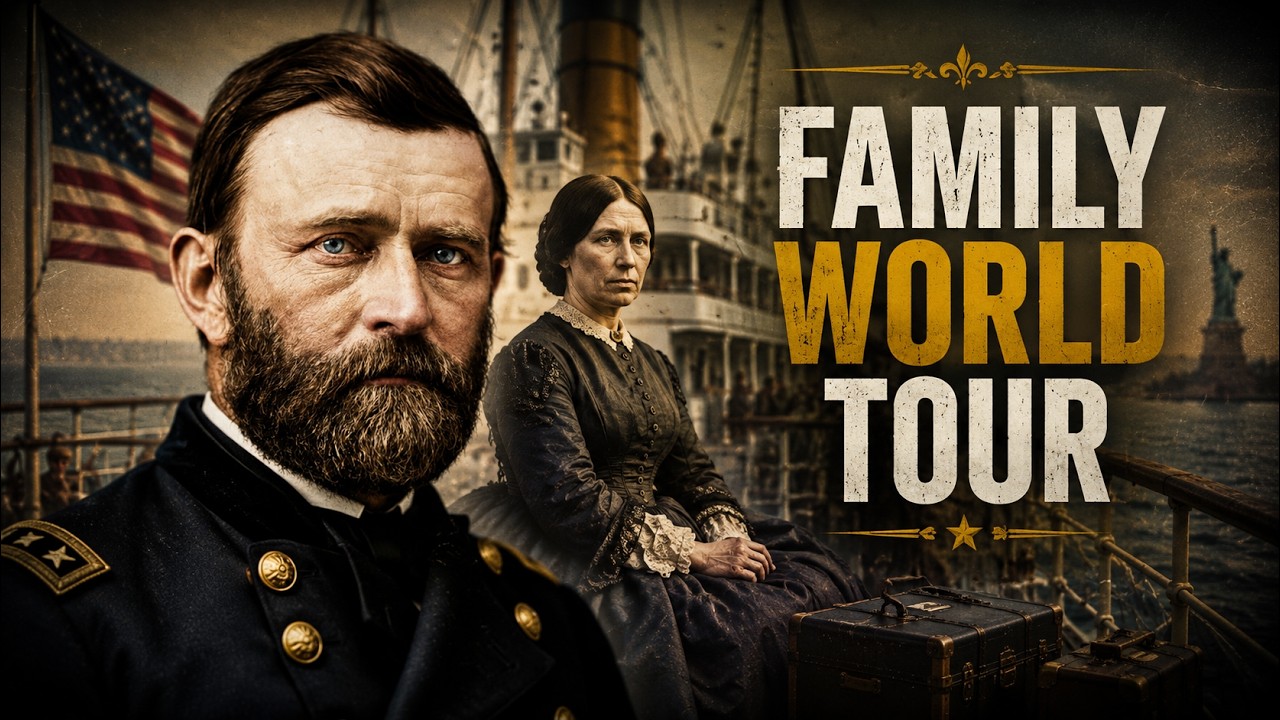
No guards, no soldiers, no one clearing the road for him. He approached a palace and knocked on the door as if visiting a neighbor’s house. Accounts differ on the details. Some say he stubbed out his cigar on the doorstep first, as if he had nowhere else to go.
But what everyone agrees on is stranger than the cigar story. No retinue, no announcement, just Grant walking up and knocking. The man who opened the door was Otto von Bismarck. He had just finished unifying Germany.
Perhaps he was the most powerful man on earth. Bismarck asked his guest about the war back home. The one that killed six hundred thousand people. The one this man had won.
And Ulysses Grant, the general who defeated Robert E. Lee, the man who ran the country for eight years, said something strange. “The truth is, I am more of a farmer than a soldier. I take little or no interest in military affairs.
” He was not being modest. He meant it. And that is the strange part. Give him a war, and he was unstoppable.
Take it away, and his entire being collapsed. War made sense to him. Peace never did. So what was he really doing on that trip around the world, knocking on other people’s doors?
To understand the answer he gave Bismarck, you have to go back to before any war came to save him. There is a pattern in Grant’s life that begins early and is marked by cruelty. Fort Humboldt in California. A young army captain stuck at a remote post on the edge of the country.
Nothing to do, no one who needed him. He was thirty-one years old and falling apart. Not in a dramatic way. Quietly, the way a man falls apart when nothing is holding him up.
He was far from his wife, far from his children. By most accounts, he drank, though historians still argue about how bad it was and whether the army forced him out or he simply could not bear the distance from his family. He also suffered from migraines his entire life, so severe that more than one observer mistook them for something else entirely. What is not in dispute is what happened next.
In 1854, he resigned from the army, resigning with a heavy burden. His biographer Ron Chernow describes him as the man who left Fort Humboldt a gloomy, defeated figure surrounded by a vague aura of isolation. Then came a period almost no one talks about. Seven years of trying.
He tried farming. Failed. He tried real estate. Failed.
He tried collecting rents for other men’s tenants. Failed at that too. By the winter of 1858, Ulysses Grant, the man who would one day lead a million soldiers, stood on a street corner in St. Louis selling firewood from a wagon, wearing his old army coat because it was the only coat he owned.
Then the war came, and what happened next is one of the strangest transformations in American history. That man selling firewood in a worn coat became, within four years, the most important soldier in the country at Vicksburg, Chattanooga, and Appomattox. His staff officer Horace Porter could not get past the contradiction. He said Grant had the manner of a man born for a courtroom, not a battlefield.
Yet the same officer watched him write military dispatches while shells burst around him without flinching. The cigar habit began at Fort Donelson when a reporter noticed him holding one in the middle of battle. By the time the story hit the newspapers, so many well-wishers sent him cigars that he never stopped smoking afterward. Here is what people miss.
Grant did not change between the firewood wagon and the surrender table. He remained the same man. The moment changed. His closest friend through all of it was a man named Ely Parker, a Seneca chief, an engineer, and eventually Grant’s military secretary.
They met years before in Galena when Grant was a clerk in his father’s leather store. Two quiet men in a culture that valued talk. Parker saw something in him. Grant’s stubborn silence matched a Seneca ideal of restraint that Parker had been raised on.
He saw a kindred spirit while most people saw only an odd clerk. Parker’s hand wrote the terms of surrender at Appomattox. According to the common account, Lee was surprised to see Parker in the room and briefly mistook him for a Black man. When he shook Parker’s hand, he said he was glad to see a real American there.
Parker replied, as the story has been passed down, “We are all Americans. ”
When Grant became president, he brought Parker with him, making him the first Native American to serve as Commissioner of Indian Affairs. But the presidency turned out to be the worst period of peace. Grant trusted people deeply, sometimes blindly.
That was an asset on a battlefield. In an office full of politicians, it was a burden. Scandals piled up. The Whiskey Ring.
Men embezzling, trading favors, buying influence. Then they came for Parker. Grant’s enemies in Congress put Parker on trial for corruption. The charges did not hold, mostly because they were not true.
It was mostly men who could not stand seeing a Native American in such a position. Parker was acquitted. He resigned anyway, humiliated. He largely disappeared from public life afterward.
Grant said not one word in his defense. That silence still seems strange after all these years. This was the man who wrote the words that ended the Civil War. When it mattered, Grant did not stand by him.
When Grant finally left the White House in March 1877, he left behind a farewell address historians still analyze. He wrote that taking the presidency without political training had been a calamity for him as much as a fortune. Describing his failures, he called them errors of judgment, not of intent. The word calamity is a strange one for a man to use about his own presidency.
That is not humility. That is a man defending himself before a jury that had already left. On May 17, 1877, he stood on a ship in Philadelphia. A vessel called the Indiana was preparing to leave.
Grant was fifty-five. He had not bought a return ticket. With him were his wife Julia, his youngest son, and a reporter from the New York Herald named John Russell Young, chosen by Grant himself. That choice mattered.
Bringing a journalist meant this was not just a trip. It was a production, and someone was recording it. Young took the job so seriously it changed the rest of his life. He would later become U.
S. minister to China and then Librarian of Congress. Almost everything we know about what Grant said and thought there comes from Young’s notebook. Here is the plan Grant’s political friends had devised.
Get the general out of the country. Let the kings and queens roll out the red carpet. Let the whole world treat him like royalty. Meanwhile, at home, people would quietly forget about the Whiskey Ring and the corruption.
By 1880, voters would remember only one thing. The man who saved the Union. But that explanation does not cover everything. A man rebuilding his image does not spend two months in Japan.
Nor does he wander through Burma and Siam. Something else was pulling him. To understand this journey, look at the two people making it. Julia boarded the ship happy, even excited.
Her time as First Lady had been the best years of her life, and she was not shy about saying so. Two years earlier, when Grant decided not to run for a third term, he had not even asked her. He knew she would try to talk him out of it. When she found out, she cried and later wrote that she felt like prey.
This trip, in a strange way, was giving her back exactly what she had lost. She was not running from anything. She was reclaiming something. Grant stood on that same deck and watched his country fade behind him.
His presidency was over. Ely Parker was gone. Reconstruction was gone. The promise that Black Americans in the South would be safe and free was already coming apart behind him.
The federal troops that protected Black voters across the South were being withdrawn state by state. Everything Grant had wanted his presidency to mean was collapsing without him. He was not just leaving the country. He was fleeing what was left of it.
In England, Grant received the loudest welcome of his entire trip. Liverpool, London, and Newcastle, where about a hundred thousand factory workers gathered just to see him pass. Not politicians, but working men. They knew exactly who he was.
The general who stood behind a flag that actually meant something. Grant told them that whatever greatness America had came from the people who did the work. Without labor, he said, nothing worth preserving would be left. The man who once sold firewood on a St.
Louis street corner meant every word. Then the receptions came one after another. In Constantinople, the sultan gave him two Arabian horses that shaped American horse breeding for a generation. In Paris, someone tried to explain a strange new game called polo.
Grant watched for a few minutes, then told the men beside him it was exactly the kind of training a cavalry unit should do, even in times of rest. Part of him never stopped being a soldier. Kings, palaces, gifts, music. Grant accepted it all the way he had accepted Appomattox.
Quiet, polite, unmoved by the spectacle. No one in any of those countries asked him the one question that truly mattered. Then in Berlin, at the Radziwill Palace, someone finally did. Bismarck’s question was the one no one at home had ever pressed him on.
What was the real purpose of the war? What did all that blood achieve? Sitting in the palace, treated as the greatest living soldier, Grant gave an answer he rarely had the chance to say at home. He told Bismarck that the moment slavery fired on the flag, it had to end.
Saving the Union and ending slavery were never separate things. They were the same fight. One account of that visit says Bismarck told him he looked remarkably young despite everything he had been through. Grant brushed it off, calling it the highest compliment a man could receive.
It is one of the clearest statements Grant ever made about why the war happened, and he said it in a palace in Berlin, not in Washington. Egypt was the next stop, then Palestine. In Jerusalem, officials had arranged a band to accompany Grant along the Via Dolorosa. Grant took one look and waved them off.
He walked the path in complete silence. Young later wrote that Grant seemed sorry the ceremony had been arranged at all. This was the same man who asked his soldiers not to cheer at the fall of Vicksburg, who canceled the artillery salute at Appomattox. He understood something most people do not.
The greater the moment, the less noise it needs. By the time he reached India, you could not miss the contrast. Young watched Grant carried through the streets on the back of an elephant amid the full pomp of the British Empire. Grant just passed through it, present in body, his mind elsewhere.
Young kept noticing the same thing country after country. No matter where they were, Grant’s conversations always returned to the same place. Vicksburg, Sherman. Choices made in the mud years before.
His body was in India. His mind had never left Virginia. Then China, and something no one expected. In Beijing, four children of American missionaries heard he was coming through the city gate.
They made little paper flags and waved them as his procession passed. Grant noticed them, stopped, had them brought to him, sat them down, and told them how proud they should be of their country. The Emperor of China did not grant him an official audience, but Prince Gong and Viceroy Li Hongzhang gave him something close to a state visit. Li did not just want to shake hands with a famous general.
He wanted Grant to intervene in a dispute with Japan over control of the Ryukyu Islands before it turned into war, to prove that two nations could settle things with words instead of guns. Grant agreed and tried. He told Li that arbitration might not satisfy either side completely, but it settled something larger. The conscience of the watching world.
It did not change the outcome. Japan annexed the islands anyway, and the dispute continued after Grant’s death. But the offer itself, a general asking two nations to trust words over soldiers, meant something even in failure. While in China, Grant said something else in passing that no one had asked him to say.
He was not ready to justify how Chinese immigrants were being treated back home. Thousands of miles from home, he kept telling the truth out loud anyway. In China and later in Japan, people knew exactly what Grant had done in his country. They knew about the war, about slavery, about everything he had fought to end.
They honored him for it with genuine warmth. It was a strange kind of mirror. The very legacy being celebrated abroad was being quietly dismantled at that moment by the men who had replaced him in Washington. Japan was the last stop, and it felt different from everywhere else.
He met Emperor Meiji and is said to have been the first foreign visitor the Emperor ever shook hands with, in Nagasaki and again in Tokyo. Grant took part in tree-planting ceremonies, asking only that the trees grow. Young noticed the change in him almost immediately. Grant stopped talking about Vicksburg.
His speeches became warmer, more personal. He was no longer going through the motions. For the first time in years, perhaps for the first time ever, he seemed like a man who was actually present. There is a second story hidden inside this one, and it belongs to Julia.
Julia loved the world tour. Without hesitation, without complicated feelings. Her diary is full of its details. The markets, the gifts, riding an elephant in India, descending into a silver mine in Nevada on a bet and coming back laughing.
In Siam, when the boat carrying her to the royal yacht nearly capsized, she stayed so calm that Young mentioned her specifically in his reports. She was fully present, having the time of her life. While Grant was somewhere else the whole time. While Julia immersed herself in the world around her, the reporters traveling with them kept recording Grant’s conversations, and they always circled back to the same few things.
Vicksburg, Sherman, Sheridan, the men he had sent into battle who never came home. Read her diary beside his conversations from the same weeks, and you would hardly believe they were on the same ship. Hers is full of elephants and near-capsized boats. His is still fighting a war that ended fifteen years earlier.
On September 20, 1879, the ship arrived in San Francisco. The bay was packed with decorated vessels as if for a holiday. Crowds lined the docks for miles. Grant had finally come home, and the reception was enormous.
But San Francisco was not really the end, whatever the postcards suggested. For three months, Grant kept wandering around his own country. Yosemite, the silver mines of Nevada, Fort Vancouver, where he had served decades earlier as a young officer, away from his family in the same isolated stretch of life that eventually led to Fort Humboldt. He was standing on the West Coast again, but this time the whole country was watching instead of no one seeing him at all.
The tour did not officially end until December in Philadelphia, the same city where it began. The real test was not the parade. It was in Chicago in 1880, at the Republican convention. That was the point of the world tour.
Take Grant around the world. Let the monarchs treat him like royalty, then bring him home for one last attempt at the White House. Grant stayed in Galena watching the telegraph dispatches and waiting. The voting began.
First ballot. Grant led, but not enough to win. Second ballot, tenth, twentieth. The numbers barely changed.
Thirty-five times they called the names. Thirty-five times Grant’s supporters did not budge. The 306 delegates who stood with Grant through all thirty-five ballots would spend the rest of their lives calling themselves “the 306 Immortals. ” Then on the thirty-sixth ballot, the split happened.
The other side finally united behind James Garfield. Garfield won. Grant lost. A year later, in July 1881, President Garfield was shot.
When he died weeks later, reporters watched Grant weep openly. The same man who had shown nothing at all when his own political career ended in defeat. What came next was worse. Grant went into a business partnership with a man named Ferdinand Ward.
Ward was smooth, looked enormously successful, and was actually running what we would call a Ponzi scheme. Grant trusted him without hesitation. The same flaw that had wrecked his presidency. He trusted the people closest to him absolutely.
Once he trusted, he stopped watching, the way peace had always undone him. On May 4, 1884, Ward convinced Grant to personally borrow $150,000 from his neighbor William Vanderbilt to keep the company afloat. Grant handed the money straight to Ward. Two days later, Grant walked into the office and discovered the truth.
The money was gone. Ward was gone too. Grant sat there motionless, silent in that office until five in the evening. Before he finally left, he turned to the company accountant and said, “I do not see how I can ever trust any human being again.
” He walked out owning only eighty dollars. Julia had one hundred thirty. Two hundred ten dollars combined. Then came the cancer.
Throat cancer, inoperable. By late 1884, he could barely speak above a whisper. He was dying and bankrupt. But he had one final task.
He made a publishing deal with Mark Twain to write his memoirs. The proceeds were the only thing protecting his family from poverty. He had to finish before the cancer finished him. So he treated it like a military campaign, writing for hours on end, using a cocaine solution to numb his throat enough to keep going.
When he lost his voice completely, he began writing notes on scraps of paper instead. He did not stop. He would not allow himself to stop. He finished the manuscript on July 20, 1885.
He died three days later. Ely Parker tried to see him before the end. The story goes that Grant’s own son turned him away at the door. The final chapter in a friendship that went back to Appomattox, a friendship Grant never found the words to defend.
The book saved Julia. The royalty check she received was the largest ever paid to an American author up to that time. But it was more than that. His Personal Memoirs turned out to be a genuine literary masterpiece, written in the same voice he had used with Bismarck in Berlin.
The same voice that drafted the surrender terms at Appomattox. Clear, direct, free of affectation. He wrote that way until he could no longer write at all. Call it a comeback tour if you want.
That is partly true. But for two and a half years, something bigger than politics lined up in Grant’s life all at once. He was sober. He was celebrated for the right reasons.
Julia was beside him, and Washington could not touch him there. He was the man that crises always brought out, without the peace that always broke him afterward. The world was ready for him. America had to keep working through him.
He came home to face betrayals, ruin, and a race against his own death. He sat before the most powerful man in Europe and called himself just a farmer. He walked the Via Dolorosa without fanfare. He would not let his men cheer over a defeated enemy.
Victory and peace were never one thing to him. He knew that since Appomattox. What he never learned was how to give himself peace. The trees he and Julia planted in Tokyo took root.
Decades later, in 1929, the city honored them with a monument. He never found peace, but something he planted did. Julia lived seventeen years after him. Her memoirs, the first by a First Lady, were not published until after her death.
She gave the book its own final line. That the light of his glorious fame still reaches her, still envelops her, still warms her.