On a January evening in 1945, an Army photographer named David Conover walked through a radio plane factory in California, searching for women who could represent the war effort at home. He found a young worker with dark hair who seemed to change when a lens turned toward her. Her name was Norma Jeane Dougherty, born Norma Jeane Mortenson nineteen years earlier in Los Angeles, and she had never imagined herself in front of a camera. But the photographs Conover took that day opened a door she had not known existed, and within a decade she would become the most photographed woman in America, a name invented for the screen who would try, against nearly every force in Hollywood, to sign that name as her own.
The child who became Marilyn Monroe did not grow up with anything resembling ownership. Her mother, Gladys Pearl Baker, worked as a film cutter, handling pieces of other people’s stories, but she suffered periods of serious mental illness and could not reliably care for her daughter. Norma Jeane passed through foster homes, the homes of family friends, and a period at the Los Angeles Orphans Home, though her mother was alive. That fact made the separation harder to understand.
She learned early to scan adults for danger, favor, and withdrawal, and she learned that a home could feel real and temporary at the same time. Grace McKee, a friend of her mother, admired Hollywood glamour and encouraged the girl’s interest in movie stars, dressing her and arranging her hair as if beauty might become a path out of uncertainty. The lesson stuck. Presentation could alter the way the world treated you.
In 1942, when Grace’s husband prepared to move the family, sixteen-year-old Norma Jeane faced another displacement. The practical solution was marriage. James Dougherty, a neighbor several years older, was kind and steady, and they married weeks after her sixteenth birthday. It was a legal doorway out of foster care.
The marriage was not cold. Dougherty later remembered her with affection, and the young couple shared ordinary pleasures. But the war changed the arrangement. Dougherty joined the merchant marine, and Norma Jeane went to work at the factory.
When he returned, he found a wife with ambitions he did not share. She wanted to model and move toward motion pictures. Their divorce became final in 1946. That summer, 20th Century Fox offered her a short-term contract.
The studio preferred a new name. Executive Ben Lyon proposed Marilyn, recalling a stage performer from an earlier era. Norma Jeane supplied Monroe, a family name from her mother’s side. The two words described a possibility, not yet a person.
The studio system knew how to manufacture possibility. But Fox did not renew her contract after the first year. She had given up her marriage for the profession, and the profession had not promised to keep her. She continued at Columbia Pictures, appeared in a low-budget musical, and worked with acting coach Natasha Lytess, who treated her as more than a decorative presence.
Producer Johnny Hyde became an advocate, securing introductions and important tests. In John Huston’s The Asphalt Jungle, released in 1950, she played a young mistress with brief screen time but visible discipline. The same year, in All About Eve, she used stillness and timing as Miss Caswell. The audience noticed her.
So did studios, columnists, and photographers. Recognition did not mean authority. Studios cast her as secretaries, mistresses, and beautiful interruptions. Publicists arranged photographs that emphasized her body, and columnists wrote about her measurements as if they were professional credits.
She participated because attention created work, but she also kept studying because she understood how quickly attention could replace work. She knew photographers by name, remembered which angles they favored, and could concentrate a room around her. The image that would soon threaten this rise had been made in 1949, when acting jobs were scarce and rent was due. She posed nude for photographer Tom Kelly, was paid fifty dollars, and expected the photographs to disappear into the anonymous world of calendars.
They did not. Once her career accelerated, the image became valuable, and when the connection surfaced in 1952, studio executives urged denial. Marilyn chose another strategy. She admitted she had posed because she needed money.
In a United Press interview, she said she had done nothing wrong. The public response was largely sympathetic. People who had struggled during the Depression understood needing fifty dollars. In that first crisis, she prevented the studio from writing her as a liar or a fallen woman.
Her roles grew more substantial. In Niagara, she played a wife involved in a murder plot with a hard, contained quality. Then came Gentlemen Prefer Blondes. Fox had imagined the role of Lorelei Lee for a more established star, but Marilyn was cheaper.
Her salary was a fraction of what co-star Jane Russell commanded. Russell treated her as a colleague, and their contrast served the film. The number “Diamonds Are a Girl’s Best Friend” became one of the defining images of American popular culture. Its apparent simplicity hid exact work.
Lorelei’s materialism could have made her cold. Marilyn played her as someone whose logic was perfectly coherent. A child moved from household to household might understand why promises felt weaker than objects. By the end of 1953, she was one of Fox’s most important attractions, and she was still fighting over roles and pay.
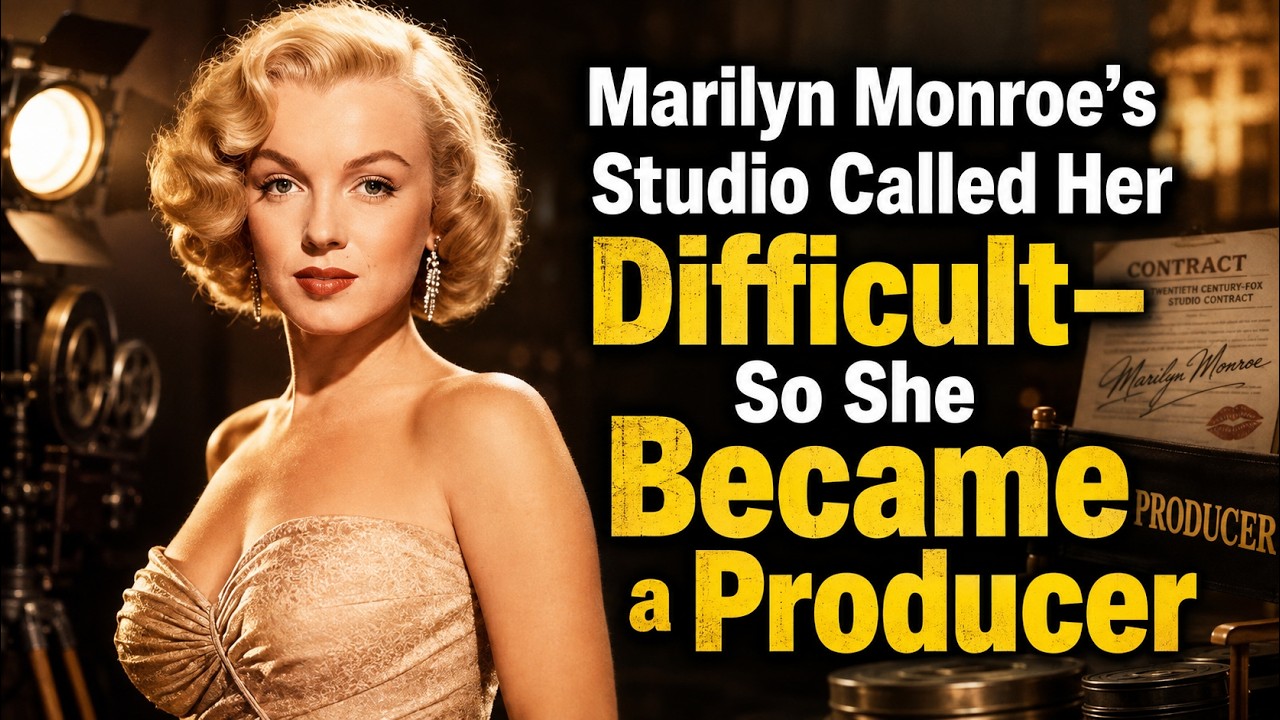
She refused assignments, missed calls, and forced confrontations. Executives called her difficult. From their desks, difficulty meant a valuable employee who had begun to say no. Her private life moved toward another form of American mythology.
On January 14, 1954, she married Joe DiMaggio at San Francisco City Hall. He was a retired baseball hero who represented discipline and masculine reserve. Together they looked like the nation’s favorite couple before they had learned how to live as one. DiMaggio had completed the public phase of his career and preferred privacy.
She was entering the most exposed phase of hers. During their honeymoon trip to Japan, Marilyn was invited to perform for American servicemen in Korea. Over several days, she appeared before enormous crowds in severe winter conditions, wearing a light sequin dress and singing with an energy photographs can still convey. She later remembered it as a moment when she understood the scale of her fame.
DiMaggio experienced the same event differently. The public adoration directed at his wife did not feel harmless. The Seven Year Itch offered a better role in one of the most calculated publicity events in Hollywood history. On a September night in 1954, a crowd gathered on Lexington Avenue in New York as Marilyn stood over a subway grate and an updraft lifted the white skirt of her costume.
Director Billy Wilder filmed repeated takes while photographers and spectators shouted. The scene looked spontaneous only because an entire apparatus had been built to manufacture spontaneity. The crowd saw flirtation. The cameras saw an image that could travel around the world.
Joe DiMaggio, watching the public display, saw humiliation. Less than a month later, Marilyn announced she would seek a divorce. The legal language was mental cruelty. The human language was disappointment.
When filming ended, Marilyn did not return obediently to the old arrangement. She left Los Angeles for New York and placed physical distance between herself and Fox. Milton Greene, a successful photographer, helped make that move possible. He treated her frustration as a business problem that could be answered with structure.
On January 7, 1955, reporters gathered in a New York hotel expecting another performance from one of the most photographed women in America. She entered the room beside Greene and announced a company bearing her own name, Marilyn Monroe Productions. Flashbulbs made the event look effortless. It was not.
The woman sold as instinct without discipline was trying to become a producer. She wanted better scripts, a voice in choosing directors, and time to study. She was not rejecting the image that had made her famous. She was asking who had the right to control it.
In New York, she pursued the training Hollywood had mocked. She studied with Lee Strasberg and attended the Actors Studio. Critics later argued about whether this training liberated her or increased her self-consciousness. Evidence exists for both effects.
Fox initially dismissed the company, but the studio also had a problem. Films built around her had earned large sums, and no replacement could reproduce what she brought. Negotiations lasted through much of 1955. When the settlement came, Marilyn won a more favorable salary, payment connected to earlier disputes, and a meaningful voice in projects and directors.
She also gained the right to make films through her own company. The victory was real, but it was not effortless emancipation. Even so, a woman publicly described as unserious had forced one of Hollywood’s largest companies to renegotiate. The first major test of the new contract was Bus Stop.
Marilyn played Cherie, a nightclub singer in a worn costume who dreams of reaching Hollywood. She used pale makeup, roughened hair, an uncertain accent, and deliberately strained singing. The character’s wish to be respected rather than carried away by a man gave the film an argument that reached beyond romantic comedy. Critics who had treated Marilyn as a phenomenon began to write more seriously about her acting.
The praise mattered because Bus Stop was the answer she had promised at the New York press conference. Almost at the same moment, her relationship with Arthur Miller moved toward marriage. Miller was one of America’s most respected playwrights. Their courtship unfolded under political pressure.
Miller was called before the House Un-American Activities Committee and refused to name other people who had attended meetings associated with a Communist Party. Marilyn stood by him publicly when advisers warned the association could harm her career. They married in June 1956. Soon after, she traveled to England to make The Prince and the Showgirl with Laurence Olivier.
The collaboration brought together two prestigious forms of stardom, but their working methods collided. He wanted punctuality and repeatable technique. She needed preparation and room to search for a moment until it felt true. The film did not become the triumph the company needed, and the partnership between Marilyn and Milton Greene was deteriorating.
The end of the partnership repeated an old pattern. A structure created for safety became another place of conflict. Her health was also becoming harder to separate from her work. She suffered from endometriosis and endured pregnancy losses during her marriage to Miller.
Medication offered temporary relief from pain, anxiety, and sleeplessness. In the medical culture of the 1950s, barbiturates and sedatives were prescribed with a freedom that would later appear alarming. She returned to Hollywood for Some Like It Hot, directed by Billy Wilder. Production was difficult.
She was frequently late and sometimes unable to remember simple lines. But the film became one of the most admired American comedies, and Marilyn received a Golden Globe for her performance. Sugar Kane’s emotional warmth carried much of the film. She is surrounded by disguises and people performing identities for survival.
Marilyn Monroe, who had spent her adult life doing the same, made that artificial world feel human. After another pregnancy ended in miscarriage, the distance between Marilyn and Miller deepened. Miller had written a short story called The Misfits and developed it into a screenplay for her. The project gathered John Huston, Clark Gable, Montgomery Clift, and Marilyn.
It was filmed in Nevada in the summer of 1960 under punishing heat. The set’s difficulties cannot be assigned to her alone. But The Misfits contains some of her most exposed work. Only days after filming ended, Clark Gable suffered a heart attack and died.
The film was released in early 1961. By then, Marilyn and Miller had announced their separation. Their divorce became final that January. After the divorce, Marilyn entered one of the most vulnerable periods of her life.
She was exhausted, grieving, and increasingly dependent on physicians and medication. A hospital admission in New York, intended as psychiatric care, became an experience she described as frightening confinement. Joe DiMaggio assisted in arranging her transfer to a setting where she felt safer. By 1962, she was preparing a return to Fox in Something’s Got to Give, an unfinished remake of the 1940 comedy My Favorite Wife.
She had purchased a modest house in Brentwood, the first home she owned alone. The new film began badly. She suffered from illness, including a serious sinus condition, and missed many days. When she traveled to New York to sing at President John F.
Kennedy’s birthday celebration in May, the contrast enraged Fox. Too sick for the set, apparently well enough for a nationally watched performance. The appearance intensified the studio conflict. Fox fired her in June and announced legal action.
Yet Dean Martin refused to continue with another actress, and negotiations quietly reopened. The woman publicly declared finished still possessed bargaining power. During the weeks after her dismissal, Marilyn did not behave like a person who had abandoned the future. She discussed new projects, considered stage work, and negotiated through representatives.
In a long interview with writer Richard Meryman, she discussed childhood, work, fame, and the studio system with a mixture of pride and weariness. When discussing the label of sex symbol, she said, “I just hate to be a thing. ” The sentence was not a rejection of sexuality. What she rejected was the conversion of a living worker into a thing other people could own, repeat, and interpret without limit.
The complete conversation was prepared for publication decades later and released in 2026. In her own words, she sounded like a person still in motion. On the night of August 4, 1962, Marilyn was at her Brentwood home. The reconstruction of her final hours has produced decades of claims and contradictions.
Early on August 5th, she was found dead in her bedroom. She was thirty-six years old. The official investigation determined that the cause was acute barbiturate poisoning from an overdose and classified the manner as probable suicide. A later review by the Los Angeles County District Attorney found no credible evidence of homicide or conspiracy.
The word probable matters. It records an official judgment while acknowledging that the dead cannot answer questions about intent. Her death immediately activated the machinery she had spent years trying to control. Headlines compressed a complex career into a story of disaster.
Joe DiMaggio arranged the funeral and limited attendance. Lee Strasberg delivered the eulogy. Andy Warhol soon began making silkscreen images based on a publicity photograph from Niagara. Repetition made her more recognizable and less individual.
Later decades offered competing versions of Marilyn, each selecting evidence. None could contain the whole life. The centenary attention surrounding her birth in 2026 produced exhibitions, books, and restored materials. At the Academy Museum of Motion Pictures in Los Angeles, hundreds of objects were assembled, including a voting agreement dated January 7, 1955, recording the existence of Marilyn Monroe Productions.
It belongs to the same day as the flashbulbs and reporters, yet it does not smile. It establishes shares, authority, and responsibility. It shows that the announcement had a legal body. The structure did not last.
The document did. So did the films made possible by the fight, the testimony of friends and co-workers, the unfinished notes, the contract changes, and the moments on screen when preparation became ease. On the paper, authority is imperfect, partnership is fragile, and the future is uncertain. But one name appears not as a studio label or a caption beneath a picture.
It appears as the name of a producer. Marilyn Monroe.