The car was seven inches long, maybe eight, built at 1/24 scale, big enough to fill a teenage hand and heavy enough to feel real. Nobody walked into a store and bought one ready to race. The chassis was chosen from a catalog of brass and piano wire—Dynamic, Miura, Russkit, Champion—names that meant nothing outside the hobby and everything inside it. A Dynamic Dynaflex was not just a frame; it was a philosophy, engineered to flex through corners and keep the tires flat while lesser chassis bounced and lost time.
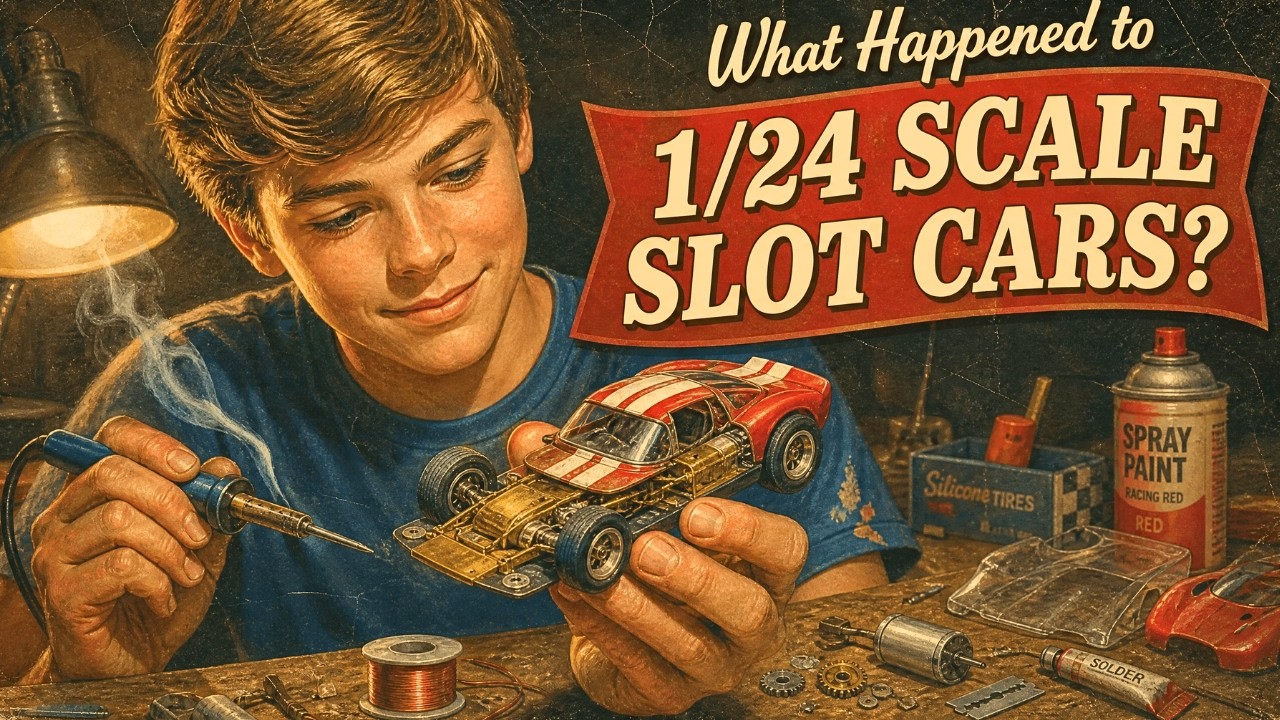
You selected it the way a carpenter selects a hammer, by what it could do, and then you learned it, its weight distribution, its flex points, the way a thousandth of an inch of adjustment to the rear axle could be felt on the very first lap. The motor was the heart. Some boys bought them from Champion or Mira or K&B; others wound their own armatures, sitting at the kitchen table with a spool of copper wire and a magnifying glass, counting each wrap with trembling fourteen-year-old hands. One extra turn meant the motor ran hot; one too few meant it ran slow.
When the leads were connected and the power touched for the first time, the motor screamed—a high-pitched whine that carried through the walls of the house and announced that something alive, something hand-built, now existed in that bedroom. The body was where a racer became an artist. Lexan, clear and flexible, was cut with scissors and painted from the inside so the finished exterior stayed smooth and glossy. The stripes and numbers and sponsor decals went on first, the base color over them, sealing the artwork inside the shell.
Some used airbrushes; some used spray cans in the backyard. One boy at the local raceway painted his car in his high school colors, black and gold, and every racer knew whose car it was before they saw the number. Tires decided whether a racer won or watched. Serious competitors did not buy them off a rack.
They poured their own silicone compound, mixing small batches with formulas kept private. Soft tires for grip, hard tires for durability, separate batches for qualifying and the race itself. The compound was poured into molds, cured, pulled, and then trued on a lathe—a contraption built from a hobby motor, a dowel rod, and sandpaper. A flat spot the size of a pinhead caused vibration at speed, and vibration meant the car danced in the corners instead of gripping.
Boys stayed up until midnight sanding a rubber circle to within a thousandth of an inch, a task no one outside the hobby could understand. The controller was the link between hand and machine. Not a joystick or a button, but a resistor in a pistol grip with a trigger to be squeezed, not pressed. Sensitivity came from practice, patience, and failure.
Too much trigger and the car broke loose; too little and the draft was lost. Racers chose between 45-ohm, 70-ohm, and 95-ohm controllers, weighing low-speed control against full-speed response, selecting by feel the way a pool player selects a cue. After a year with the same unit, the trigger knew the hand the way a glove knows a fist. Saturday morning was the test.
The racer walked through the raceway door with a car in one hand, a controller in the other, and the owner behind the counter nodded, remembering the boy from the past six months, remembering his corner-entry problem, and silently noting whether the work had been done. The car went to the tech table for inspection: ride height, tire compound, guide flag, braids. Then it was set on the track, and the trigger was squeezed. Listening mattered.
A good motor sounded clean; a bad bearing sounded rough; a loose gear sounded like it was chewing itself apart. The ears knew the car the way a mechanic’s ears know an engine, and if something was wrong, the racer heard it before he felt it. The pit table was home base, a folding table beside the track crowded with tools, spare parts, a tire truer, and motor spray. Every racer kept his own soldering iron, his own alignment jig, and his own jar of tire sauce, mixed in secret and never shared.
Between heats, racers adjusted brush tension, trued tires, and bent chassis rails by fractions of an inch to alter corner loading. No one talked about what they were doing; tuning was strategy, and strategy was secret, but everyone watched each other’s hands, and that visual education was the real training. The first race with a car built from scratch was a disaster. The car was slow, the motor wrong, the tires too hard, the body too heavy from excess paint.
The racer finished last in every heat, and the old man in lane six lapped him twice without looking up. The car went home, was torn apart, and was rebuilt. The next Saturday it was faster—not fast enough, but faster—and the Saturday after that, faster still. Somewhere along the way, maybe the fifth or tenth Saturday, the racer completed a heat without being lapped, and the owner behind the counter muttered, “Nice run,” without lifting his eyes from the newspaper.
Those two words outweighed any trophy. Racing was the final exam. Six lanes, eight men leaning over the rail. The starter counted down three, two, one, and the trigger was squeezed.
The car launched into the first corner, the corner that had cost two car lengths every week because the rear end broke loose on a slight dip. But this week the weight had been moved forward, the rear tire compound softened, the motor timing adjusted by a fraction. When the car hit that corner at full speed and held, when the tires gripped and the chassis flexed and the body stayed low, the racer felt a reward no video game ever produced: the reward of his own hands. The competitors were not strangers or screen avatars.
They were the kid from the next town with his Miura chassis and Champion motors, the old man whose battered car was still the fastest on the track, and the new teenager whose car kept crashing because he had not yet learned to feather the trigger. Older racers helped him, showing him where his braids were too tight and his rear tires too hard, because someone had helped them when they first arrived with cars that would not hold a corner. Knowledge passed from hand to hand, from car to car, from Saturday to Saturday. The raceway was the classroom.
Every raceway had a name: the Pitstop in East Toledo, the Aurora Raceway in West Hempstead, Scott’s in Fremont, Checkpoint in Southern California. Riders remembered which corner was fast, which was a trap, which lane favored the straight and which favored the infield. They remembered the track surface—routed Masonite, painted wood, or bare plywood sealed with lacquer—the fluorescent tubes that cast a green tint and made the Lexan bodies glow, and the sound of six cars at full speed, a hum that vibrated the walls. The air smelled of ozone and hot copper, and the outside world ceased to exist.
The parts counter was the altar. Behind the glass, on pegboard hooks and in small plastic drawers, sat the components of the fastest cars in the world: motors wound to tolerances a professional racing team would respect, brass gears with teeth so fine a loop was needed to count them, tires poured from silicone recipes each shop mixed itself. Bearings, armatures, lead weights, pickup braids, guide flags, solder, wire, motor spray. A thirteen-year-old stood at that counter with his allowance in his pocket and made engineering decisions with real consequences.
No adult chose for him. He figured it out himself, and when he got it wrong, he came back next week and tried again. That entire ecosystem is gone. The companies that built it vanished in less than five years.
Dynamic, the chassis maker that changed everything, is gone. Miura, the motors hand-built by Ron Miura in San Leandro, California, is gone. Champion, Russkit, and K&B, bought by Aurora and then dissolved, are gone. Cox, maker of the Chaparrals and Lotus 40s that were every kid’s dream, is gone.
Revell and Monogram left the business entirely. An industry that supported a $500 million hobby disappeared, not because the products were bad, but because the raceways closed. Without tracks, there was no reason to build a car. The track died first, the car second, and the skill last.
The skill is dying now. The men who can wind a slot car motor by hand are in their seventies; the men who can pour a silicone tire compound from scratch are in their eighties. A few hundred people in the country can still look at a chassis and identify its maker by the flex point. When they go, that knowledge goes with them.
It lives in muscle memory, in fingers that wound ten thousand turns of copper wire, in eyes that can spot a thousandth-of-an-inch misalignment from across a pit table, in ears that hear the difference between a motor running right and one about to burn. It cannot be downloaded or streamed or purchased. It resides in the hands of men who were once fourteen, and it will die when they do. There is no raceway to bring a next generation to, no counter to stand at, no pit table to sit at.
The infrastructure that supported the education is gone, and without it, the education ends. Some still have the car in a box in the garage or a corner of the attic. The body is dusty, the tires hardened, the motor silent for forty years, but the chassis is still true and the solder joints still clean. The weight is still exactly where it was placed, with precision, and it has not moved.
The car could be cleaned, fitted with new tires, oiled, and set on a track, and it would run the way it ran the last time it raced. It has been ready for forty years. There is just nowhere left to take it. A few found somewhere.
Vintage race meets are held in church basements, VFW halls, and converted garages, where men in their sixties and seventies bring their original 1960s cars and race them on wooden tracks built in spare time. The chassis flex the same way, the motors scream the same way, and the controllers feel the same way in hands forty years older but still knowing the squeeze. For a single afternoon, the years fall away. The track is the raceway, the man in lane four is the one who used to win every Saturday, the owner is calling lap times, and the smell of hot motor windings fills the room.
The world is six lanes wide, and nothing matters except the next corner. Some tried to teach it. Grandsons were brought to the garage and shown the chassis, the motor, the body, the tools. They were shown how the armature sits in the magnets, how the gears mesh, how the braids pick up the current.
They watched politely, asked a few questions, and then went back inside to their phones. Not because they did not care, but because the world they live in has no place for what was being offered. There is no raceway to take them to, no counter to spend an allowance at, no Saturday morning countdown. Slot cars are still sold.
Carrera makes beautiful 1/24 scale models with detailed paint, chrome, and working headlights. They come out of the box, are set on the track, and run with the press of a button. They are gorgeous and fast and perfect, and they are not yours. Nobody wound the motor, poured the tires, or painted the body from the inside with shaking hands and a spray can.
Nobody chose the chassis or the gears or the weight placement. The car came finished, and it will never mean what the old cars meant, because the old cars had hands in them. What vanished was not slot cars or 1/24 scale or the brands or the trophies. What vanished was the act of building something fast with your own hands and proving it somewhere.
The counter, the allowance, the soldering iron at eleven o’clock on a Tuesday night, and the moment the car held the corner for the first time. The pride of authorship, the ownership of speed, the feeling that the fastest car on the track was fast because of you.