In October 1971, health inspectors from Suffolk County, armed with a warrant and accompanied by police, forced their way through the overgrown gates of Grey Gardens, a once-majestic twenty-eight-room estate in East Hampton. What they found inside was beyond anything their training had prepared them for. They had to wade through waist-high piles of empty cans. The floorboards were sticky with animal waste.
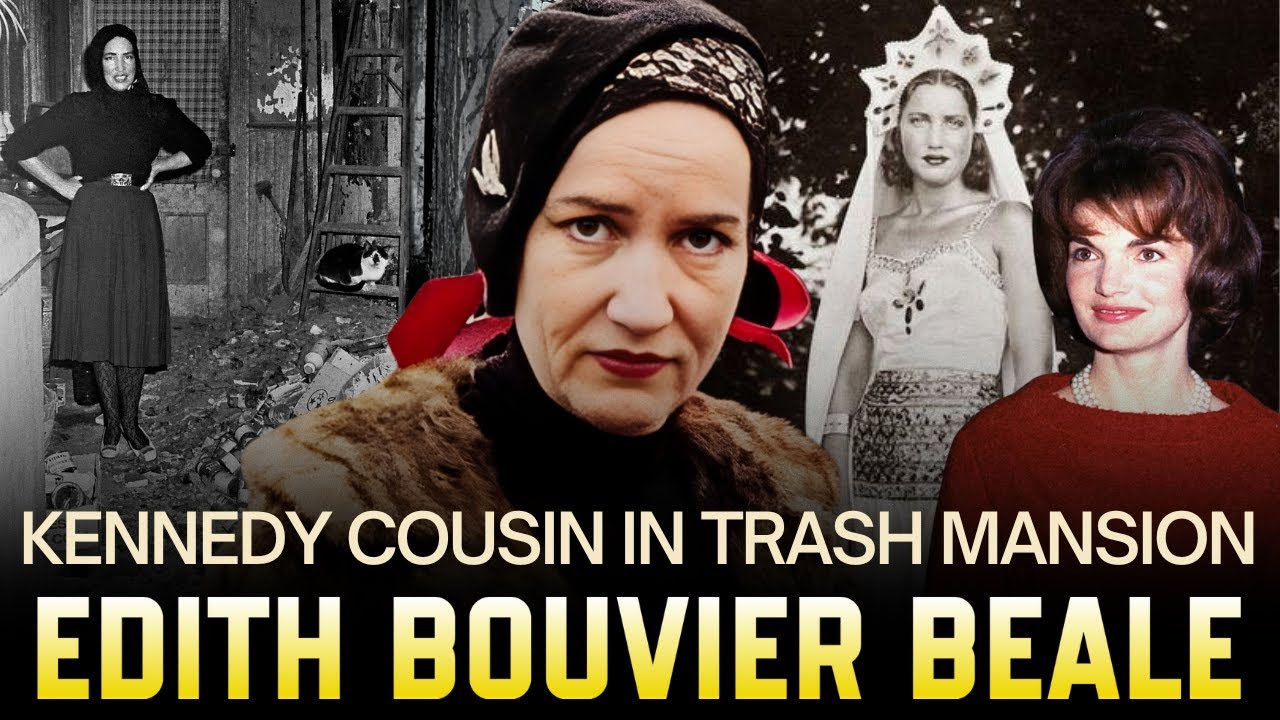
In the dining room, priceless oil paintings of Bouvier ancestors hung crookedly on water-damaged walls, looking down on a table covered in debris. They counted fifty-two cats living inside the house. Raccoons nested in holes in the walls. An opossum lived in the attic.
There was no running water, the pipes having rusted out years earlier. The toilet was a bucket. The refrigerator was broken and filled with maggot-infested food. The house was declared unfit for human habitation, and the women who lived there were given an ultimatum: clean it up or be evicted.
The women were Edith Bouvier Beale, known as Big Edie, and her daughter, also named Edith, known as Little Edie. They were two reclusive aristocrats whose lives had unraveled behind a wall of privacy for nearly two decades. And when word of the raid reached the press, the story exploded. These were not just two eccentric old women.
They were the aunt and cousin of Jacqueline Kennedy Onassis, the most scrutinized woman in the world. The National Enquirer ran the headline: “Jackie Kennedy’s Aunts Live in Filth. ” The contrast was irresistible. While Jackie sunbathed on a yacht in Scorpios wearing designer scarves, her own flesh and blood were eating cat food in a flea-infested mansion.
Little Edie and Big Edie, however, did not see themselves as victims of tragedy. They saw themselves as artists being persecuted. When reporters shouted questions over the fence, Little Edie adjusted her turban and answered with perfect dignity: “It’s an artist’s home. We’re artists.
We have no time for housework. ” They believed the health department was a Republican plot to steal their land. The embarrassment was so severe that Jackie Onassis and her sister, Lee Radziwill, were forced to intervene. Jackie flew to East Hampton, stepped out of her limousine into the weeds, entered the ammonia-soaked house, and embraced her relatives.
She did not lecture them. She simply wrote a check, reportedly between twenty-eight and thirty-two thousand dollars, to fund a massive cleanup. Workers filled over one thousand industrial garbage bags. They shoveled out animal waste and exterminated fleas.
They repaired the roof and restored the plumbing. For the first time in years, fresh water flowed and lights came on. But the cleanup only fixed the house. It did not fix the women.
Almost as soon as the workers left, the habits returned. The cats came back. The cans began to pile up again. The story of how these two women came to live this way begins decades earlier.
Edith Bouvier Beale was born on November 7, 1917, into the heart of New York’s highest society. Her family, the Bouviers, were cornerstones of what was known as Catholic aristocracy. Her grandfather, Major John Vernou Bouvier Jr. , was a man obsessed with appearance and lineage who fabricated a family history linking the Bouviers to French nobility.
Little Edie was the only daughter among three children, born into a household that was already a battlefield. Her father, Phelan Beale, was a stern Wall Street lawyer, a man of the nineteenth century living in the twentieth, who believed there was a right way to do everything. Her mother, Big Edie, was his opposite, a bohemian soul with an untrained singing voice she imposed on guests at every opportunity. She saw life as a stage and herself as its eternal star.
Phelan hated her singing. She hated his rules. Little Edie grew up caught in the no-man’s-land between them. For her father, she had to be the perfect Bouvier lady.
For her mother, she had to be a companion and an audience. Physically, Little Edie won the genetic lottery. Even as a child, she had an ethereal beauty, wide blue eyes, porcelain skin, and a lively athletic figure. Her life was a whirlwind of privilege.
The family split time between a spacious apartment on Park Avenue and the summer estate in East Hampton. She attended the finest schools, including Miss Porter’s, the same school that later educated Gloria Vanderbilt and Jackie Kennedy, Little Edie’s cousin. At Miss Porter’s, Little Edie excelled. She was beloved, beautiful, artistically talented, and voted the prettiest girl.
She seemed destined for the top of American society. But beneath the golden surface, cracks were forming. In 1935, when Little Edie was seventeen and about to graduate, she was suddenly pulled out of school. The official reason given was a mysterious respiratory illness.
The real reason, whispered among those who knew the family, was that Big Edie, lonely in her unhappy marriage and emotionally unstable, had begun hoarding her daughter. She could not bear Little Edie being away. Little Edie obeyed and returned home. It was the first time she surrendered her independence to her mother’s needs.
It would not be the last. In 1936, Little Edie was presented to society at a debutante ball at the Hotel Pierre in New York. The New York Times, rarely given to excess in its social columns, chose her as the season’s crowned star. She was dubbed “the Beautiful Body” by the press.
She was the catch of the decade. But she had secret ambitions. She wanted to be an actress and a dancer. Hollywood came calling.
Talent scouts from MGM and Paramount saw her photos and offered screen tests. When her father heard of it, he flew into a rage. For a man of his generation and class, an actress was only one step above a prostitute. According to a painful anecdote from that period, Phelan Beale, walking down a busy Manhattan street, passed a storefront displaying a large photo of his daughter modeling.
In a fit of cold fury, he took his heavy walking stick and smashed the storefront window, destroying the image. He forbade her from accepting the studio offers and threatened to cut her off financially. The dream died. Her romantic life, meanwhile, was a swirl of possibilities.
There were whispers of relationships with the mysterious billionaire Howard Hughes. Oil tycoon J. Paul Getty, considered the richest man in the world, reportedly proposed marriage, and she sent back a letter refusing him, a piece of paper that cost her billions. She dated Joseph P.
Kennedy Jr. , the handsome golden child groomed for the presidency, who died in a tragic plane explosion over the English Channel during World War II. In 1946, the storm that would topple the Bouvier legend arrived not with thunder but with the cold administrative cruelty of a delivered message. Phelan Beale had fallen in love with a younger woman.
He did not sit down with his wife to explain his decision. Instead, Big Edie received a telegram sent from Mexico, informing her that he had obtained a Mexican divorce and that the marriage was over. The cruelty was financial. He gave her Grey Gardens but provided a monthly allowance of only three hundred dollars, a sum that could not begin to maintain a twenty-eight-room mansion by the sea.
He was, in effect, setting her up for a slow, humiliating failure. If his departure was a shock, her father’s reaction was the final nail in the coffin. The Major had been humiliated at her son’s wedding in 1942, when Big Edie arrived late in a bizarre opera dress and began singing loudly during the ceremony. When the Major died in 1948, he left his fortune to his other children and grandchildren, including Jackie, but for Big Edie, his own daughter, he left only a small trust barely sufficient for survival.
She was effectively disowned. While her mother’s walls were closing in, Little Edie struggled in Manhattan. She lived at the Barbizon Hotel for Women, a legendary fortress of virtue for young ladies seeking husbands or jobs. She was now in her early thirties, entering dangerous territory by the brutal calculations of the 1950s marriage market.
She scoured the streets for acting roles and modeling work, but the answer was always the same: too old, too special, too Bouvier. She was too aristocratic for working-class roles and too desperate and eccentric for society roles. Broke and dependent on small allowances, she began selling her jewelry piece by piece. Under the immense pressure, her body began to rebel.
Her hair started falling out. She was diagnosed with alopecia universalis, an autoimmune disorder. Within months, she was completely bald, having lost her eyebrows and eyelashes as well. For a woman whose currency had been her physical beauty, it was a catastrophe.
She could not bear for anyone to see her bald. So she began to improvise, wrapping scarves, towels, and shirts around her head, not just to cover it but to decorate it. She created a look out of necessity, a mask, a shield. Inside, she was crumbling.
In 1952, the call came from East Hampton. Big Edie was ill. The staff had all been let go because she could not pay them. She was alone in the mansion, recovering, surrounded only by stray cats she had begun feeding.
She told Little Edie she needed help, just for a short while. It was a deceptive appeal, playing on guilt and on Little Edie’s fear that New York had rejected her. The only person in the world who truly wanted her was her mother. Little Edie packed a few bags, took her best clothes and her headscarves, and boarded the train to East Hampton.
She walked up the gravel drive, past the overgrown fence, and opened the heavy front door of Grey Gardens. She would not leave again for twenty-five years. The years between 1952 and 1972 were the lost years. In the absence of money for repairs, the house slowly died around the two women.
A piece of roof blew off in a storm, too expensive to fix, so they left it. Water leaked in, plaster rotted, the ceiling sagged. They simply closed the door to that room and moved to another. The heating system broke down in the mid-1950s.
They stopped heating the house, huddling in Big Edie’s bedroom in winters, wearing furs indoors. The pipes burst, cutting off running water. They began using buckets. The real agent of chaos was the animals.
Big Edie’s eccentricity had developed into full-blown hoarding, focused specifically on animals. She felt a deep kinship with the strays of the neighborhood. First a few cats, then ten, then twenty. They bred unchecked and moved inside.
At the height of the infestation, more than fifty cats were estimated to be living on the property. Where there was cat food, there were raccoons. They climbed the vines, entered through holes in the rotting roof, and took up residence in the attic, eventually gnawing through the walls. Little Edie later recounted with strange indifference how raccoons would come down the chimney and steal bread from the table while she slept.
Why did they stay? The two women had settled into a state of shared madness, a relationship of intense, suffocating codependency. Big Edie was the spider at the center of the web, manipulative and terrified of being alone. When Little Edie spoke of returning to New York to dance, Big Edie would laugh.
“You can’t leave, Edie. You’re too old. You have no money. You’re bald.
Who will want you out there? You’re safe here. ” She manipulated her daughter into believing the outside world was a war zone. Little Edie, for her part, was paralyzed by duty.
She saw herself as the beautiful daughter who had sacrificed her life for her sick mother. It gave her a sense of purpose. They lived on canned liver pâté, ice cream, and boiled eggs. They slept until noon and stayed up all night.
Time stopped at 1952. The calendars on the walls were never changed. The magazines piled up for decades. The raid in 1971 changed everything.
It opened the door to the outside world, and through that door came the men who would immortalize Little Edie. In 1973, Lee Radziwill wanted to make a film about her childhood in the Hamptons. She hired the Maysles brothers, Albert and David, legends of direct cinema. Their style was unique: no voiceover, no interviews, no scripts, just cameras observing reality as it happened.
Lee brought them to Grey Gardens to meet her eccentric relatives, thinking they would be colorful side characters in her story. But the moment Albert and David Maysles walked into the sunroom, they realized the truth. They looked at Lee, polished, elegant, and slightly boring. Then they looked at Little Edie, wearing a sweater as a turban, dancing to a recording that sounded like it was underwater.
They realized the story was not about the princess. It was about the prisoners. They told Lee they would not make her film. They wanted to make a film about the Beales.
Lee was reportedly furious, and the project caused a rift between the cousins that lasted for years. The Maysles brothers offered Big and Little Edie five thousand dollars each plus twenty percent of profits. For Little Edie, it was the invitation she had been waiting for since 1939. Lights, camera, action.
Filming took place over six weeks in the fall of 1973. The two women performed for the camera as if it were a beloved audience. We see them eating liver pâté straight from the can with a knife. We see them feeding Wonder Bread to raccoons.
We see Little Edie’s survival couture, made from tablecloths and upside-down skirts, pinned together. She explains her philosophy: “This is the best thing to wear for the day, you see? Because I don’t like women in skirts, and I think the best thing is to wear long stockings or pants under a short skirt. And when the pants are under the skirt, you can pull the stockings over the pants under the skirt.
And you can always take off the skirt and use it as a cape. So I think this is the best outfit for today. ” It was nonsensical but utterly brilliant, the armor of a woman who refused to let poverty strip her of her style. The camera also captured the vicious circular arguments between mother and daughter.
Big Edie would scream, “You had your chance. ” Little Edie would scream back, her eyes wide with thirty years of pent-up rage: “I never had a chance. You drove him away. You told him I was crazy.
” And five minutes later, they would be singing together, harmonizing on “Tea for Two,” smiling at each other with a terrifying real love. They hated the cage, but they were terrified of flying. The documentary, titled Grey Gardens, was released in 1975. At the premiere at the New York Film Festival, Little Edie attended, stepping out of a limousine in one of her homemade outfits, looking every bit the star.
Cameras flashed. Reporters called her name. For one night, at age fifty-eight, the debutante returned. Inside the cinema, reactions were divided.
Some critics were horrified. The New York Times critic called it a “circus of grotesquerie. ” People accused the Maysles brothers of exploitation. But Little Edie did not see it that way.
When asked if she felt exploited, she gave her famous answer: “It’s a artistic triumph. ” She loved the film. It proved she existed. It proved she was interesting, talented, and a person of consequence.
The film found its audience not among society matrons but among artists, outcasts, and dreamers. They looked at Little Edie and did not see a crazy cat lady. They saw a rebel, a woman who refused to conform to a world that had rejected her. The film brought them fame but did not solve their problems.
The money ran out quickly. Big Edie began to fade. In February 1977, Edith Ewing Bouvier Beale, Big Edie, died in her sleep at Grey Gardens. The anchor was gone, the jailer was gone, the mother was gone.
Little Edie was fifty-nine years old, alone in a twenty-eight-room mansion crumbling over her head. For the first time in twenty-five years, the door was open. The question was whether she still knew how to walk through it. She did.
Instead of collapsing, she breathed a sigh of relief. For the first time since 1952, she was the sole captain of the ship. In 1978, just one year after her mother’s death, Little Edie booked a cabaret act in New York City at Reno Sweeney, a famous Greenwich Village nightclub. The opening-night audience included Andy Warhol and designers like Calvin Klein.
She sang old classics like “Tea for Two” and told rambling stories about the Kennedys and her lost love. The reviews were brutal. The New York Times called it a public humiliation. But Little Edie did not see it that way, and neither did her true fans.
For the queer community and the alternative art scene, she was a punk rock icon before punk existed. She presented eight shows and received standing ovations. For those eight nights, she was not the crazy cat lady of East Hampton. She was a professional performer in New York City.
She had defied her father’s ghost. Yet the reality of Grey Gardens was pressing in. Without Big Edie’s small trust fund, which had mostly evaporated, Little Edie could not afford the house. Taxes piled up.
The structure became dangerous. She had to sell. But she refused to sell to anyone who would tear the house down. Ben Bradlee, the legendary executive editor of the Washington Post, and his wife, journalist Sally Quinn, came to see the house in 1979.
They saw the sturdy bones of the architecture beneath the grime. Quinn promised Little Edie, “We won’t tear it down. We’ll restore it. We’ll make it beautiful again.
” That was all she needed to hear. She sold the house for two hundred twenty thousand dollars, a fraction of the land’s value. On the day she left, she came out onto the porch and performed a little spinning turn, waving her hand in a grand theatrical gesture: “I leave it to you, Sally. It’s all yours.
” She described the moment as her graduation from the Garrison finishing school. She felt that she had served her sentence. Little Edie moved to Bal Harbour, Florida. She rented a small, modern, clean apartment.
There were no cats and no raccoons. She kept it simple, as if purging herself of the hoarding that had defined her mother’s life. She walked to the ocean every day and swam for hours. She received bags of fan mail every week and answered it all, writing pages of advice about love and fashion and life.
She never married. She would tell people, “I have my freedom. ” After twenty-five years as a nurse and a prisoner, the ability to eat what she wanted, wake up when she wanted, and go where she wanted was the ultimate luxury. In January 2002, she was found dead in her apartment, most likely from a heart attack or stroke.
She was eighty-four. She had died as she had lived in her last twenty years, alone but on her own terms. She was buried in the Bouvier family plot in East Hampton, next to her brother and, of course, next to Big Edie. Her legend only grew after her death.
In 2006, a Broadway musical opened based on their lives. The creative team, Doug Wright, Scott Frankel, and Michael Korie, understood something profound: the Beales were theatrical creatures. The musical won three Tony Awards. In 2009, an HBO film starring Drew Barrymore as Little Edie and Jessica Lange as Big Edie brought the story to a global audience.
Drew Barrymore studied the documentary for months, perfecting Little Edie’s unique aristocratic cadence. The film revealed the darker side of the story that the documentary only hinted at, the pressure from Phelan Beale, the moment Little Edie’s hair fell out, the heartbreaking intervention of Jackie Kennedy. Little Edie also conquered the fashion world in death. She is the patron saint of eccentric style.
Designers like John Galliano cited her as a major influence on his Dior collections. Marc Jacobs named a handbag after her. Vogue and Harper’s Bazaar have done multiple shoots mimicking her aesthetic. Why does fashion love her?
Because she represents the ultimate fashion ideal: authenticity. She was never following trends. She was expressing exactly what was inside her through fabric. And finally, there is her language.
Her most famous concept was “staunchness. ” For her, being staunch meant keeping your dignity while standing in a pile of garbage. It meant drawing on your eyebrows when you have no hair. It meant dancing in front of the camera while the whole world laughs at you.
Today, if you go to Grey Gardens, you will find the house in perfect condition. The cats are gone. The smell is gone. But if you listen carefully to the wind in the hedges, you might hear a faint, sharp voice singing “Tea for Two” and the click of heels dancing on the porch.
The film ends, but the dance goes on forever.