On the evening of November 22, 1985, two young mechanics from the Detroit area stopped for drinks at a rural tavern called Linkner’s Lounge, about five miles west of the small town of Mio, deep in Michigan’s pine country. David Tyll and Brian Ognjan, both 27 and best friends since their Boy Scout days, had set out that Friday before Thanksgiving for a weekend of deer hunting at the Tyll family cabin in White Cloud. They had cash for hunting licenses, a black 1980 Ford Bronco, and plans for a simple weekend in the woods. Tyll had just gotten married and worked as a mechanic for his father-in-law.
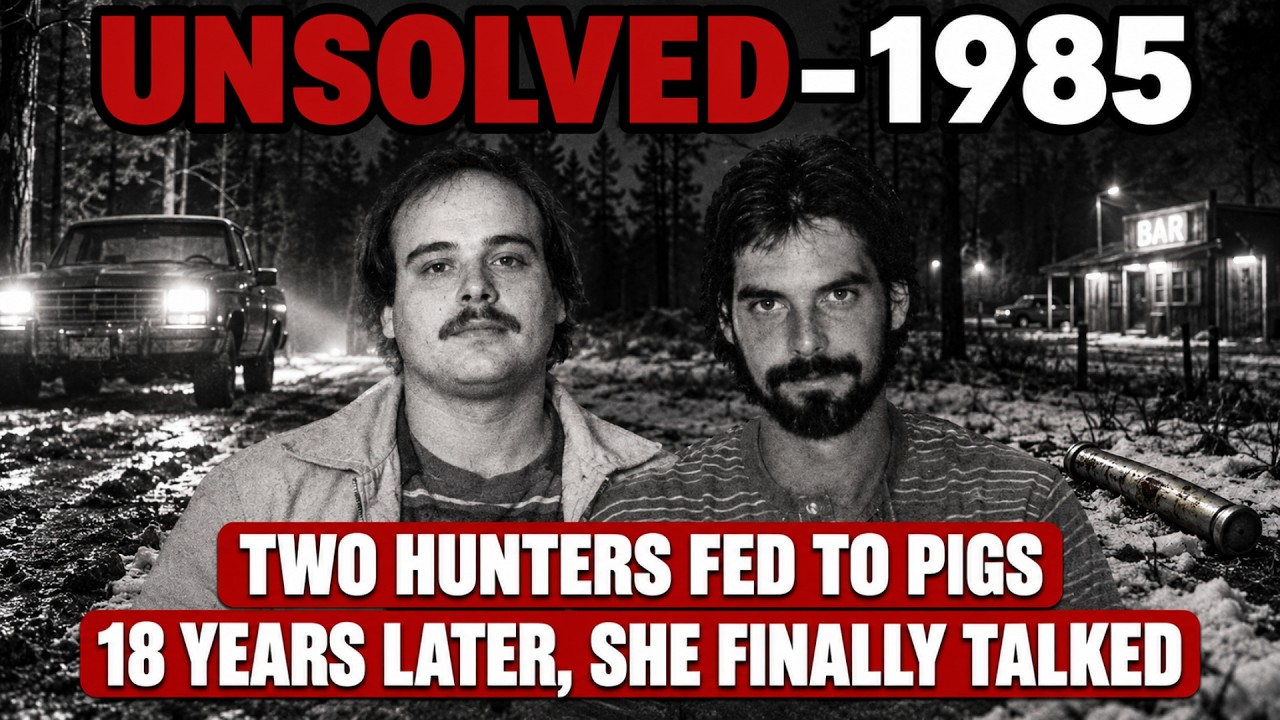
Ognjan was saving every dollar to buy an engagement ring for his girlfriend. They were reliable, hardworking men with lives ahead of them. They never reached the cabin. They never bought hunting licenses.
They never contacted their families again. The Bronco vanished. The rifles vanished. No blood, no clothing, no trace of the two men was ever found.
What followed was one of the most agonizing missing-person cases in Michigan history. Police deployed divers, ground-penetrating radar, cadaver dogs, and aerial searches. The case drew in the 15-person Alcona County Sheriff’s Office and even Interpol. Unsolved Mysteries aired the story nationally.
Thousands of tips poured in over the years, from sightings in Florida to claims of fugitives in Mexico and even a Bigfoot theory. Every lead dead-ended. The black Bronco, license plate 447 HRZ, seemed to have evaporated from the face of the earth. But in Mio, the residents knew what had happened that night.
They just did not dare say it aloud. The killers were the Duval brothers, seven men who lived by their own rules in the forests of northern Michigan. Raymond “JR” Duval Jr. , 34, and Donald “Coco” Duval, 33, were the eldest.
They ran a chop shop for stolen cars, poached trout and deer, tapped power lines for free electricity, and lived in rough cabins and trailers. Locals compared them to the backwoods thugs of the film Deliverance, multiplied. If you crossed one Duval, you faced all seven. Farmers blamed them for killing livestock.
Police, by their own admission, avoided contact unless absolutely necessary and always went in force. The Duvals silenced their neighbors with terror: dogs shot or run over, threats whispered about pretty nieces, midnight knocks on doors. For 18 years, no one in Mio spoke. According to testimony pieced together at trial, the trouble started inside Linkner’s Lounge.
Tyll and Ognjan, city boys enjoying themselves, drank beer, played pool, and flirted with waitresses. They were louder and more confident than was safe. JR and Coco Duval were present, and an argument flared. The Duvals made phone calls.
Friends and brothers began arriving at the bar. A witness named Barbara Boudreau and her boyfriend, Ronnie Emery, sensed the danger and left. The Duvals bought Tyll and Ognjan a six-pack of beer and told them they had better head home, because something was about to start. It was not advice.
It was a warning. Boudreau and Emery returned to her nearby home, just a few hundred yards down a dirt road, and settled in to watch Scarface on VHS. Outside, temperatures hovered near freezing, and light snow dusted the ground. Then screams tore through the night.
From inside the house, Boudreau and Emery heard cries for help and the sounds of beating. They saw a strange truck parked at the entrance to Boudreau’s driveway. Too frightened to use the front door, they climbed out a bathroom window and crept through the woods toward the noise. What they saw would haunt Boudreau for the rest of her life.
In the semicircle of light cast by truck headlights, the Duvals and their companions were beating David Tyll. He lay curled on the ground, begging them to stop, begging for his life. They used fists, boots, and an aluminum baseball bat. The sound of metal striking skull was like dropping a pumpkin on concrete.
Blood splattered everywhere. They beat him until he stopped moving, then kept beating him. They laughed. Brian Ognjan witnessed the murder of his best friend while two men held him.
He broke free and ran toward the darkness of the forest, running for his life. They caught him and dragged him back into the light. He collapsed completely, so terrified he lost control of his bladder. The Duvals laughed at him.
Then they beat him to death with the same bat, the same fists, the same boots. Minutes after Boudreau and Emery slipped back inside through the bathroom window, a knock came at the door. Boudreau opened it. Coco Duval stood there and said a single sentence that echoed in her mind for the next 18 years: “You didn’t see anything.
Pigs gotta eat too. ”
The Duvals later bragged to many people, in many places, that they had cut up the two bodies, put them through a wood chipper, and fed them to their hogs. The Bronco was taken to a scrap yard and dismantled piece by piece. No bodies, no bone fragments, no blood, no weapon were ever found.
The Duvals knew that even if everyone knew what happened, no one could prove it. For years, the case went cold. The original detectives retired or transferred. The families of Tyll and Ognjan appeared before cameras every November, pleading for information, with no result.
Then the case files landed on the desk of Michigan State Police investigator Robert Lessnicky, nicknamed “Bronco,” in the late 1990s, more than 15 years after the disappearances. Lessnicky was not the sort of detective to shelve a file. He read thousands of pages, reorganized chaotic boxes of documents, and worked hundreds of unpaid hours, often carrying a shovel in his trunk to dig at any piece of metal protruding from the forest floor near Mio. He re-interviewed old witnesses.
One tip changed everything. A woman told him that another woman, who lived near the tavern in Luzerne where Tyll and Ognjan were last seen, might know something. Her name was Barb Boudreau. Lessnicky began knocking on doors after his shifts, at night, unmarked car, asking for her.
When he finally found her, the woman trembled violently and said, “You’re gonna get me killed,” before slamming the door. He returned the next day, and the next, and the next. He came as a neighbor, helping with repairs, installing a security camera, always careful that no one saw a police car at her house. Over many months, Boudreau began to talk, but at first in a specific way: she claimed her boyfriend Ronnie Emery had gone outside and seen everything.
Since Emery was dead, her account was hearsay, useless in court. Lessnicky understood. She was protecting herself. In 2002, Prosecutor Mike Cox authorized subpoenas compelling Boudreau and other witnesses to testify under oath in Lansing.
When Boudreau finished her story through the dead man’s eyes, Lessnicky turned off the recorder, leaned close, and begged her to tell the truth. Something shifted in her eyes. She said, “You know I saw it, don’t you? ” He said yes.
Then she said four words he had waited years to hear: “I’m a dead woman. ” And she told the story as her own. She was there. She watched the Duvals beat two young men to death under truck lights.
She heard the batting of the skull, the pleading, the laughing. She stayed silent for 17 years because she believed speaking meant death. In May 2003, nearly 18 years after the murders, JR and Coco Duval were arrested and charged with two counts of first-degree murder. The trial moved to Standish, about 60 miles from Mio, to escape intense local coverage.
The prosecutor was Donna Pendergast, a tough assistant attorney general who had put dozens of killers behind bars. But this case was unlike any she had handled: no bodies, no physical evidence, no weapon, no confession. Only witnesses, the most important being a recovering alcoholic who had drunk nine drinks on the night of the murders and stayed silent for nearly two decades. Boudreau testified calmly, facing the brothers for the first time since they had knocked on her door.
She described the truck lights forming a semicircle, the aluminum bat, the sound of it striking Tyll’s skull, Ognjan being held, breaking free, running, being dragged back, collapsing in terror, and the Duvals laughing. She described Coco Duval at her door saying she had seen nothing, and that pigs had to eat too. The defense attacked her credibility: the alcohol, the 18-year gap, the changing story. She held firm.
The defense then called bizarre witnesses. One claimed Tyll and Ognjan had told him they planned to leave the country. Another, a Duval brother, claimed to remember nothing due to cocaine, a stroke, and Alzheimer’s. A third claimed his friends had killed the two men with a hatchet in Grayling and drowned them in a river, and that he had a personal connection to serial killer Leslie Williams.
Pendergast demolished him in cross-examination, asking whether he knew who prosecuted Leslie Williams. When he said no, she replied, “You’re looking at her. ”
The Duvals did not take the stand. In closing arguments, Pendergast told the jury not to reward the defendants for 18 years of lies and intimidation.
She turned and looked directly at the brothers and said, “Those faces are just masks for monsters. ” The jury deliberated for about two hours. They returned a verdict of guilty on all charges. Both brothers were sentenced to mandatory life in prison without parole.
Brian Ognjan’s 77-year-old mother said, “God answered my prayers. ” David Tyll’s father told reporters, “They took my son. ”
The conviction without a body, without physical evidence, became one of the most extraordinary in Michigan legal history. The Duvals’ appeals were rejected.
Investigators believed at least three other people witnessed or assisted in the murders, but no one else was ever charged. Barbara Boudreau died in 2007, four years after the trial. In 2005, Dawn Duval, the brothers’ daughter, who had suffered abuse within the family, was convicted of second-degree murder for stabbing a man to death. Violence bred violence.
David Tyll and Brian Ognjan were never found. The black 1980 Ford Bronco was never found. Every November, when deer hunting season returns, hunters still drive the road where Linkner’s Lounge once stood. The story was never forgotten.
Asked for a motive, Pendergast said she had no answer, because there was no way to understand why Brian and David died. It was pure evil. As she put it, you can only recognize it for what it is.