William Slim was not the general the world remembered. That honor belonged to Montgomery, the victor of El Alamein, whose face and name filled the newsreels and the bronze monuments. Slim himself had once dismissed a rival as no more than a colonial general, a soldier unworthy of his attention. But among the men who fought the Second World War on its harshest front, in the jungles and mountains at the edge of the earth, one commander stood above all the rest.
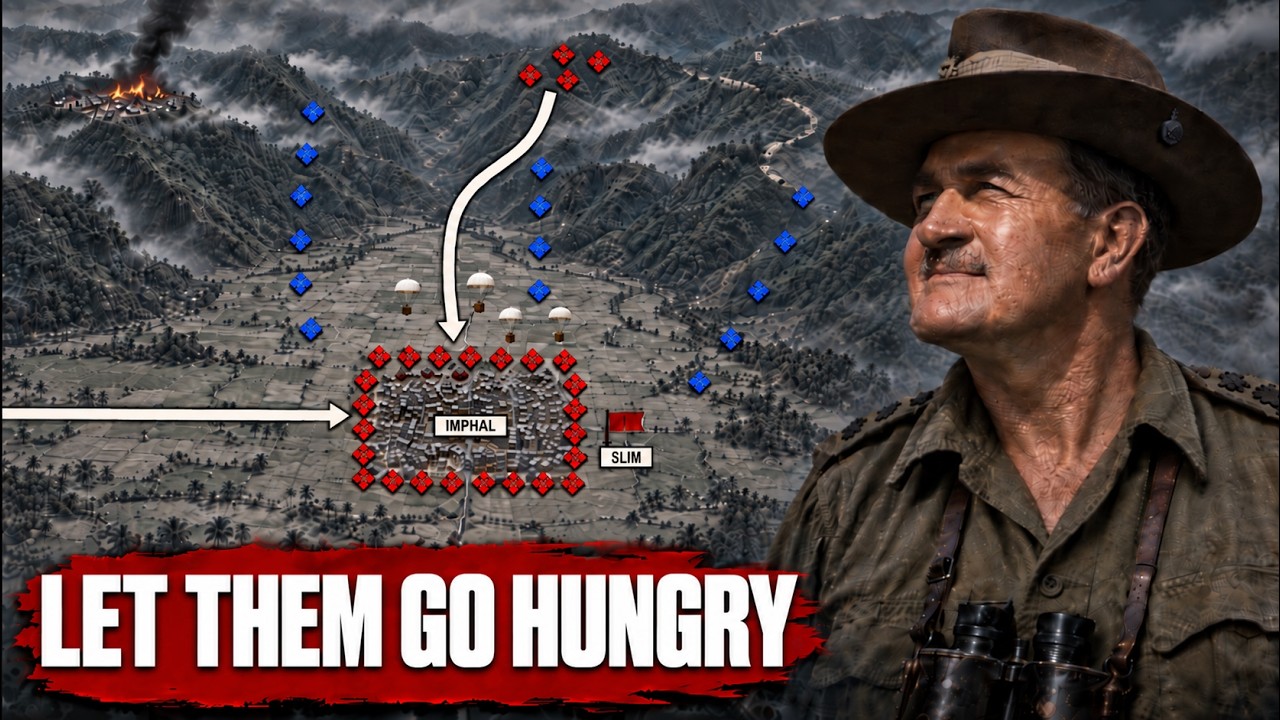
His men did not fear him. They loved him. They called him Uncle Bill. Field Marshal William Slim commanded the longest retreat in British military history, then turned it into the greatest land defeat the Japanese army ever suffered.
And yet history nearly forgot his name entirely. Three battles defined his Burma campaign. In each, he used the same weapon in a different way, and in each, he broke the Japanese army’s grip on Asia. Two years before those battles, in 1942, Slim led a shattered army in a fighting withdrawal of nine hundred miles out of Burma, the longest retreat in British military history.
He never forgot the lessons of that defeat. He rebuilt his broken men, restored their pride, and taught them a new way to fight. By the winter of 1943, that army was advancing back through the coastal jungles of the Arakan in western Burma. The Japanese were waiting.
In February 1944, they struck in an operation they called Ha-Go. For two years, the Japanese had won nearly every jungle battle the same way: slip through the trees, encircle the enemy, cut his supply lines, then wait for the trapped British to lose their nerve and collapse. The plan had never failed. Lieutenant General Tadashi Hanaya expected the same result again.
But Slim had studied this trap for two long years, and he had prepared the answer. He reversed Japanese fighting doctrine completely. Trapped units were forbidden to retreat. Instead, they formed a defensive box, a hedgehog bristling with guns in every direction.
They held their positions and were supplied entirely from the air. The enemy would be allowed to encircle them. The men inside would not starve. They would be fed from the sky.
On the sixth of February, the Japanese overran the headquarters of the 7th Indian Division and closed their rings around a patch of dry rice fields at Sinzweya, no more than twelve hundred yards across. Inside were seven thousand men: cooks, clerks, drivers, and gunners. History would remember the position as the Admin Box. The fighting was face to face, and it was merciless.
On that first night, the Japanese seized the main dressing station and killed the wounded where they lay. Thirty-one helpless patients and four doctors were bayoneted on their stretchers. When the men of the West Yorkshires fought their way back to the position, they found only a handful of survivors. But the atrocity did not break the defenders’ will.
It hardened it. Every man in the Box knew exactly what surrender meant. If the Box collapsed, the entire Arakan front would collapse with it. Twice the enemy set fire to the ammunition dumps.
Twice those fires were put out. But the Japanese found no answer to the Lee tanks that prowled the perimeter. As the days passed, it was they, not the British, who began to go hungry. They had wagered everything on seizing the supplies inside the Box, but the Box did not yield.
On the twenty-second of February, the 5th Indian Division fought its way through the Ngakyedauk Pass and broke the siege. One Japanese regiment entered the battle with more than two thousand men. It came out with no more than four hundred. In eighteen days of fighting, the Japanese lost more than five thousand soldiers, nearly three hundred killed and wounded for every day of the siege.
As Slim himself said, for the first time a British force had met a major Japanese offensive, held against it, and defeated it decisively. The legend of the invincible Japanese army, the myth that had haunted every British soldier since the fall of Singapore, died in the dust of the Admin Box. But the Box did more than break a myth. It proved one revolutionary truth: a surrounded force that kept its nerve and received supplies by air could turn encirclement itself from a death sentence into a killing ground.
Slim had not chosen that battle. The Japanese had forced it on him, and he had simply refused to lose it. Now he knew the method worked. He had found the only weapon capable of defeating the Japanese army, its hunger, and he had found it by accident in a single rice field.
The question was what he would do with that weapon when he used it deliberately. In March 1944, the blow fell. Lieutenant General Renya Mutaguchi believed his destiny was to decide the war’s decisive battle for Japan. His plan, known as U-Go, was staggering in its ambition.
Three divisions were to cross the rugged frontier mountains, seize the bases of Imphal and Kohima, and burst into the plains of India. But Mutaguchi carried almost no supplies. He gambled everything on speed, confident he could capture the British stockpiles before the monsoon began and drowned the jungle roads. The Japanese even had a name for the enemy rations they intended to live on: Churchill supplies.
Slim saw the gamble for what it was and decided to frustrate it. In the Admin Box, survival had been forced on him. Here, for the first time, he would do the same thing deliberately, not to escape a siege but to build one. Instead of meeting the Japanese in the forward hills, where his own supply lines would be dangerously stretched, he did something that looked to many like a retreat.
He pulled his advanced divisions, the 17th and 20th Indian, deliberately back from the mountains to the Imphal plain. There, on ground of his choosing, his supplies arrived over good roads and by air, while every mile the Japanese advanced stretched their own lines through the valleys. He was not defending a line. He was setting a trap the size of a country and inviting an entire army to walk into it.
Then came the logistical masterstroke. When the road to Kohima was cut and his reserves were exhausted, Slim and his superior Louis Mountbatten pulled transport aircraft off the great supply route over the Himalayas and flew an entire division, the 5th Indian, directly from the Arakan to the battlefield. Men who had been fighting in a coastal jungle in the morning found themselves in the heart of the fight at Imphal three days later. The fiercest fighting of all came at the small hill station of Kohima.
There, fifteen thousand Japanese soldiers of the 31st Division attacked a garrison of barely fifteen hundred men. The two sides fought across the tennis court of the deputy commissioner’s bungalow, so close they exchanged grenades across the court’s width. Their commander, Lieutenant General Kotoku Sato, had toasted his officers with champagne before the attack and told them the plain truth. Most of them would likely lose their lives in the operation.
They must be prepared to starve to death in those mountain strongholds. If Kohima fell, the road lay open to the great supply base at Dimapur and the plains of Bengal beyond, the gateway to India itself. The garrison held. Reinforcements fought their way through, the siege was broken, and on the twenty-second of June the road between Imphal and Kohima was reopened.
In the mountains, Mutaguchi’s grand design was collapsing. His starving men could not be fed from captured stores that never arrived. Sato, his best subordinate, openly disobeyed his orders, cut communications, and led his emaciated division out rather than watch it die in vain. Mutaguchi, driven mad by failure, ordered his men to fight with their bare hands and even with their ghosts if their bodies failed them.
The route of that retreat became known as the Road of Bones, littered with the corpses of men who had starved. The numbers were staggering. Of an army of eighty-five thousand, some fifty-three thousand were killed or missing. For every British or Indian soldier who fell, three or four Japanese perished, and most of them had not died in battle at all.
They had starved. It was the greatest defeat the Japanese army had ever suffered in the field, and Mutaguchi had marched into it exactly as Slim had planned. In the Admin Box, the enemy had encircled one division by accident. Here, Slim had done the encircling himself, deliberately, on a scale a hundred times larger.
The desperate reaction in a single rice field had become the cold blueprint for an entire campaign. What had once been survival became annihilation. But defense was never Slim’s ambition. While the monsoon washed the last remnants of Mutaguchi’s beaten army into the hills, Slim turned to the offensive and to the boldest deception of his career, one that would lead his army across one of the greatest rivers on earth.
By the first weeks of 1945, Slim’s Fourteenth Army was pushing the defeated Japanese toward central Burma and the great barrier of the Irrawaddy River. Before the crossing, a young corporal named George MacDonald Fraser stood in the ranks as Slim came to speak to his battalion beside a lake. Fraser never forgot it. Slim was a huge, plain man with a strong jaw and an unmilitary uniform.
He spoke not of glory but of the hard, ordinary work of killing the enemy in the open. Yet, Fraser wrote, this was a man with the mind of a general and the heart of a simple soldier. Slim’s original plan was to encircle and destroy the Japanese in the open Shwebo plain north of the Irrawaddy. But the new Japanese commander, Lieutenant General Heitaro Kimura, was no fool.
He pulled his entire army behind the river, a full mile of open water, and waited. He would let the British exhaust themselves in the crossing, then annihilate them at the water’s edge. It was a cunning plan. And it rested on one assumption: that Kimura knew where Slim’s army was.
He did not. Within days, Slim redesigned his entire campaign. He kept his 33rd Corps advancing noisily toward Mandalay in the north, drawing all Japanese attention to the obvious crossing points. In complete secrecy, he detached an entire corps, his 4th Corps, and sent it on a march of more than three hundred miles through a hidden valley to the south under total radio silence.
Then came the detail that made the whole plan work. To conceal the disappearance of an entire corps, Slim left a ghost in its place. A dummy corps headquarters remained in the north, broadcasting the same volume of radio traffic as before, so Japanese eavesdroppers heard the 4th Corps in its usual position long after its soldiers had slipped south. Kimura was guarding a ghost.
The real objective was not Mandalay at all. It was a dusty road-and-rail town far to the south called Meiktila, the beating heart of the entire Japanese supply system, the hub through which nearly every ton of food and ammunition destined for the front passed. Here was the final touch of Slim’s art. He had won two previous battles by staying still and letting the enemy starve himself against a wall.
Now he would use the same weapon, the enemy’s need for food, and instead of waiting patiently for hunger to do its work, he would reach out and cut the artery with a single stroke. Once Meiktila fell, the lifeline of every Japanese army in Burma would be severed in a single day. Slim called it the vital blow. On the night of the thirteenth of February 1945, the 7th Indian Division began crossing the Irrawaddy at Myingyan, where the river was nearly two thousand yards wide.
Slim described it as the longest river crossing under enemy fire in any theater of the war. The point he chose lay exactly on the boundary between two Japanese armies, the weakest point in the entire line. Then he unleashed his armor. The 17th Indian Division with its Sherman tanks broke out of the bridgehead and drove hard for Meiktila.
When the news finally reached a Japanese staff officer that the British were already ninety miles behind the front, he could only stammer in disbelief that there must be some mistake. There was no mistake. On the first of March the attack began, and by the evening of the third, Meiktila had fallen. Kimura realized too late what had been done to him.
The loss of Meiktila had severed the lifeline of his entire army in Burma. In his fury, he threw division after division at the town to retake it. But the commander Slim had placed there did not fortify and wait for a siege. He controlled the city with flexibility and sent his tanks out in every direction, smashing the Japanese attacks to pieces.
On one occasion the enemy attacked using a captured British tank. It, too, was destroyed. The counterattacks shattered against the armor, and Japan’s finest formations were drained to the last man. Meanwhile, to the north, the 19th Indian Division stormed the heights of Mandalay Hill and surrounded Fort Dufferin, the great fortified citadel in the heart of the city.
Its walls were so massive that bombs and heavy guns firing directly could not breach them. In the end, the Japanese garrison simply fled through the sewers under cover of darkness. On the twentieth of March, Mandalay fell. In the Battle of Central Burma, the Japanese lost some thirteen thousand men, nearly three dead for every one of Slim’s soldiers.
But the real loss was Japanese Burma itself. With their supplies cut off, Kimura’s armies disintegrated, and the road to Rangoon lay open. In the space of a few weeks, Slim had crossed a mile-wide river, deceived an entire army with a ghost, and destroyed the Japanese force in Burma forever. Three battles, and in each, the same single weapon, the enemy’s own hunger, used in three different ways.
In the Admin Box, he turned the enemy’s encirclement into its grave. At Imphal, he set a trap the size of a country and let an entire army walk into it. At the Irrawaddy, he struck deep behind the enemy front and cut the lifeline before the enemy knew the blade had fallen. The historian Frank McLynn would later rank Slim’s crossing of the Irrawaddy among the greatest military achievements in history, alongside Hannibal at Cannae and Napoleon at Austerlitz.
He fought with fewer men, worse supplies, and over harsher terrain than any other British commander in the war, and yet he achieved the greatest land victory of them all. Montgomery captured the headlines. But Louis Mountbatten, who had watched both men closely, called William Slim the finest general the Second World War produced.
Perhaps the only real mistake Uncle Bill ever made was his excessive modesty, which kept him from saying so himself.