The night before she died, Queen Victoria dictated twelve pages of instructions for her own burial. She specified what she would wear, what would be placed beside her, and what would be concealed from her family. When the family gathered at Osborne House to look into her coffin, they saw the items that matched the public story of her life: Albert’s dressing gown, the plaster cast of his hand, and both wedding rings. What they did not see was a photograph of John Brown wrapped in tissue paper, a lock of his hair, and the wedding ring Brown had given her in 1883.
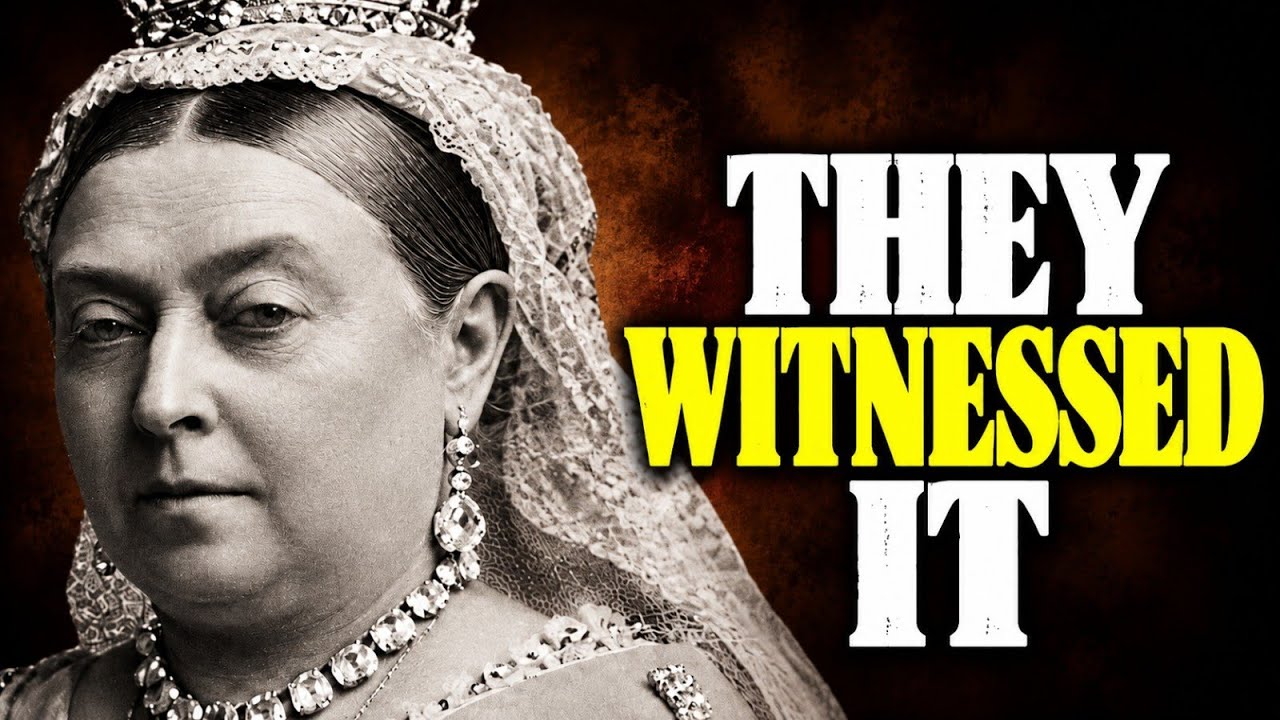
These lay hidden under flowers arranged specifically to keep them invisible. After the family was asked to retire, Sir James Reed, Victoria’s physician, carried out the private instructions alone. The portrait history has preserved of Victoria is consistent: the black dress worn for four decades, the imperial stare, the grieving widow loyal to a dead man, the iron monarch who ruled for sixty-three years and seven months. All of that is documented.
None of it is the complete picture. The women who served her at the closest range described her in their private letters home, with no audience but their families, as selfish, demanding, and contradictory. These were not political enemies. They were aristocratic ladies of the bedchamber who loved their positions and would not have given them up.
And still, from inside the arrangement, the word that emerged across the private record was prison. The first system that shaped Victoria was not her own. Sir John Conroy entered the household after her father died in 1820, when Victoria was eight months old. He saw the opportunity clearly: a financially precarious widowed duchess, isolated from the senior royal family, in possession of a daughter who would one day inherit the throne.
If he could make that child psychologically dependent on her household and keep her isolated from all external influence until she turned eighteen, he would control either the queen or the regent who governed in her name. He called his strategy the system. Others called it the Kensington system. The rules were comprehensive.
Victoria was not permitted to walk downstairs without holding an adult’s hand. She was not allowed to be alone at any time. She shared a bedroom with her mother every night from infancy until the morning she was told she was queen, at which point she immediately and permanently moved her mother to separate rooms. Conroy moved his own family into Kensington Palace, eliminated potential sources of external influence, and organized public tours across Britain to build the public’s association of Victoria with his household.
The tours were not for her education. They were for the cultivation of a political asset. In 1835, when Victoria was sixteen and ill at Ramsgate, Conroy attempted to force her to sign a document granting him a formal position as her private secretary. He stood at her bedside with her mother present, both adults united in requiring her compliance.
She refused. He tried again. She refused again. The document was never signed.
The system had tried to create someone incapable of resistance. It had instead built someone incapable of accepting control from anyone other than herself. On June 20, 1837, Victoria met her council alone. Her mother attempted to accompany her.
Victoria closed the door. The machinery Conroy had spent sixteen years building produced the opposite of everything it had intended. But the system had not left her unchanged. It had given her a complete model of what total control over a human environment looked like.
Once she had the power to apply that model outward, she applied it with the precision of someone who had been studying it from the inside for nearly two decades. The Lady Flora Hastings affair of 1839 was the first public demonstration of that legacy. Lady Flora presented herself to the court physician with abdominal swelling. Victoria recorded in her private journal the suspicion that Flora was pregnant by Conroy and pushed for a medical investigation.
Lady Flora was subjected to a physical examination she later described as rough, prolonged, and humiliating. It found nothing. She was not pregnant. A tumor on her liver was killing her.
She died in July 1839, weeks after the examination ordered by a twenty-year-old queen acting on personal resentment dressed as moral concern. The conditions of court life tell their own story. At Balmoral, the cold inside the private apartments was severe enough that the cushions on the billiard table froze solid. Victoria found the cold invigorating.
Her preferences determined every physical condition of the environment. Dinner at Windsor began at nine in the evening and lasted thirty minutes. Victoria was served first, ate fast, and the moment she placed her utensils down, the plates of everyone else were cleared. Prime Minister William Gladstone, who chewed each mouthful thirty-three times as a personal discipline, would find his plate removed while he had barely started.
Rules for ladies in waiting were framed behind glass and posted on the walls of their rooms: the distance they could travel from the palace required formal permission, and mandatory attendance could extend for weeks. Charlotte Canning, an accomplished artist, had her original watercolors confiscated by the Queen and incorporated into Victoria’s own souvenir albums without credit or acknowledgment. The physician management system was among the most clearly documented. Sir James Reed joined the household in 1881.
The minimum attendance requirement was four presentations per day. When Victoria was anxious or unwell, the number reached eight across an eighteen-year tenure. She wrote to him every single day when they were geographically separated. His predecessor, Dr.
William Jenner, had become what the household diaries called a hopeless alcoholic under the pressure of the role and was counseled to resign. Victoria rarely raised her voice. Her preferred instrument was calibrated withdrawal: the pointed note left unanswered for days, the sustained look of cold disappointment delivered in full public view. When her chaplain, Randall Davidson, counseled her against publishing her personal memoir of John Brown, a document every senior figure in the household judged wholly inappropriate for release, she was furious.
His position at court became so uncomfortable that he departed. The household learned what the cost of honesty was. The financial record reveals the same pattern. Parliament was told Victoria was desperately short of money, and the civil list allocation was increased.
Separately, her savings from the civil list alone had by 1889 reached £824,025. Her income ran across at least four streams that were never consolidated into a single public accounting. In 1872, Liberal MP Sir Charles Dilke introduced a motion for a full public inquiry into the Queen’s expenditure. Disraeli’s government deployed the full weight of parliamentary skill to defeat it.
Prince Albert died on December 14, 1861. What followed was not grief in any conventional sense. It was an operational architecture designed to refuse the fact of his physical absence. The morning after his death, Victoria had the Blue Room photographed completely, and the photographs were used as a permanent reference standard.
Fresh flowers were displayed continuously. New clothes were laid out on Albert’s bed every day. Hot water was added to his washstand every morning. These orders remained in force for the remaining forty years of her life.
Every bed in which Victoria slept had attached to it, at the back on the right-hand side above the pillow, a photograph of Albert’s head and shoulders as he lay dead, surmounted by a wreath of immortelles. The plaster cast of Albert’s hand was made immediately after his death. Victoria required it to accompany her into her coffin. The instruction was carried out.
John Brown had been Albert’s personal Scottish ghillie before the prince’s death. Victoria came to associate his proximity with the proximity of Albert’s spirit. Brown drank heavily, smoked a pipe whose smell was unpleasant, and was openly rude to members of the household far above his rank, including the Prince of Wales. Victoria noticed none of it.
When she fell seriously ill in 1870, Brown was admitted to her private rooms. Her adult children, who had traveled to Windsor in response to the illness, were kept in the outer rooms. When Brown died in 1883, Victoria commissioned portraits, ordered statues, designed a memorial brooch, and wrote a personal biographical memoir of him. The memoir was suppressed after her death by her private secretary, Henry Ponsonby, who understood it represented a threat to the institution.
Her private correspondence with her eldest daughter contains the most concentrated record of how she thought about her own children. She called pregnancy the shadow side of marriage. She described carrying children as the misery and plagues that women endured because of selfish men. She told the Princess Royal that newborn infants were froglike.
She wrote that children were an incumbrance. She had nine of them. When her eldest son Bertie became involved in a scandal at Cambridge, Albert traveled to manage the situation personally. He was already ill with the disease that would kill him within weeks.
Victoria held Bertie responsible for his father’s death. I never can or shall look at him without a shudder, she wrote to her twenty-year-old son. She refused to give him access to state papers for decades. He was fifty-nine when he finally became king.
Her youngest daughter Beatrice sought to marry Prince Henry of Battenburg. Victoria responded with total communicative withdrawal, passing notes across the breakfast table rather than addressing her daughter verbally, until Beatrice agreed that she and her new husband would reside permanently with the queen. Henry was confined to a life of decorative proximity. In 1895, he obtained Victoria’s reluctant agreement to serve in the Ashanti expedition.
He contracted malaria and died at sea at the age of thirty-five. Victoria died on January 22, 1901. Within hours, the erasure of the private Victoria began. Beatrice had been tasked with transcribing Victoria’s journals, and as she produced each section, she fed the originals into fires she personally supervised.
The most revealing passages are not edited in the surviving record. They are ash. Ponsonby destroyed the Brown memoir. The phrase we are not amused, with no reliable primary source, became the cultural shorthand for the reign.
The portrait was built from a record that had been edited specifically to produce it. The woman at the center of it understood the gap between her private and public self, with enough clarity to arrange its concealment from inside her own coffin. The question the record still cannot answer is how much of what burned in Beatrice’s fires would have changed everything we think we know.