On the third of January 1946, William Joyce walked into the execution chamber at Wandsworth Prison. He was thirty-nine years old. Waiting for him was Albert Pierrepoint, Britain’s most experienced hangman, a man who had perfected the long-drop method of execution, a technique designed to break the condemned person’s neck cleanly and instantly. Joyce’s arms were bound behind his back, his legs tied together, and a white hood was placed over his head.
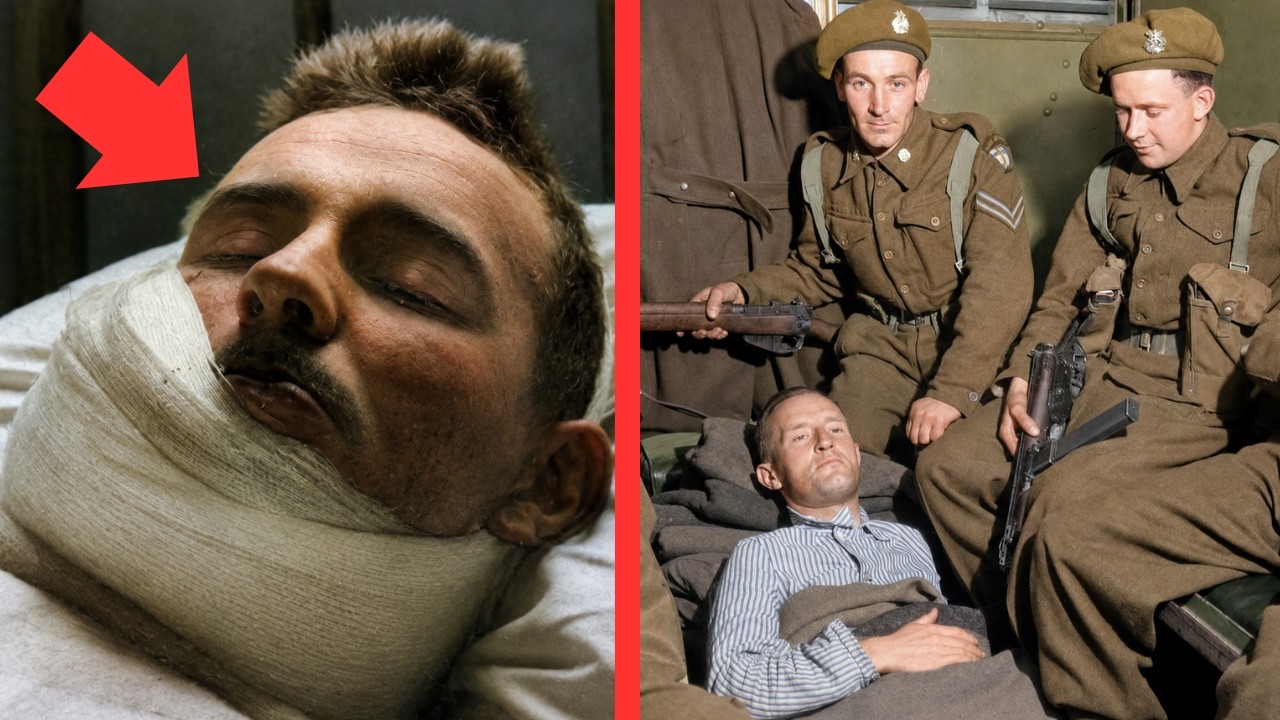
Pierrepoint adjusted the noose, checked his measurements, and pulled the lever. The trapdoor opened, and Joyce fell. But what followed was not a clean execution. As Joyce reached the end of the drop and the rope snapped taut, the force of the fall tore open an old scar on his face.
Blood poured onto the floor of the execution chamber. By the time his body was cut down, his face, his clothes, and the room itself were covered in blood. The doctor who had to confirm his death struggled with the task. The entire scene was so gruesome that it was later described by some as a crime in itself.
Yet even before the bloodshed, a deeper question hung over the case. William Joyce, known to millions as Lord Haw-Haw, had just been hanged for treason against the British Crown. But many argued that he should never have been hanged at all. William Joyce had always moved against the current.
He was born in the United States, a fact that would later become central to his trial. His father was Irish and his mother came from an Anglo-Irish family. When Joyce was still young, the family returned to Ireland. There, according to some accounts, he worked as a courier for enemies of the Irish Republican Army, and at one point the IRA tried to kill him on his way to school.
He survived, but the violence left its mark on him. He later moved to England, where he became involved in right-wing politics. In 1932, he joined the British Union of Fascists, led by Sir Oswald Mosley. By then, Joyce was already seasoned in political street fighting.
A scar across his face, the result of an attack by Communists, was a permanent reminder of those battles. Within the fascist movement, he found his true place. Witnesses described him as a thin, pale, intense man who electrified audiences within minutes of speaking. He became the movement’s director of propaganda and a fighter who was not afraid to bloody his hands against his enemies.
His rhetoric mirrored the Nazis in Germany, aimed at the same groups they would later persecute. Eventually, Joyce was expelled from the British Union of Fascists. With war between Britain and Nazi Germany looming, he and his wife Margaret left Britain and fled to Germany. In 1940, he became a naturalized German citizen.
The Nazis welcomed those who shared their beliefs, and Joyce found work in the Reich Ministry of Propaganda. He was initially hired as a news announcer for the German radio’s English service. He quickly became the most famous British broadcaster in Germany. His program, Germany Calling, was beamed directly to Britain.
Millions listened. In his broadcasts, Joyce mocked the British war effort and tried to demoralize the population, urging them to abandon their government and align with the Nazis. It was from these broadcasts that he earned the nickname Lord Haw-Haw. For most British listeners, the show became a source of amusement rather than fear, but Joyce’s work went beyond the airwaves.
He wrote propaganda books and materials that were distributed among prisoners of war, and he even tried to recruit British POWs into a Waffen-SS unit being formed, known as the British Free Corps. For his efforts, Hitler awarded him the War Merit Cross, though the two men never met. Joyce made his final broadcast on April 30, 1945, the same day Hitler died. Berlin was collapsing under Soviet bombardment, and Joyce was drunk.
After the broadcast, he fled. Knowing he would be easier to capture in the cities, he headed for the countryside and reached Flensburg, near the German border with Denmark. Flensburg had become the last capital of the Third Reich, where Admiral Karl Dönitz had established his government after Hitler’s death. But the British were hunting Joyce.
They knew exactly who Lord Haw-Haw was. Rumors reached them about a British couple living in the village of Keffermarkt, and British intelligence officers moved in. According to the account, Joyce was walking alone in the woods after an argument with his wife. When the officers approached him, Joyce reached into his pocket to pull out his passport.
They mistook the movement for an attempt to draw a weapon, and shot him. He was taken to Britain and put on trial for treason. The charge carried three counts. Joyce pleaded not guilty.
His defense argued that he had never been a British citizen, and therefore could not be a traitor. They claimed he had never acknowledged the authority of the Crown, so he owed it no allegiance. But the court rejected that argument. William Joyce, Lord Haw-Haw, was sentenced to death and transferred to Wandsworth Prison.
His appeals failed. While awaiting execution, he showed no remorse. He reportedly said, “Let the swastika be raised from the dust. ” In his final written words, he challenged what he called the forces of darkness, warned the British people about the overwhelming imperialism of the Soviet Union, and expressed pride in dying for his ideals.
He wrote, “I am proud to die for my ideals, and I am sorry for the sons of Britain who died without knowing why. ”
The execution itself, however, became part of the controversy. Pierrepoint had measured Joyce carefully to calculate the drop distance that would break his neck. But the force of the fall reopened the old scar on Joyce’s face.
The blood that flowed made the proceedings far more brutal than the standard hanging. Even after his death, the debate over whether Joyce should have been executed continued. Those who defended him argued that he held a British passport illegally, and that possessing a passport did not place him under the Crown’s protection or impose any duty of allegiance. They pointed out that Joyce was Irish and American, that his British nationality was effectively cancelled when he became a German citizen, and that he should have been treated as a prisoner of war rather than a traitor.
He had been born an American citizen and later became a German citizen. Whether he had ever truly been British, and therefore whether Britain had the right to hang him, remains contested to this day. The historian A. J.
P. Taylor later remarked that Joyce was, in a technical sense, hanged for making a false statement when applying for a passport, an offense normally punishable by a small fine. In the modern era, it is likely that Joyce would have escaped most punishment entirely. After his execution, Joyce’s body was buried in an unmarked grave inside the walls of Wandsworth Prison.
His family was not allowed to claim it. But in 1976, thirty years after his death, his daughter successfully petitioned for the release of the remains. His body was exhumed and taken to Ireland, where he was reburied in a cemetery in Galway. The case of William Joyce, Lord Haw-Haw, remains a source of disagreement.
Many believe he was wrongly executed. His execution was certainly bloodier and more savage than intended, ending in a scene of chaos in the execution chamber. And yet his name remains permanently associated with treason, one of the most infamous figures of the Second World War.