In the autumn of 1947, as the last British survey teams began their slow withdrawal from the Himalayas, a 38-year-old surveyor named Aldis Peton sat in a monastery courtyard east of the Khumbu Glacier and listened to a story that would follow him for the rest of his life. The monk who told it was named Dorje Wangchuk, sixty-four years old, with close-cropped gray hair and eyes that Peton would later describe as very still. He had spent more than three decades in those mountains, and for most of that time he had watched the ranges north of the valley with a care that bordered on obsession. Peton had come to the monastery because of a guide named Pasang, a man known among the British teams for his steadiness and his refusal to embellish.
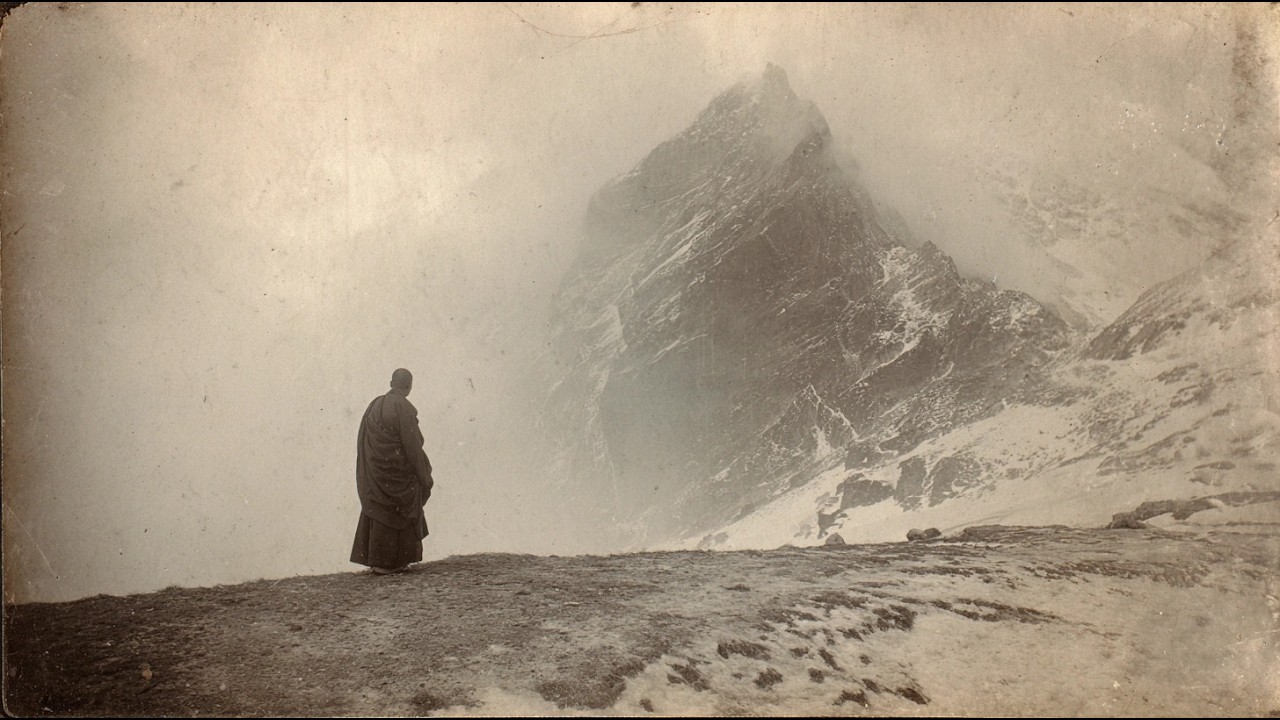
Pasang had told him that the monk had witnessed things in the high ranges that Peton should hear before his team moved any further north. When Peton asked how reliable the monk was, Pasang said only that Dorje Wangchuk was the most reliable person he had ever met in his life. Peton was an empirical man. He had spent eleven years doing survey work across British India and Nepal, recording measurements and trusting numbers over stories.
His father, a church vicar, had taught him that the human mind was skilled at constructing elaborate fictions to explain what it did not understand. Peton had refined that skepticism into a professional practice. He kept a separate journal for the stories he heard from porters and guides, labeled simply local accounts, dated with care. He was not credulous.
He was thorough. That thoroughness had brought him to the monastery. The monk asked through Pasang whether Peton was asking because he wanted to go up into the ranges himself. Peton said he was simply trying to be thorough.
The monk was quiet for a long moment. Then he said, through Pasang, that was not what he had asked. What followed took three days. Dorje Wangchuk spoke in Tibetan, with occasional pauses where words had no equivalent in any other language, because the things they described had no equivalent anywhere else in the world.
Peton wrote it all down. The monk told him that the lower ranges of the massif had not always been a concern. A hundred years before his time, they were simply mountains. The change began slowly, in the latter half of the previous century.
Herders reported animals behaving strangely near certain passes, standing still and refusing to move, dogs sitting with their heads low and their eyes showing white. A merchant who had used a particular pass for over a decade arrived at the monastery one evening changed, as if something he had believed about the way the world worked had been quietly removed without his permission. He had been crossing the pass at dusk when he felt a physical certainty that something of considerable size was standing directly behind him. He turned.
There was nothing there. Thirty steps later, the feeling returned. The wind had stopped both times, completely, and the silence was the wrong kind. Not the absence of sound, but something using the space that sound normally uses.
Dorje Wangchuk had first gone to the lower ranges when he was twenty-six, accompanied by his teacher, an older monk named Gyalwa Rinzin, who had taught him that the things in those ranges operated according to rules that human beings were not designed to read intuitively. They reached a broad plateau two-thirds of the way up the range and waited. In the second hour, the monks became still. Dorje Wangchuk followed their attention and saw something moving along a natural shelf about three hundred meters above them.
His first thought was that it was a large animal. His second thought was that he did not know of any animal that moved in that way. It moved laterally, from east to west, at a consistent pace, but the relationship between its size and its speed was off. Things that size moved with a weight you felt before you heard it.
This thing moved the way shadows move, quick and without heaviness. It stopped with a sudden completeness, not resting but attending. It was facing toward them. From that distance, he could not make out details, only that the overall shape was tall and wrong at the top, and that the more he looked, the less it resolved.
As if the harder you focused, the less it was willing to be seen clearly. After about ten minutes, it moved on, disappearing behind an outcrop. Gyalwa Rinzin waited another twenty minutes before leading them down. That evening, he explained that the things in those ranges were not new.
The monastery’s records, going back several centuries, described encounters in broadly similar terms. Large. Moving strangely. The upper portion of the figure poorly defined.
Associated with a particular quality of silence and a sudden drop in wind. The accounts did not agree on what the things were. The oldest ones did not try to categorize them at all. The frameworks that later generations brought to bear never quite fit.
They were not interested in us, Gyalwa Rinzin said, and that was the most important thing. The problem was not them noticing us. The problem was deciding we understood them. In the spring of 1931, a German mountaineering team arrived in the region, four men documenting the lower ranges for cartographic purposes.
Their interpreter, a man from Darjeeling named Suresh, had the particular weariness of someone who had been in enough unusual situations to develop an instinct for when something was going to go wrong. He came to the monastery and asked Dorje Wangchuk what he could tell the Germans to change their decision. The monk asked whether they believed what they could not measure. Suresh said he doubted it.
Then tell them the terrain is technically unpredictable, Dorje Wangchuk said. That was true, and it was the kind of truth they could accept. The team went anyway. They returned on the third day, three of them, walking the way people walk when they are very carefully not thinking about something.
A fourth man, Heinrich, had seen something on the slope more directly than the others. He was behind them, moving slowly. Suresh went back along the trail and found him walking in a completely straight line that did not quite follow the actual path, correcting himself as if navigating by something other than the visible terrain. When Suresh called to him, Heinrich stopped, and looked at him with the face of someone who has just been reminded that other people exist.
He spoke coherently. He answered questions. He said he was tired. He was, by every external observation, fine.
But he had stopped being surprised by anything. He returned to Germany, resumed his work, functioned normally in every observable regard. The people who knew him said he had changed in a way they struggled to specify. He lived to old age.
He never returned to the Himalayas. Dorje Wangchuk had been watching the high ranges for twenty years by then, thirty times up to the plateau, always with another monk, always before dawn. On about a third of those visits, they observed movement in the upper slopes. The thing always moved along consistent paths, always at the same elevation relative to the plateau, never lower.
The records confirmed this pattern going back two centuries. The lower boundary of their visible movement did not change. Why that was, no one had been able to determine. Dorje Wangchuk had a thought about it, which Peton marked with quotation marks because he found it striking.
Perhaps the line is not about where they go, he said. Perhaps it is about where we are allowed to see them clearly. In 1939, when he was fifty-six, Dorje Wangchuk made the trip alone, which was against the established practice. He had been carrying a question for twenty years, whether the things were aware of being observed.
His teacher had said they were not. But Dorje Wangchuk had gone back through the monastery’s records and found that the longest gaps between sightings correlated not with weather or season, but with the frequency of observation. He went to test the question directly. He sat on the plateau as the light came up and waited for four hours.
Nothing moved. He began to leave, and then he heard the wind stop. He was facing downslope toward the descent. He did not turn around.
He told Peton this with a directness that Pasang conveyed without inflection. This was the most important decision I have made in my life. He stood with the silence behind him for about three minutes. His body changed.
His mind generated three distinct impulses to turn around, each one arriving with a quality of urgency that felt less like his own reasoning and more like pressure applied from outside. He did not turn. He began slowly to walk downslope, not running, not fast. The silence stayed with him for about fifty meters.
Then the wind came back. He spent the following three months thinking about what had happened. He never determined whether the instruction to turn had come from whatever was behind him or from within himself. What he did determine was this.
The correlation he had found was real, but the causation was not what he had suspected. The things were not responding to being watched. The monks were going up to watch more frequently because the things were present more frequently. The attention and the elevated presence were both effects of a third factor that neither the monks nor the things controlled.
That, he said, was what his teacher meant by correct understanding. Not understanding the things themselves, but understanding the position you occupy relative to them. Peton wrote in his journal, I came here to be thorough. I leave less certain of what thoroughness means.
In the margin of his notes, he had already circled a phrase from the records of a close-range encounter from around 1790. The traveler who had come back and lived another thirty years, perfectly functional and unremarkable in every way except one. He never again expressed surprise at anything, because when asked, he said he had already seen the largest thing he was ever going to see. Everything else was smaller by comparison.
When Peton left the monastery, Dorje Wangchuk gave him a final instruction. You are going north. When you are in that area in the morning when the air is clear, do not look at the upper slopes directly. Look beside them, the way you look beside a fire to see the coals rather than the flame.
Peton asked why. The monk said, Because if you look directly and you see nothing, you will assume there is nothing. That assumption is the one that causes the most difficulty. Peton’s team moved north four days later.
In his survey logs from that period, there is a single annotation in the column marked remarks, in his careful survey hand, for the morning of the third day. It reads, Anomalous large form, upper slope, east, west, traverse, light poor, shape unresolved, not noted in official log. That is all he wrote. In a personal letter to his sister in Bristol, written about two weeks later, he described what happened.
He had looked beside it, not at it. He still could not say what he had seen. He could say that it was large in a way that was not about physical dimension. He could say that it moved as though the concept of movement he had used his adult life as a reference point was a regional convention rather than a universal law.
And after about thirty seconds, he looked away. The looking away was not a choice made by the reasoning part of his mind, which had already begun constructing explanations. It came from somewhere older. He was grateful to it.
Peton returned to England the following year and never went back. He never published the account. He lived to seventy-six, continued measuring things for the rest of his career, and wrote in the last journal he kept a single sentence his sister found when going through his papers. The monk was right about looking beside it.
I wish I had learned that method earlier. It applies to more things than mountains. The monastery still stands in that valley. The monks still make the trip up to the lower plateau.
Dorje Wangchuk’s final recorded statement, the last thing he said to Peton on the morning of the third day, was this. The question is not what they are. That question has no useful answer for us. The question that matters is this.
In all the centuries we have been watching them, have they been watching back? And if they have, what have they been patient enough to wait to see? He walked back into the monastery. Peton stood in the courtyard for a moment, then picked up his notes and walked out into the mountain morning.
The peaks above were perfectly clear. He did not look at the upper slopes. He looked beside them, and he walked.
That is where the record ends.