Look again at the wedding photograph from Newport. September 1953, eight hundred guests, and the groom’s father had approved every detail. The bride’s own father never saw her inside the church. Standing nearby was Rose Kennedy, who had fled her marriage in 1920 and been ordered back to her husband by her father.
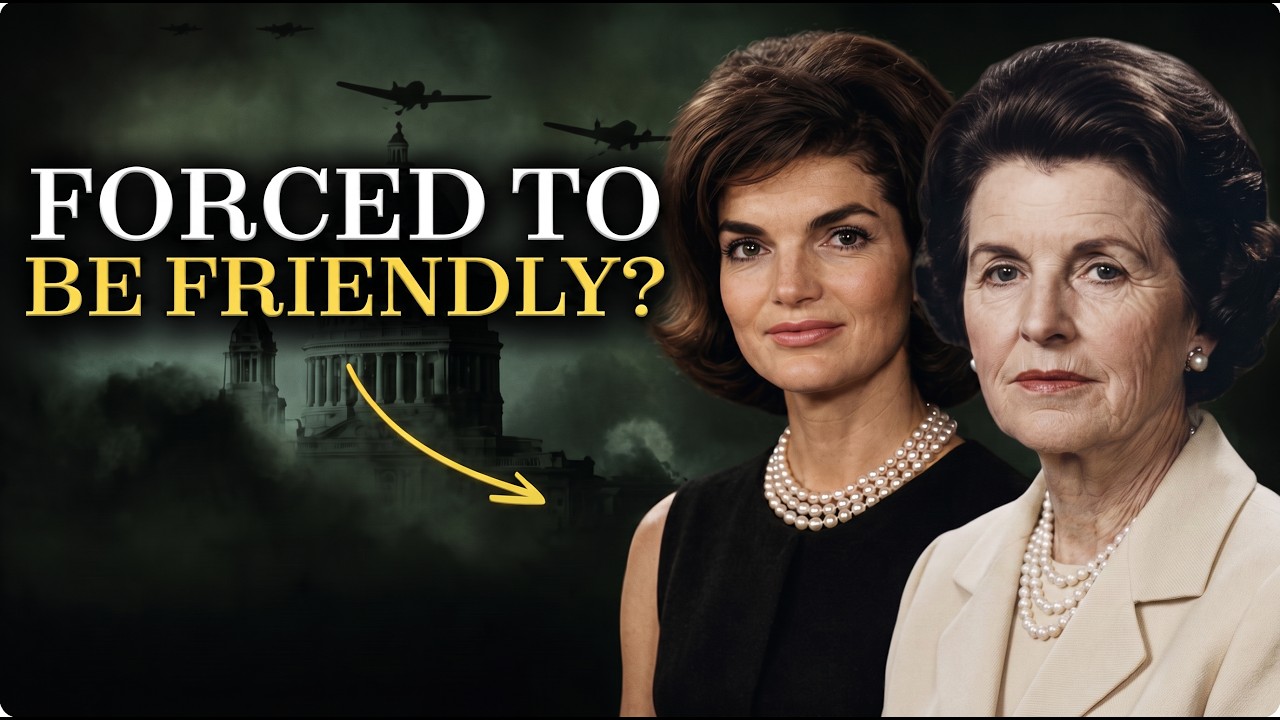
She mailed clippings to relatives with their fashion mistakes circled in ink. Historians who have read her letters to her daughter-in-law describe them as cold at the start, and the young woman Rose constantly corrected would one day write the sentence that swallowed Rose’s entire career. It all began at a small dinner party in Georgetown. The hosts were Charles and Martha Bartlett.
Charles was a journalist, Martha a friend of both families, and together they had been plotting an introduction. Charles knew John F. Kennedy, a thirty-four-year-old congressman from Massachusetts who suffered from back pain and Addison’s disease, a chronic illness his family concealed from voters. The woman he was introducing was twenty-one, from a distinguished family but practically penniless.
The Bartletts expected a spark. What actually happened was slower and more practical than the romance suggests. Kennedy did not call for months. Meanwhile she became engaged to someone else.
That part is absent from the anniversary tributes, but it matters because the marriage that produced America’s most photographed first lady did not begin with courtship. It began with assessment. To understand what Jacqueline Bouvier was walking into, you have to understand the position Rose Fitzgerald had occupied for four decades. Rose was not simply a bystander in this system.
She was one of its architects and one of its first victims. Rose was the daughter of John Francis Fitzgerald, the mayor of Boston, a man who campaigned with a shrill voice and a signature nickname. She was intelligent, social, and wanted to attend Wellesley College. Her father instead enrolled her in a convent school, partly, according to most accounts, because Boston’s Catholic mayor could not afford to send his daughter to a Protestant college.
Rose later identified that decision as the greatest regret of her life, and she said so plainly in her memoirs more than sixty years later. That is the first essential fact about Rose Kennedy. Her opinions were overruled early, she remembered it forever, and she never made a public scene about it. In 1914 she married Joseph P.
Kennedy in a small ceremony in a cardinal’s private chapel. She bore nine children, and she also endured his infidelities, which were neither secret nor occasional. Gloria Swanson, America’s most famous movie star, visited Hyannis Port as a family guest during her affair with Joe. Swanson described those visits decades later in her memoirs, a source with obvious personal bias.
But the visits themselves are documented. Rose received her politely and served her drinks. She never said a word. After Rose stopped having children around 1920, having produced four in six years, she packed her bags and returned to her father’s house in Dorchester.
She stayed about three weeks. Her father, the same man who had chosen her college, told her she had made a promise and would return to keep it. She went back. Rose told different versions of this story in her memoirs and interviews, and biographers have reconstructed it from family accounts.
The details vary; the outcome does not. She returned and rebuilt herself as the person the family could rely on. She kept index cards on her children, their illnesses, vaccinations, weights, and dental work, a filing system for a household run like a small institution. She cut out newspaper photographs of her children and her husband’s family, circled anything that offended her taste in appearance, and sent the clippings back with written corrections.
The amount of shirt cuff showing under a suit sleeve. A hemline. A posture. Barbara Perry, who spent five years researching through 250 boxes of Rose’s papers released by the Kennedy Library in fall 2006, found this habit pervasive in the correspondence.
To understand the habit, remember what Rose did not control. She had no authority over her husband’s money, his affairs, or even the medical care of her daughter. In 1941, Joe arranged surgery for Rosemary Kennedy that left her permanently incapacitated. By most accounts, Rose was not consulted in advance.
What Rose controlled was the public image: clothing, church attendance, behavior, the picture itself. She spent forty years polishing the appearance of a family she was not allowed to manage internally. In 1951 the Vatican granted her the title of papal countess, an honor perfectly suited to a life of public devotion. So when a twenty-three-year-old with a French education and refined taste arrived to marry the second son, Rose recognized her immediately.
Jackie was meeting her own successor in a position Rose had held without interruption since 1914, and almost immediately the corrections began arriving. Jackie had reasons of her own for agreeing to the match, and they were not the reasons in the society pages. Her father, John Vernou Bouvier III, known as Black Jack, was a stockbroker whose fortune and credibility had eroded, and whose alcoholism had destroyed his marriage. Her mother, Janet, divorced him and married Hugh D.
Auchincloss in 1942, moving Jackie into Hammersmith Farm and Merrywood, among the finest houses in the Northeast, neither of which would ever belong to her. Auchincloss had heirs of his own. Jackie and her sister Lee were stepdaughters in a very rich house with no claim to any part of it. Jackie worked as a reporter for the Washington Times-Herald for about forty dollars a week.
She had been engaged to John Husted, a pleasant young stockbroker, and the engagement ended in early 1953, reportedly after her mother had calculated his income out loud. Then Kennedy became serious. What each side saw is no secret. The Kennedys gained a Catholic bride from Newport, fluent in French, with unshakeable self-possession.
This was exactly what Joe Kennedy had been looking for over thirty years and could not produce on his own. Jackie gained escape from a house where she had been a decorative dependent, plus proximity to a witty, famous, ambitious man. The families understood the arrangement, and no one involved seems to have found it objectionable. The warning signs were not subtle either.
Kennedy’s reputation with women was known in Washington. In letters Jackie wrote over fourteen years to Father Joseph Leonard, an elderly Vincentian priest in Dublin she had befriended as a student, letters that surfaced in 2014 and were withdrawn from auction and never published, she reportedly expressed concern that Kennedy was a womanizer before the wedding. She married him anyway. Then there was the engagement timing itself, which reveals who was actually running things.
The Saturday Evening Post was preparing a profile built around the Senate’s most eligible bachelor. Many biographers have concluded that the engagement announcement was delayed until that article appeared, so the family could commercially exploit the bachelor image one final time before abandoning it. That was not a rumor about private feelings. That was a scheduling decision made by people other than the bride.
The wedding on September 12, 1953, at St. Mary’s Church in Newport was not Jackie’s wedding, nor Rose’s. It was a product launch. Janet Auchincloss wanted a modest Newport wedding.
As it happened, eight hundred guests attended the ceremony, hundreds more attended the reception at Hammersmith Farm, roughly two thousand spectators lined the police barriers outside the church, and news media from across the country covered it. Senators, congressmen, and photographers were positioned where the Kennedy office placed them. Every significant detail required the groom’s father’s approval. Ann Lowe designed the gown.
Lowe was a Black couturier who had dressed the Bouvier family for years. She had made Janet’s 1942 wedding dress and was commissioned to make fifteen dresses for this wedding. Ten days before the event, a water pipe burst in her New York workroom, destroying most of them. Lowe and her team rebuilt the wardrobe from scratch at their own expense, absorbing the loss.
When she arrived at Hammersmith Farm to deliver the gowns, she was asked to use the back door because she was Black. She refused and entered through the front. This account comes from Lowe’s later recollections, retold by fashion historians including Elizabeth Way. The New York Times covered the wedding at length the next morning and did not print her name.
Jackie disliked the dress and said so privately for years. There was too much fabric, the skirt was too long, and it did not suit her. She wore it because her mother wanted it, because eight hundred people and every wire service in America were waiting, while her father sat drinking in a hotel room a few miles away, excluded from the Kennedy dinner the night before. He never made it to the church.
Hugh Auchincloss walked her down the aisle instead. Jackie got through the day without breaking down, which she had been practicing for about a decade. The interesting part came when Jackie moved into the household Rose had spent forty years running. Hyannis Port was not a home.
It was three houses on six acres overlooking Nantucket Sound, with Joe’s house in the middle, and the arrangement made the line of command clear. Meals ran on Rose’s schedule. Guests who arrived late for breakfast found their plates cleared. Joe sat at the head of the table, quizzing the children on world affairs and expecting answers.
Rose posted notes. Rose turned out lights behind guests. Rose, who lived amid immense Wall Street wealth, was known inside the family for her frugality, which was not about economy so much as being the only person in the compound who enforced the rules. Into this entered a young woman whose adolescence had been praised for composure.
She did not fit in, and she made little effort to do so. The Kennedy sisters played touch football on the lawn with fierce intensity. Jackie, after injuring her ankle in one of those games early on, stopped playing. She read instead.
She skipped group activities. Rose gave the sisters a nickname, passed along by more than one friend to later biographers, likening them to a cheerleading squad. Rose could imitate all of them, and she did, for people she trusted. That account comes from friends speaking to writers decades later, so it should be taken with caution, but the underlying behavior appears in the documented record too.
As first lady, Rose organized her schedule to spend as little time as possible in the compound, as much as the family allowed. Rose responded the way she always did, on paper. Memos about protocol, skirt lengths, what was appropriate for a senator’s wife, and later a president’s wife. Newspaper clippings with circles drawn on them arrived.
Perry, working through Rose’s private files, described the early correspondence between the two women as cold and dry, and Rose kept everything. So that coldness is preserved in Rose’s own handwriting in a collection Rose herself donated. Jackie called her la belle-mère, French for mother-in-law, a term of affection or a very elegant way of keeping the relationship formal. What she said about Rose when Rose was absent was harder.
In her letters to Father Leonard in Dublin, Jackie reportedly wrote that she did not think her mother-in-law was particularly intelligent, that Rose preferred reciting the rosary to reading a book. That quote was carried in press coverage when the letters surfaced in 2014. But the archive was withdrawn and never published, so we rely on journalists’ descriptions rather than an open collection. What is verifiable is whom she was writing to.
A priest. She was not gossiping. She was confessing. In the fall of 1954, Kennedy underwent back surgery at a hospital in New York and nearly died.
He received last rites. He had another operation the following February. He spent months at his father’s house in Palm Beach. During those months, Jackie was there, reading to him, handling his correspondence, gathering books, and doing research for the project that became Profiles in Courage.
Whatever the state of their marriage by 1955, it was a marriage between a woman and a gravely ill man she accompanied through the worst year of his life. The book won the Pulitzer Prize in 1957. Joe Kennedy worked the committee hard for it, and Ted Sorensen later acknowledged writing most of the first draft. Together those two facts fairly summarize how this family manufactured greatness.
Then came the summer of 1956, with the closest thing this story has to a plain, brutal, documented fact. Kennedy lost the vice-presidential nomination at the Chicago convention in August and left almost immediately on a Mediterranean yacht trip with friends. His wife was eight months pregnant. At Hammersmith Farm she began hemorrhaging and was rushed to surgery.
The baby girl was stillborn. Bobby Kennedy was the one at the hospital. Bobby signed the papers and arranged the burial. Her husband was on a boat and did not return at once.
He was contacted, and he stayed. George Smathers, the Florida senator, eventually influenced him, saying years later that he told Kennedy plainly he would lose his marriage if he did not go home. Smathers was a friend of both spouses, and his account came decades after the fact. But Kennedy’s absence is not disputed, and it lasted about three days after he was notified.
Peter Lawford, married into the family and later a talkative source for writers, said the Kennedys did not confront Jackie directly, but the atmosphere around her suggested she had not produced enough children. Lawford had his own ambitions at the time. Still, Jackie had miscarried in 1955 and delivered a stillborn in 1956 in a family whose operating principle was fertility, and the woman who ran the household had borne nine children. In 1957 the newspapers began printing separation rumors.
A story has circulated through dozens of books ever since: Joseph Kennedy offered his daughter-in-law one million dollars to stay married. The story is repeated constantly and has no historical evidence. No letter, no known witness. It appears in later biographies based on unsourced information.
The persistence of the rumor is the point. The family was so plainly a financial instrument that the idea of buying a wife’s cooperation seemed plausible to everyone who heard it. What is documented is that Joe Kennedy admired Jackie greatly, and she returned the admiration, one of the strangest aspects of this relationship. The serial adulterer who had humiliated Rose for forty years was Jackie’s ally inside the family.
He listened to her. He supported her against his own daughters. She had no such relationship with Rose. Caroline was born in November 1957, and the marriage stabilized.
That part was real. Then the machine started again. The landslide Senate re-election in 1958, the presidential campaign, Jackie pregnant again through most of 1960. Watch what she did instead of campaigning, because at this point she stopped being decorative.
She could not travel much, so she wrote. A newspaper column appeared under her name, titled Campaign Wife. She answered voter mail. She gave television and print interviews and appeared in Spanish-language ads.
She gave the press an image and let it work while she stayed off the trail. She had been a photojournalist. She knew exactly what reporters needed and what they would print. Rose had spent forty years managing a family image by finding flaws in photographs of others.
Her daughter-in-law had learned how to place the correct photograph. John Jr. arrived a few weeks after the election, premature, and the family moved into the White House with two small children and a wife who had just endured a difficult birth. Then she began winning public affection.
Within months she leased Glen Ora, an estate near Middleburg, Virginia, and spent long stretches there, away from Washington, away from the presidential compound, away from tourists, staff, and the Kennedy family. When the lease ended in 1963, she built her own house, Wexford, in Atoka, in the same Virginia hunting country. She designed it herself. Compare that with Rose’s life for a moment.
Rose Kennedy had lived in her husband’s houses, on his schedule, on his money, for fifty years. She built nothing. Her daughter-in-law barely spent two years in the White House before acquiring her own address in another state. The money moved the same way.
Mary Gallagher, Jackie’s personal secretary, published a memoir in 1969 without family approval claiming that the first lady’s personal spending in 1961 exceeded one hundred thousand dollars, more than the president’s salary. Gallagher was an interested witness selling a book, not an auditor. But Kennedy’s irritation at the bills is confirmed elsewhere. The pattern is what matters.
Rose imposed economy. Jackie spent extravagantly. No one in the family stopped her. In February 1962 she took a television crew through the White House she had spent a year restoring.
About fifty-six million people watched. She received an honorary Emmy. She had turned the highest office in American public life into a documented professional achievement, before the largest audience any Kennedy had ever assembled. In December of that year, at a formal dinner in Washington honoring the family’s work on intellectual disability, the seat of honor beside the president went to his mother.
Rose spoke, introduced by Adlai Stevenson. A photograph shows the president standing behind her, applauding, and Rose was delighted. The moment survives in her papers, which is how we know how much it meant to her. Jackie was in the room, seated elsewhere.
Eight months later, the marriage would be tested by something neither family money nor Rose’s papers could fix. In August 1963, Jackie gave birth at a Cape Cod hospital, five and a half weeks early. Patrick Bouvier Kennedy lived thirty-nine hours. He was transferred to Boston, and the president accompanied him.
When it was over, Kennedy returned to Cape Cod, and according to those around them, he held his wife in a way witnesses said they had never seen from him before. Dave Powers said he had never seen the president like that. Powers was a loyal aide who wanted to preserve the warmth of their relationship, so his testimony always leans warm. But something changed that fall.
Friends noticed the couple touching in public, holding hands in Newport, which was not their habit. It was the closest chance that marriage had to repair itself. It lasted about ten weeks. In October she left the country.
Aristotle Onassis, the Greek shipping magnate whose company the Kennedy administration had pursued in court, and whose reputation was a political liability, invited her onto his yacht. She went. The president objected, then arranged an escort, sending Franklin Roosevelt Jr. and his wife to make the trip look respectable.
It did not entirely work. Questions were raised in Congress. Photographs ran everywhere. Think about what that says about the balance of power.
Six weeks after burying her child, the first lady of the United States left for two and a half weeks on a Greek billionaire’s yacht over her husband’s objection, and went anyway. The apology, if that is the word, came in the form of agreeing to do something she had refused for three years: the campaign trip. She would go with him to Texas in November. Everything you know about the rest of that trip is true, and I will not describe it.
What matters here is what she did in the four days afterward, because it is the most consequential act in this entire story. She took control of the funeral. She chose the Lincoln catafalque, the riderless horse, and the eternal flame at Arlington Cemetery, which was her idea over objections, and she had it installed before she left the cemetery. She designed, organized, and choreographed the state funeral of an assassinated president to her own specifications, at age thirty-four, four days after becoming a widow.
Then, the following weekend, she summoned Theodore H. White of Life magazine to Hyannis Port. He drove through the rain. She talked for hours and handed him the frame: the Kennedy years as Camelot, a brief shining moment drawn from the Broadway album her husband supposedly played at night.
White later admitted the whole thing was her invention, that she was dictating a myth and he knew it, and he published it anyway. Life’s editors wanted to cut details. She stood in the next room while White argued with them on the telephone, making sure the words stayed in the text. She invented Camelot in four days, under deadline pressure, from a musical.
Now hold that up against Rose. Rose Fitzgerald Kennedy had spent nearly fifty years building the public image of this family. Church attendance. Photographs.
Adjusted sleeves. Circled clippings mailed to everyone. She had even accepted a papal title. In one weekend, her daughter-in-law replaced all of it with a single word.
That word is what the world uses now. Rose appears inside the Camelot story, but she does not own it. She is a supporting character in a legend composed by her daughter-in-law while Rose was still alive, sitting in a house four hundred yards away. But something else happened after Dallas that complicates the picture and cannot be ignored.
The letters between the two women became warmer. Reviewing Rose’s papers, Perry noticed the correspondence softened in the late 1960s. In 1970, Rose wrote to Jackie in her own handwriting that she was certain the two of them would outdo any mother-in-law and daughter-in-law pair in history. That letter exists, Rose kept it, and she donated her files.
It can be read two ways: either grief ended something between them, or Rose Kennedy, who devoted her life to recording what the record should show, was writing for the file. Both explanations fit everything she did. I lean toward the second, and I would point out that the affection appeared precisely when Jackie stopped being a competitor inside the house and became the family’s most valuable public asset, because Rose did not object to the Onassis marriage. In October 1968, Jackie married a divorced man in a Greek Orthodox ceremony, and half the American press treated it as desecration.
The Vatican buzzed about whether she had now publicly fallen into sin. Cardinal Cushing, the family’s spiritual guide in Boston, defended her and took heavy losses for it. Rose issued a warm public statement, and afterward visited the island. She was seventy-eight, had spent five decades imposing rules of propriety on everyone around her, and when her daughter-in-law, the president’s widow, married a shipping magnate for money and protection, Rose Kennedy traveled to Greece and smiled for the photographers.
Of course she did. Rose understood the terms of the bargain better than anyone in America. She had made the same deal in 1914 and been sent back to it in 1920. The difference, the essential difference, is that Jackie’s version came with an exit, a contract, and a residence no one could take from her.
That brings us to the archives, and to who actually won. Look at what was preserved. The Camelot interview with White was deposited in the Kennedy Library under restrictions that sealed it until one year after Jackie’s death. The eight hours of oral history she recorded with Arthur Schlesinger in 1964 stayed sealed for forty-seven years, released only in 2011 when Caroline Kennedy decided the time had come.
The library’s archivists have stated plainly that they hold very little of her original writing, no signed correspondence between her and the president. She kept whatever existed as personal property. Asked about letters still in her possession, her secretary said she had never published them. Then in 2014, All Hallows College in Dublin found thirty-three letters Jackie wrote to Father Leonard between 1950 and 1964 and consigned them to a rural auction house.
They were estimated at millions. These were the letters in which she wrote about her fear of her husband’s infidelity, her faith after the assassination, and Rose’s state of mind. The auction house described them as her unpublished autobiography. They were never sold.
The family intervened, Caroline hired Dublin counsel to assert copyright, a missing will surfaced showing the college never owned them, and the sale was canceled three weeks before the auction. The college closed shortly afterward, and its president said the withdrawal of those letters weighed heavily on that decision. A Catholic religious school founded in 1842 closed partly because of correspondence a dead first lady’s daughter refused to let anyone read. So here is the record.
Rose Kennedy left 250 boxes to a presidential library, opened them to researchers in 2006, and allowed historians to read the details of her marriage. Everything we know about her coldness toward her daughter-in-law comes from rows of papers she kept and handed over herself. Jackie left almost nothing, controlled what she could not avoid leaving, and her heirs went to court in a foreign country to keep thirty-three letters out of the public record. Rose wanted to be understood.
Jackie wanted to be remembered. Only one of those is achievable, and she got it. Return to Newport. In September 1953, eight hundred guests.
A dress the bride hated. A designer whose name the newspapers did not print. A father who never left the hotel. A father-in-law who approved every detail because he was buying a Catholic president.
Rose stands in that photograph as she stood in every photograph for eighty years: immaculate, controlling only the exterior. She spent her life circling other people’s mistakes in ink and mailing them corrections. The one image she never corrected was the one where a strange young man of twenty-four stood beside her, someone she assumed needed instruction, someone who learned exactly how the machine worked, grew large enough to operate it, name it, and close the drawer.