Al Swearengen arrived in Deadwood, South Dakota, in May 1876. The Black Hills gold rush had drawn thousands of prospectors to the lawless frontier camp, and within a week of his arrival, the thirty-year-old Iowan had already opened a makeshift dance hall. The place was thirty by one hundred fifty feet, and according to a later account of the town’s early history, a man had to push and crowd to get inside, day and night. Swearengen was not a miner.
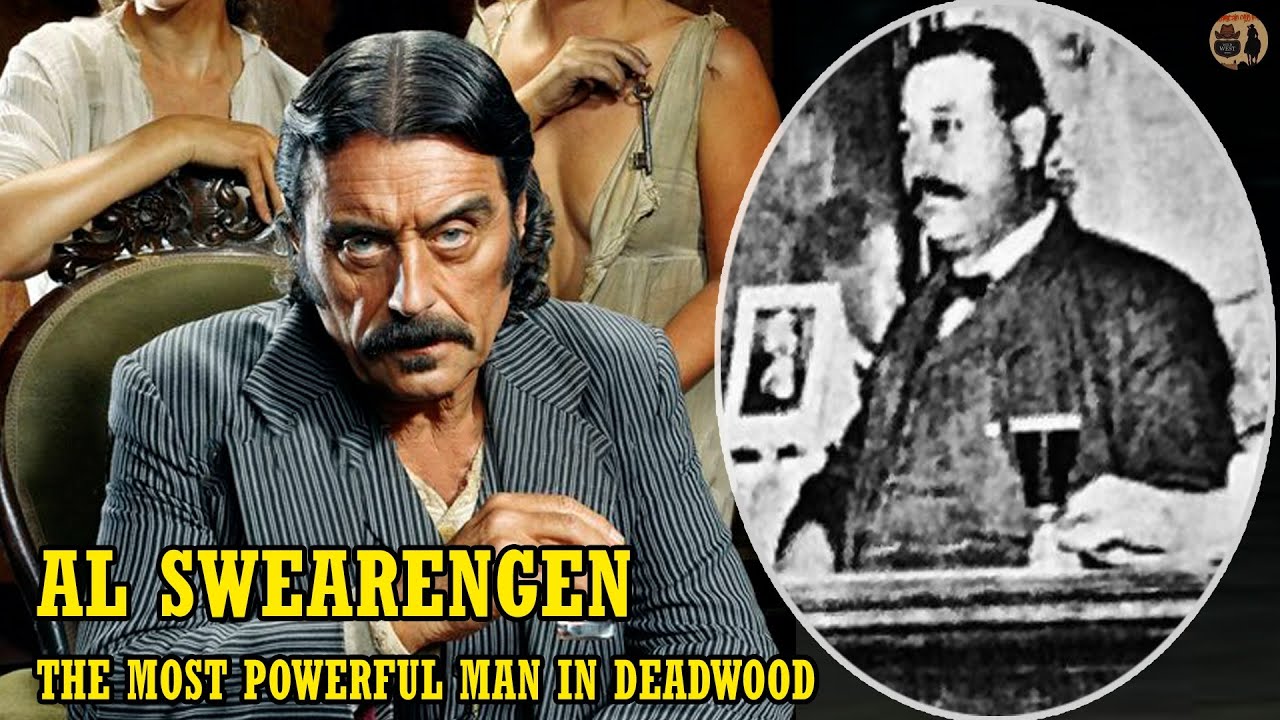
He was an entertainer, a businessman, and, in time, a pimp whose name would become inseparable from Deadwood’s most infamous institution. His twin brother, Lemuel, had been born with him on July 8, 1845, in Oskaloosa, Iowa, the eldest children of Daniel and Kaziah Swearengen. They had eight siblings. The twins stayed in Iowa until adulthood, when Al set off for the Black Hills, leaving his brother behind for the time being.
His home life in Deadwood quickly unraveled. His wife, Nettie, left him in September 1876 and filed for divorce, citing her husband’s abuse. She was not the last. Swearengen would marry twice more while living in Deadwood, and both marriages ended in divorce under similar allegations.
The turbulence of his personal life did little to slow his professional ambitions. He replaced his original makeshift dance hall with a permanent building called the Criterion Saloon, a small, narrow venue that the press often referred to as a hall. Despite its size, the Criterion became a popular entertainment destination. Swearengen introduced boxing matches in a limited five-by-five-foot space, persuading ordinary working miners to step into the ring for the amusement of the crowd.
There were no rewards for the participants, only the spectacle itself. On April 7, 1877, Swearengen opened a far more ambitious venture. The Gem Variety Theater was described by the Black Hills Daily Pioneer as a theater of impeccable style and sophistication, surpassing any venue of its kind on the Western frontier. It quickly became the region’s leading entertainment spot, featuring comedians, singers, and dancers, alongside boxing matches staged to excite the crowd.
But the Gem was not merely a theater. Behind the performances, it operated as a brothel, and its notoriety grew from the cruelty at its core. Swearengen used deceptive tactics to recruit women from the eastern states, luring them with promises of luxury hotel jobs and grand stage performances. When they arrived, they found themselves trapped.
They either worked for Swearengen under brutal conditions or were thrown out into the streets. Some women, according to accounts of the period, considered taking their own lives rather than enduring such a fate. Those who stayed faced a life marked by physical bruises and emotional suffering. None of this harmed the Gem’s business.
The beautiful women became the camp’s main attraction, drawing the patronage of many prominent citizens. Local authorities, including so-called citizen leaders, turned a blind eye, allowing the establishment to operate with impunity. The Gem featured a spacious bar area with plenty of seating that served as a prelude to what happened further inside. Toward the back of the building, hidden discreetly between curtains, were several small rooms where the women entertained their guests.
According to local legend, the Gem’s band would sing into the night from their balconies, after which glamorous women would lure would-be customers inside. The prices were steep for the time: twenty dollars for a dance, ten dollars for a beer, and ten dollars for a bottle of wine. As for the charges for other services, those remained unknown. Swearengen’s staff included Dan Denty as general manager, Johnny Burns overseeing the women, and a security team.
These men, like Swearengen himself, were known for their brutal treatment of the women, and physical abuse was a regular occurrence. Though originally an entertainment venue, the Gem quickly became known as a violent house, where the sound of gunshots echoed within its walls all too often. Some shots were fired during scuffles between drunken men, but others were fired in amusement, sometimes aimed at the girls themselves. In one notable case, a prostitute named Louisa shot a man in the head after he brutally beat her.
Incredibly, the man did not die instantly. A doctor was called and placed a probe on the man’s head, shocked to find that he had miraculously survived the bullet. About thirty minutes later, the man died. Amid the chaos of the Gem, a quiet boundary defined the town.
It was said that Swearengen and Sheriff Seth Bullock reached an agreement, drawing an imaginary line along Main Street. This boundary, known as the Badlands, effectively divided Deadwood. Swearengen took control of the lower part of Main Street, while Bullock controlled the upper part. The division separated their spheres of influence and their financial interests.
Bullock emphasized the general well-being of the community; Swearengen focused on his lucrative projects along the lower section of the street. In the early summer of 1879, fire swept through the Gem, causing considerable damage. Swearengen repaired and rebuilt the facility quickly, but just three months later, in September 1879, a catastrophic fire ravaged the entire town of Deadwood, consuming around two hundred buildings, including the Gem. Undeterred, Swearengen rebuilt the theater from scratch.
The new Gem was more majestic than before, and its opening in December 1879 was met with great anticipation. The Daily Times enthusiastically called it the most splendid theater ever to appear. The Gem thrived, raking in substantial profits nightly. On average, it grossed five thousand dollars a night, with some nights surpassing ten thousand, a sum equivalent to roughly three hundred thousand dollars in 2023.
But the success did not last. In 1899, the Gem faced its final destruction in a devastating fire that left it in ruins. Swearengen’s reign in Deadwood came to an end as the Gem permanently closed, severing his ties to the town for good. On October 2, 1904, an unfortunate incident befell Lemuel, Al’s twin brother, who had remained in Iowa.
While leaving a local butcher market, Lemuel was assaulted and received a severe blow to the head. The attacker tried to rob him. Lemuel was found the next day unconscious and, despite receiving medical attention, died eight days later. Less than two months afterward, on November 15, 1904, Al Swearengen’s life came to an abrupt and tragic end.
His body was discovered on the street near his residence. Like his brother, Al had been brutally hit on the head with a heavy, blunt object. The circumstances of his death baffled Denver police, who could not determine whether it was an accidental incident or an intentional act of violence. Subsequent reports suggested that Swearengen died penniless while trying to hop onto a freight train.
The man who had once built and ruled the most notorious theater in Deadwood left nothing behind but a legacy of violence, exploitation, and ruin.