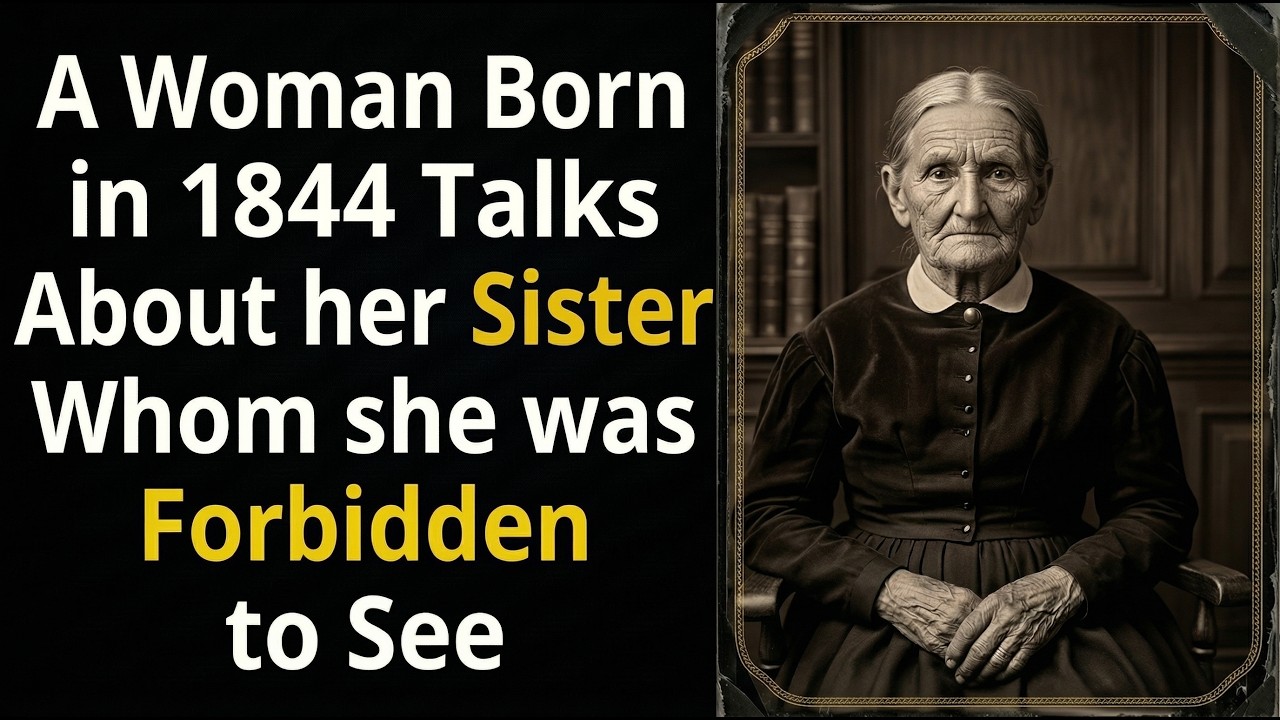
Clara Josephine Mercer was born in March 1844 on a farm in Calhoun County, Illinois, a place that no longer exists. The house was torn down decades ago, the orchard cleared. All that remains is her memory, and at 82 years old, she knows that will not last much longer. When people ask her about regrets, they expect the soft acceptance of old age.
She is not that kind of woman. The regret she carries sits in her chest like a stone placed there when she was 19 years old, and it has never once moved. Her sister Rose was born in May 1845, fourteen months after Clara. From the time Rose could walk, she followed Clara everywhere.
They shared a bed, a life, a private language no one else in the family understood. When Clara was afraid, Rose knew it before she spoke. When Rose was sad, Clara felt it in her own body like a shift in the weather. They were, in the truest sense, each other’s world within the larger world of their family.
Their father, Elias Mercer, had come to Illinois from Kentucky as a young man, bringing with him the rigid convictions of his upbringing. He believed in hard work, in the authority of men over their households, in the Bible as he interpreted it, and in the absolute correctness of his own judgment. He was not cruel in the way of men who used their fists, but he was unyielding. There was his way, and there was the wrong way.
Their mother, Eleanor, had learned early that the cost of disagreeing with him was higher than she was willing to pay, so she smoothed things over and found small ways to give her children comfort without drawing his displeasure down upon the household. There were six children in total. Clara was the eldest, then Rose, then Junior, Martha, little George who died of fever before he was three, and the youngest, Caroline, who was born when Clara was already twelve and barely knew her sisters before they were both gone. The farm produced enough to feed the family and sell a modest surplus at the market in Hardin.
Elias Mercer had a reputation as a hard worker and an honest man, which he was, and as a stern and unapproachable one, which he also was. In temperament, the two sisters were very different. Clara was serious, cautious, inclined to think before she acted. Rose was vivid, impulsive, full of laughter she could not always restrain.
She was the one who would steal the last piece of pie and deny it with such cheerful conviction that even her father almost believed her. She taught herself to whistle, which her father declared unladylike, and continued in secret for years afterward. She had a quality Clara can only describe as aliveness. Children were drawn to her.
Animals followed her. Even their father sometimes watched her with an expression that was almost wonder, as though he could not entirely account for how he had produced something so full of light. That quality, Clara believes, is what ultimately led to the disaster. Rose was not made for careful living, for the confines of a small farm and a rigid father.
She had a spirit that required more room than their circumstances could provide. And eventually, she found a way to give it more room. His name was Thomas Ballard. He came to Calhoun County in the spring of 1863, when Rose was seventeen and Clara was nineteen.
He was twenty-three, the son of a merchant from St. Louis, educated and well-spoken, accustomed to a kind of ease and polish entirely foreign to everyone they knew. He came to work with a relative who owned land in the county. Clara noticed him first, one Sunday in April at church.
She observed him throughout the service with a combination of curiosity and caution, the instinct of someone who already sensed that this person was going to change something. But it was Rose he loved. He met her at a community gathering some weeks later, and Clara watched them talking from across the room. She saw in Rose’s face an expression she had never seen before.
Rose was lit up from the inside, as though something in her that had been waiting had finally found what it was waiting for. Clara was genuinely glad. Thomas Ballard seemed to her a good man, thoughtful and decent. The problem was not Thomas Ballard.
The problem was that Thomas Ballard was a Methodist, and Elias Mercer was a Baptist of the old and uncompromising variety. In his view, the distance between those two things was fundamental and irreconcilable. When he discovered that Rose had been meeting with Thomas in circumstances that had not been properly sanctioned, his response was immediate and absolute. He forbade it.
Rose argued, which surprised everyone, for she was usually clever enough to find ways around her father rather than through him. But she was seventeen and in love for the first time. She told him Thomas Ballard was a good man. He told her he could and would govern every choice she made.
What followed was three months of increasing conflict. Thomas continued to come to community events, and Rose continued to meet with him, sometimes with Clara’s help and sometimes without it. Clara helped when she could because she believed they were doing nothing wrong and could not bear to see Rose unhappy. During those months, Thomas Ballard went to the father twice and requested permission to formally court Rose.
He was refused both times. The refusals were entirely reasonable in tone and entirely unreasonable in content: Rose was not yet of an age to be courted, and when she was, it would not be by a Methodist. In September of 1863, Rose turned eighteen. Three days after her birthday, she left.
She did not tell Clara she was going to go. That is the thing Clara has returned to a thousand times in sixty-three years. They had shared everything, every thought, every fear, every secret. Rose made the decision to leave without telling her.
Clara woke in the morning to an empty side of the bed and a note on Rose’s pillow addressed to their parents. It said she was sorry to cause them pain, but she could not spend her life within boundaries she found impossible. She and Thomas Ballard had been married that morning by a justice of the peace in Hardin, and they were leaving for St. Louis.
She did not write a note for Clara. Clara believes she understands why now, though the understanding does not make it hurt any less. She thinks Rose did not tell her because she knew Clara would have tried to stop her, or would have expressed her fear, and she could not afford to be weakened by that fear. She loved her too much to risk it.
Their father’s response was what you might expect. He went very still and very quiet. That evening, after supper, he announced that Rose had made her choice. She was no longer his daughter.
Her name was not to be spoken in his house. Anyone who communicated with her would be communicating with a stranger. His voice did not waver. Their mother said nothing.
Junior said nothing. Martha cried, and her father ignored it. Clara said, “She is still my sister. ” Her father looked at her for a long moment.
“No,” he said. “She is not. ”
In the weeks that followed, Clara received two letters from Rose, written from St. Louis, where she and Thomas had established themselves in a modest apartment near his family’s business.
She was happy. She was sorry she had not told Clara. She hoped Clara was not too angry. Would she write back?
Clara wanted to with every part of herself. But she was living in her father’s house, subject to his authority, and she was not yet twenty years old, and she was afraid. She did not know at the time that her father had intercepted both letters. She found out only much later, after his death, when she discovered among his things a small bundle of letters tied with string.
Six letters from Rose, spanning the years 1863 to 1866. He had kept every one of them. He had also intercepted Clara’s own three attempts to write to her sister. None of them reached her.
She only learned this when she and Rose finally spoke, decades later. Sixty-three years of believing Rose had abandoned her without a word. And Rose had spent those same sixty-three years believing Clara had chosen their father’s prohibition over her love for her sister. They had each spent their lives believing the other had let go first.
By the time Clara was old enough and independent enough to have written without interference, something had hardened inside her. She had been waiting for a word that never came, not understanding that her own words had also never arrived. Clara married in 1867, a farmer named William Aldridge, a good and steady man who knew about Rose and understood without being asked that she was not a subject Clara was willing to discuss. She built her life, raised her children, managed her household.
Her father died in 1891. Her mother followed in 1893. Martha died young in 1879 of typhoid fever. Clara did not look for Rose.
She told herself it was because she did not know how to find her. That was partly true. It was also true that looking would have required opening something she had spent thirty years keeping closed. It was her son Edmund who found her.
A determined man, he had heard enough of the story in the pieces Clara let slip over the years to understand that his mother carried something unresolved. He found Rose in 1921, by then Mrs. Thomas Ballard, living in a small house in a suburb of St. Louis.
Thomas had died in 1914. Rose had three grown children and several grandchildren. Edmund wrote to her, and she wrote back within the week. He brought her letter on a Tuesday morning in October.
Clara sat at her kitchen table and held it without opening it for the better part of an hour. She was seventy-seven. Rose was seventy-six. She opened it.
Her handwriting was nothing like Clara remembered, but the voice was hers, entirely unmistakably hers. She wrote with the directness and warmth that had always defined her. She said she had spent a long time believing Clara had chosen their father’s silence over her love. Edmund’s letter had told her otherwise.
She was glad to know the truth, and she wanted to see Clara if she was willing. Clara wrote back the same afternoon. Come whenever you can. Rose came in November.
Edmund drove to St. Louis and brought her back. An old woman with white hair and Clara’s sister’s eyes stood in the front parlor, and they looked at each other for a long moment that contained everything the sixty-three years between them had contained. Then Rose crossed the room and put her arms around her, and neither of them said anything for quite some time.
They had four years. Rose stayed with Clara for several weeks each summer, and Clara went once to St. Louis to meet her children and grandchildren. They wrote letters throughout the year.
They tried to compress into four summers what they should have had in fifty years. They could not do it. There was too much. But they had what they had, and it was real.
Rose died quietly in her sleep in January of 1925. Clara was not there. She received the telegram on a Thursday morning and sat at her kitchen table, the same table where she had sat with Rose’s first letter four years before, and felt the stone in her chest shift for the first time in sixty-three years. Not release, not relief, just movement, as if the stone acknowledged that what it had been there for was now finished.
What Clara carries now is the grief of what was taken from them. Sixty-three years of sisterhood, of knowing and being known, of all the ordinary days that add up to a life lived alongside someone. Rose’s children grown without an aunt who knew her as a girl. Clara’s children grown without knowing the woman who had been the other half of their mother.
All of that taken by a man who believed his authority over his daughter extended beyond her leaving his house and into every year of her life afterward, who intercepted letters and kept them tied in a bundle and never once relented. He went to his grave without a word about any of it. But he kept the letters. Clara is eighty-two years old.
She thinks of her life as containing a before and an after. Before Rose left, and after. She thinks of the four years at the end as a small grace, insufficient to restore what was lost, but real and true. Ours, she says.
They were forbidden from each other for sixty-three years, and they lost sixty-three years, and they found each other at the end and held on as long as they could. That is the truth of it. That is all of it.
That is enough.