In 1849, a man walked into a law office in western New York and asked to join the bar. He had studied law for three years, spoke two languages with equal fluency, had defended his nation’s treaties before the United States government, and had shaken the hand of a sitting president. His request was refused. Not because he failed the exam, but because he was never allowed to take it.
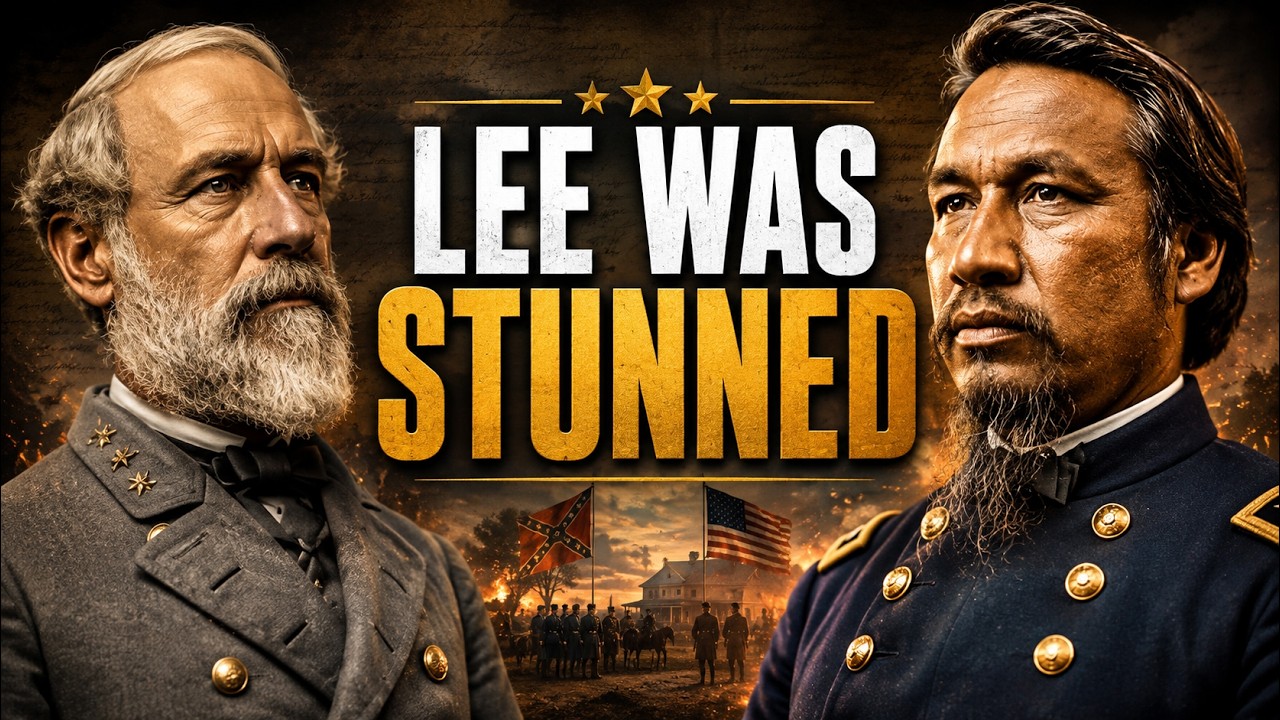
Under New York law, he was not a citizen. The state considered him, legally, not American at all. Sixteen years later, that same man sat at a table in a farmhouse called Appomattox and wrote out the terms that ended the Civil War in his own hand. Robert E.
Lee looked at him for a long moment and, according to several accounts, said he was glad to see one real American in the room. Ely Parker’s reply was simple: “We are all Americans. ” He meant it. Even though the country he addressed would not grant him or his people citizenship until 1924, twenty-nine years after his death.
This is his story. Born on the Tonawanda Seneca reservation in western New York, Parker was given the Seneca name Hasanoanda, often translated as “Chief’s Name. ” His father was a Baptist minister and a chief who had fought for the United States in the War of 1812. He belonged to a family that had survived generations of struggle between Seneca sovereignty and American expansion, always finding a way through.
Around age thirteen, something marked him permanently. British soldiers passing through mocked his imperfect English. The exact words were lost, but his decision in response stayed with him. Parker resolved to master not just the language, but the entire machinery of American civic life: law, engineering, politics, every institution that held the power to decide who belonged and who did not.
He would become so skilled in their world that they would have no legitimate reason to exclude him. Before he turned twenty, he was already at work. Parker carried the Tonawanda Seneca struggle to preserve their ancestral land into the halls of the federal government in Washington. He served as interpreter, advocate, and voice of his nation in a city that did not recognize him as a citizen.
According to his own account, he stood before President James K. Polk himself. A teenager from a reservation shaking the hand of a president who could not, under his own government’s law, become a citizen of the country he led. In his early twenties, Parker did what almost no one in his position had done.
He spent three years studying law: the texts, the cases, the arguments. When he was ready, he applied to join the bar in Ellicottville, New York. The bar rejected him. Not because his knowledge was insufficient, not because his character was in question, but because he could not sit for the exam.
Under New York law, he was not an American citizen, and without citizenship, he could not practice law. He was Seneca, a sovereign people. Seneca men were not American citizens. So he became a civil engineer.
He studied at Rensselaer Polytechnic Institute. He worked for the federal government building lighthouses along the Great Lakes. He was competent enough, in the eyes of the government that refused him citizenship, to build the infrastructure of American commerce. But he was not American enough to argue in court.
He continued the work anyway, drafting arguments and shaping the legal battle to keep the Tonawanda Seneca on their ancestral land. The case climbed until it reached the United States Supreme Court. He was not allowed to be a lawyer. He simply refused to stop being one.
Then the war came, and Parker tried again. He went to the governor of New York and offered to raise a regiment of Haudenosaunee volunteers, men who knew the land and had served in American wars before. The governor refused. Parker went to Washington, met with Secretary of War Simon Cameron, and offered his engineering skills, his military training, even himself.
Cameron refused, because he was an Indian. Parker went further. He petitioned Congress directly, asking them to grant him citizenship specifically so he could volunteer. Congress refused.
He tried once more. Secretary of State William Seward told him the conflict he wished to join was a matter between white men. “Go home,” he said, “and till your land. We will settle our problems ourselves without any help from Indians.
” This was 1861. The Union had just suffered a crushing defeat at Bull Run, was bleeding, humiliated, and desperate for men. The secretary of state was telling Ely Parker, a man of engineering experience, military knowledge, and legal training, to go home and farm because he was a native. Governor, secretary of war, House of Representatives, secretary of state.
Four different men, each with different authority, all telling him the same thing: you are not American enough. Parker went home. He farmed. He watched the war from the outside.
And somewhere in the quiet of the Tonawanda farm, he wrote a letter to the one man who had never made him feel that way. The text of that letter is lost. What is known is what came of it. In 1860, Ulysses Grant was a nobody: a former army officer who had resigned his commission in 1854 under circumstances remembered but not favorably.
He had tried farming, real estate, other ventures. He was working as a clerk in his father’s leather goods store in Galena, Illinois, selling hides and saddles. That same year, Parker was assigned to a federal engineering project in Galena. They met, and something between them defied easy explanation.
They became true friends. Parker would later describe Grant’s arrival at Appomattox as the man smoking a cigar and laughing, as though that were the only fact about him that mattered. Grant would spend the rest of his life serving Ely Parker faithfully. After receiving Parker’s letter, Grant went to Washington and pressed quietly but firmly until Parker received a captain’s commission as an engineer in the Army of the Tennessee in 1863.
The distance between being sent home to farm and wearing a captain’s uniform in the Union army had a name. Parker’s first major assignment was the siege of Vicksburg, forty-seven days of slow encirclement of a Confederate fortress on the Mississippi. As chief engineer, he planned the approach trenches and supervised the work that turned a field army into a siege machine. Grant watched him.
Noticed his steadiness. Noticed that Parker was exactly what he appeared to be, competent. When Grant went east, Parker went with him. When Grant became general-in-chief of all Union armies, Parker became his military secretary with the rank of lieutenant colonel, the man who managed the paperwork that ran the war.
By early April 1865, the end was clear to anyone who could read a map. Richmond had fallen. Lee’s Army of Northern Virginia, once the most feared fighting force on the continent, was retreating westward on rations that barely qualified as food. Men were boiling leather belts for whatever nourishment they might yield.
Desertion was no longer occasional but torrential, hundreds of men leaving every day. Grant pursued relentlessly. His one fear, driving his army to exhaustion, was that Lee would slip away and join another Confederate force in North Carolina. That would lengthen the war, bring more battles, more dead.
He would not allow it, even while suffering one of the worst migraine attacks of his life. On the night of April 8, Grant lay in a farmhouse somewhere in the dark between two armies, his head pounding, nauseated, nearly incapacitated. He soaked his feet in boiling water and mustard powder, wrapped his wrists and neck in cloth wet with mustard. A remedy from the 1860s, probably useless, but he tried it.
He spent the night in agony, waiting for morning. The next morning, April 9, a courier rushed through the mud and placed a letter in Grant’s hand. He read it, and the migraine that had lasted eighteen hours vanished. Not faded, not eased.
Gone completely. Grant wrote about this moment in his memoirs two decades later, his memory undimmed. “I was cured,” he wrote. Lee was surrendering.
Grant, muddy boots and cigar in his mouth, turned his horse toward a small brick house in a village called Appomattox Court House. Parker rode beside him. Wilmer McLean had never wanted any of this. In 1861, his farm near Manassas had been shelled during the First Battle of Bull Run.
He packed up his family and moved to the most remote corner of Virginia, a tiny village called Appomattox Court House, hiding from the war. On the morning of April 9, one of Lee’s aides knocked on McLean’s door and asked to use his parlor. McLean, who had once tried to escape history, had no way to refuse. Lee arrived first, around one o’clock, in a full Confederate uniform, new and immaculate: gold sash, ceremonial sword, white gloves, high boots with red stitching.
Fifty-eight years old, his hair and beard entirely white. One witness wrote that he looked like a challenge wrapped in silk, a man who had decided that if he could not control what would happen, he would control how he appeared while it happened. He sat and waited for an hour and a half. Grant had ridden twenty miles around both armies to get there, arriving at 1:30.
His coat was a plain soldier’s blouse with lieutenant general’s insignia, mud-spattered from the morning’s ride. No sash, no ceremonial sword, no sign he had changed anything for the occasion. Grant later noted in his memoirs that Lee was tall and perfectly proportioned in his clean uniform, and that he himself, in his ordinary clothes, must have looked strange. They shook hands, and then something unexpected happened.
They talked, not as enemies, not as victor and vanquished, but as two old soldiers who had served in the same army before all of this. Mexico, 1846, Monterrey, Chapultepec. Both had been there. For a few minutes, four years of war fell away.
Then Lee brought them back. “General Grant, what terms do you propose for the surrender of my army? ”
Grant drafted the terms, five sentences in clear military style. Officers could keep their arms.
Men kept their personal property. All would return home on parole, not to fight until formally exchanged. Then Parker did something the famous paintings of this scene omit entirely. He revised.
Quietly, he added small parentheticals to Grant’s draft, three precise legal insertions that removed ambiguity from the parole language. The kind of precision that a man trained in law brings to documents that must not be read two different ways by two different parties. Documents that would determine the fate of twenty-five thousand men. The man who had never been allowed to sit for the bar exam was now shaping the most important legal document written in the American century.
Lee read the draft, and something crossed his face. Slight relief, the kind that comes when a man prepares for a blow and it lands lighter than he feared. He had expected imprisonment, treason trials, worse. The clause allowing officers and men to return home unmolested by United States authorities was what he had been waiting for.
Lee raised one additional point. His cavalrymen and artillerymen owned their own horses. They were farmers. Without those horses, the land would go unplanted, and without the land, their families would have no food in the spring.
Grant did not hesitate. He would issue a separate order. Any man claiming a horse or mule could keep it. Another order.
Lee had roughly twenty-five thousand starving men in the fields outside. Grant turned to Parker and ordered him to arrange rations for the entire garrison. What almost no account mentions is that those rations were not drawn from Union stores. They were captured Confederate supplies.
The day before, Sheridan’s cavalry had seized Confederate supply trains, food intended for Lee’s army that never arrived because Union forces got there first. Grant was not feeding his enemy from his own stores. He was giving Lee’s men back their own captured food. Generosity and logistics, both at once.
Now came the moment the entire story had been moving toward. Grant’s draft was complete, Parker’s legal brackets in place. Colonel Theodore Bowers, Grant’s trusted adjutant, was tasked with writing the final copy, the official version on official paper that would become the actual legal surrender document. Bowers sat down, took the pen, and could not write.
His hand trembled. Witnesses described it differently, some said he was overcome by the weight of what his hand was asked to write, others said he was simply exhausted from weeks of strain. Whatever the cause, the pen would not find the paper. Parker stepped forward, took the pen from Bowers’ hand, sat down, and wrote.
His hand did not tremble. He would describe this moment years later with characteristic restraint, saying he wrote the terms in his usual calm manner. The man rejected by the bar, rejected by the army, rejected by Congress, told by the secretary of state to go home and farm, picked up the trembling pen and, with the steadiest hand in the room, wrote the document that ended everything. Lee and Grant signed.
Papers were exchanged. The meeting ended with a handshake. As Lee mounted his horse Traveller on the porch, Grant stepped down and raised his hat. His officers did the same without a word.
Lee raised his hat from horseback in return. No words. Lee rode back through his lines. His soldiers pressed around Traveller, weeping, reaching out to touch him.
Lee, who had kept his composure through the entire meeting, now seemed to be struggling. He returned to his tent and faced his men: “I have done for you all that was in my power to do. My heart is too full to say more. Goodbye.
”
Inside the house, Union officers were already stripping the furniture for souvenirs. One general bought the signing table on the spot, reportedly for forty dollars. Parker took nothing from the room. He kept his multigraph, one of the three original copies of Grant’s handwritten draft, with his legal brackets visible in the margins.
That was enough. That evening, Ely Parker was brevetted brigadier general of volunteers, effective April 9, 1865, the same day. For four years after Appomattox, he served as aide to the most powerful man in America. When Grant was elected president in 1868, Parker went with him.
In 1869, Grant appointed Parker Commissioner of Indian Affairs, the first Native American to hold a federal office at that level. The man who had once had no place in Washington now shaped the United States government’s relationship with every indigenous nation in the country. It lasted two years. In late 1870, a Philadelphia philanthropist named William Welsh published a series of accusations in Washington newspapers, alleging Parker mismanaged supply contracts, enriched himself, was corrupt.
Congress investigated and cleared Parker of all charges. But before the verdict, consider the language of the campaign against him. His accusers claimed Parker represented a race only one generation removed from savagery, not expected to resist the temptations of businessmen his superiors. The man who wrote the surrender terms, the man Robert E.
Lee called a real American, was described in Washington newspapers as one generation from savagery. He won the legal case. He lost the political one. Congress stripped his office of any real power.
He was exonerated, then marginalized. He resigned rather than be a figurehead. He was forty-three. For a few years, Parker tried to build something in the private world.
He made considerable money on Wall Street for a time. He married and had a daughter, Maude Theresa, whom he called Ah-wa-hoo, meaning beautiful flower in Seneca. Briefly, things seemed to hold together. Then the Panic of 1873 swept it all away.
By the late 1870s, Ely Parker was a clerk, working at the New York City police headquarters on Mulberry Street. A modest salary, a modest life. His neighbor, the journalist Jacob Riis, who documented the poverty of the Lower East Side in what became How the Other Half Lives, later wrote of a deep sadness in the man, something suppressed, something never allowed to become what it should have been. In 1880, Parker wrote to Grant.
Grant was fifty-eight, a former president, still celebrated. His memoirs were not yet written, his throat cancer not yet discovered. Parker asked for something simple. He had kept his multigraph, one of the three original copies of the surrender draft in Grant’s own hand, with Parker’s legal bracket visible in the margins.
He had framed it. He asked Grant to authenticate it in writing. Grant replied in October 1880, describing the document as one of the original copies of the paper on which he wrote the terms of surrender of General Lee’s army at Appomattox Court House, April 9, 1865. He signed it.
Parker hung that authenticated document on the wall of his modest apartment off Mulberry Street. The most important document of America’s reunification hung on a nail, its writer looking at it in the evening. In 1885, Parker wrote a long letter to a friend named Harriet Converse, his most private document. He wrote about his life and the bargain he had accepted: master our language, our laws, our institutions, our army, and you will belong to us.
Then he wrote this: “Was it right to strive for civilization with all its troubles, and is it better now to go back to the darkness of our holy wilderness and live there in quiet and peace, heedless and placid, as the birds of the air and the beasts of the field? It is a pleasant thought,” he wrote, “but perhaps impractical. ” This was the man who said we are all Americans in that room. Twenty years later, alone, in a letter to a friend, quietly wondering in the dark whether the whole bargain had been worth it.
Ely Parker died on August 30, 1895, at sixty-seven, without the recognition that the room where he once stood seemed to promise. One hundred and seventy-six years after New York told him he was not American enough to sit for the exam, the New York Supreme Court, Appellate Division, Fourth Department, held a ceremony on November 14, 2025. Justice Gerald J. Whalen read the order.
Ely Samuel Parker was posthumously admitted to the New York State Bar, the first Native American posthumously admitted in United States history. In the courtroom was Melissa Parker Leonard, Parker’s great-great-great-granddaughter. She told those assembled: “We acknowledge that the failure was never his. It was the failure of the law itself.
”
The man who said we are all Americans, in that room on April 9, 1865, did not wait for the country to call him American. He acted as though it already had. He defended his people when the courts rejected him, presented their cause to a president who refused him citizenship, forced himself into a war four officials swore was not his. He lived the answer to Lee’s question before Lee thought to ask it.
Then he wrote those words, the terms of surrender in his own clear, steady hand, and spent the next thirty years watching the country he had just reunited decide again and again that it was not yet ready to live up to what he had written. Commissioner of Indian Affairs, gone within two years. Wall Street fortune, lost in one. Clerk on Mulberry Street, twenty years until his death.
The framed document on a clerk’s apartment wall, with Grant’s hand and Parker’s brackets, now displayed at the New-York Historical Society. The pen that did not tremble, the hand that held it, the country that ended its war and wrote its peace, the country he called ours, did not grant citizenship to his people until 1924, twenty-nine years after his death.